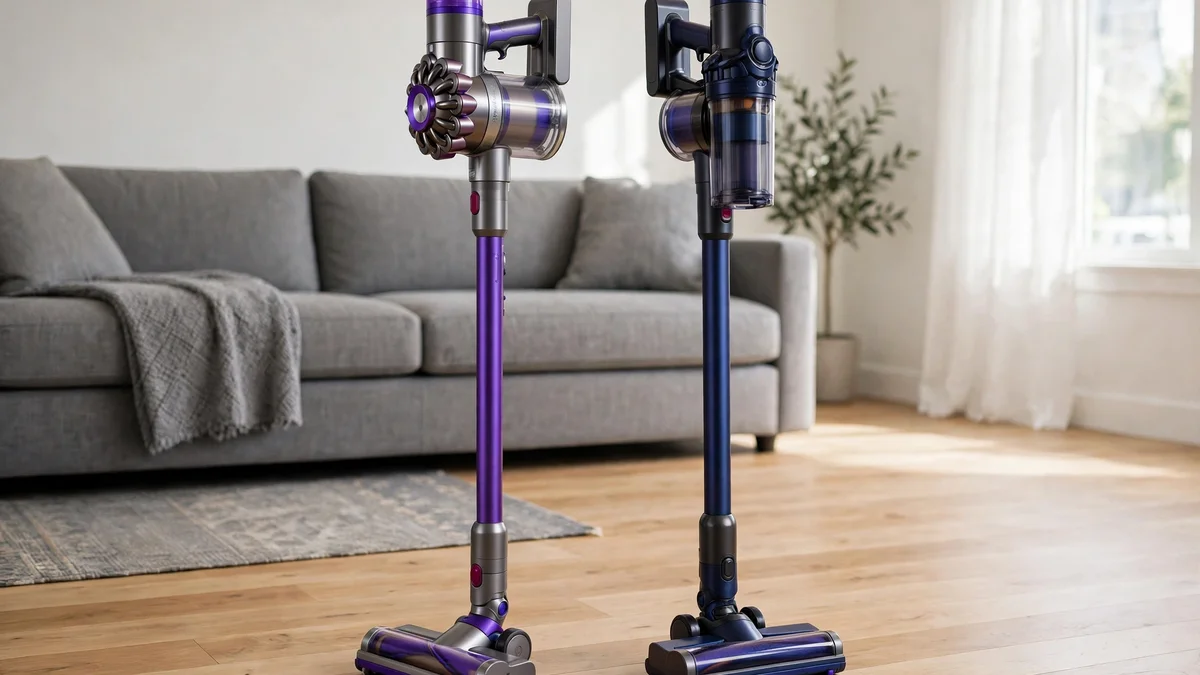
Dyson vs Shark vacuums in 2027 is a contest between the premium pioneer and the value challenger. Dyson built its name on powerful suction and prices that often top $500. Shark built its name on doing most of the same job for far less, with practical features like self-cleaning brush rolls and flexible wands.
The real difference is not whether either brand cleans well. Both do. It is what you pay for the extra performance, how long the battery lasts, how heavy the vacuum feels, and how much the running costs add up. A large home with thick carpets and pets justifies a Dyson; a smaller home on a budget is usually better served by a Shark.
This comparison covers the current cordless stick ranges, from the Shark Stratos at around $300 to the Dyson V15 Detect at around $750, on price, ease of use, limits, cleaning performance, and who each suits best. Prices are approximate starting prices, so check current pricing before you buy.
Key takeaways
- Dyson wins on raw suction, filtration, and build quality, with the V15 Detect the strongest cordless cleaner.
- Shark wins on value, cleaning similarly for roughly half the price.
- Shark’s self-cleaning brush roll and flexible wand solve real problems in homes with long hair and pets.
- Dyson batteries and parts cost more to replace, while Shark offers longer warranties on many models.
- Pet owners with thick carpets should buy Dyson; budget buyers and smaller homes should buy Shark.
At a glance: Dyson vs Shark
| Model | Best for | Starting price | Standout limit |
|---|---|---|---|
| Dyson V12 Detect Slim | Smaller homes, hard floors | About $650 | Small bin, short boost battery |
| Dyson V15 Detect | Most homes, pet hair | About $750 | Heavy, premium price |
| Dyson Gen5detect | Maximum power and filtration | About $950 | Highest price, heavy |
| Dyson Ball Animal 3 | Upright fans, deep carpet | About $450 | Corded, bulky |
| Shark Stratos | Budget cordless cleaning | About $300 | Shorter battery than Dyson |
| Shark Detect Pro | Pet homes on a budget | About $400 | Smaller bin than V15 |
| Shark Navigator Lift-Away | Upright value, stairs | About $250 | Corded, less suction |
Dyson: the suction benchmark
Dyson is the benchmark other vacuums are measured against. Its cordless sticks use a powerful digital motor and sealed filtration that traps fine dust and allergens, and the laser on the V15 Detect reveals dust on hard floors the eye misses. In tests, Dyson picks up more fine dust from carpets than almost any rival.

The range starts with the V12 Detect Slim, a lighter model for smaller homes and hard floors. The V15 Detect is the model most people should buy: it pairs the laser dust detector with a cleaner head that adjusts suction to the floor type, and its battery lasts up to 60 minutes on eco mode. The Gen5detect is the flagship, with Dyson’s strongest cordless suction and a HEPA filter capturing 99.97 percent of particles down to 0.3 microns.
Dyson’s build quality is a genuine strength. The vacuums feel solid, the bins empty with a single pull, and the parts fit together with precision. The LCD screen on the V15 and Gen5detect shows remaining battery life and a count of particles picked up. Our guide to the best cordless vacuums in 2027 places these models against every major rival.
Pros: The strongest suction in a cordless vacuum, excellent sealed filtration for allergy sufferers, the laser dust detector, and superb build quality.
Cons: Premium prices from around $650, heavy in the hand, short battery life on maximum power, and expensive replacement batteries and filters.
Shark: the value challenger
Shark takes the opposite approach: most of the performance for roughly half the money. Its cordless sticks use dual brush rolls, one soft roller for hard floors and one bristle brush for carpets, and the self-cleaning brush roll removes wrapped hair as you clean. For homes with long hair or shedding pets, that feature saves real time.
The range starts with the Shark Stratos, a capable cordless stick at around $300 with the dual brush roll and a flexible wand that bends so you can clean under low furniture without crouching. The Detect Pro adds dirt detection, adjusting suction automatically when it senses extra mess. The Navigator Lift-Away is the corded upright pick, with a detachable canister for stairs and upholstery.
Where Shark pulls ahead is practical design. The flexible wand is genuinely useful, the dustbins are easy to empty, and many models carry a five-year warranty, longer than Dyson’s standard two years. Shark vacuums are also lighter, which matters on the stairs. The trade-off is refinement: Shark machines feel more plasticky, they are louder, and their filtration is not sealed to Dyson’s standard.
Pros: Roughly half the price of a comparable Dyson, self-cleaning brush roll, flexible wand, long warranties, and lighter weight.
Cons: Weaker suction on deep carpet, louder in use, less refined build, and filtration that is not fully sealed like Dyson’s.
Price: Dyson costs twice as much, Shark cleans nearly as well
On the sticker price, Shark wins by a wide margin. A Shark Stratos at around $300 does the daily cleaning job of a Dyson V12 Detect Slim at around $650, and the Detect Pro at around $400 competes with the V15 Detect at around $750. The gap is roughly double at every level.
The running costs widen the gap further. A replacement Dyson battery costs around $100 or more, and Dyson filters and brush heads are priced at a premium. Shark batteries and parts cost noticeably less. Over five years, a Dyson can cost $200 to $300 more to own than a comparable Shark.
Ease of use: Shark is lighter, Dyson is smarter
Shark is the easier vacuum to live with day to day. Its cordless models are lighter, the flexible wand reaches under beds and sofas without effort, and the controls are simple: a trigger, a power button, and a floor-type switch. Emptying the bin is a one-handed job, and the self-cleaning brush roll means you rarely cut hair off the roller.
Dyson is the smarter vacuum. The V15 and Gen5detect adjust suction automatically, show battery life and particle counts on an LCD screen, and the laser reveals dust you would otherwise miss. That intelligence comes with weight: the V15 is around 3 kg, and holding it at arm’s length gets tiring. For ease alone, Shark wins on weight and simplicity; for feedback and automation, Dyson wins.
Limits: battery, bins, and cords
This is where both brands show their limits. Dyson’s headline battery figures, up to 60 minutes on the V15, apply only to eco mode with a non-motorised head. On boost mode with the main cleaner head, you get closer to 10 minutes. Shark’s batteries are similar, with around 40 to 50 minutes on eco and far less on maximum power.
Dustbin size matters too. The V15 holds 0.77 litres, which sounds generous until you clean a pet-heavy home and empty it twice per session. Shark’s bins are smaller still on the Stratos, at around 0.6 litres. Corded uprights avoid both problems: the Ball Animal 3 and the Navigator Lift-Away run as long as you want, with no battery anxiety, at the cost of dragging a cord around.
Performance: suction, carpets, and pet hair
On raw cleaning performance, Dyson wins. Its motors generate more suction, and in carpet tests the V15 lifts more embedded dust and pet hair in a single pass than the Shark Detect Pro. The laser head is also a genuine advantage on hard floors, showing exactly where dust remains.
Shark is closer than the price gap suggests. On hard floors and short-pile carpets, the Stratos and Detect Pro clean almost as well as a Dyson, and the dual brush roll handles mixed flooring without swapping heads. Where Shark falls behind is deep-pile carpet and heavy pet hair, where Dyson’s extra suction makes a visible difference. Dyson holds its suction better as the bin fills.
Best for: the verdict by use case
Buy a Dyson if you have thick carpets, pets, or allergies. The V15 Detect is the best vacuum for most homes with pets: it has the strongest suction, the laser head, and sealed filtration that keeps allergens out of the air. Allergy sufferers and deep-carpet homes will notice the difference every week.
Buy a Shark if you want strong everyday cleaning without the premium price. The Stratos is the best value cordless vacuum for smaller homes, while the Detect Pro suits pet homes on a budget. Shark is also better for anyone who struggles with weight, since its models are lighter. There is no tie: heavy carpet and allergy homes belong on Dyson, and budget and small homes belong on Shark.
How to choose
Start with your floors. Thick carpets and pets point to Dyson, because suction and sealed filtration matter most there. Hard floors and short-pile carpets point to Shark, because the cleaning gap is small and the savings are large.
Next, check the weight and the battery. Pick the vacuum up in a shop if you can, and hold it at arm’s length for thirty seconds: that is what cleaning shelves feels like. For a deeper guide, read our cordless stick vacuum buying guide.
Checklist: before you buy
- Measure your carpet pile: thick carpets justify Dyson’s suction.
- Weigh the vacuum in a shop: 3 kg gets heavy fast.
- Check the battery time with the motorised head, not the eco-mode headline.
- Count pets and long hair: Shark’s self-cleaning brush roll helps most here.
- Compare the warranty: five years on many Sharks against two on Dyson.
- Price a spare battery and filters first: Dyson parts cost more.
Frequently asked questions
Is Dyson really better than Shark?
Dyson is better on raw suction, filtration, and build quality, and it cleans deep carpet more thoroughly. Shark is better on value, weight, and practical features like the flexible wand.
Which vacuum is best for pet hair?
The Dyson V15 Detect is the best cordless vacuum for pet hair overall, thanks to its suction and anti-tangle cleaner head. The Shark Detect Pro is the best budget option, with a self-cleaning brush roll that stops hair wrapping. For more pet-focused models, see our guide to the best robot vacuums for pet owners.
Do Shark vacuums last as long as Dyson?
Both brands typically last five to eight years with normal use. Dyson feels more solidly built, but Shark’s five-year warranty on many models covers faults longer than Dyson’s two-year warranty.
Why are Dyson vacuums so expensive?
Dyson charges for its motors, sealed filtration, and engineering. The premium buys measurably stronger suction and better filtration, but for many homes the extra performance is more than they need.
Is a cordless vacuum powerful enough for a whole house?
Yes, for most homes, if you clean on auto or eco mode and use boost only for stubborn spots. Large homes may need a second battery or a corded upright.
Should I buy a corded upright instead?
Buy a corded upright if you have a large home with wall-to-wall carpet and hate charging batteries. Cordless sticks win for flats, hard floors, and quick daily cleans, since they are lighter and easier to grab.
The bottom line
Dyson vs Shark has no single winner. The V15 Detect is the best vacuum for homes with thick carpets, pets, or allergies: it cleans deeper, filters better, and feels built to last. Anyone who wants the strongest clean and can afford it should buy it.
But the Shark Stratos is the smarter buy for most people. It cleans hard floors and short carpets almost as well, it is lighter, its brush roll cleans itself, and it costs roughly half as much. Pick your floors first, your budget second.