
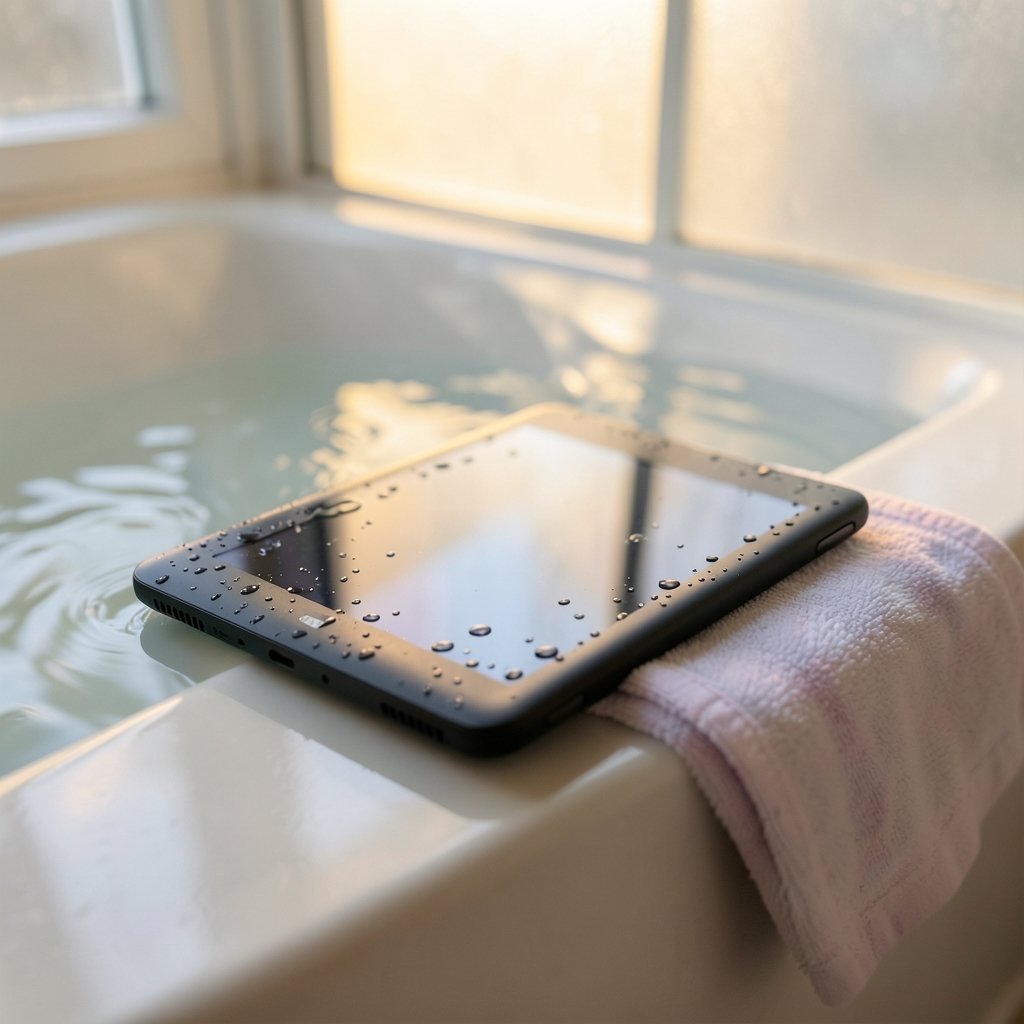
Can you read in the bathtub without killing your Kindle? The answer depends on a two-character code most shoppers skim past: IPX8. That label gets printed on boxes, splashed across product pages, and repeated in reviews, yet very few people understand what it actually promises. Worse, two devices with the same IPX8 rating can have wildly different real-world limits. This guide breaks down the waterproof rating system for e-readers, explains what the numbers mean, and shows where manufacturers’ claims stop and reality begins. (CNET best e-readers)
What the IP Rating Code Actually Means
IP stands for Ingress Protection. The rating system is defined by an international standard, IEC 60529, which sets out how test labs measure a device’s resistance to dust and water. The code has two digits after the letters. The first digit covers solids like dust and sand. The second covers liquids.
That structure explains why e-readers almost always advertise something like IPX8 rather than IP68. The “X” means the dust protection digit is unspecified. Manufacturers skip the solid-particle test entirely and only certify the water side. For a device that lives on a nightstand, that is a reasonable trade-off, but it also means you learn nothing about dust resistance from the rating.
The second digit runs from 0 to 8. For e-readers, you will mostly see IPX7 and IPX8. Here is how those levels compare:
| Rating | Water Protection Level | Typical Test Conditions |
|---|---|---|
| IPX4 | Splashing water | Spray from any direction |
| IPX7 | Temporary immersion | Commonly 1 meter for 30 minutes |
| IPX8 | Continuous immersion | Depth and duration set by the manufacturer |
The critical detail sits in that last row. Under the standard, IPX8 does not define a fixed depth or time. The manufacturer and the testing lab agree on the conditions, and the device is tested against those agreed conditions. One brand might certify 2 meters for 60 minutes. Another might certify 1.5 meters for 30 minutes. Both can legally print IPX8. The rating tells you a device survived a specific dunking test, not that all IPX8 devices are equally tough.
Why “Waterproof” Is a Marketing Word, Not a Technical One

Here is a distinction that saves shoppers from expensive mistakes: almost no consumer electronics are truly waterproof. They are water-resistant. Waterproof implies water cannot get in under any circumstances. Water-resistant means the device can withstand water exposure up to defined limits.
Manufacturers lean on the friendlier word anyway, and consumer protection agencies have pushed back on vague claims over the years. The practical takeaway is simple. Treat every e-reader as water-resistant up to a stated limit, and assume that limit applies to a new, undamaged unit.
That last part matters more than most buyers realize. Seals, gaskets, and port covers age. Adhesive degrades. A flap that clicked shut securely in year one may not seat as tightly in year four. The rating was earned by a factory-fresh sample, not by the device sitting in your beach bag.
What IPX8 E-Readers Are Actually Tested Against
Because IPX8 conditions are manufacturer-defined, the honest way to compare devices is to read the fine print on each spec sheet. Brands that publish specific numbers are giving you something concrete. A claim of “IPX8, tested at 2 meters for 60 minutes” tells you far more than a bare “IPX8” badge.
In practice, most major e-reader makers that advertise water resistance publish a depth and time figure alongside the rating. Some also specify that testing was done in fresh water at a controlled temperature. That detail is not marketing fluff. Fresh water is the standard test medium, and it is the environment where the seals perform best.
Salt water is a different story. Pool water with chlorine is a different story. Soapy bathwater with oils and salts is a different story again. Many manufacturers explicitly warn against submerging devices in anything other than fresh water, and some warranties exclude damage from salt water entirely. If you plan to read poolside or on a boat, check that specific warning before you trust the badge.
Common Mistakes That Kill Water-Resistant E-Readers
Knowing the rating is half the battle. The other half is avoiding the everyday errors that turn a water-resistant device into a dead one. These are the mistakes that show up again and again in repair forums and support threads.
Charging a Wet Device
This is the number one killer. Water trapped in or around the charging port can cause corrosion or a short when power flows. Many modern e-readers detect moisture in the port and refuse to charge, displaying a warning instead. That is a safety feature, not a malfunction. The fix is patience: let the port dry fully, often for several hours, before plugging in. Never charge a device you just pulled out of the tub.
Trusting a Damaged Seal
A cracked screen, a bent corner, or a port cover that no longer sits flush all compromise the water resistance. The IPX8 rating applies to an intact device. If your e-reader has taken a drop onto a hard floor, assume the seal integrity is now unknown.
Submerging Beyond the Stated Limit
“IPX8” is not a license for unlimited depth. If the spec sheet says 2 meters for 60 minutes, that is the tested envelope. A device that slips out of your hand in a deep pool may exceed the pressure it was designed for.
Ignoring Temperature Extremes
Hot water and steam are tougher on seals than cool water. Reading in a hot bath or a steam-filled shower pushes conditions beyond what a fresh-water lab test covers. Warm water also softens some gasket materials.
Forgetting That Warranties Exclude Water Damage
Read the warranty before you buy, not after. Many e-reader warranties explicitly exclude liquid damage even on models marketed with water resistance. The rating is a durability feature, not an insurance policy.
Fresh Water, Salt Water, and Soapy Water: A Practical Comparison
Not all water is created equal, and the rating system does not distinguish between them. Here is how different environments stack up in practice:
| Water Type | Risk Level | What to Know |
|---|---|---|
| Fresh tap water | Low | The standard test medium; best-case scenario |
| Bath water with soap or oils | Moderate to high | Surfactants and oils can degrade seals; many brands warn against it |
| Chlorinated pool water | Moderate to high | Chemicals can attack gaskets over repeated exposure |
| Salt water | High | Corrosion risk; frequently excluded from warranty coverage |
| Hot water or steam | High | Heat stresses seals beyond typical test conditions |
The pattern is clear. A quick accidental dunk in the sink is the scenario these ratings are built for. A daily habit of reading in a chlorinated hot tub is not.
How to Read a Waterproof Claim Before You Buy
Shoppers who want real confidence should look past the badge and check four things on the spec sheet. First, find the specific depth and duration the manufacturer tested. Second, look for the test medium, ideally fresh water. Third, check whether the warranty covers liquid damage at all. Fourth, look for any explicit warnings about salt water, soap, or hot water.
If a product page lists only “IPX8” with no supporting detail, that is a yellow flag. It does not mean the device is bad. It means the manufacturer chose not to disclose the conditions, so you cannot compare it fairly against a competitor that did. The same discipline applies to any spec-heavy purchase, whether you are comparing water resistance or working out Leonardo AI pricing plans and features before committing to a subscription.
It also helps to think about how the device will actually be used. A reader who mostly reads in bed gains little from water resistance and may prefer to spend the budget elsewhere. A reader with a nightly bath ritual or a poolside habit gets real value from it. Matching the spec to the habit is the whole game.
Where Waterproof E-Readers Fit in the Broader Device Market
Water resistance has become a standard checkbox across consumer electronics, from phones to smartwatches to e-readers. The same IP code governs all of them, which is why the quirks of IPX8 show up everywhere. Apple’s approach to cloud infrastructure and device security, for instance, follows a similar philosophy of publishing specific, testable claims rather than vague marketing language, a pattern examined in this breakdown of Apple private cloud compute and Google cloud in 2026. The lesson transfers: specific numbers beat vague badges.
For e-readers specifically, water resistance tends to appear on mid-range and premium models rather than budget ones. That is a manufacturing cost decision. Adding sealed ports, gaskets, and a coated internal board raises the bill of materials, and budget devices cut those features first. If water resistance is a must-have, expect to pay for it.
The Environmental Cost Nobody Mentions
There is a quieter angle worth knowing. Electronics that survive water exposure tend to last longer, which is good for the planet. But the manufacturing process behind water-resistant devices carries its own footprint. Data centers and the digital services that feed e-readers consume real resources, and the water footprint of AI and cloud computing has become a genuine area of study, covered in this look at how much water AI uses per day. Even a humble e-reader sits inside a larger infrastructure story.
Conclusion
The e-reader waterproof rating is a useful tool, but only if you read it correctly. IPX8 means a device survived a manufacturer-defined immersion test, usually in fresh water, at a specific depth and duration. It does not mean the device is invincible, and it does not mean two IPX8 readers are equally tough. Check the stated depth and time, respect the fresh-water limitation, keep the charging port dry, and read the warranty before you trust the badge. Do that, and a bathtub read becomes a pleasure instead of a gamble.
Frequently Asked Questions
Is IPX8 better than IPX7 for an e-reader?
Generally yes, but not automatically. IPX7 covers temporary immersion, commonly tested at 1 meter for 30 minutes. IPX8 covers continuous immersion under manufacturer-set conditions. An IPX8 device tested at only 1 meter for 30 minutes is not meaningfully tougher than a good IPX7 device. Always compare the stated depth and duration, not the number alone.
Can I read my waterproof e-reader in the bathtub?
Usually yes, with caveats. Most water-resistant e-readers handle a splash or a brief accidental dunk in fresh water. Hot bathwater with soap, oils, or bath salts is harsher on seals than the fresh water used in testing, and many manufacturers warn against it. Keep the device above the waterline where possible and dry it promptly.
Can I take a waterproof e-reader to the beach or pool?
Check the manufacturer’s warnings first. Salt water and chlorinated pool water can degrade seals and cause corrosion, and many warranties exclude damage from salt water. Rinse and dry the device if it gets splashed, and avoid submerging it in anything other than fresh water unless the brand explicitly permits it.
Why won’t my e-reader charge after it got wet?
Many water-resistant e-readers detect moisture in the charging port and block charging as a safety measure to prevent corrosion or a short circuit. Let the port air-dry completely, which can take several hours, then try again. Never force a charge or use heat to speed drying, since heat can damage the seals and internal components.
Does water resistance last forever?
No. The rating applies to a new, undamaged unit. Seals and gaskets age, port covers loosen, and drops or cracks compromise the protection. Once a device has been dropped or shows physical damage, treat its water resistance as uncertain. Most warranties exclude liquid damage even on water-resistant models.
Is a waterproof e-reader worth the extra cost?
It depends on how you read. If you read in the bath, by the pool, or near water regularly, the added protection is genuinely useful and can prevent a costly replacement. If your reading happens mostly in bed or on the couch, the premium may not pay off, and that money might be better spent on a larger screen or better lighting.



