
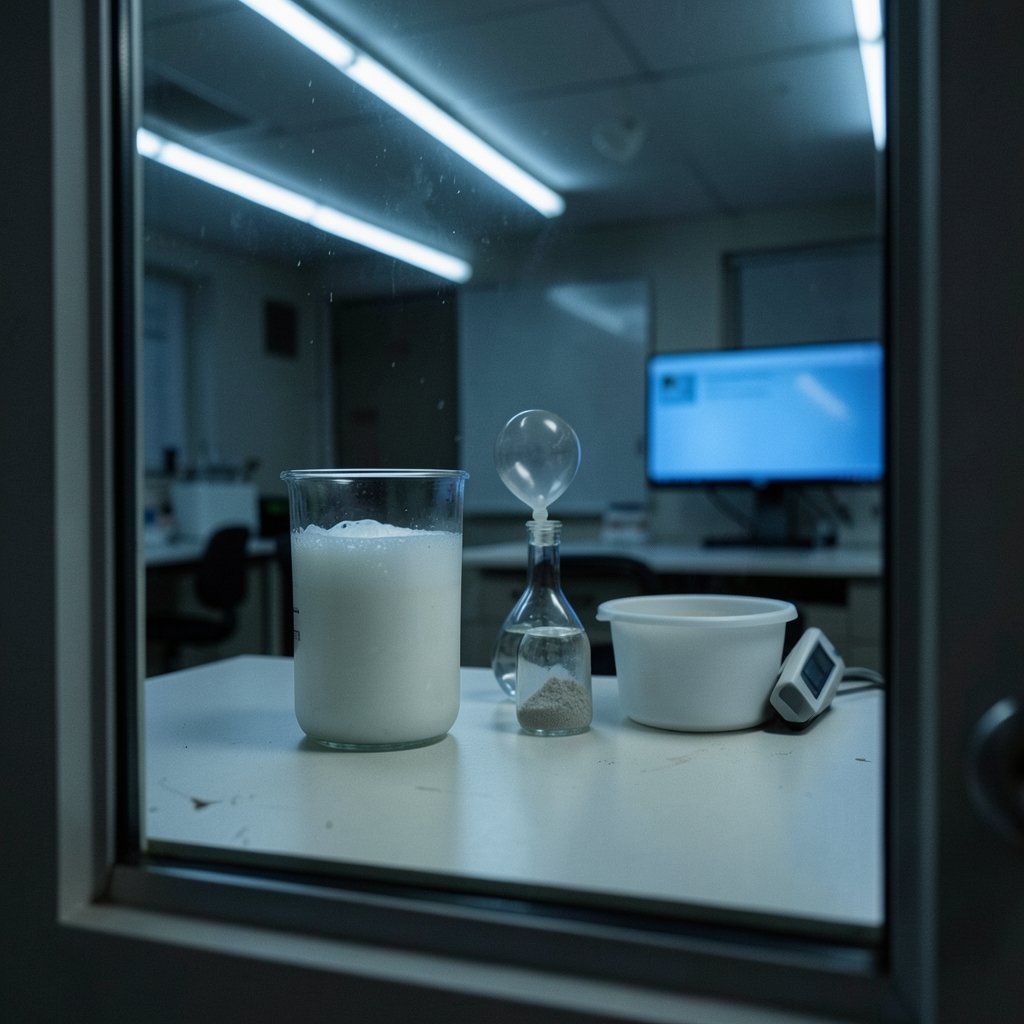
What happens when you mix baking soda and vinegar, and why does the cup feel cold afterward? That question is the focus of experiment 6 in most lower-secondary science courses, and it is also where many students quietly get confused. The fizzing looks like magic, the equation looks like alphabet soup, and somewhere between the two the actual chemistry gets lost.
This guide walks through what experiment 6 on simple chemical reactions is meant to teach, how to run it without wasting materials or setting off the fire alarm, and the mistakes that trip up both students and teachers. It sticks to the chemistry that holds up under scrutiny, flags where textbook claims are shakier than they appear, and gives you enough detail to write up a lab report that earns marks for understanding rather than neat handwriting.
What experiment 6 is actually asking you to show
A chemical reaction is a process where reactants turn into products with different properties. Atoms get rearranged, but they are not created or destroyed. That is conservation of mass, and it is the idea most simple-reaction experiments are built to demonstrate.
Most versions of experiment 6 follow a predictable shape. You combine two or more everyday substances, observe what changes, and then explain the change using evidence rather than vibes. The evidence usually falls into five categories:
| Sign of reaction | What you see | Typical example |
|---|---|---|
| Gas evolution | Bubbles, fizzing, a balloon inflating | Baking soda plus vinegar |
| Colour change | Solution shifts from clear to coloured | Indicator added to acid or alkali |
| Temperature change | Container warms or cools | Neutralisation warming; dissolving ammonium nitrate cooling |
| Precipitate formation | Cloudy solid appears in a clear liquid | Two soluble salts swapped |
| Light emission | Glow or flash | Combustion or glow-stick chemistry |
If your experiment 6 write-up lists an observation but never names which of these five it is, you have described a magic trick, not a reaction. Naming the category is half the marks.
Baking soda and vinegar: the workhorse reaction
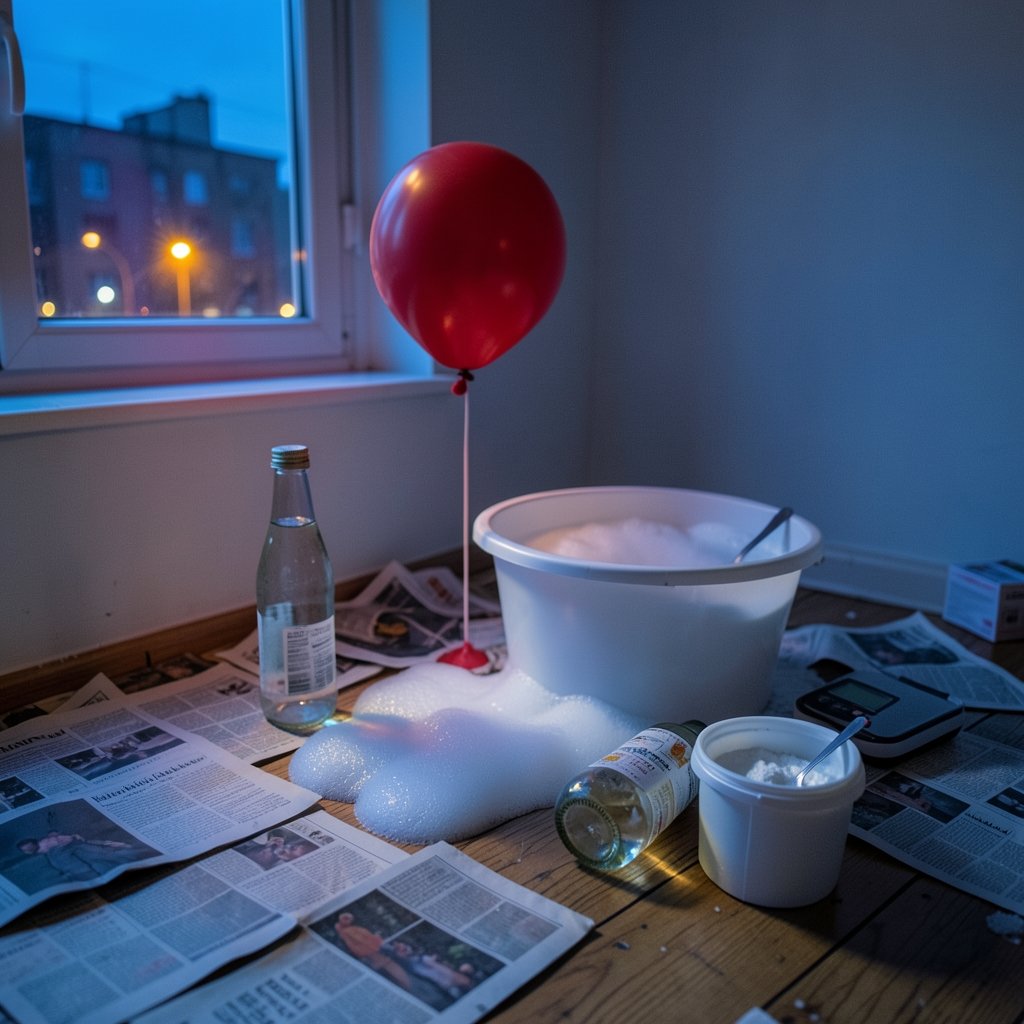
Sodium bicarbonate reacting with acetic acid produces sodium acetate, water and carbon dioxide:
NaHCO₃ + CH₃COOH → CH₃COONa + H₂O + CO₂
The CO₂ is what you see. Every bubble is gas leaving the system, which is why the cup feels cool and why the mass on the balance drops if the container is open. That drop is not matter vanishing. It is matter escaping as gas.
Practical tips that save a lot of grief:
- Use a tall container. Foam expands faster than most people expect, and a shallow bowl guarantees a countertop cleanup.
- Add a few drops of washing-up liquid to slow the foam collapse and make the gas production easier to observe.
- Put a balloon over the neck of a bottle to capture the CO₂. The balloon inflating is a much better visual than fizzing alone, and it lets you weigh the closed system before and after.
- Weigh the open cup before and after, then weigh the balloon version. The contrast between the two results is the single most useful teaching moment in the whole experiment.
The temperature claim worth checking
Many teaching sources describe baking soda plus vinegar as slightly endothermic, meaning it absorbs heat and feels cool. That is broadly right, but the exact thermal effect depends on concentration, starting temperature and how much of each reactant you use. If your write-up needs a number, measure it rather than copying one. A cheap thermometer and thirty seconds of recording will beat a borrowed figure every time.
Elephant toothpaste and what a catalyst really does
The foaming peroxide demonstration, often called elephant toothpaste, relies on hydrogen peroxide decomposing into water and oxygen:
2H₂O₂ → 2H₂O → O₂
The decomposition happens on its own, just very slowly. Adding a catalyst, commonly potassium iodide or yeast, speeds it up without being consumed overall. Soap traps the released oxygen into foam, which is why the result looks dramatic even though the chemistry is straightforward.
This is where experiment 6 can go wrong in a specific way. Students often write that the catalyst “reacts with” the peroxide. It does not, at least not in the net equation. It provides a lower-energy route and comes out unchanged at the end. If you are marking a report, that distinction is worth a full grade band.
Safety matters more here than in the vinegar version. Concentrated hydrogen peroxide is a skin and eye irritant, and school practical guidance sets concentration limits for good reason. Eye protection and ventilation are not optional extras. If you are working at home rather than in a lab, stick to the low-concentration peroxide sold for first aid and keep the volume small.
Reading the equation like a sentence
The arrow is the most underrated symbol in school chemistry. Reactants sit on the left, products on the right, and the arrow means “turns into.” State symbols in brackets tell you the physical form: (s) for solid, (l) for liquid, (g) for gas, (aq) for dissolved in water.
A balanced equation is just bookkeeping. Every atom on the left must appear on the right in the same number, because atoms are not created or destroyed. If your equation balances, conservation of mass is already baked in.
This is also where the crossover with other technical disciplines gets interesting. Debugging a reaction that will not work as predicted is not so different from tracking down a pipeline failure that silently breaks a build; both reward the person who reads the evidence instead of assuming the tool is right. Anyone who has chased a mystery through common GitHub Actions mistakes that quietly break your CI will recognise the pattern of a system doing exactly what it was told rather than what you meant.
Mistakes that quietly ruin the results
Most failed experiment 6 attempts are not caused by bad chemistry. They are caused by small procedural slips that never get written down.
Not labelling containers. Two clear liquids look identical. Ten minutes later, so do your notes.
Measuring by eye. “A spoonful” of bicarbonate varies wildly. Use a balance or a measuring spoon and record the amount. Without it, you cannot compare your results to anyone else’s, including your own from last week.
Ignoring the starting temperature. A reaction that feels cool may simply have started cold. Record the temperature before you begin.
Confusing “no visible change” with “no reaction.” Some reactions produce nothing you can see. That is a result, not a failure, and it deserves a sentence in the discussion.
Skipping the control. Run the same setup without one reactant. It takes two minutes and it proves the change came from the combination rather than from stirring or from the air.
There is a broader lesson in this that shows up far outside the lab. People trust a demonstration more when it is filmed, staged or dramatic, and less when it is plain. The same instinct that makes a hidden-camera format feel more real than a scripted scene is the one that makes students trust the foaming version of an experiment over the boring one that actually proves the point. If you want to see how that psychology plays out in practice, the mechanics behind whether a TV show hidden camera experiment really works are a useful parallel for anyone designing a demonstration.
Choosing materials: household versus lab-grade
Experiment 6 can be run with supermarket supplies or with proper lab reagents. Both are legitimate. The trade-off is control versus accessibility.
| Factor | Household materials | Lab-grade reagents |
|---|---|---|
| Cost | Very low | Higher, plus disposal |
| Concentration accuracy | Poor to fair | High |
| Safety risk | Low but variable | Managed with training |
| Reproducibility | Weak | Strong |
| Best for | First exposure, home learning | Assessment, data analysis |
The honest advice is to start with household materials to build intuition, then move to measured reagents once the concepts are secure. A student who has felt the cup go cold understands endothermic reactions better than one who has only read the word.
Where this fits in the wider curriculum
Simple chemical reactions appear in lower-secondary science across most systems, typically covering reactants and products, word and symbol equations, and the observable signs of change. The topic is deliberately placed early because it underpins almost everything that follows: acids and alkalis, rates of reaction, energy changes and electrochemistry all assume you can read an equation and recognise evidence of a reaction.
The pedagogical trap is treating the experiment as a performance. Foam and fizzing are memorable, but memory is not understanding. The strongest write-ups are usually the least spectacular: a clear table of masses, a named sign of reaction, a balanced equation and one honest paragraph about what the results do not prove.
That last point is worth dwelling on. A single trial tells you very little. Two trials with different amounts tell you whether the effect scales. Three trials with a control tell you whether you have found a real relationship. Experiment 6 rarely demands that level of rigour, but adding one repeat and one control costs almost nothing and lifts the work from description to investigation.
Writing it up without padding
A clean report structure that fits most mark schemes:
- Aim, stated as one sentence with a measurable outcome.
- Prediction, with a reason drawn from prior knowledge.
- Method, in numbered steps someone else could follow.
- Results, in a table with units.
- Observations, separated from measurements.
- Conclusion, tied directly back to the aim.
- Evaluation, naming one weakness and one improvement.
The evaluation section is where most marks are lost and most marks are available. “It went well” is not an evaluation. “The balance read to the nearest gram, so a small mass loss from escaping gas was hard to detect” is.
For readers who enjoy seeing how other technical fields handle evidence and iteration, the debates around game development are a surprisingly good analogue. The reporting around FF7 Remake and Hamaguchi’s story decisions not being changed by player reactions is really a story about creators sticking to a method rather than chasing feedback, which is exactly the discipline a good experiment requires.
Conclusion
Experiment 6 on simple chemical reactions is not really about making foam. It is about learning to trust evidence over spectacle. The fizzing cup, the inflating balloon and the cooling thermometer are all saying the same thing: atoms rearranged, mass conserved, energy moved. Get the observations right, name the signs of reaction properly, balance the equation, and the marks follow. Chase the dramatic version without the measurements and you end up with a memorable mess and nothing to write down.
Run it once for fun. Run it again with a balance, a thermometer and a control. The second version is the one that teaches you chemistry.
FAQ
What is the simplest chemical reaction for experiment 6?
Baking soda plus vinegar is the standard choice. It uses safe household materials, produces obvious carbon dioxide bubbles and can be measured with a balloon or a balance. It also demonstrates conservation of mass neatly once you compare an open container with a sealed one.
Why does the baking soda and vinegar cup feel cold?
The reaction absorbs heat from its surroundings, making it endothermic. The exact temperature drop depends on how much of each substance you use and the starting temperature, so measure it rather than assuming a fixed value.
What is the difference between a catalyst and a reactant?
A reactant is consumed during the reaction and appears on the left of the equation. A catalyst speeds up the reaction and is recovered unchanged overall, so it does not appear in the net equation. In the peroxide demonstration, potassium iodide or yeast acts as the catalyst.
Why does mass seem to disappear in an open container?
Because carbon dioxide escapes as gas. The atoms still exist, just not in the cup. Weigh the same setup with a balloon sealed over the neck and the total mass stays essentially constant, which demonstrates conservation of mass.
How many trials does a school experiment need?
One trial shows a change happened. Two or three trials with different amounts show whether the effect is consistent and how it scales. Adding a control, where one reactant is left out, proves the change came from the combination rather than from stirring or the air.
Is elephant toothpaste safe to do at home?
Only with low-concentration hydrogen peroxide and small volumes. Concentrated peroxide irritates skin and eyes and should be handled with eye protection and ventilation. School practical guidance sets concentration limits for exactly this reason, and those limits exist to be followed rather than approximated.



