What if you could watch a 3D movie, play a game, or study a 3D model without ever reaching for a pair of plastic glasses? That promise has been dangled in front of consumers for more than a decade. The problem was always the same: the moment a display went 3D, something else got worse. Resolution dropped, viewing angles narrowed, and anyone sitting off-center saw a blurry mess. Recent research suggests that trade-off is finally being broken, and the breakthroughs are coming from labs rather than marketing departments.
Why Glasses-Free 3D Was Stuck for So Long
The basic idea behind autostereoscopic displays, the technical name for glasses-free 3D, is simple. Show the left eye and the right eye slightly different images, and the brain fuses them into depth. The hard part is doing that without glasses and without ruining the picture.
Most systems rely on lenticular lenses, thin optical layers that steer light in different directions. They work, but only within a narrow sweet spot. Move your head a few inches and the effect collapses into crosstalk, where the left-eye image bleeds into the right eye. That is the ghosting sensation that made early 3D phones and TVs feel like a gimmick.
There is a second problem, and it is the one that really killed consumer enthusiasm. A lenticular layer permanently sacrifices resolution. Every pixel gets split between multiple viewing zones, so a 4K panel behaves like something much lower when the 3D layer is active. And when you just want to read text or watch a normal video, the lens is still sitting there, softening everything. Manufacturers were essentially asking buyers to pay a permanent quality tax for an occasional effect.
The Metasurface Lens That Switches Between 2D and 3D
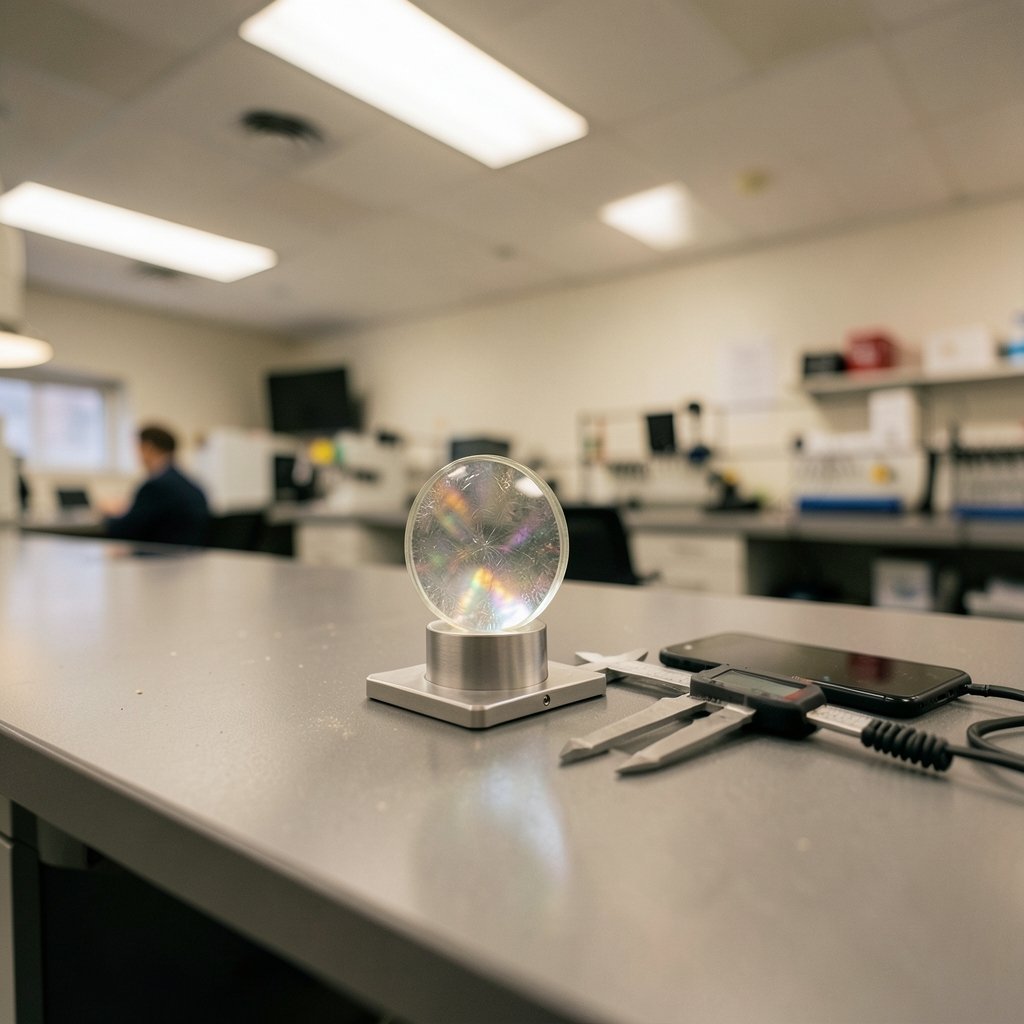
The most significant development in this space is a thin display that can toggle between wide-angle 3D and high-resolution 2D on demand. A nanostructured metasurface lens makes the switch possible, and the work was reported in the journal Nature.
The engineering detail that matters is thickness. The optical layer is roughly 1.2 millimeters thin, built from nanoscale structures that control how light behaves. Because the layer is so thin, it adds almost no bulk to a screen. That is a quiet but important shift: it means the technology can plausibly fit into a phone or a tablet, not just a bulky television.
Voltage control does the switching. In 2D mode, the lens lets light pass straight through for a sharp, high-resolution flat image. Flip to 3D mode, and the nanostructures redirect light into separate viewing zones. Multiple people can watch the 3D effect at once, which is a meaningful step up from eye-tracking systems that optimize for a single viewer.
The research was a collaboration involving Samsung Electronics, Samsung Research, and South Korea’s POSTECH (Pohang University of Science and Technology). The paper title, “Switchable 2D-3D display through a metasurface lenticular lens,” sums up the approach neatly. For anyone tracking display technology, this is the headline item worth following.
Samsung’s OLED Version and What It Changes
Samsung has also revealed that it developed the world’s first glasses-free 3D OLED display technology, building on the metasurface work. The company claims a better 3D effect and better picture quality than the LCD-based approach it used previously.
That distinction is not trivial. OLED panels control brightness pixel by pixel, which matters enormously for 3D. Depth perception depends on subtle differences between the two eyes’ images, and any light leakage between viewing zones undermines the illusion. A display that can switch individual pixels fully off has a structural advantage in keeping those zones clean.
Samsung already sells a glasses-free 3D gaming monitor, the Odyssey 3D, which uses LCD technology. The OLED research points toward where the next generation could go, likely starting with gaming monitors, phones, and tablets rather than living-room televisions. Readers who follow the broader hardware race may find the coverage of display defects and quality control in other product categories a useful reality check on how fast new panels actually reach shelves, such as these reports on inner display problems across three countries in the iPhone Duo inner display defect reports.
Super-Snell: Fixing the Angle-Versus-Resolution Problem
A separate research thread attacks the core trade-off from a different angle. A team at Tsinghua University proposed what it calls the super-Snell scanning light-field display, or SSS-LiD. The name refers to pushing beyond the classic Snell’s law limits that constrain how light can be refracted through conventional optics.
The design pairs an ultrawide-angle, low-aberration refractive optical structure with mechanical synchronous scanning. In plain terms, the system sweeps its optical element in sync with the image it displays, building up a wide viewing angle without sacrificing resolution. The work was published in Nature Photonics.
Why does this matter? The team frames glasses-free 3D as foundational technology for digital twins, human-computer interaction, distance education, and virtual social interaction. Those are applications where a narrow viewing window is a dealbreaker. A surgeon reviewing a 3D scan, a class watching a shared model, or two colleagues standing at the same screen all need to see the effect from where they actually stand.
EyeReal and AI-Assisted Desktop 3D
Meanwhile, researchers from Shanghai Artificial Intelligence Laboratory and Fudan University developed a system called EyeReal, which uses artificial intelligence to create glasses-free 3D on desktop-sized screens. It achieves a 100-degree field of view at full HD resolution, meaning viewers can move around naturally while the 3D effect holds.
The pitch is refreshingly concrete: imagine watching a car race where the vehicles seem to leap out of the screen, staying sharp even as you shift side to side in your chair. That is a far cry from holding your head perfectly still. The system represents the first ultra-wide full-parallax glasses-free 3D display at desktop scale, according to the research team.
The AI component is doing real work here. Rather than relying purely on fixed optics to sort light into viewing zones, the system computes how to render content for the geometry of the situation. That is the same philosophy showing up across consumer tech, where software increasingly compensates for hardware limits. It echoes the pattern seen in other display categories, where matching the panel to the workflow matters more than raw specs, as explored in this guide to the best monitors for a Mac mini desk setup.
Commercial Glasses-Free 3D Beyond the Lab
Not all the news comes from research papers. Large-format glasses-free 3D displays are already being shown at trade events for digital signage, professional audiovisual, and experiential marketing. Companies in that space demonstrate landscape and portrait autostereoscopic screens showing 3D video and interactive experiences without glasses, headsets, or wearables.
There is an important distinction to draw here. Much of what gets marketed as “3D” on big LED billboards is forced perspective, an optical trick that only looks three-dimensional from one carefully chosen spot. True autostereoscopic displays create actual depth perception. Buyers evaluating signage hardware should ask which one they are being sold, because the visual results look similar in a photo and completely different in person.
How the Approaches Compare
| Approach | Key strength | Main limitation | Likely first products |
|---|---|---|---|
| Metasurface lenticular (Samsung/POSTECH) | Switches to true high-res 2D; thin layer; multiple viewers | Still research-stage | Phones, tablets, monitors |
| Super-Snell scanning light field (Tsinghua) | Ultrawide angle with high resolution | Complex moving optical assembly | Professional and industrial displays |
| EyeReal AI light field | 100-degree view at desktop size | Desktop-scale focus | Desktop monitors |
| Commercial autostereoscopic signage | Available now; no wearables needed | Fixed viewing zones; content must be authored for it | Retail, events, ProAV |
Practical Advice Before You Buy Anything
For anyone tempted by the first glasses-free 3D product that appears on a store shelf, a few habits will save real money.
First, test the viewing window yourself. Stand where you would actually sit, then lean left and right. If the 3D effect breaks within a few inches, the display will frustrate you within a week. Demo units are usually positioned at the perfect angle for a reason.
Second, check what happens in 2D mode. Ask specifically whether the 3D optical layer can be switched off entirely, or whether it stays in the light path. A screen that stays soft for spreadsheets and text is a poor daily driver no matter how good the 3D looks.
Third, count the viewers. Single-user eye-tracking systems are fine for one person at a desk. Shared screens in a living room or classroom need multi-viewer support, which is exactly the gap the metasurface work targets.
Fourth, ignore resolution claims that do not specify mode. A panel described as 4K may deliver far less effective resolution per eye in 3D. Ask for the per-eye figure.
The most common mistake is treating glasses-free 3D as a feature to tick off a spec sheet rather than an experience to evaluate in person. The second most common is assuming that any 3D claim involves real depth. Some of it is just clever printing.
What to Watch Next
The realistic timeline runs through phones, tablets, and gaming monitors before it reaches the living room. The metasurface approach is the most consumer-friendly candidate precisely because it does not force a permanent quality sacrifice, and because a 1.2-millimeter layer can go where a bulky optical stack cannot.
The bigger question is content. Glasses-free 3D only shines when material is authored for it, and most video is not. That is why gaming, design review, medical imaging, and education look like the strongest early use cases. Each involves interactive 3D content that already exists in some form.
For readers watching the wider hardware landscape, the same pattern keeps repeating: a lab result lands, a manufacturer prototypes it, and the gap between announcement and shipping turns out to be years. Keeping an eye on steady, verified reporting, like the daily roundups in this technology news feed, is a better strategy than reacting to every press release.
Conclusion
Glasses-free 3D spent years as a punchline because the physics seemed to demand a trade: depth in exchange for resolution, or immersion in exchange for a locked head position. The recent wave of research attacks that trade directly. A switchable metasurface lens restores full 2D quality at the press of a button. A scanning light-field design widens the viewing angle without collapsing resolution. An AI-driven desktop system lets you move in your chair. None of these are on a shelf yet, and the honest advice is to stay skeptical of any product that claims the problem is fully solved today. But for the first time in a long while, the direction of travel is genuinely encouraging.
Frequently Asked Questions
What does glasses-free 3D actually mean?
It refers to displays that create depth perception without special eyewear. The screen sends slightly different images to each eye, and the brain combines them into a three-dimensional scene. The technical term is autostereoscopic display.
Is glasses-free 3D the same as the 3D effect on LED billboards?
No. Many large billboards use forced perspective, an optical illusion that only appears three-dimensional from one specific spot. True autostereoscopic displays create real depth that holds as you move, which requires specialized optics rather than clever artwork.
What is a metasurface lenticular lens?
It is an ultra-thin optical layer made of nanoscale structures that steer light. In the Samsung and POSTECH research, a layer about 1.2 millimeters thick can switch between a high-resolution flat 2D mode and a wide-angle 3D mode using voltage control.
Why did earlier glasses-free 3D products fail?
Two reasons dominated. The 3D effect only worked within a narrow range of viewing angles, so moving your head caused ghosting. And the optical layer permanently reduced resolution, even when you were not using 3D, which made the products poor everyday displays.
How wide a viewing angle is possible now?
One research system, EyeReal, reports a 100-degree field of view at full HD resolution on a desktop-sized screen. Separate work at Tsinghua University targets ultrawide angles combined with high resolution using a scanning light-field approach.
Should I wait to buy a glasses-free 3D display?
It depends on your need. Commercial autostereoscopic screens for signage and events are available now. Consumer products based on the newest switchable and light-field research are still in development, so buyers who want the latest approach should watch for shipping announcements rather than pre-release coverage.