
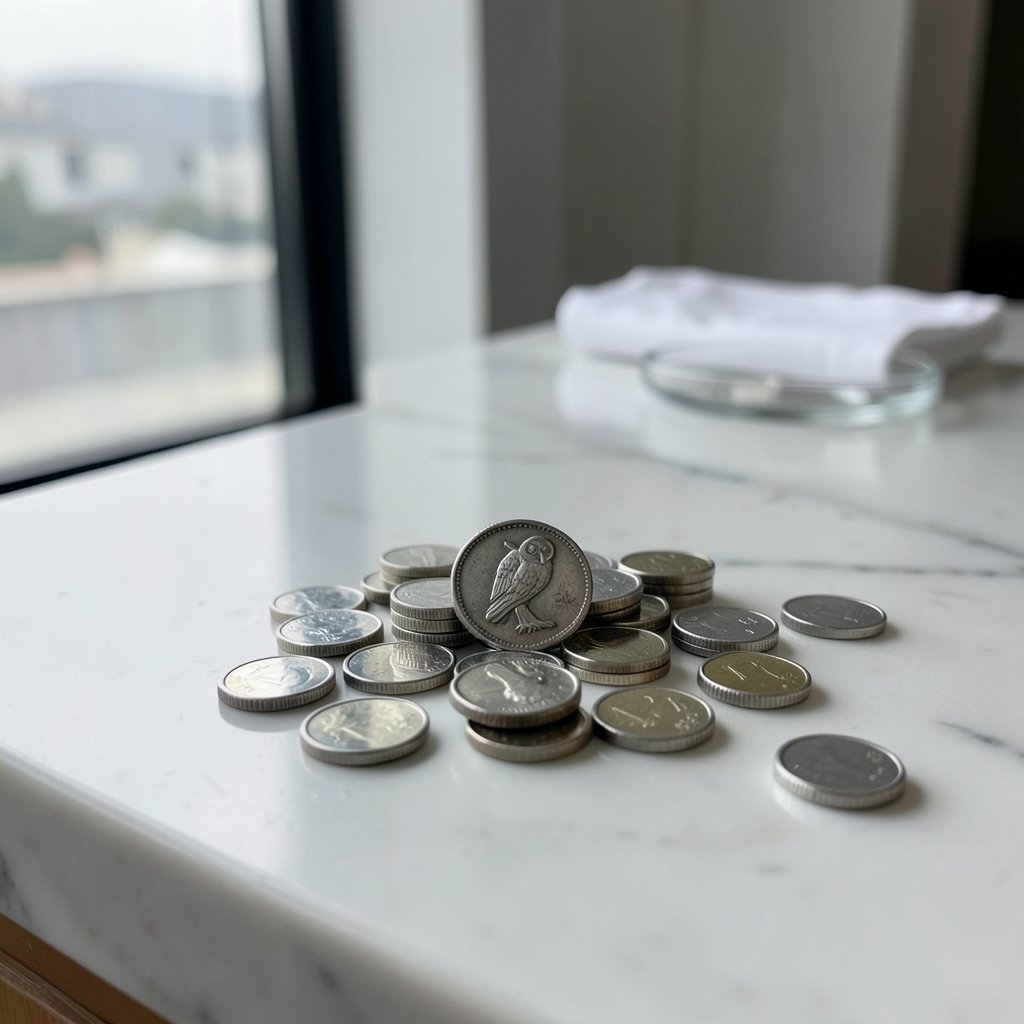
What happens to a country’s money when its government can’t pay its bills? For Greece, that question stopped being theoretical in 2010. The answer reshaped the country’s banks, its wages, its savings accounts, and even the coins in people’s pockets. Greek money is a story about ancient silver, a currency swap, a debt crisis, and a slow climb back to normal. It touches anyone who has traveled to the islands, held a Greek bank account, or wondered why a country that invented coinage ended up needing three international bailouts.
What Was Greek Money Before the Euro?
For most of modern history, Greece’s currency was the drachma. The name is ancient. It comes from a Greek verb meaning “to grasp,” a reference to a handful of six obols, the small metal sticks once used as money. The modern drachma was reintroduced in 1832, shortly after Greek independence, and it stayed in circulation through wars, occupations, and dictatorships.
The drachma’s long life ended in stages. The euro became Greece’s currency on 1 January 2001, and euro banknotes and coins entered circulation on 1 January 2002. The fixed conversion rate was 1 euro = 340.750 drachmas. That rate was locked, not negotiated at the till. If you still have drachma notes in a drawer, they are collector’s items now, not spending money.
Greece was the twelfth country to adopt the euro. It joined one year after the first wave of eleven countries in 1999, which matters for understanding what came later. Greece had to meet the same entry tests as everyone else, and the quality of its statistics would become the center of a political storm.
The Drachma’s Ancient Roots
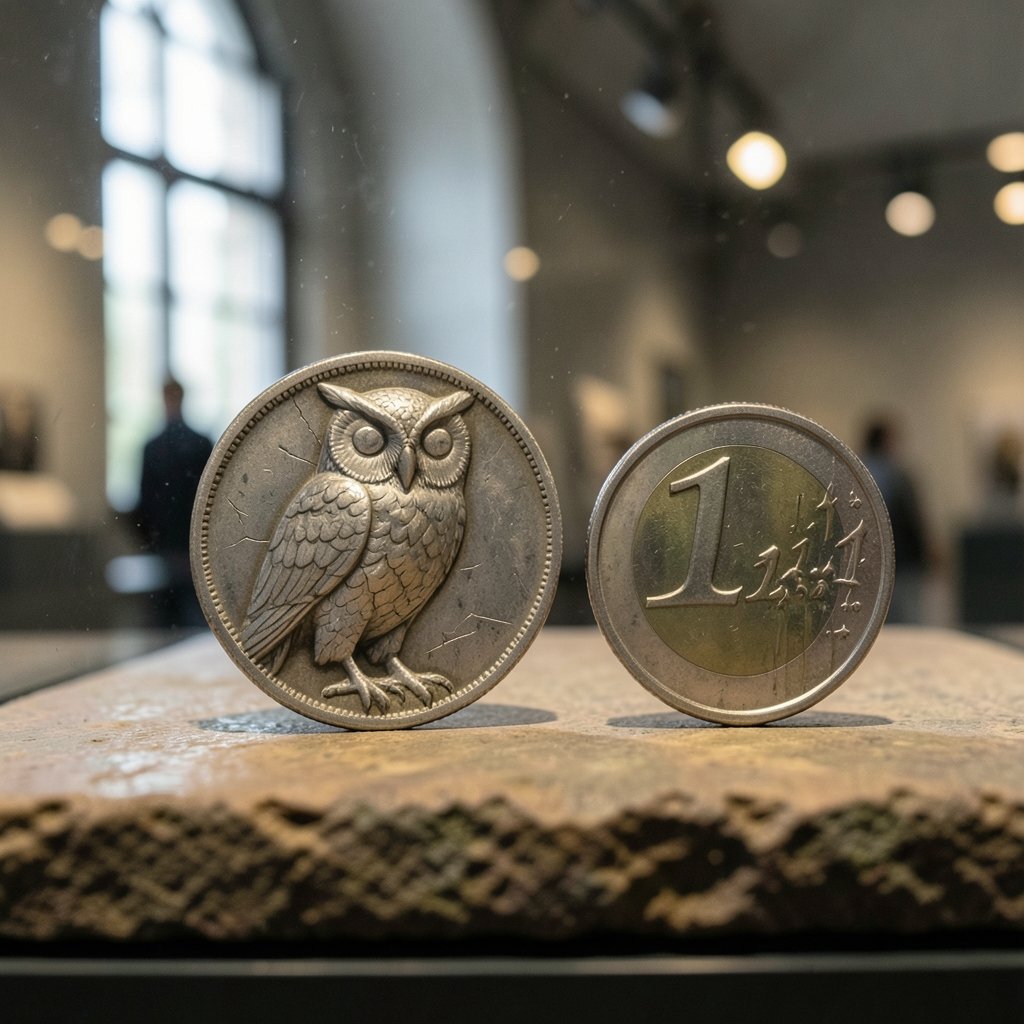
Greece used money early and helped invent the idea in the Western world. Ancient Greek city-states minted silver coins, and the Athenian owl became one of the most recognizable designs in antiquity. That owl still appears today, on the Greek 1-euro coin, a small piece of continuity between the temple and the till.
The word drachma carries that history in its syllables. A drachma was originally a handful of obols, and the term survived for more than two thousand years as the name of the national currency. Few currencies can claim that kind of run.
For readers who want the full etymology and the coin’s long history, the Encyclopaedia Britannica entry on the drachma covers both the ancient unit and the modern currency.
How Greece Joined the Euro
Joining the euro was a national project, not a technical formality. Greece wanted the credibility, the low inflation, and the sense of belonging that came with the single currency. The government tightened fiscal policy, and in 2001 the country was admitted.
The mechanics were straightforward on paper. The Bank of Greece became part of the Eurosystem, and monetary policy for Greece moved to the European Central Bank. That means interest rates in Athens are set in Frankfurt. A country inside the euro area gives up its own monetary policy, which is fine in good times and painful in bad ones.
The cash changeover in 2002 was a massive logistical exercise. Dual pricing, conversion calculators, and banknote distribution had to happen fast. The European Central Bank’s account of the euro cash changeover explains how the swap worked across member states, including Greece’s fixed rate.
The Statistics Problem That Changed Everything
Here is where the story turns. In 2004, the statistical office of the European Union reported that Greece had under-reported its deficit figures. The country’s statistics were subsequently revised. Budget numbers that had looked acceptable at entry looked much worse in hindsight, and trust in Greek fiscal data never fully recovered.
This matters for anyone trying to understand the crisis. The problem was not only debt. It was also measurement. Markets price risk based on numbers, and when the numbers are wrong, the repricing is brutal. Greece’s fiscal statistics became a case study in why independent statistical agencies matter. Eurostat publishes government finance statistics for all member states, and the Greek revisions are part of that public record.
The Debt Crisis: 2009 to 2018
The Greek government-debt crisis began in late 2009. In October 2009, the newly elected government revised the projected 2009 deficit sharply upward, and market confidence collapsed. Borrowing costs jumped. The country could no longer fund itself at sustainable rates.
What followed was a decade of bailout programmes, austerity, and negotiation. Greece received three international programmes. The first was agreed in May 2010 with the European Union and the International Monetary Fund. The second came in 2012. The third was agreed in 2015, and it ended in August 2018. The European Stability Mechanism keeps an official record of Greece’s assistance programmes, including the conditions attached to each one.
The human side was severe. Pensions were cut. Wages fell. Youth unemployment climbed above 50 percent at its peak. Shops closed. Young graduates left for Berlin, London, and Melbourne. A country that had spent decades converging with Western Europe reversed direction.
Capital Controls and the Week the Banks Closed
In June 2015, after bailout negotiations broke down, Greece introduced capital controls. Banks were closed for weeks. ATM withdrawals were capped, and money could not easily leave the country. For ordinary people, this was the most tangible moment of the crisis. Queues at cash machines became the defining image.
The controls were gradually lifted, and they were fully removed by 2019. The episode is a reminder that money is not only a unit of account. It is also a promise that you can move your own funds when you want to. When that promise weakens, trust weakens with it. The Bank of Greece, the country’s national central bank, documented the banking-sector stress and the slow return to normal.
Anyone running a household or a business should understand how quickly access to cash can change. The same logic shows up in modern fraud, where scammers rely on urgency and confusion. A gift card scam works because victims rarely get their money back once the codes are shared, which is why pressure tactics deserve suspicion whether the crisis is national or personal.
What Greek Money Looks Like Today
Greece uses the euro like the other members of the euro area. The European Central Bank sets monetary policy, and the Bank of Greece implements it at home. Greek euro coins carry national designs on one side, and the owl on the 1-euro coin is the most famous of them. The European Central Bank’s guide to euro coins explains how national sides work across the currency union. (Euro)
Day-to-day money in Greece looks much like money anywhere in the eurozone, with a few practical wrinkles worth knowing.
| Situation | What to expect | Practical tip |
|---|---|---|
| Cards in cities | Widely accepted in Athens, Thessaloniki, and tourist areas | Carry a card and a backup card |
| Small islands and villages | Some tavernas and shops prefer cash | Keep 50 to 100 euros in small notes |
| ATMs | Common, but fees vary by bank | Use bank ATMs, not standalone machines |
| Tipping | Not mandatory, but appreciated | Round up or leave 5 to 10 percent |
| Taxis | Often cash, sometimes card | Ask before the ride starts |
Greece has also pushed hard toward digital payments since the crisis. Card acceptance expanded quickly, partly because tax rules encouraged it. For visitors, that means fewer cash-only surprises than a decade ago, though remote areas still reward preparation.
Lessons From Greek Money for Households and Businesses
The Greek experience offers several practical lessons that apply far beyond the Aegean.
Currency risk is real, even inside a union. Greece could not devalue its way out of trouble because it no longer had its own currency. That removed one tool and made internal adjustment, meaning wage and price cuts, the only path. Countries and households that borrow in a currency they cannot print face the same asymmetry.
Statistics and records matter. The 2004 revisions showed how fragile confidence becomes when the numbers are unreliable. The same principle applies to personal finance. Keep clean records, and do not rely on optimistic projections you cannot defend.
Access to liquidity is a form of security. Capital controls showed that bank balances can become partially frozen overnight. Keeping some cash and some funds outside a single institution is a basic hedge. The full cost picture of identity fraud and account takeover is worth understanding, since identity threat detection really costs where money goes when a breach forces a rebuild of accounts and trust.
Recovery takes years, not months. Greece returned to international bond markets in 2017 and 2018, and it exited its final bailout in 2018. Growth returned. But the social scars, from emigration to low birth rates, outlasted the bond yields. The Public Debt Management Agency tracks the country’s borrowing and debt profile if you want the numbers.
How Greece Rebuilt Its Finances
The comeback was unglamorous. Greece cut spending, raised taxes, reformed pensions, and sold state assets. It also cleaned up its statistical service and strengthened budget reporting. Creditors demanded institutional changes as well as fiscal ones.
By the late 2010s, the primary budget was in surplus, and the debt profile had been stretched with longer maturities and lower interest rates. The country’s credit rating improved gradually. Tourism broke records. Shipping remained strong. The economy diversified into technology and logistics, though wages stayed below pre-crisis levels for years.
The euro area also changed. Banking union, the European Stability Mechanism, and stricter fiscal rules were partly responses to what happened in Greece. Whether they are enough is still debated, but the architecture is different from the one that failed in 2010.
The Future of Greek Money
Greece’s monetary future is tied to the euro area’s. That means the digital euro project matters for Greek households, even if the details are still being settled. A central bank digital currency would be a claim on the central bank rather than a commercial bank, and it raises questions about privacy, bank funding, and offline payments. The debate over how a CBDC digital currency works and what central bank money going digital means for ordinary savers is worth following, because Greece would adopt whatever the euro area agrees.
Cash is also part of the picture. Greece has a strong cash culture, especially outside the cities, and any move away from notes will be gradual. For now, the euro note in your wallet is the same in Athens as in Lisbon.
For younger Greeks, money is increasingly about side income and digital work. The question of how to make money with AI is not abstract in a country with high youth unemployment and a large freelance sector. Remote work has become a genuine export industry. The broader question of how AI companies make money shapes which tools stay affordable and which disappear. (Identity threat detection really costs where money goes)
Businesses in Greece face the same automation decisions as everywhere else. The trick is to use AI business automation without wasting money on tools that never pay back. Start with one process, measure the result, and expand only if the numbers hold up. That discipline is the same one the Greek state had to learn the hard way.
Conclusion
Greek money has been through more in twenty-five years than most currencies see in a century. It began as the drachma, a name older than democracy, and became the euro at a fixed rate of 340.750 to one. It survived a statistics scandal, three bailouts, closed banks, and capital controls. It came back through budget discipline, institutional reform, and a lot of patience.
The practical takeaways are simple. Keep records you can trust. Hold some liquidity outside a single institution. Understand the currency you borrow in. And remember that confidence, once broken, is the hardest thing to rebuild. Greece learned that lesson in public. The rest of us can learn it for free.
Frequently Asked Questions
What currency does Greece use now?
Greece uses the euro. The euro became the country’s currency on 1 January 2001, and euro notes and coins entered circulation on 1 January 2002. The drachma is no longer legal tender.
What was the exchange rate from drachmas to euros?
The fixed conversion rate was 1 euro = 340.750 drachmas. It was locked at entry and did not float, so the rate is the same for any conversion done during the changeover period.
Can I still exchange old drachma notes?
Drachma banknotes generally can no longer be exchanged for euros, though some coin exchange arrangements ran for a limited period. Treat old drachma notes as collectibles rather than spending money, and check with the Bank of Greece before assuming any exchange is possible.
Why did Greece need bailouts?
Greece needed bailouts because it could not borrow at affordable rates after late 2009, when the newly elected government revised its projected deficit sharply upward and market confidence collapsed. The country received three international programmes, agreed in 2010, 2012, and 2015, with the last ending in August 2018.
What were the Greek capital controls?
Capital controls were limits on moving money out of Greece, introduced in June 2015 after bailout negotiations broke down. Banks closed for weeks and ATM withdrawals were capped. The controls were gradually lifted and fully removed by 2019.
Is Greek money safe for travelers and savers?
For travelers, Greek money is as safe as any euro-area currency, with normal precautions about pickpockets and card skimming. For savers, the main lesson from the crisis is diversification. Keep funds across more than one institution and hold some cash for emergencies, because access can change faster than most people expect.



