

What if the quarter rattling around in your junk drawer is worth more than the coffee it could buy? That happens more often than most people think, but not nearly as often as social media would have you believe. The coin world is full of stories about rare quarters worth money, and a few of them are true. Most are not. (Best games nintendo switch 2 whats worth your time money) (Quarter (United States coin)))
The trick is learning to tell the difference between a coin that is genuinely scarce and one that simply looks old. Age, silver content, mint mark, condition, and errors all play a role. Get those factors straight and you can sort a jar of quarters in an afternoon instead of paying someone to tell you what you already own.
Why Some Quarters Are Worth More Than 25 Cents
A quarter’s value comes from three separate forces, and they don’t always move together.
The first is melt value, the worth of the metal inside the coin. The second is numismatic value, the premium collectors pay for scarcity and condition. The third is demand, which can shift with fashion, news coverage, and the number of people actively building sets.
A coin can be rare and still cheap if nobody wants it. A coin can be common and still expensive if it sits in flawless condition. That distinction trips up almost every beginner.
The Silver Divide: 1964 and 1965
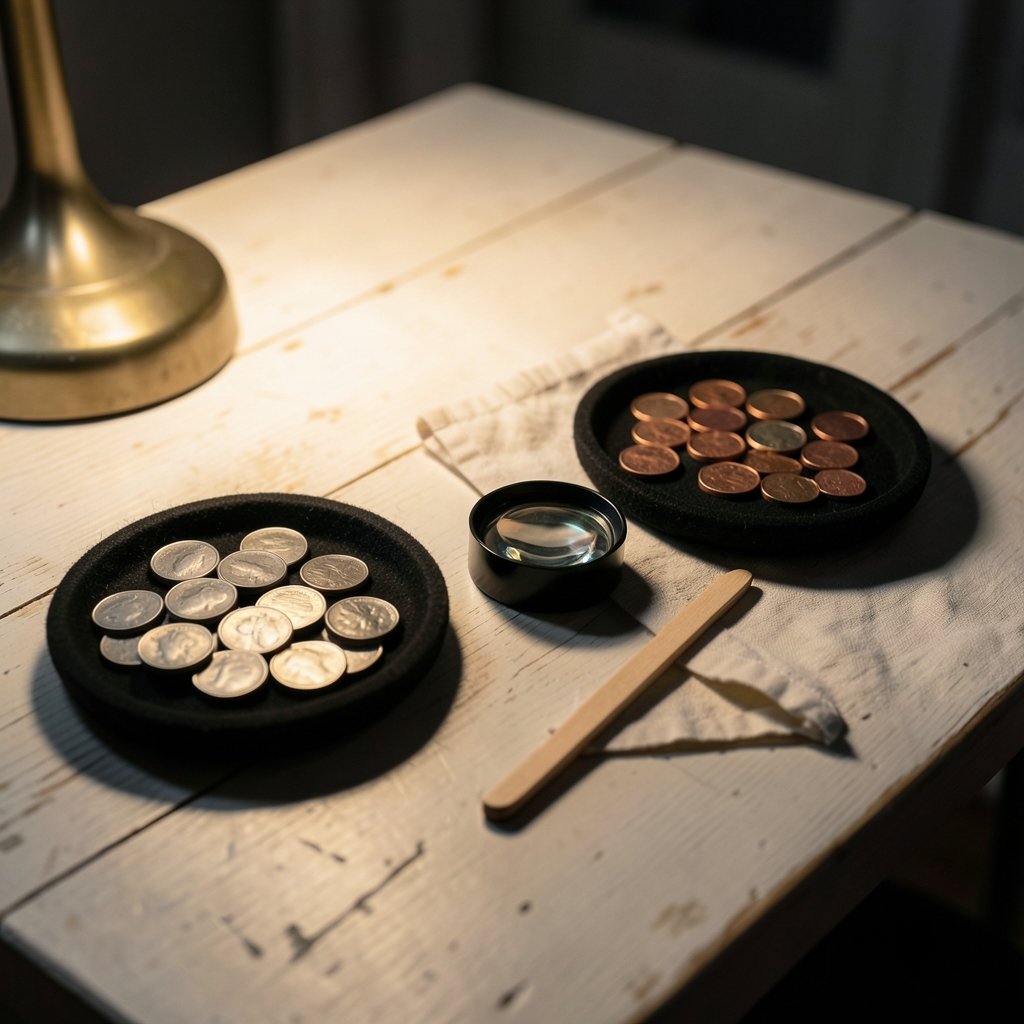
Quarters minted from 1932 through 1964 are 90% silver and 10% copper. Each one contains about 0.18084 troy ounces of fine silver. Starting in 1965, the composition switched to clad copper-nickel, which has essentially no melt value.
This single fact creates the first useful filter. Any silver quarter is worth at least its metal content, which floats with the spot price. Any clad quarter from 1965 onward is worth face value unless it carries a specific collector premium.
The practical takeaway: sort by decade first. Silver on one side, clad on the other. Then look for the dates and mint marks that matter.
The Key Dates: 1932-D and 1932-S
The Washington quarter debuted in 1932 to mark the 200th anniversary of George Washington’s birth. The Philadelphia mint struck millions. Denver and San Francisco struck far fewer.
The 1932-D quarter saw roughly 436,800 pieces leave the press. The 1932-S saw about 408,000, making it the lowest-mintage regular-issue Washington quarter. Both are considered key dates, the coins that complete a set and therefore command the strongest demand.
In circulated grades, these two coins regularly sell for well over face value, and the gap widens fast as condition improves. A worn example and a crisp uncirculated example of the same date can differ by thousands of dollars.
Here’s where beginners go wrong: they assume any 1932 quarter is a jackpot. A 1932-P is common. The mint mark, a small letter on the reverse below the wreath, is what separates a nice find from a genuinely valuable one. Buy a cheap loupe. Learn where that letter sits. It takes five minutes and saves a lot of disappointment.
Bicentennial Quarters Are Not Rare
The dual-dated 1776–1976 Bicentennial quarter is the most misunderstood coin in America. More than 1.6 billion were struck across the Philadelphia and Denver mints. That is not a rarity. That is one of the largest production runs in U.S. history.
People save them because the design looks different, with the colonial drummer boy on the reverse. Sentiment is fine. Value is not. A circulated Bicentennial quarter is worth 25 cents.
The exception is the 40% silver collector version sold in special mint sets, which carries modest silver value. Even those aren’t scarce. If someone offers to buy your Bicentennial roll for a premium, ask why.
Standing Liberty and Barber Quarters
Older series produce the real rarities, and they’re often found in inherited collections rather than pocket change.
The Standing Liberty quarter ran from 1916 to 1930. The 1916 issue is a key date, and the 1918/7-S overdate, where a 7 is visible under the 8, is a famous variety. Both are heavily counterfeited and heavily altered, so authentication matters more than the asking price.
The Barber quarter ran from 1892 to 1916. The 1901-S is usually cited as the key date, with the 1892-S close behind. These coins are old enough that most survivors are worn, and high-grade examples are genuinely rare.
If you inherit one of these, resist the urge to clean it. Cleaning strips the original surface and can cut value by half or more. Collectors pay for originality, and a bright, scrubbed coin screams “I ruined this.”
Errors and Varieties: Real Money, Real Risk
Mint errors can add serious value. Doubled dies, off-center strikes, wrong-planchet strikes, and broadstrikes all have devoted collector followings.
The problem is the market. For every genuine error, there are dozens of damaged coins listed as errors by sellers who don’t know better or do know better and don’t care. A coin that took a hit from a lawnmower is not an error. A coin with a blob of solder on it is not a mint mistake.
The safeguard is third-party grading. Reputable services examine a coin, attribute the variety, assign a grade, and seal it in a holder. That holder is what buyers trust. Without it, you’re asking a stranger to take your word for it.
Grading standards themselves are worth understanding before you spend money. The Sheldon scale runs from 1 to 70, and the difference between a 60 and a 65 can be a five-figure swing on a key date. Learning the basics of how graders evaluate strike, surface, and luster is the highest-return hour a new collector can invest. (Gift card scam works victims rarely get their money back)
How Grading Changes Everything
Two coins with the same date and mint mark are not the same coin. Grade is the multiplier.
| Grade | Typical Description | Effect on a Key Date |
|---|---|---|
| About Good 3 | Heavily worn, date barely readable | Lowest collector tier |
| Very Good 8 | Design outlines visible, major detail gone | Modest premium |
| Fine 12 | Moderate wear, lettering clear | Solid mid-range value |
| Very Fine 20 | Light wear on high points | Strong premium |
| Extremely Fine 40 | Sharp detail, minor wear only | Large premium |
| Mint State 60+ | No circulation wear, full luster | Highest tier, widest spread |
The lesson is simple. Before you accept any offer, know the grade. A dealer quoting a price for a “worn 1932-D” and a “Mint State 1932-D” is quoting two completely different markets. Ask which one you have.
Where to Check Real Values
Published price guides are estimates, not offers. They’re a starting point, not a paycheck.
The most reliable signals come from auction records and sold listings, not asking prices. Anyone can ask $500 for a common quarter. What matters is what buyers actually paid, for a coin in a specific grade, on a specific date.
A practical routine works well:
- Identify the date and mint mark with a loupe.
- Check the metal content and whether the coin is silver.
- Look up recent sold prices for that exact date, mint mark, and grade.
- Compare at least three sold listings before forming an opinion.
- If the coin seems valuable, get it authenticated before selling.
That last step is where people lose money. Skipping authentication to save a fee can cost far more than the fee itself.
Common Mistakes That Cost People Money
Mistake one: trusting the word “rare.” Marketplace listings use “rare” as a marketing word. It means nothing without a mintage figure and a grade.
Mistake two: cleaning coins. Already covered, but it bears repeating. Don’t.
Mistake three: ignoring the mint mark. The same date can be common or scarce depending on a single letter.
Mistake four: confusing asking price with sold price. One is a wish. The other is data.
Mistake five: buying without a return policy. If a seller won’t accept returns on a raw coin, that tells you something.
Mistake six: storing coins in PVC holders. Soft plastic containing polyvinyl chloride can leach onto coin surfaces over years and leave permanent green residue. Use inert holders.
Building a Realistic Collecting Strategy
If the goal is enjoyment plus reasonable value retention, focus on key dates in mid-grade condition. They’re liquid, well-documented, and easier to resell than exotic varieties. (Apportionment)
If the goal is speculation, understand that you’re competing with full-time dealers who see thousands of coins a month. The odds are not in your favor, and that’s worth saying plainly.
If the goal is simply sorting an inherited jar, start with silver. Pull every pre-1965 quarter, then check mint marks on the 1932s, then look at anything older than 1932. That sequence finds most of the value in under an hour.
Collectors who track their spending the way they’d track any hobby budget tend to stay in the game longer and enjoy it more. The same discipline that makes a budgeting app useful applies to coin buying, and the comparison between zero-based budgeting and net-worth tracking is a useful frame for anyone deciding how much to sink into a collection.
What Actually Sells
Liquidity matters as much as rarity. A rare coin with a thin market can sit unsold for months.
The most liquid quarters are key dates in recognized grades, sealed by major grading services. Next come common silver quarters, which sell instantly at melt value. Least liquid are raw, unattributed oddities that require a specialist buyer.
If you’re buying, ask yourself who you’d sell to. If the answer is “nobody I can name,” reconsider.
Conclusion
Rare quarters worth money do exist, and the list is shorter than the internet suggests. The 1932-D and 1932-S Washington quarters, key-date Standing Liberty and Barber issues, and authenticated errors are where the real premiums live. Bicentennial quarters, common silver, and most “rare” listings are not.
The work is unglamorous: check the mint mark, confirm the metal, learn the grade, compare sold prices, and get anything valuable authenticated. Do that, and you’ll avoid the two classic outcomes, overpaying for a common coin and giving away a scarce one for face value. Start with the jar on your dresser. You might be surprised, and you’ll definitely be better informed than you were an hour ago.
Frequently Asked Questions
Are Bicentennial quarters worth anything?
Almost nothing beyond face value in circulated condition. More than 1.6 billion were minted, so they are extremely common. The 40% silver collector versions carry modest metal value, but they are not rare either.
What is the rarest Washington quarter?
The 1932-S has the lowest mintage of any regular-issue Washington quarter at roughly 408,000 pieces, with the 1932-D close behind at about 436,800. Both are key dates that command strong premiums, especially in higher grades.
How can I tell if a quarter is silver?
Check the date. Quarters dated 1964 or earlier are 90% silver. Those from 1965 onward are clad copper-nickel. The edge can also help: silver quarters have a solid look, while clad quarters show a copper core line.
Should I clean an old quarter before selling it?
No. Cleaning removes the original surface that collectors pay for and can cut value dramatically. Leave the coin as it is and let a grading service evaluate it in its natural state.
Is a 1965 quarter worth money?
Generally no. 1965 was the first clad year, and those quarters are worth face value in circulated condition. The exception would be a specific mint error, which requires authentication to confirm.
How do I know if a quarter error is real?
Get it attributed by a reputable third-party grading service. Genuine errors are documented and sealed in a holder. Damage, post-mint alterations, and solder marks are frequently misrepresented as errors by inexperienced or dishonest sellers.



