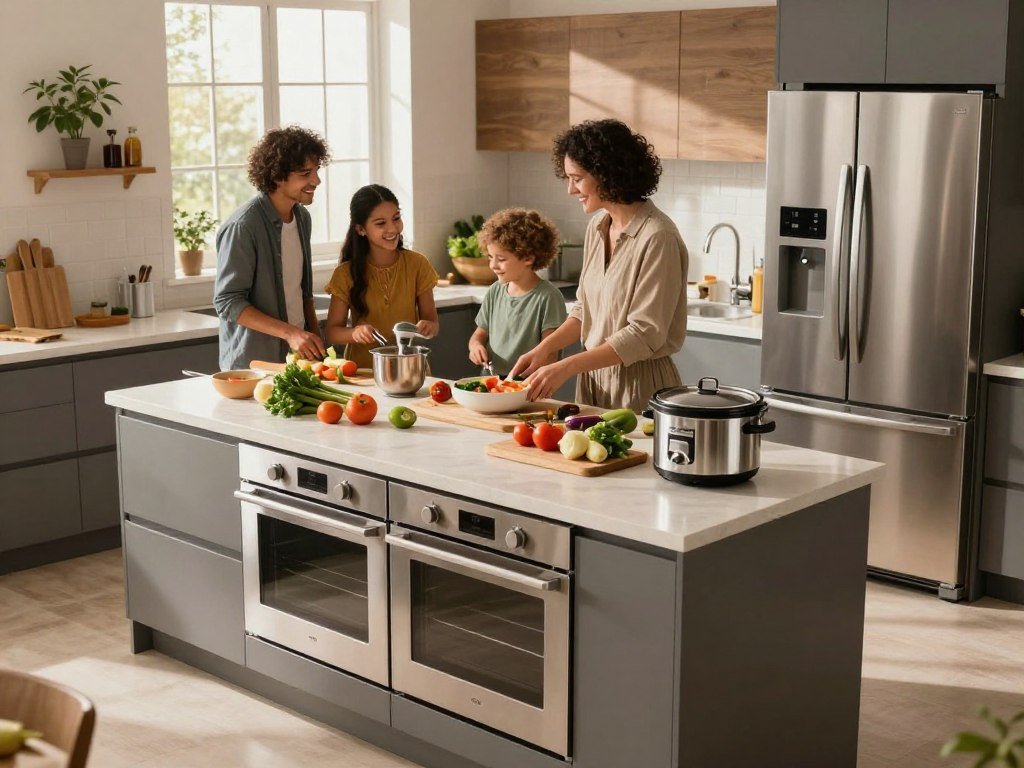
The right mix of home appliances starts with the rooms you use, the space available, and the tasks you want to make easier. Your household needs may change with room size, daily routines, and the utility connections in your home. A product that suits one family may not work well in another.
Predicted reliability is an estimate of how a new model is expected to hold up during its first five years of use. It can help you compare choices, but it cannot promise how a specific unit will perform in your home. Think of it as one way to weigh a purchase alongside fit, features, and cost.
Good choices can make everyday routines easier and support home comfort without adding features you will rarely use. You can compare product types and functions without treating one brand as the right choice for every household. Start with the room and task that matter most to you.
Key Takeaways
- Start with a household task that needs help.
- Measure the space and check utility connections.
- Compare models within the same appliance type.
- Check exact product details and delivery terms.
- Unplug idle devices only when they can safely lose power.
Begin with the category that solves your most immediate household need.
Which Home Appliances Belong in a Complete Home?
A practical home inventory can include food storage, cooking, dishwashing, laundry, and room cooling. Your home does not need every appliance category; choose products based on real tasks and available space.
Some major appliances handle daily needs, while others suit a specific room or routine. This appliance list offers ten familiar examples, not a required set for every household.
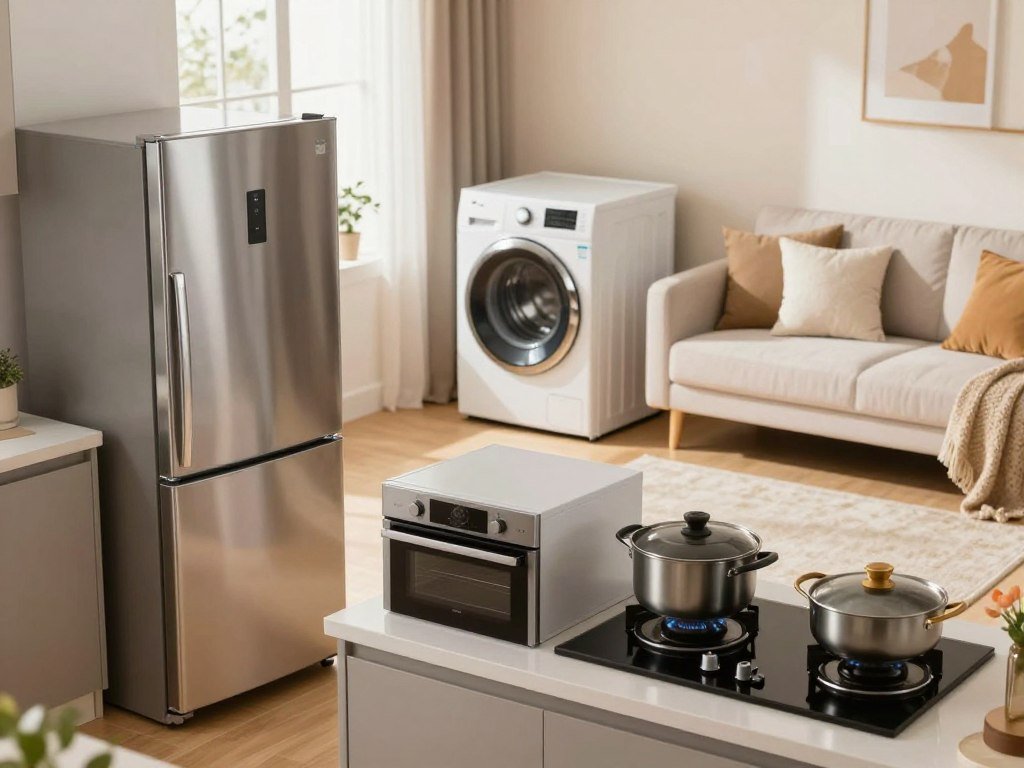
Buy only what serves a real household task or space need. A complete home does not need every appliance type.
Kitchen food storage and cooking
Refrigerators and freezers keep fresh and frozen food close at hand. Cooking choices often depend on how you prepare meals, the room’s layout, and the fuel or power available.
Kitchen categories include ranges, cooktops, wall ovens, and microwaves. Dishwashers handle cleanup, while compact refrigerators can add cold storage where a full-size unit will not fit.
The Q2 2026 U.S. major-appliance category includes ten types, from refrigerators and washers to built-in ranges. You can see the major-appliance category list for more examples across the home.
Laundry and room comfort
A washer and dryer may stand side by side, stack, or share one vertical footprint in a laundry center. Air conditioners cool rooms, while freezers provide extra storage for food.
Air conditioners and other comfort products can also shape everyday routines. A smart thermostat may help manage home comfort, but its fit depends on your HVAC system and wiring; see this beginner’s guide to smart home devices.
Supporting appliances for cleaning and storage
Other product categories include ice makers and compact refrigerators. Some homes use these to meet a specific storage or serving need, while others have no use for them.
One range combines cooking elements and an oven, so its functions can overlap with separate products. These five pairs give you exactly ten everyday examples:
- Refrigerator and freezer
- Range and microwave
- Dishwasher and cooktop
- Washer and dryer
- Air conditioner and oven
Use the pairs as examples, not as a required shopping checklist. Add a product to the list only when it serves a real household task or space need.
How Do You Choose Appliances That Fit Your Home?
A refrigerator can fit its width measurement and still block a walkway when its depth or door swing is overlooked. Measure the whole route, then match the product to your room, hookups, and daily use.
Check width, height, depth, door swing, delivery access, and every required connection before ordering. Electrical, gas, venting, and water needs vary by appliance and model.
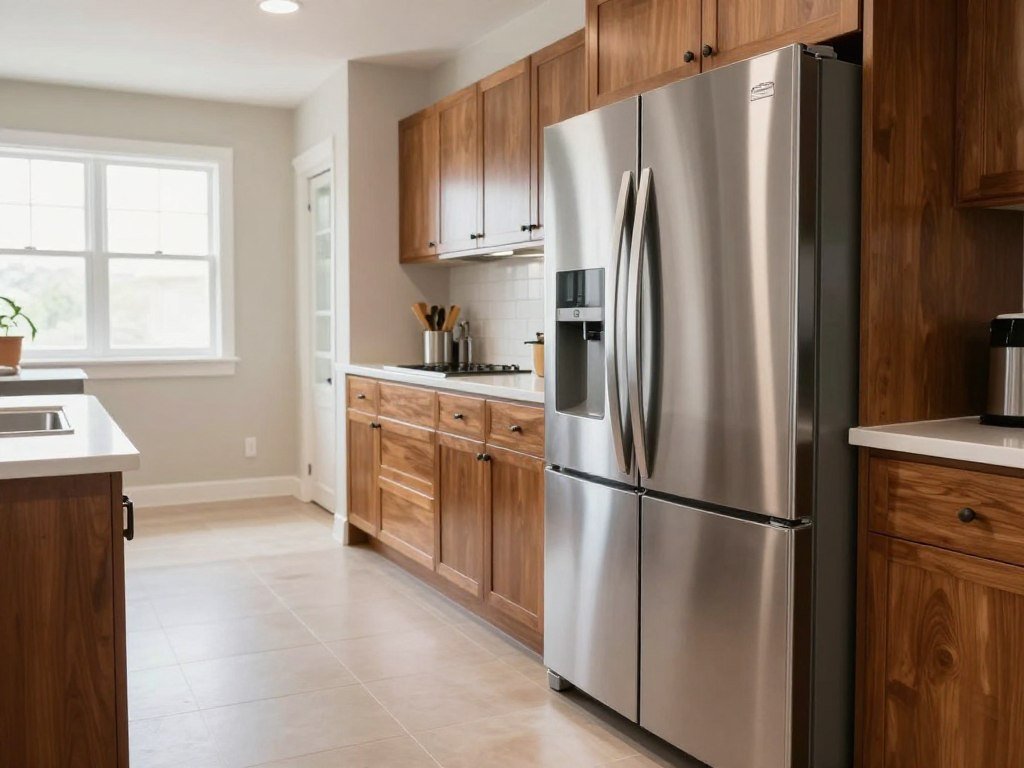
Check openings, depth, and utility connections
Measure the opening, then note nearby counters, cabinets, walls, and handles. Include the space needed for doors to open and for people to pass through.
Measure the path from the entrance to the final room, including tight turns and stairways. A delivery crew needs a clear route for the appliance, not just an open space at its destination.
A home appliance store near me can help you inspect controls and finishes in person. Confirm local availability before making the trip, since the display model may not be ready for delivery.
Buying home appliances online works best when the exact model number, dimensions, delivery terms, and installation needs are clear before checkout. Check the listing against the space and utility connections you measured.
For home appliances such as a washer and dryer, compare capacity, depth, door swing, venting, and hookups. A matching pair may still be too deep or need different connections than your room provides.
Compare refrigerator and laundry formats
Refrigerator features can change how a model fits and works. Counter-depth units sit closer to cabinets, while standard-depth models extend farther into the room.
The Bosch 800 Series B36CT80SNS is counter-depth, with separate compressors and evaporators for its refrigerator and freezer. The Bosch 500 Series B36FD52SNS is a 36-inch French-door model with standard-depth sizing and one compressor and evaporator.
The refrigerator testing results report produce-moisture retention and cooling-cycle noise for these models and the Samsung Bespoke RF30BB6200QL.
| Model | Produce moisture retention | Cooling-cycle noise |
|---|---|---|
| Bosch 800 Series B36CT80SNS | 97.4% | 36.6 dBA |
| Bosch 500 Series B36FD52SNS | 97.2% | 34.5 dBA |
| Samsung Bespoke RF30BB6200QL | 92.5% | 38.1 dBA |
Those figures are performance measurements, not reliability ratings. The GE GTS22KGNRWW has a top-freezer layout and measured 93.1% produce-moisture retention.
Laundry capacity matters too, especially when you wash bulky loads or have limited floor space. The 24-inch Whirlpool WET4024HW laundry center combines a 1.6-cubic-foot washer and a 3.4-cubic-foot dryer.
Compare laundry formats and their trade-offs in this washer and dryer buying guide. Confirm the delivery route and every required hookup before placing the order.
Which Appliance Brands Have the Fewest Problems?
Reliability findings are most useful when they match the appliance type and the way problems were measured. GE had the fewest owner-reported problems in the cited front-load and top-load washer segments; KitchenAid led for dishwashers, with Bosch and GE close behind.
Compare each brand within the same appliance type and measurement. The best home appliances are models that suit your household and perform well in their exact category.
Compare reliability within the same appliance type
Predicted reliability estimates how a new model may hold up during its first five years. Owner-reported problems count issues reported by people who own the product, while repair-call records describe service work.
Refrigerator reliability should be compared across five formats: top-freezer, bottom-freezer, French-door, side-by-side, and built-in. A 2026 survey covered 85,290 refrigerators with icemakers bought new between 2016 and 2026.
These findings do not make one brand the winner across every product. The side-by-side refrigerator guide also separates model fit and test results from owner satisfaction.
In the 2025 U.S. Appliance Reliability Study, dryers and cooking appliances had 56 problems per 100 units, the lowest rate among appliance categories. KitchenAid dishwashers had the fewest owner-reported problems, with Bosch and GE close behind.
For kitchen products, Consumer Reports’ predicted-reliability rankings use surveys of 252,640 kitchen appliances bought new between 2015 and 2025.
Read brand and service figures in context
First-year service rates count service during the first year after sale, not lifetime failures. In a 2026 study of 33,190 first-year service calls, Speed Queen had a 3.7% rate, LG had 5.5%, and Miele had 7.4%.
Sharp, Gaggenau, Bosch Benchmark, GE Profile, LG Studio, Bosch, Signature Kitchen Suite, and GE Appliances each had rates below 10%. These results cover brands sold and serviced in Greater Boston, Cape Cod, and Southern New Hampshire.
From January 2023 to October 17, 2026, 68,864 service calls were recorded, with a brand listed for 34,756. In refrigerator repair records, compressor work made up 9.8% of LG calls, compared with 2.3% to 3.1% for Samsung, GE, Whirlpool, and Frigidaire.
Match common breakdowns to the appliance
Repair-call patterns can point to issues worth checking, but they are not per-unit failure rates. The table shows reported issues among more than 381,000 appliances bought between 2008 and 2018.
| Appliance category | Reported issue | Reported share |
|---|---|---|
| Refrigerator | Dispenser stopped; ice maker stopped | 17%; 13% |
| Dishwasher | Poor cleaning; poor drying; poor draining | 11%; 9%; 7% |
| Washer | Front-loader door mold; drum; draining | 14%; 6%; 5% |
| Dryer | Incomplete drying; faulty rollers, motors, or belts | 10%; 7% |
| Cooking | Burner or cooktop element fails; oven will not heat | 6%; 6% |
Other refrigerator reports included ice buildup at 7%, water leakage at 6%, and no cooling at 5%. Samsung refrigerator calls included ice-maker problems in 21.7% of cases, compared with 11.3% for GE.
For a refrigerator with the fewest problems, compare predicted reliability within its specific format instead of guessing from call shares. Avoid a blanket brand blacklist; reported component patterns are prompts to check an exact model and its service terms, not proof of a brand-wide defect. Check the warranty and repair support for the exact model before choosing between close category matches.
What Should You Unplug to Reduce Standby Power?
Unplug idle electronics that do not need to stay connected, but leave essential monitoring functions powered. Standby power is electricity used by connected devices while they are idle.
Standby power accounts for an estimated 5%-10% of residential energy use and could cost an average American household as much as $100 per year. Those are broad estimates, not a bill prediction for every home.
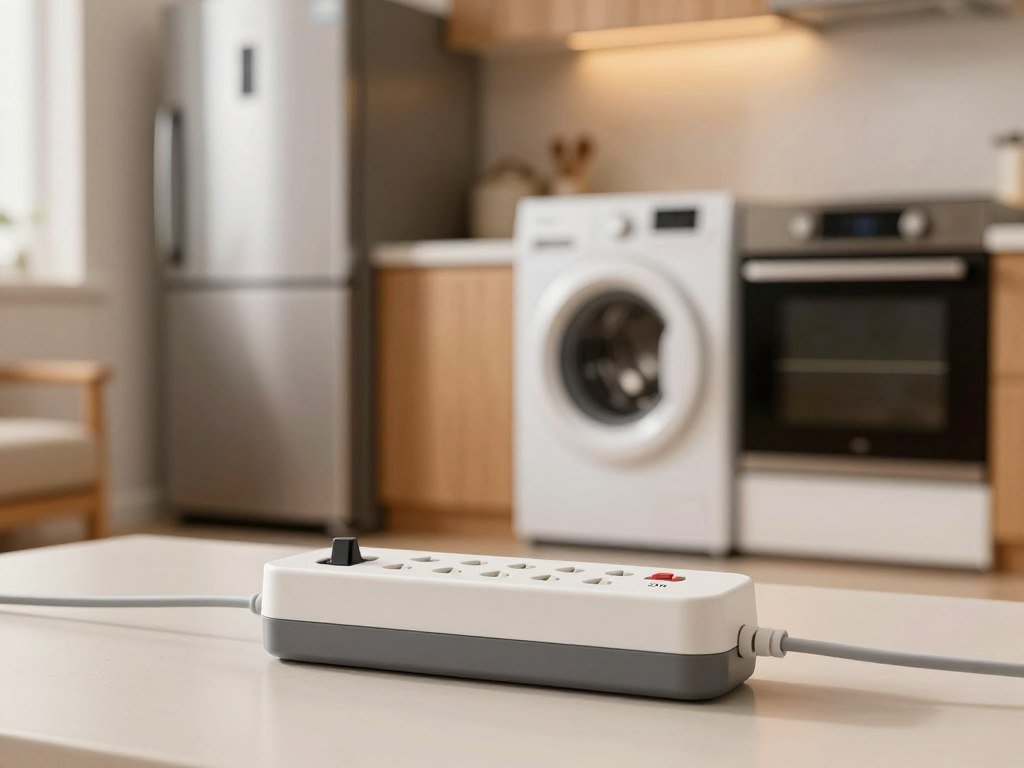
Keep power running to functions that protect food or preserve settings. Check what each device loses before cutting power to a group of electronics.
The right choice depends on what needs a live connection and what you can safely switch off. Use these four ways to reduce or measure standby power:
- Use a switched power strip for grouped electronics.
- Unplug devices that do not need to remain connected.
- Choose ENERGY STAR-certified products.
- Use a watt meter to measure standby draw.
A switched power strip lets you turn off several connected devices at once. Group electronics that can lose power together, and keep devices with needed functions on a separate outlet.
A watt meter can show how much energy a connected device uses while idle. Check one device at a time so you can see which items draw power without guessing.
ENERGY STAR-certified products can help reduce energy use. Look at the specific product label when comparing choices, since the mark does not mean every device uses power in the same way.
Refrigerators need power for temperature monitoring, so unplugging one can interrupt that function. A clock or saved setting on another device may also reset when power is removed.
Some electronics can remain plugged in without needing a live connection while idle. Others may need power for monitoring, an internal clock, or saved settings.
Before switching off a power strip, check that each attached device can safely lose its clock and saved settings.
Conclusion
A good purchase starts with a clear household need and a model that fits the home. Pick one category, then shortlist models that match your available space and everyday routine.
Check the exact model details, delivery terms, and installation requirements before ordering. Those final checks can prevent a product from arriving that cannot fit or connect where you need it.
Pick the category you need first, then compare exact models and confirm the final fit before checkout.
FAQ
What are examples of home appliances?
Ten everyday examples are a refrigerator, freezer, range, microwave, dishwasher, cooktop, washer, dryer, air conditioner, and oven. These cover food storage, cooking, dishwashing, laundry, and room cooling. A range combines cooking elements with an oven, so you may not need both a range and a separate oven. Choose the types that serve your home’s actual tasks.
What should you unplug when not in use?
Unplug devices that do not need a live connection, such as idle electronics that can safely lose power. Keep a refrigerator connected because it needs power for temperature monitoring. Some clocks or saved settings may reset when you unplug a device, so check those functions first. A switched power strip can make it easier to turn off suitable electronics together.
What is the most reliable brand of home appliances?
GE led the cited front-load and top-load washer segments for owner-reported problems, while KitchenAid led dishwasher results. Bosch and GE were close behind KitchenAid for dishwashers. These findings apply to specific appliance categories, not every product a brand makes. Compare predicted reliability and owner reports for the exact type you plan to buy.
What appliance breaks down the most?
In the breakdown reports, a refrigerator water or ice dispenser stopping work was the most common individual issue, at 17%. That figure describes the share of reported issues, not the failure rate for all refrigerators or appliances. Ice makers no longer making ice came next among the listed refrigerator issues, at 13%. A repair-call share cannot show how often each unit fails.
What are the refrigerator brands to avoid?
Avoid using a blanket blacklist based on repair-call shares. Compressor work accounted for 9.8% of LG refrigerator calls, compared with 2.3%-3.1% for Samsung, GE, Whirlpool, and Frigidaire. Those call patterns are not per-unit failure rates and do not prove a brand-wide defect. Check predicted reliability within the refrigerator format you want, then review the exact model’s service terms.
What brand of appliance lasts the longest?
No problem-count ranking proves which brand lasts the most years. Such rankings track reported issues or service, not the full lifespan of every appliance. Compare category-specific reliability with the warranty, maintenance needs, and repair support for the model you are considering. A brand that performs well in one category may not lead in another, so avoid treating one name as a universal answer.