
A fixed monthly payment can make a one-time home project easier to budget for, but the rate and loan term determine what that payment costs. Your actual offer depends on your credit, equity and loan terms. This page helps you estimate payments and compare offers.
Your combined loan-to-value ratio (CLTV) is your mortgage and other home-secured debt divided by your home’s value. Use a calculator to test how different amounts and terms could affect your budget before you apply.
A longer term may lower each payment, but it can keep you in debt longer. A shorter term may cost less overall, yet require a larger monthly payment. Check both the payment and the total borrowing cost as you compare options.
A useful comparison starts with the amount you need and a monthly payment your budget can support.
Key Takeaways
- Your credit, equity and loan terms shape your offer.
- Compare offers using the same loan amount and term.
- Look at APR, not just the interest rate.
- A fixed rate keeps the loan payment steady.
- Choose a payment that leaves room in your budget.
Home Equity Loan Rates: What Are Current Averages?
October 2026 averages clustered between 8.67% and 8.77% for the three surveyed loan terms. Advertised starting rates can be lower, but they are not guaranteed offers for every borrower.
The average rate is a benchmark, not a personalized quote. A home equity loan pays one lump sum, then charges a fixed rate with fixed monthly payments.
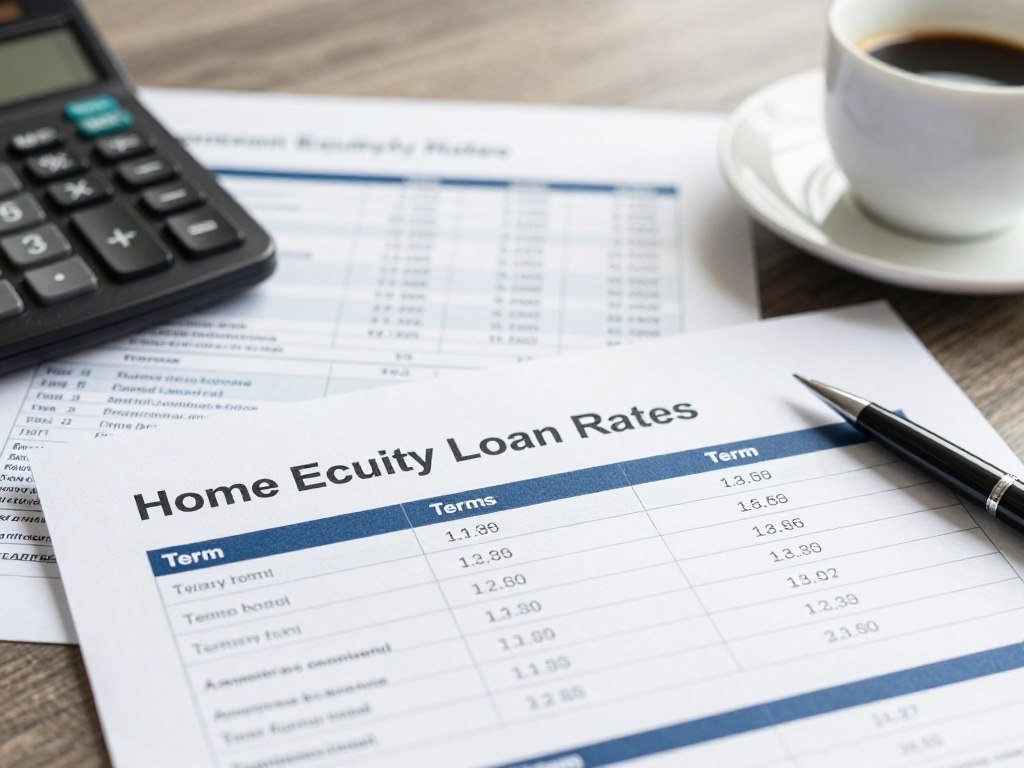
Average rates by loan term
In October 2026, the average annual percentage rate (APR) depended on the loan term. These averages used a $30,000 loan, a 700 FICO score, and 80% CLTV.
The rate survey assumed a primary, single-family detached home. Rates can differ from these averages when your loan or borrower details differ.
| Term | Average APR | Average rate range |
|---|---|---|
| 5 years | 8.67% | 6.00%-10.49% |
| 10 years | 8.77% | 6.25%-10.54% |
| 15 years | 8.76% | 6.51%-10.75% |
These figures show the average and range for surveyed loans, not a fixed annual percentage rate that every applicant can get.
Which lenders advertise the lowest starting APRs?
Fifth Third Bank advertised the lowest starting APR in this group, at 5.99%. Each lender sets its own loan amounts and terms.
| Lender | Starting APR | Loan amount | Terms |
|---|---|---|---|
| Fifth Third Bank | 5.99% | $10,000-$500,000 | 10-30 years |
| Third Federal Savings and Loan | 6.99% | $10,000-$300,000 | 5-30 years |
| Regions Bank | 7.00% | $10,000-$500,000 | 10-20 years |
| TD Bank | 7.39% | $10,000 minimum | 5-30 years |
| U.S. Bank | 7.65% | $25,000-$750,000 | Up to 30 years |
U.S. Bank lists a $1 million maximum in California. Connexus Credit Union advertised a 7.31% starting APR, a $5,000 minimum and 5-15-year terms.
Starting APRs are advertised entry points, not guaranteed offers. Compare the APR and terms you qualify for before choosing a lender.
Fixed-rate loans with 20-year and 30-year terms
Fifth Third, Third Federal, TD Bank and U.S. Bank list terms reaching 30 years. Regions’ terms reach 20 years, while Connexus’ reach 15 years.
A 20-year home equity loan rate or 30-year home equity loan rate may differ from a lender’s lowest advertised figure. Starting APRs do not quote every borrower for every term.
Eligibility and pricing depend on borrower and loan details. Compare the APR for the term you actually want, not only the lowest starting figure.
How Can You Estimate Your Monthly Payment?
At 8.05% APR over 10 years, a $50,000 fixed-rate loan has an illustrative monthly payment of $607.96. Your own estimate changes with the loan amount, rate and term.
Use the same rate and term when comparing different loan amounts. That makes it easier to see how borrowing more affects monthly payments.

Enter accurate details in a calculator
A home equity loan rates calculator can give you an estimate based on your details. Enter your credit score range, home value and remaining mortgage balance.
It may also ask for your state, county, valid ZIP code and the amount you want to borrow. The calculator can use location, APR, fees and your chosen term to shape its estimate.
Small errors in home value or mortgage balance can shift the result. Use figures from recent records when you can.
Compare payments using the same rate and term
U.S. Bank’s example shows $607.96 per month for a $50,000 loan at 8.05% APR over 120 months. The payment excludes property taxes and insurance.
At that same APR and term, a $100,000 loan has an illustrative payment of $1,215.92 monthly. A $150,000 loan has an illustrative payment of $1,823.88 monthly.
Those two figures are calculations, not average payments or lender offers. Your actual obligation may be higher if property taxes or insurance are escrowed with the payment.
Recalculate with your own loan amount and term before deciding whether the payment fits your budget.
What Affects Your Rate and How Much You Can Borrow?
A rough borrowing estimate starts by taking 80% of the home’s value and subtracting the remaining mortgage balance. That estimate is only a starting point, since lenders set their own limits.
Applicants typically need 15%-20% equity, though some lenders allow borrowing at 90% or more of home value. A lender may approve less than your estimate.

Check equity and lender requirements
Equity is the gap between your home’s value and the debt secured by it. A rough estimate can help you decide whether to explore an application.
Automated home value tools can help, but unusual features, home condition, few nearby sales or fast local changes may affect their accuracy. You can learn how automated property estimates work, then compare results with recent local sales.
Lenders may review these four parts of your application:
- Your home equity and loan-to-value ratio.
- Your credit history and credit score.
- Your debt-to-income ratio.
- Your income history.
U.S. Bank requires a FICO score of at least 660 for its home equity loan and HELOC. It also asks applicants for employment, income, ownership and insurance documents.
See how credit and loan details affect pricing
Your credit score, debt-to-income ratio, loan-to-value ratio, loan amount and term can affect your interest rate. Market competition can affect lender pricing too.
Federal Reserve rate changes can influence the cost of new home equity loans. They do not change the rate on an existing fixed-rate loan.
Compare APRs from at least three lenders because APR combines the interest rate and fees. An interest rate alone does not show the full borrowing cost.
Check whether the lender’s calculation leaves enough equity in your home for your comfort, not just for approval.
How Does a HELOC Compare With a Home Equity Loan?
A fixed home equity loan is built for one known lump sum, while a HELOC can provide access to funds over time. The choice depends on whether you need all the money at once.
A home equity loan pays out a fixed amount with fixed payments, while a HELOC lets you draw funds as needed. A HELOC usually has a variable rate.

Choose between a lump sum and flexible draws
If you borrow $50,000 with a home equity loan, you receive that amount at once and repay it in fixed payments. A HELOC gives you access up to an approved credit limit.
You draw from the line as expenses come up, rather than taking the full amount at the start. That structure can suit repeat or uncertain costs, such as repairs done in stages.
An equity line credit product, usually called a HELOC, may be useful when the total cost is not yet clear. The line credit lets you borrow only what you need during the draw period.
Understand draw periods and rate changes
A HELOC generally has a draw period followed by a repayment period. Payments can rise when the draw period ends and you must repay the balance.
Some lenders allow interest-only payments during the draw period. That can keep early payments lower, but it does not reduce the amount you borrowed.
Bank of America describes a typical 10-year draw period and 20-year repayment period. It offers a variable rate tied to the Wall Street Journal Prime Rate, with an option to convert $5,000 or more of the balance to a fixed rate.
U.S. Bank also has a 10-year draw period, and its calculator’s minimum payment estimate reflects interest-only payments. These lender terms are examples, not rules for every HELOC.
Check lender-specific limits and fees
Chase showed an 8.37% variable APR in October 2026 for a new $100,000, 30-year line in ZIP code 43240. The example assumed up to 55% CLTV, a primary detached home in Ohio and an excellent-credit borrower.
Chase ties its rate to the Wall Street Journal Prime Rate plus a fixed margin, with an 18% cap. Prime was 7% on October 23, 2026.
Chase requires a 680 credit score, excludes Texas and generally allows borrowing up to 80% of home value less the mortgage balance. Bank of America requires a 660 score and 15% equity, and generally allows borrowing up to 85% of home value less the mortgage balance.
Bank of America has no application fee, annual fee or closing costs on lines up to $1,000,000. Its maximum is $1,000,000 for a primary residence and $500,000 for a second or vacation home.
On primary-residence lines up to $500,000, Bank of America may lend up to 85% of total equity. Texas limits are 80% of total equity and 80% of home value; second-home lines up to $100,000 may reach 80% of total equity.
U.S. Bank’s variable APR ranged from 6.20%-11.10% on September 17, 2026, with a 3.25% floor and an 18% cap. It charges a $75 annual fee after year one, waived with a Platinum Checking Package, plus an early closure fee of 1% of the original line, up to $500, within 30 months.
U.S. Bank also requires property insurance. Its no-fee Bank of America HELOC terms and lender examples are not interchangeable quotes; pricing and rules vary by borrower and location.
Before choosing a HELOC, check what the payment could become when the draw period ends.
Can You Deduct the Interest, and What Are the Risks?
The tax treatment depends on how you use the borrowed money, not simply on the fact that your home secures the debt. The use matters under the 2026 rules.
Interest may qualify for a tax deduction when the money buys, builds or substantially improves the home securing the debt. Interest for other uses generally does not qualify.
When home equity interest may qualify
Qualifying work generally adds value, extends the home’s useful life or adapts it for a new use. Routine repairs and maintenance generally do not meet that test.
Keep renovation contracts, itemized receipts, invoices and bank statements. These records can help show how you spent the borrowed money.
Tax rules can depend on your return and the details of your project. Ask a tax professional how the rules apply to your situation.
What happens if you cannot repay
Your home secures a home equity loan or HELOC, so missed payments can put it at risk of foreclosure. That risk is real even when the money paid for an important expense.
Dave Ramsey recommends avoiding debt and paying off a home rather than borrowing against its equity. That is one viewpoint, not a rule that fits every household.
Do not borrow against your home unless the repayment plan still works if your finances change.
What Could Be a Better Option for Your Borrowing Need?
A personal loan may fit a borrower who wants a lump sum without putting the home up as collateral. Your best fit depends on the job the money needs to do.
The cheapest route depends on the rate, fees, term and access pattern you need. A lower advertised APR alone does not settle the comparison.
Consider these three matches:
- A HELOC for staged work or expenses with an uncertain final cost.
- A cash-out refinance when replacing your mortgage also fits your goals.
- A personal loan when avoiding debt secured by your home matters.
A cash-out refinance replaces your current mortgage with a larger one and pays you the difference. A personal loan is unsecured and commonly has a 2-7-year term, though lender terms and amounts depend on your credit profile.
Home equity debt uses your home as collateral, while a personal loan does not. That difference can matter as much as the payment.
The lowest total cost depends on the amount, rate, fees, term and whether you need one payout or repeated access. Compare the full cost and collateral risk against the job the money needs to do.
Conclusion
A home equity loan can make a planned expense predictable when its fixed payment fits your budget. Its steady rate can suit one known lump sum, while another borrowing option may better match a changing project or your need to avoid home-secured debt.
Start by entering your home value, mortgage balance, desired amount and preferred term into a calculator. Use that estimate to judge the payment against your regular expenses.
Then request comparable APRs for the same amount and term. Use your home and mortgage figures to estimate a payment, then compare written offers before committing.
FAQ
How much does a $50,000 home equity loan cost per month?
A $50,000 home equity loan costs an illustrative $607.96 per month at 8.05% APR over 120 months. That estimate excludes property taxes and insurance, which can raise the amount due if escrowed. Your actual payment depends on your approved APR and term. A longer term can lower the monthly bill but keep you in debt longer.
What does Dave Ramsey say about a home equity loan?
Dave Ramsey recommends avoiding debt and paying off a home rather than borrowing against its equity. His view reflects a debt-avoidance approach, not a rule for every borrower. A home equity loan uses your home as collateral, so missed payments can put the property at risk. Weigh that risk against your repayment plan and the purpose of the loan.
What is the cheapest way to borrow against home equity?
The cheapest way is the offer with the lowest total cost for the amount and access you need. Compare APR, fees and term, not just the advertised starting rate. A home equity loan may suit one lump sum, while a HELOC can fit repeated draws. The lowest starting APR may not be the lowest-cost offer you qualify for.
How is a $50,000 home equity loan different from a $50,000 home equity line of credit?
A $50,000 home equity loan pays you the full amount at once and has fixed payments. A $50,000 HELOC provides a credit limit you can draw from as needed, usually at a variable rate. With the HELOC, you may not use the full amount, but payment terms can change. Both use your home as collateral.
What is the average payment on a $100,000 home equity loan?
An illustrative payment for a $100,000 loan is $1,215.92 monthly at 8.05% APR over 120 months. This is a calculation, not an average payment or a lender offer. Your payment changes with the APR and term you receive. Property taxes and insurance can add to the amount due when they are included in escrow.
What is the downside of taking a home equity loan?
The main downside is that your home secures the debt and could face foreclosure if you cannot repay. A fixed payment can be easier to plan for, but it still becomes a serious obligation if your income falls or expenses rise. Before borrowing, consider whether the payment would remain manageable through a change in your finances.
What is the monthly payment on a $150,000 home equity loan?
An illustrative payment on a $150,000 loan is $1,823.88 monthly at 8.05% APR over 120 months. The figure uses the same rate and term as the smaller payment examples, so it is not a quote or national average. Your lender’s APR, loan term, taxes and insurance can change the actual amount you pay.
Can you borrow 100% of your home equity?
Borrowing the full value of your home is generally not allowed through a home equity loan or HELOC. Applicants typically need 15%-20% equity, though some lenders allow borrowing at 90% or more of home value. A lender also reviews credit, income and debt. The amount you can borrow may be less than your available equity.