
Two houses with similar sale prices can receive very different insurance estimates because rebuilding costs and risks may differ. A useful estimate starts with the home’s rebuilding needs, location, coverage choices, and deductible. Replacement cost is the estimated cost to rebuild a home using current labor and materials, excluding the value of the land.
You will learn how to estimate a yearly premium, compare prices, and avoid treating market value as insurance value. An estimate is not a guaranteed quote because insurers price each home’s details and risks. Start with rebuilding needs, not the home’s sale price.
Key Takeaways
- Base your estimate on the home’s replacement cost and location.
- Match coverage limits and deductibles when comparing prices.
- Check what each policy covers, excludes, and limits.
- Review the dwelling limit as rebuilding costs change.
- Treat early estimates as a planning range, not a promise.
Weather, local construction costs, and insurance rules can all shape a state’s average. Treat every early estimate as a planning range until an insurer prices the home’s specific details.
How Much Are Home Insurance Costs in 2026?
A useful national benchmark is $2,543 a year for a specified $300,000 dwelling and liability policy with a $1,000 deductible. That 2026 average fits those exact terms, not every household; your price may differ.
For that policy, the average cost homeowners pay works out to about $212 per month. Actual billing schedules can change monthly payments, and installments may include fees. Progressive’s network range for 12-month policies effective on or after January 1, 2025, was $100.59-$293.17 monthly, not a national average.
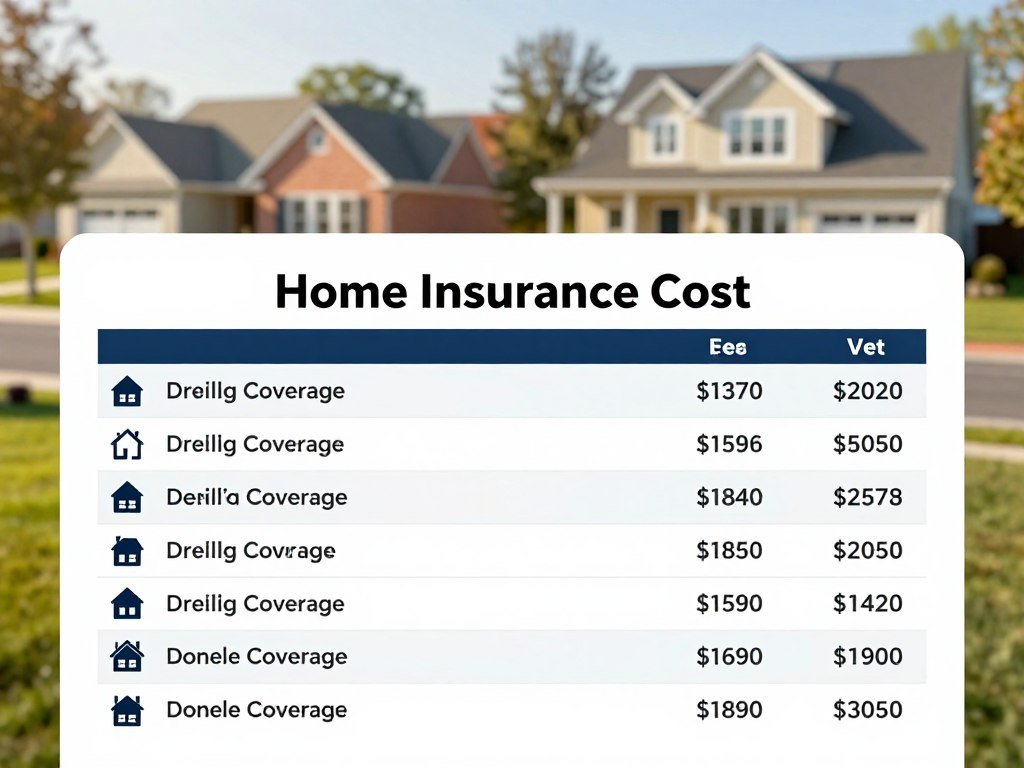
Coverage amount gives a useful comparison, but a house’s sale price does not set its dwelling coverage. These 2025 averages show how premiums changed across dwelling brackets:
| Dwelling coverage bracket | Average annual premium | Year |
|---|---|---|
| $200,000-$299,999 | $1,679 | 2025 |
| $400,000-$499,999 | $2,036 | 2025 |
| $500,000-$599,999 | $2,297 | 2025 |
| $800,000-$899,999 | $3,091 | 2025 |
A $150,000 home’s sale price does not set its dwelling limit. If its needed dwelling coverage falls in the $200,000-$299,999 bracket, that bracket averaged $1,679 in 2025.
For a $400,000 house, the $400,000-$499,999 dwelling bracket averaged $2,036. A $500,000 house may fit the $500,000-$599,999 bracket, which averaged $2,297. House value and dwelling coverage can differ.
Compare premiums only when the dwelling limit and deductible describe the same kind of risk.
The $2,543 annual benchmark answers the $300,000-house question only when its dwelling and liability limits are each $300,000 and its deductible is $1,000. A different deductible or limit changes the comparison.
Matic reported a $1,966 average annual homeowners premium in 2025, with state averages from $610 in Hawaii to $3,237 in Louisiana. Those figures also describe a different sample and year. Compare estimates only after confirming that the dwelling limit and deductible describe the same kind of risk.
Why Do Premiums Differ So Much by State?
A $300,000-dwelling policy averaged $7,136 in Florida and $659 in Hawaii in 2026, though Hawaii’s figure excludes hurricane coverage. That gap shows how strongly location can shape homeowners insurance prices.
The comparison uses the same dwelling coverage and $1,000 deductible in each state. Severe-weather exposure, local rebuilding costs, and state insurance rules can all contribute to these differences.

Florida had the highest state average, while Hawaii had the lowest. Other state figures for the same 2026 policy terms include:
| State | 2026 annual average | Note |
|---|---|---|
| Florida | $7,136 | Highest listed average |
| Louisiana | $5,986 | Gulf Coast state |
| Kansas | $5,260 | Central Plains state |
| California | $1,616 | Same policy terms |
| Hawaii | $659 | Excludes hurricane coverage |
Oklahoma averaged $5,010, and Colorado averaged $4,963. Lower state averages included Vermont at $1,063, New Hampshire at $1,300, Maine at $1,335, and Oregon at $1,572.
California’s median annual home insurance cost was about $1,200 in 2023, 2.2% above 2013. The 2023 figure differs from the 2026 average because the year and measure differ. State prices need their own context.
In California in 2023, 16% of homeowners without a mortgage lacked insurance, compared with 21% nationally. Among California households without mortgages, 40% of mobile-home households were uninsured, versus 12% of single-family homeowners.
California homeowners in the lowest income quartile, earning below $66,000 yearly, spent about 3% of income on insurance in 2023. The typical California homeowner spent about 1%.
The 2023 median cost per $100,000 of property value was $483 for mobile homes, $182 for single-family homes, $131 for two-to-four-unit homes, and $123 for condominiums. Mobile-home coverage cost more per property value than the other listed types. Check what a state’s average covers before using it as a proxy for a particular home or household.
How Do You Estimate the Dwelling Coverage You Need?
Start with the cost to rebuild the structure today, not the price the home might fetch on the market. Dwelling coverage should reflect current rebuilding needs, and you should review its limit each year as labor and material costs shift.
An insurer’s replacement-cost estimate may differ from your market-value estimate. Resale value includes land and reflects what a buyer might pay, while rebuilding focuses on the structure and current work costs.

The common 80% rule offers a rough check, not a universal promise. Some policies require coverage closer to 100%, and the rule is not legally required.
- Estimate the home’s rebuild cost using its size and local construction costs.
- Multiply that estimate by 0.80 for a rough 80% rule check.
- Compare the result with the policy’s required coinsurance threshold.
- Review the dwelling limit each year as rebuilding costs change.
A rough estimate uses square footage multiplied by local construction cost per square foot, then multiplied by 0.80. For example, a 2,000-square-foot home and a local cost of $200 per square foot produce a $400,000 rebuild estimate and a $320,000 80% check.
That result is only a starting point. A home’s design, materials, and site details can affect the cost of rebuilding, so the insurer’s estimate may use different assumptions.
The 80% guideline usually concerns dwelling coverage, not personal liability. The 80% coinsurance guideline can help flag a low limit, but it does not replace your policy’s own terms.
Some policies use a coinsurance clause that can reduce claim payments when coverage falls below the required share of replacement cost. Check the policy’s own coinsurance language before relying on an 80% calculation.
What Does a Homeowners Policy Cover, and How Do Limits Work?
A homeowners policy usually separates protection for the building, belongings, liability, and added living costs. Each part has its own limit, and one cap does not guarantee payment for every loss.
The policy’s limits are maximum amounts or rules for covered claims. A claim payment also depends on the loss, exclusions, and other policy terms.

Coverage for the house and belongings
Dwelling coverage protects the house’s structure. Other-structures coverage may apply to a detached garage, shed, or fence, while personal property coverage applies to belongings such as furniture and electronics.
Many policies set other-structures coverage at 10% of dwelling coverage and personal property at 50%. These are common patterns, not fixed rules, so check the limits in your policy.
High-value items may need separate or scheduled coverage. Do not assume the standard personal-property limit fully protects jewelry, art, or other costly belongings.
Liability and temporary living costs
Personal liability can help with covered injuries or property damage for which you are responsible. Common liability limits are $100,000, $300,000, or $500,000.
Additional living expenses may help pay extra costs when a covered loss makes your home temporarily unlivable. The South Carolina Department of Insurance explains common homeowners policy coverage parts, though each insurer’s terms can differ.
A limit is a policy cap, not a promise that every loss will be paid in full. Read each limit beside its coverage name, since one limit does not automatically apply to every part of the policy.
How Do Calculators and Address Estimates Work?
A calculator can estimate the coverage a home needs without estimating what an insurer will charge. Coverage needs and a premium estimate are different tasks, and an address result is not a binding quote.
The details you enter shape the result, so missing or outdated information can make an estimate less useful. Treat an online number as a starting point.
Calculators that estimate coverage needs
A home insurance calculator may suggest coverage limits based on details about the house. Progressive’s calculator estimates coverage needs, but it does not estimate insurance prices.
Actual prices also depend on location, home type, and claims history. A coverage calculator can help you set a limit to discuss, but it cannot show exactly what an insurer will charge.
Address-based premium comparisons
An address-based estimate may use location, county, or dwelling-limit details to show a comparison or median rate. It does not promise that an insurer will offer that price.
The U.S. News homeowners insurance calculator uses state, county, and dwelling coverage inputs. Its data was accurate as of March 25, 2026.
California’s Department of Insurance offers a 2026 premium comparison tool and says its survey results are comparisons, not quotes. Use the address result as a guide, then confirm the home’s details directly in a quote.
These tools can help you frame questions about coverage and cost, but their methods and dates matter. Check the tool’s date and whether its result is a median comparison or an actual quote.
Which Factors Affect Your Premium Most?
A home’s location, roof condition, claims record, and coverage choices can matter as much as its size. Insurers weigh different risks, and the same house can receive different rates from different companies.
Local rules also shape which details insurers may use. A quote reflects the insurer’s view of the home and household under those rules.
Location, construction, and condition
Weather exposure, wildfire risk, fire-service access, and crime can affect a rate. Local construction costs also matter because they help shape the cost to repair or rebuild.
Insurers may consider home type and age, roof age and condition, building materials, and safety systems. A maintained roof or alarm may change how an insurer views risk, though each company sets its own rating rules.
Pools and trampolines can raise liability concerns. Some insurers restrict injury liability or require a fence or locked gate at least four feet high around a pool.
For safety devices, compare features before buying. A guide to wireless outdoor security cameras covers choices such as Wi-Fi, cellular service, local recording, and paid monitoring.
Claims history and credit-based insurance scores
Claims history can affect eligibility and price. In most states, insurers may also use credit-based insurance scores in rate or eligibility decisions, though state rules differ.
California, Maryland, and Massachusetts ban credit as a homeowners insurance rating factor. Michigan and Oregon limit its use, so a national credit estimate may not fit your state.
A reported comparison in states that allow credit-based scores found that a homeowner with a score of 630 may pay around $2,000 more per year than one with a score of 820.
Quote inquiries are soft credit checks and do not lower your credit score. Ask whether credit is used in your state before treating a credit-based estimate as a guaranteed rate.
Why Have Premiums Been Rising, and Are They Easing?
The average renewal premium still rose 10.6% in the first half of 2026, even though some homeowners paid less. Renewal prices were still rising overall, so the market was not broadly going down.
Newly written policies and renewals measure different groups. The first-half 2026 average for new policies was $2,057 after a 5.9% year-over-year increase, while renewing policyholders saw a 10.6% increase.
These recent changes follow several years of rising rates. The table separates nationwide annual rate changes from 2026 policy measures:
| Measure | Period | Change |
|---|---|---|
| Nationwide home insurance rates | 2024 | 12.7% increase |
| Nationwide home insurance rates | 2025 | 6.0% increase |
| Renewing policyholders | First half of 2026 | 10.6% average increase |
| Newly written policies | First half of 2026 | 5.9% year-over-year increase |
Rates rose 46.8% cumulatively from 2020 to 2025. The 2025 national annual average was $2,395, compared with $5,298 in Oklahoma and $801 in Hawaii.
From 2020 to 2025, rates rose 100.8% in Colorado, 96.0% in Iowa, 88.2% in Minnesota, and 53.7% in California. Colorado had the largest state increase in 2025 at 18.3%, while Florida had the smallest at 0.4%.
From 2020 to 2024, the United States averaged around 23 disasters each year causing at least $1 billion in damage, compared with 15 per year in the prior five-year period. Rising rebuilding costs and catastrophe losses can push premiums up. NOAA tracks these billion-dollar weather disasters.
Renewal outcomes still vary by household and insurer. In the first half of 2026, 11.7% of renewing homeowners saw a decrease, compared with 7.4% in 2025 and 4.9% in 2024.
Six states, including California, Florida, and New Jersey, had double-digit premium increases in the first half of 2026. The average number of available quotes per person rose 27% from 2025 to 2026 and stood 74% above its 2024 low. Treat one renewal offer as a household-specific result, not proof of a national price trend.
How Can You Lower Your Premium Without Cutting Essential Protection?
Raising a deductible can lower the premium, but it also increases what you must pay after a covered loss. Choose a deductible you can cover, and keep enough accessible savings for that amount.
A $1,000 or $2,500 deductible is common. The deductible is your out-of-pocket claim amount before insurance pays, so a lower premium may not help if a claim would strain your budget.
Choose a deductible you can afford
Compare the premium change with the added cost you would face after a claim. A higher deductible shifts more of a covered loss to you.
Think about money you can reach quickly, not savings reserved for another bill. Do not choose a deductible that would force you to delay urgent repairs after a claim.
Reduce risk and ask about discounts
Ask insurers whether any of these choices may lower your premium:
- Bundling home and auto policies.
- Installing alarms or other safety devices.
- Paying annually or in full.
- Making eligible roof, electrical, or plumbing upgrades.
Discounts and eligibility vary by insurer. A safety or building upgrade should protect the home and household, not be chosen for a promised discount.
Some devices have monthly service fees or need a reliable connection, so compare the full cost before buying. A discount is useful only if the change still makes sense for your home.
How Do You Compare Insurers and Find a Fair Price?
Three quotes are useful only when they describe comparable limits, deductibles, and protections. Match the policy details before comparing prices, or the lowest premium may buy less coverage.
At least three quotes make a practical comparison set. In 2026, the average number of available quotes per person was 27% higher than in 2025 and 74% above its 2024 low.
Use the same checklist for each insurer:
- Match dwelling and personal-property limits.
- Match personal liability limits.
- Match deductibles and endorsements.
- Compare exclusions, claims service, and insurer financial strength.
Endorsements add, change, or extend policy terms. A quote with a different endorsement may not protect the same risks, even if the main limits look alike.
Finding the best home insurance costs means comparing equivalent protection and the insurer’s ability to meet the policy terms. The smallest premium is not automatically the best value.
Check how the insurer handles claims and whether its financial strength supports the promise behind the policy. Save the declarations pages beside the quotes so the final choice can be checked line by line.
When Might Standard Coverage Leave a Gap?
A standard homeowners policy may cover fire or wind damage while excluding flood damage. Some major risks need separate protection, so check the policy before a loss exposes a gap.
Common gaps include:
- Flood damage.
- Earthquake damage.
- Business property or liability tied to a home-based business.
Flooding can happen outside designated high-risk areas. Separate flood protection may be available through the National Flood Insurance Program or private insurers.
Earthquake damage commonly needs separate coverage. A home business may also need commercial insurance or a higher premium, depending on its property and liability risks.
Homeowners insurance is generally not required by law, though mortgage lenders commonly require it. Standard policy exclusions and limits vary, so review the actual contract.
When reporting a claim, state known facts accurately and document visible damage and dates. Do not guess at the cause or hide relevant information.
Before a loss, ask the insurer to confirm in writing which major risks need separate protection.
Conclusion
A sound premium estimate connects the home’s rebuilding needs with the protection the household can afford to keep. It becomes useful when you compare matching limits, deductibles, and policy terms.
Start by checking whether the dwelling limit still fits the cost to rebuild. Then choose the next policy decision based on the protection your household needs and can maintain.
Set a reminder 30 days before renewal to review the declarations page and confirm that the dwelling limit still reflects current rebuilding needs.
FAQ
How much is homeowners insurance per month?
Progressive’s network range was $100.59-$293.17 per month for 12-month policies effective on or after January 1, 2025. This is not a national average; it describes policies in Progressive’s network. Monthly bills can also change with the insurer’s billing schedule and fees. Compare the same coverage limits and deductible before treating two monthly prices as comparable.
Does credit score affect insurance rates?
Credit-based insurance scores may affect homeowners insurance rates in most states. California, Maryland, and Massachusetts ban credit as a rating factor, while Michigan and Oregon limit its use. Insurers use a credit-based insurance score under state rules, and it is not the same as a lender’s credit decision. Quote inquiries are soft checks and do not lower your credit score.
Is homeowners insurance going down in 2026?
No, the average renewal premium rose 10.6% in the first half of 2026. Still, 11.7% of renewing homeowners received a decrease, so some households paid less. New policies had a separate average 5.9% year-over-year increase during that period. Your renewal depends on your insurer’s pricing and the details of your home and policy.
How is homeowners insurance calculated?
Insurers price homeowners insurance using replacement cost, location, coverage limits, deductible, claims history, and eligible credit-based insurance scores. Replacement cost estimates what it would take to rebuild the structure using current labor and materials. The deductible affects how much you pay before insurance contributes to a covered claim. State rules also determine which rating factors insurers may use.
How much should home insurance be on a $400,000 house?
The 2025 average was $2,036 for a policy with $400,000-$499,999 in dwelling coverage. A home’s $400,000 sale price does not mean its rebuilding limit must be $400,000. Dwelling coverage reflects the estimated cost to rebuild the structure, not the value of the land or the home’s resale price. Use the figure as a comparison point, not a personal quote.
What is the 80% rule for homeowners insurance?
The 80% rule is a common guideline to insure the dwelling for at least 80% of its replacement cost. Some policies require coverage closer to 100%, and the guideline is not a legal requirement. It usually applies to dwelling coverage, not personal liability. Check your policy’s coinsurance terms because the required threshold can affect a claim payment.
What not to say to home insurance?
Do not guess about a loss or conceal facts when reporting a claim. Give the insurer accurate information you know, including when the damage appeared and what you can see. If you do not know the cause, say so instead of making one up. Keep records of damage and dates, and share relevant information rather than leaving out details.
How much is home insurance on a $500,000 house?
The 2025 average was $2,297 for $500,000-$599,999 in dwelling coverage. That bracket describes the amount of structure coverage, not the home’s sale price. Rebuilding needs can differ from market value because the land is not part of replacement cost. Compare the average only with a policy using similar coverage limits and deductible.