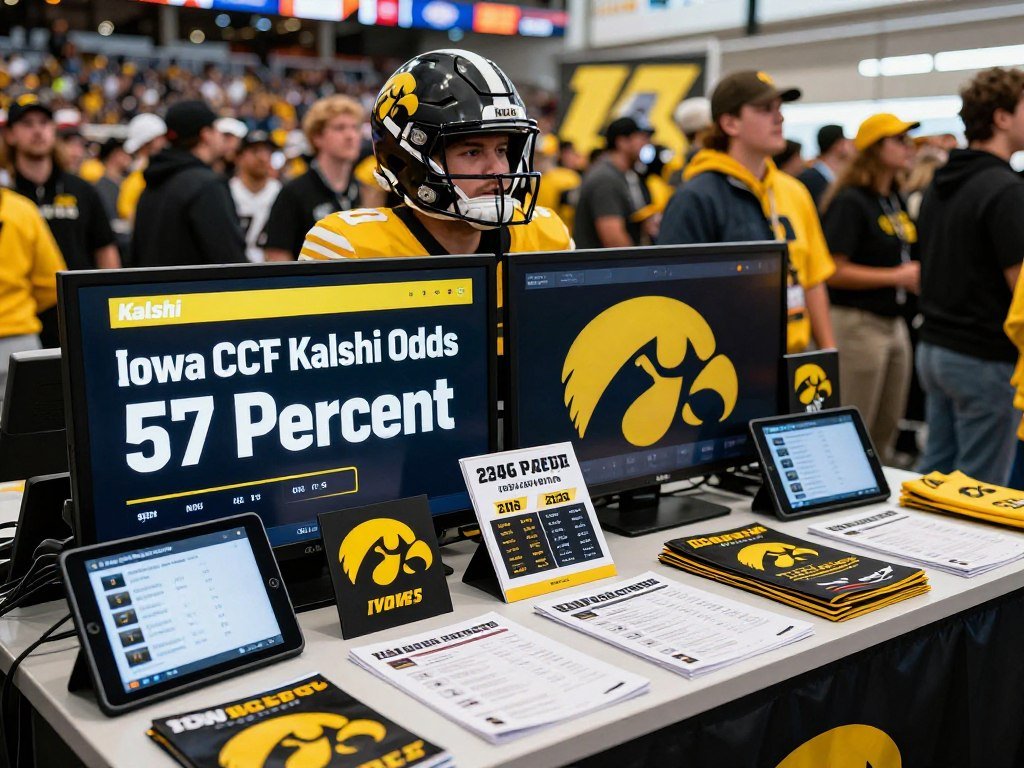
A percentage beside Iowa’s name can sound like a playoff forecast, but its meaning depends on the exact event being priced. The 57 percent headline figure needs a named contract and outcome before it can be called Iowa’s 2026 qualification chance. A broader Iowa market could measure something else entirely.
Implied probability is the percentage a market price suggests for a specific contract outcome, not a guarantee that the outcome will happen. That figure and a College Football Playoff decision answer different questions. A 24-team model is another separate issue, not proof that the tournament will expand.
The distinction matters to anyone following college football, the 2026 season, or speculation about a larger field. A market number can change, while the CFP’s format depends on decisions by the playoff governing body. Readers should separate a market estimate from a confirmed CFP decision.
Key Takeaways
- A 57 percent figure needs a specific contract outcome and time period.
- A market estimate does not guarantee that Iowa will qualify.
- The CFP has discussed a possible expansion, but discussion is not adoption.
- The stated 2026 tournament format has 12 teams.
- Iowa’s listed results provide context, not a CFP ranking.
Iowa CFP Kalshi Odds 57 Percent 24 Team Expansion 2026: Is 57% Iowa’s Real CFP Chance?
The 57% figure should not be called Iowa’s 2026 playoff chance until the contract explicitly asks whether Iowa makes that field. Only that outcome, tied to the right season, would make the number a market estimate of Iowa qualifying.
The contract’s wording and settlement period decide what the percentage measures. A market could ask whether Iowa reaches a playoff within a broader time frame. It could also price a different Iowa-related event, such as a future cutoff that does not match the 2026 season.
A percentage without its event and time period is not a dependable playoff forecast.
That distinction can be easy to miss when a headline places a number beside a team. Readers may see “Iowa” and “57%” and assume the market is about making the 2026 College Football Playoff. That assumption is not safe without the contract’s exact outcome and timing.
A market figure for making the 2026 field would have to ask that specific question. A contract about Iowa’s chances in another season, or about an event with a different settlement date, would not answer it.
Nor does a market percentage represent the CFP committee’s judgment. Committee rankings and selection rules serve the official playoff process. A Kalshi market price reflects expectations about the outcome named in its contract.
For example, “Iowa qualifies by a future date” could cover more than one season. A price for that contract would not automatically tell a reader whether Iowa makes the 2026 field.
Readers should check whether the 57% headline refers to an active Kalshi market, what the contract calls a successful outcome, and when it settles. Without those details, it remains an Iowa-related market figure, not verified qualification odds.
The number may still be useful within its own contract. It simply cannot support a stronger claim than the event it prices. A percentage without its event and time period is not a dependable playoff forecast.
Is the College Football Playoff expanding to 24 teams?
The CFP’s September 8, 2026 update was a commitment to discuss expansion with ESPN, not a decision to adopt it. Discussion is not adoption, and the 24-team idea remains separate from the stated 2026 format.
The 2026 season uses a 12-team format under the CFP’s stated rules. The format includes five highest-ranked conference champions and the next seven highest-ranked teams. Notre Dame qualifies if ranked among the top 12, rather than receiving a separate automatic berth.

What the CFP has confirmed
The CFP has confirmed that it will discuss evaluating a possible expansion with ESPN. It has not said that the field will grow, or committed to a new format.
A CBS Sports report described the talks as ongoing after ESPN’s exclusive negotiating window ended without an agreement. The report also discussed proposed media-rights terms, but those talks do not set the playoff field.
- The CFP said it would begin discussions with ESPN about evaluating a possible 24-team expansion.
- The CFP said those discussions were not a decision or commitment to expand.
- The stated 2026 format remains a 12-team field with the listed selection rules.
Which format applies in 2026
For the 2026 race, the 12-team field is the applicable format. Five places go to the highest-ranked conference champions, while seven go to the next highest-ranked teams.
Notre Dame’s route is tied to its ranking: it qualifies if it finishes among the top 12. That condition does not give Notre Dame an automatic berth outside the ranking rules.
Talks with ESPN could lead to more discussion, but they do not change the stated field by themselves. For the 2026 race, readers should use the stated 12-team format rather than assume a 24-team field.
How could an illustrative 24-team playoff bracket work?
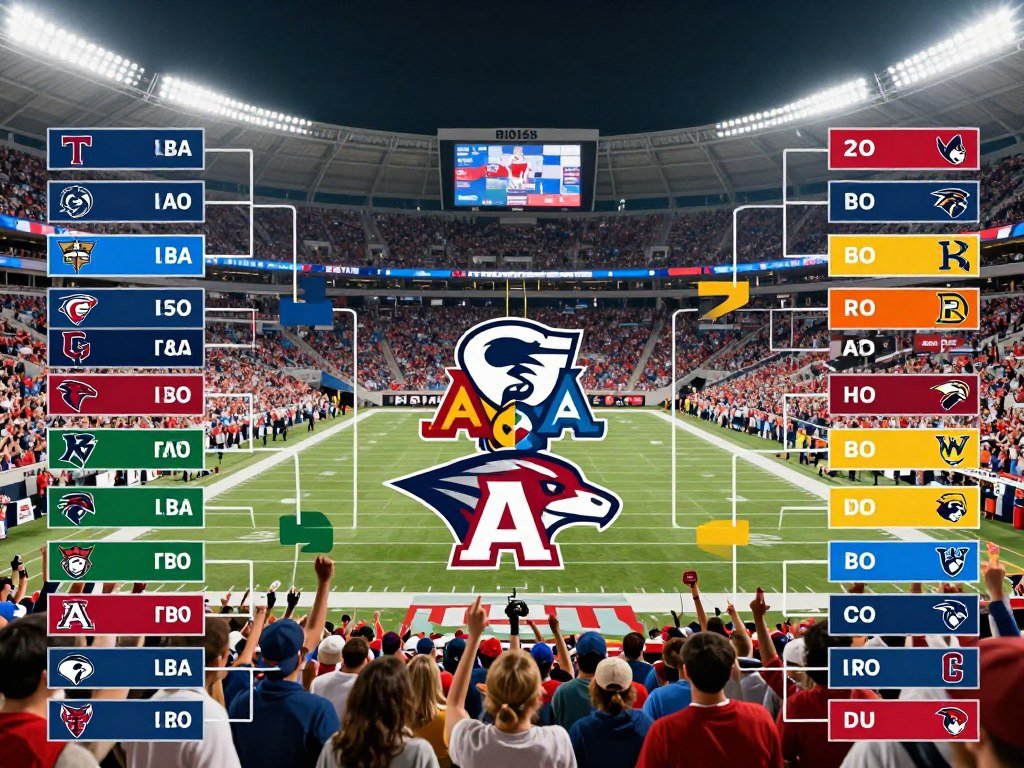
One illustrative 24-team design would reserve 19 places for at-large teams and five for automatic qualifiers. That is one model, not an adopted CFP format or a settled set of selection rules.
The proposed five automatic bids would go to four Power Four champions and the highest-ranked Group of Six champion. The remaining 19 places would be at-large bids for teams selected beyond those automatic qualifiers.
How teams could earn a place
In this model, conference titles would shape five automatic places. Four would go to Power Four champions, and one would go to the highest-ranked Group of Six champion.
Other teams could enter through at-large bids. Their path would not depend on winning one of those five conference places, though selection would still require a place among the chosen teams.
The structure keeps a role for conference champions while creating more room for teams outside the automatic spots. The exact rankings and selection steps would depend on rules the CFP would have to adopt.
What the first selection rules would change
The comparison below places the current field beside one hypothetical design. It shows the proposed numbers, not an official CFP decision.
| Bracket feature | Current 12-team format | Illustrative 24-team model |
|---|---|---|
| Field size | 12 | 24 |
| Ranked-team places beyond automatic qualifiers | The next seven highest-ranked teams | 19 at-large bids |
| Automatic bids | Five highest-ranked conference champions | Four Power Four champions plus the highest-ranked Group of Six champion |
The table shows why the phrase “24-team model” needs a clear label. Expanding the field would require choices about which conference champions receive automatic places and how other teams earn selection.
That approach could create more at-large spots than the present field offers. It would also make the automatic-bid rules different from the current system.
The comparison describes a hypothetical model, not settled rules. The 19-and-five split is a model detail, not an official CFP selection rule.
What does Iowa’s 2026 résumé show so far?
Iowa’s listed results include both a road win and two losses before its next scheduled game. The results offer context, but they do not show a committee ranking or decide whether Iowa can make the playoff.
Wins and losses provide résumé context but do not, on their own, confirm Iowa’s CFP standing. The listed games include a rivalry win, a road victory, and losses against Ohio State and Minnesota.

The recent results
Iowa beat Iowa State 16-13 on September 12, 2026. It was the Hawkeyes’ first win in the rivalry since the 2025 season.
Iowa also won 41-24 at Washington, then lost 14-31 to Ohio State. Its next listed result was a 13-10 loss at Minnesota.
| Opponent | Site | Iowa result | Score |
|---|---|---|---|
| Iowa State | not specified | Win | 16-13 |
| Washington | Away | Win | 41-24 |
| Ohio State | Home | Loss | 14-31 |
| Minnesota | Away | Loss | 13-10 |
What those scores can and cannot establish
The results give fans a concrete snapshot of Iowa’s season. The Washington win came on the road, while both listed losses came against Big Ten opponents.
Those outcomes can inform discussion of Iowa’s résumé, including how the team performs against conference rivals. They do not reveal a CFP ranking, because the committee’s position is a separate judgment.
One score cannot settle a season-long playoff outlook. Opponent strength, later results, and the committee’s view all matter to where a team stands.
The Iowa State result also provides rivalry context, not an automatic boost in playoff standing. Treat this record as a snapshot of results, not a published CFP ranking.
Who does Iowa play next?
Wisconsin is Iowa’s next listed opponent, and the Hawkeyes are scheduled to host the game. The schedule lists an 11:00 AM CDT kickoff at Iowa’s home venue.
Wisconsin is the next game shown on Iowa’s 2026 schedule. The matchup follows the results listed for the Hawkeyes and gives fans a clear date on the season slate.

Hosting Wisconsin means the game is listed at Iowa’s home venue, rather than as a road trip. The schedule gives the start time as 11:00 AM CDT.
That time uses Central Daylight Time, the local time standard named in the schedule. Fans planning travel or viewing can use it to set their plans.
A listed kickoff is useful for planning, though game schedules can change. Check the kickoff time against the game listing before making plans, since the listed start time is 11:00 AM CDT.
How should you read a Kalshi college football market?
Start by reading the contract’s actual outcome, because the word “Iowa” alone does not identify what a market measures. The event wording matters more than the team name shown beside a price.
A prediction-market percentage is an implied probability for a defined contract outcome, not a guaranteed event. The market quote applies to that contract, rather than to every question about a team or season.
Identify the exact event
A contract may describe an outcome that sounds close to a playoff berth but uses a different deadline. A market about reaching the CFP before a future cutoff is not automatically a market about qualifying in 2026.
Kalshi prices can also change as traders respond to new information. A price remains tied to the contract’s stated terms, even when the discussion around the team shifts.
Research on prediction markets found that price accuracy can vary over a contract’s life. A study of sports contracts, based on other leagues, found prices closest to calibration mid-contract and more likely to diverge near settlement.
The research examined about 23 million trades across NBA, MLB, and NHL contracts. It does not establish how accurately Kalshi prices Iowa or college football outcomes.
A price can offer a useful snapshot of market expectations, but it is not the same as a measured fact. Betting-style language such as “odds” should not blur that difference.
Separate market price from certainty
Use this checklist before reading a quote as a playoff forecast:
- The event being priced, stated as a clear outcome.
- The period or settlement date attached to the contract.
- Whether the percentage is a market estimate, not a guaranteed result.
A price does not guarantee that the named event will happen. It reflects what the market price suggests about the contract outcome at that time.
The contract’s settlement terms also matter after the game or season ends. They define what counts as a winning outcome, not a team’s general reputation.
Do not compare two percentages until their contract outcomes and settlement periods match.
What could change Iowa’s playoff outlook during the season?
Iowa’s outlook can shift as its results and the strength of its schedule change. Season developments can move expectations, but no single market price or game result confirms a CFP place.
Four factors help explain why a team’s playoff outlook may change over time. They include results, opponent quality, conference position, and committee rankings.
Results and schedule context
These factors give readers a useful way to follow Iowa’s place in college football:
- Iowa’s wins and losses across the season.
- The quality of Iowa’s opponents.
- Iowa’s place in the Big Ten race.
- CFP committee rankings as they are released.
Results show whether Iowa keeps winning, while opponent quality adds context to those outcomes. A record against strong teams may be viewed differently from the same record against weaker opposition.
The Big Ten race can shape the team’s route through its conference season. Other teams’ results also matter because they affect the standings and competition for playoff places.
Rankings and market movement
CFP committee rankings offer an official view of how the committee places teams at that point in the season. Those rankings can change as teams play more games and the committee reviews their records.
A market can react to new information, such as results or changes in expectations. Its price movement is not the same as an official selection or committee ranking.
Readers can track a market quote for the contract it names, while using committee rankings for Iowa’s CFP position. The two measures answer different questions and may move at different times.
A market price may shift even when no official CFP announcement occurs. Use committee rankings for CFP position and a market quote only for the contract it actually measures.
What would a 24-team playoff mean for Iowa?
Under one 24-team scenario, a team’s seed would determine whether it opens at home, earns a bye, or starts on the road. That path is hypothetical and would apply only if the CFP adopted such a format.
Iowa would first have to qualify and earn a seed associated with a home opener. A larger bracket would not promise the Hawkeyes a place or a home game.
A possible home game and a longer route
In the illustrative model, the top eight seeds would receive first-round byes. Seeds 9-16 would host first-round games, giving those teams a home-field opening.
Teams seeded below that range would begin on the road. That route would mean an away first-round game before any chance to face a team that received a bye.
The model also gives the eight bye teams home games in the second round. A bye would reduce the number of games needed to reach the later rounds, while lower seeds would need to win more games.
Those paths depend on both selection and seeding. Iowa could host only after qualifying and earning one of the seeds assigned a home opener.
Bowls in a larger postseason
The proposed later rounds would keep major bowl games in the playoff. The Rose, Cotton, Peach, Sugar, Fiesta, and Orange Bowls would host quarterfinals and semifinals.
The national championship would take place at a predetermined neutral site. That setup separates the title game from the home venues used in earlier rounds.
- Rose Bowl: quarterfinal or semifinal.
- Cotton Bowl: quarterfinal or semifinal.
- Peach Bowl: quarterfinal or semifinal.
- Sugar Bowl: quarterfinal or semifinal.
- Fiesta Bowl: quarterfinal or semifinal.
- Orange Bowl: quarterfinal or semifinal.
A possible home playoff game is a conditional benefit of a hypothetical format, not a promise to Iowa fans.
For Iowa supporters, a home game could mean a postseason matchup in familiar surroundings. That possibility would depend first on qualification, then on the team’s seed and the adopted bracket rules.
The bowl assignments and seed paths described here belong to an illustrative model. A possible home playoff game is a conditional benefit of a hypothetical format, not a promise to Iowa fans.
Conclusion
For now, Iowa’s market outlook and the CFP’s official format are separate questions. A market estimate is not a CFP decision, and an expansion discussion is not an adopted format.
The practical next step is to read the named Kalshi contract and check official CFP updates. Those details show whether a percentage measures a specific Iowa outcome and whether the governing body has changed its format.
Before relying on a percentage, check that its contract names Iowa’s 2026 playoff qualification as the outcome.
FAQ
What are the odds of Iowa making the College Football Playoff?
A 57% figure applies only if the specific contract measures Iowa qualifying for the 2026 field and its settlement period matches that season. A contract about a different cutoff or future period answers another question. Its price is an implied probability, not a guarantee that Iowa will reach the playoff.
Is the CFP moving to 24 teams?
No decision has been made to move the CFP to 24 teams. On September 8, 2026, the CFP said it would discuss possible expansion with ESPN, while stressing that talks were not a commitment. The stated format remains the 12-team tournament for the 2026 season.
Who does Iowa have to play next?
Wisconsin is listed as Iowa’s next opponent, at home, with an 11:00 AM CDT kickoff. The scheduled game is the next matchup on Iowa’s 2026 slate. Its listing gives fans the opponent, venue, and start time, though schedules can change as the season moves along.
Does the 24-team format apply to the 2026 season?
No, the 24-team format does not apply to the 2026 season. The stated format has 12 teams, with five highest-ranked conference champions and the next seven highest-ranked teams. The CFP’s discussions with ESPN do not change those rules or commit the governing body to a larger field.
Can Iowa host a College Football Playoff game?
In an illustrative 24-team model, seeds 9-16 host first-round games. Iowa would first need to qualify and earn one of those seeds under rules the CFP adopted. The possible home opener is a feature of that hypothetical model, not a promise that Iowa will reach the field or host.
How do prediction-market odds change?
Prediction-market prices can move as information and market expectations change. A new result may affect what traders expect, but a changing price is not an official CFP ranking or result. The contract still measures only its stated outcome and settlement period, so the price should be read in that context.