
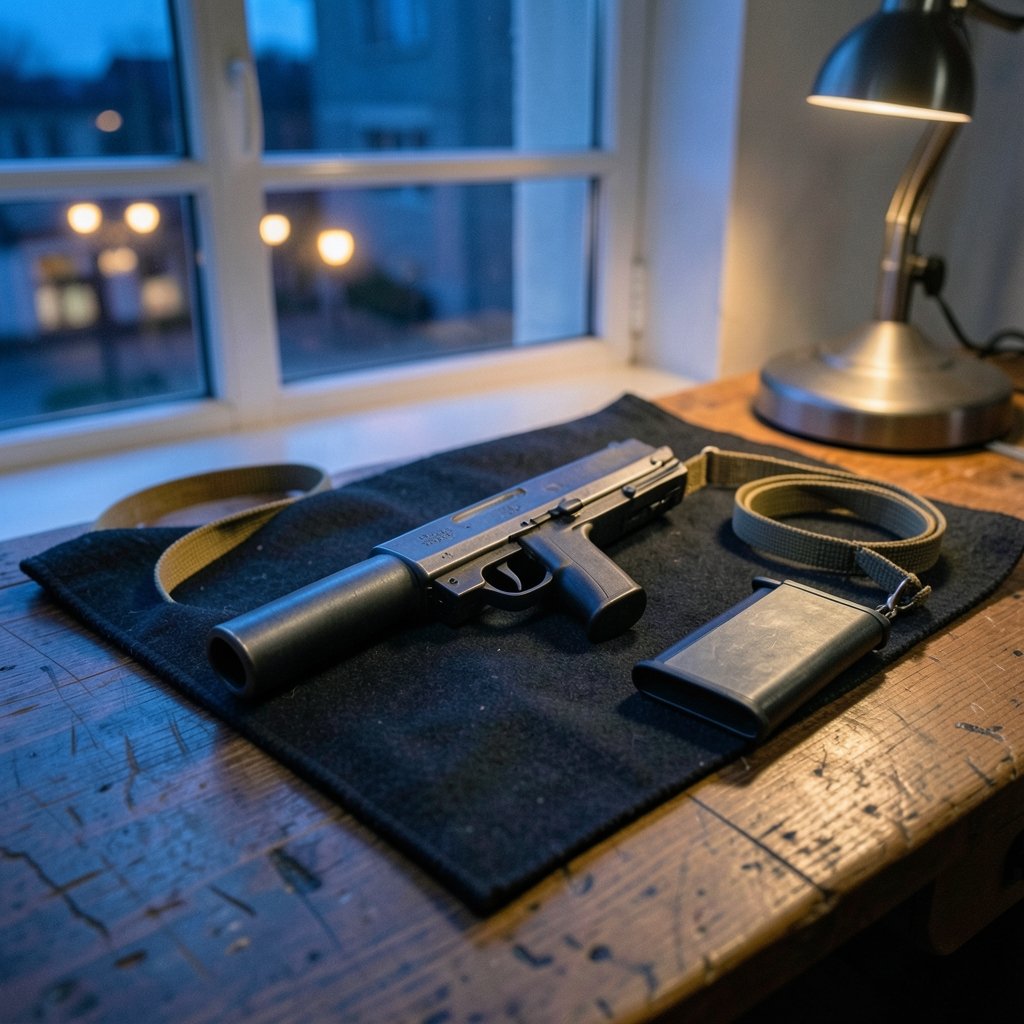
What do you get when you cross a boxy little machine pistol, a naming habit that refuses to die, and a search term that confuses gun historians and Mac computer owners alike? The answer sits somewhere in the gap between “MAC-10” and “Mac Ingram M10” — a phrase that shows up in forums, auction listings, and late-night search bars, yet never quite matches the name stamped on the actual firearm.
The short version: there is no widely documented firearm called the “Mac Ingram M10.” The term is almost certainly a scrambled reference to the Ingram MAC-10, a compact submachine gun designed by Gordon B. Ingram and built by the Military Armament Corporation. Once you untangle the naming, the story gets interesting — design history, legal classification, and a whole lot of Hollywood myth-making.
The Name Is a Puzzle, Not a Product
Names in the firearms world drift. Manufacturers rename models for export markets, collectors shorten designations, and auction houses mix and match words until a new label appears out of thin air. That is exactly what happened here.
The design is properly the MAC-10, with “MAC” standing for Military Armament Corporation. Gordon Ingram’s name attaches to the design because he created it. So “Ingram MAC-10” is the full, correct description. Flip the words around, drop a hyphen, and you get “Mac Ingram M10” — a label that sounds official but does not correspond to a distinct production model.
There is a second source of confusion. The “M10” designation is genuinely ambiguous. It can point to a MAC-10 variant, a military model number from an unrelated system, or a completely different product line. Anyone researching the term should treat “M10” as a clue rather than a fact.
The third layer is the computer problem. Search engines see “Mac” and start serving results about Apple hardware, macOS workflows, and desktop setups. That collision is worth acknowledging, because a reader who lands on this page expecting computer advice deserves a signpost rather than a dead end.
What the Ingram MAC-10 Actually Is
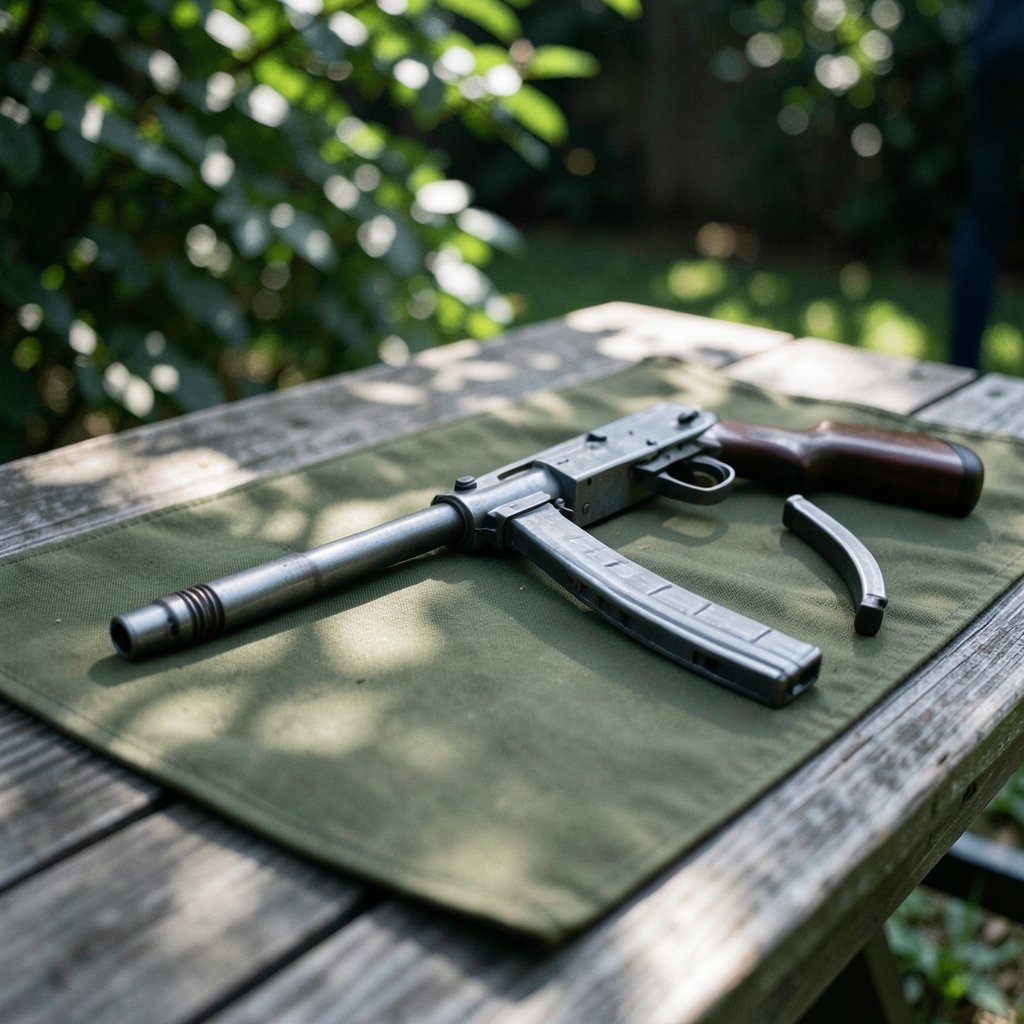
Strip away the naming chaos and a real, well-documented firearm remains. The MAC-10 is a compact, blowback-operated submachine gun developed in the United States in the late 1960s and produced from roughly 1970 onward. Gordon B. Ingram designed it, and the Military Armament Corporation manufactured it.
Several design choices defined the gun:
- A short barrel paired with a boxy, rectangular receiver
- A telescoping bolt that wraps around the barrel to keep the weapon short
- A magazine that doubles as a foregrip, inserted through the pistol grip
- Chamberings in 9×19mm Parabellum and .45 ACP
The whole concept was close-quarters concealment. The MAC-10 was built to be small, cheap to produce, and easy to fire in a hurry. It was never a precision instrument. Shooters who have handled one describe it as functional and crude — a stamped-metal tool rather than a refined piece of gunsmithing.
The line grew from there. The MAC-11 followed as a smaller variant chambered for lower-energy cartridges, and later derivatives carried the design into the 1980s. Manufacturers and sources use different naming conventions, which helps explain why the historical record reads like a family tree with tangled branches.
Why It Became Famous Anyway
The MAC-10’s reputation owes more to cinema than to ballistics. Its boxy silhouette and stubby profile made it instantly recognizable on screen, and it became a staple of action films from the 1980s onward. Popular culture turned a niche, hard-to-control machine pistol into a visual shorthand for “serious hardware.”
That fame created a feedback loop. Collectors wanted them, prices rose, and the internet filled with listings using every possible spelling of the name. Somewhere in that noise, “Mac Ingram M10” was born.
The Legal Reality in the United States
This is where the topic stops being trivia and starts mattering. In the U.S., the MAC-10 and similar firearms are regulated as machine guns under the National Firearms Act of 1934. The NFA imposes registration, taxation, and transfer requirements on weapons that fire automatically.
The Firearm Owners Protection Act of 1986 added a harder ceiling. It restricted civilian transfer of newly manufactured machine guns, which means the supply of legally transferable full-auto examples is effectively frozen at the guns that were registered before the cutoff. That fixed supply is the single biggest reason prices for transferable examples sit where they do.
A few practical points that trip people up:
- Registration status matters more than condition. A registered gun in rough shape is legally worth more than an unregistered one in perfect condition.
- State law layers on top of federal law. Some states restrict or ban these firearms entirely, regardless of federal registration.
- Paperwork errors are expensive. A missing or mismatched registration document can turn a valuable collectible into a legal liability.
- Variants are not interchangeable. Semi-automatic clones and full-auto originals look similar and are regulated very differently.
Anyone seriously researching ownership should consult current statutory text and a qualified attorney rather than forum posts. The rules are specific, and they change at the state level.
Sorting Out the Search Results
If a reader searched for “Mac Ingram M10” and landed here, the most useful thing this article can do is route them correctly. Three distinct audiences tend to collide on this term.
| What the reader probably wants | What they likely meant | Where to go next |
|---|---|---|
| Firearm history and specs | Ingram MAC-10 submachine gun | Firearms history references and NFA resources |
| A specific variant or model number | An “M10” designation from another product line | Manufacturer documentation for that product |
| Apple computer help | A Mac desktop or macOS workflow | Apple-focused setup and productivity guides |
That third row is not a joke. “Mac” is one of the most heavily indexed words on the internet, and any search containing it will drag in computer content. Readers looking for practical Mac guidance have plenty of solid material available — for example, a split screen mac practical guide that actually works covers window management in detail, and anyone comparing desktop machines can weigh a mac mini vs mac studio 2026 which desktop mac fits your breakdown before buying. Neither has anything to do with firearms, but both explain why the search term is so muddy.
Common Mistakes People Make With This Name
A handful of errors show up again and again when people research the MAC-10. Avoiding them saves time and prevents bad purchases.
Treating “Mac Ingram M10” as an official model name. It is not. Sellers who use it are usually working from memory or copying another listing. Ask for the actual manufacturer marking and serial number.
Confusing the MAC-10 with the MAC-11. The two look similar in photos but differ in size and chambering. The MAC-11 is smaller and was built around lower-energy cartridges. Mixing them up leads to wrong parts, wrong values, and wrong paperwork.
Assuming “MAC” means Apple. In this context it means Military Armament Corporation. The overlap is pure coincidence and a constant source of search confusion.
Ignoring the registration question. For NFA items, the legal status of a specific gun is the whole ballgame. Condition, accessories, and provenance are secondary.
Trusting auction descriptions over primary documents. Listing text is marketing. Registration paperwork and manufacturer markings are evidence.
There is a broader lesson here that applies well beyond firearms. When a product name gets scrambled by time and search engines, the fix is always the same: find the primary source, confirm the exact designation, and work outward from there. That habit pays off whether you are identifying a 1970s submachine gun or tracking down the right settings for a find wi fi password mac keychain terminal settings walkthrough on a laptop.
Where the MAC-10 Fits in Firearms History
The MAC-10 belongs to a specific moment. The late 1960s and early 1970s saw a wave of interest in compact automatic weapons for close-range use, and the Ingram design was one of the purest expressions of that idea. It prioritized simplicity and low production cost over ergonomics and accuracy.
That trade-off explains both its adoption and its limitations. The gun was easy to make and easy to hide. It was also difficult to control in full-auto fire, and its crude sights and short sight radius limited practical accuracy. Military and security users generally preferred more refined designs. The MAC-10 found its niche with specialized units, bodyguards, and — eventually — collectors and film prop departments.
Today the design lives on in three forms: original transferable guns in collector hands, semi-automatic clones built for the civilian market, and a long tail of derivatives and lookalikes. Each category carries its own rules and its own price range, and conflating them is one of the most common errors in online discussion.
For readers whose interest is technical rather than historical, the design itself is worth studying. The telescoping bolt concept, the magazine-through-grip layout, and the stamped receiver construction all show up in later compact weapons. The MAC-10 was not elegant, but it was influential.
Frequently Asked Questions
Is the Mac Ingram M10 a real firearm model?
No widely documented firearm carries that exact name. The term is almost certainly a scrambled reference to the Ingram MAC-10, a submachine gun designed by Gordon B. Ingram and produced by the Military Armament Corporation starting around 1970. Buyers and researchers should confirm the actual manufacturer markings rather than relying on the label used in a listing.
What does MAC stand for in MAC-10?
MAC stands for Military Armament Corporation, the company that manufactured the weapon. It has nothing to do with Apple computers, even though search engines frequently mix the two. Gordon Ingram’s name attaches to the design because he created it, which is why “Ingram MAC-10” is the fuller and more accurate description.
What calibers was the MAC-10 chambered in?
The MAC-10 was offered primarily in 9×19mm Parabellum and .45 ACP. The smaller MAC-11 variant was built around lower-energy cartridges. Chambering affects value, parts availability, and ammunition cost, so it is one of the first details to verify when identifying a specific gun.
How is the MAC-10 regulated in the United States?
It is classified as a machine gun under the National Firearms Act of 1934, which imposes registration, taxation, and transfer requirements. The Firearm Owners Protection Act of 1986 further restricted civilian transfer of newly manufactured machine guns, freezing the supply of legally transferable examples. State law adds another layer of restrictions that varies widely.
Why does searching for this term return computer results?
Because “Mac” is one of the most heavily indexed words online. Search engines cannot easily tell a 1970s submachine gun from an Apple desktop, so results for macOS workflows and hardware comparisons crowd out firearms history. Adding “submachine gun” or “Ingram” to a query usually fixes the problem.
Can a semi-automatic version be purchased like a normal firearm?
Semi-automatic clones exist and are generally treated differently from full-automatic originals under federal law, but the details depend on the specific model and the buyer’s state. The two categories look similar in photographs and are easy to confuse, so verifying the exact configuration and legal classification before any transaction is essential.
Conclusion
“Mac Ingram M10” is a name that never quite existed — a scrambled version of the Ingram MAC-10, filtered through decades of Hollywood fame, collector shorthand, and search engine confusion with Apple hardware. The real story is more interesting than the typo. A compact, blowback-operated submachine gun designed by Gordon B. Ingram and built by the Military Armament Corporation became one of the most recognizable firearms of the late twentieth century, largely because film and television turned its boxy silhouette into a visual cliché.
The practical takeaway is simple. If you are researching history, look for “Ingram MAC-10” and verify details against primary sources. If you are considering a purchase in the United States, treat registration status and state law as the deciding factors, not condition or accessories. And if you arrived here looking for help with an actual Mac computer, the naming collision is the only thing the two subjects share — the machine gun and the desktop have nothing else in common.
Untangling a confused name is its own small skill. It rewards patience, primary sources, and a willingness to ask what a label actually refers to before building anything on top of it. In this case, the answer is a genuinely notable piece of firearms design hiding behind a search term that got the words slightly wrong.



