
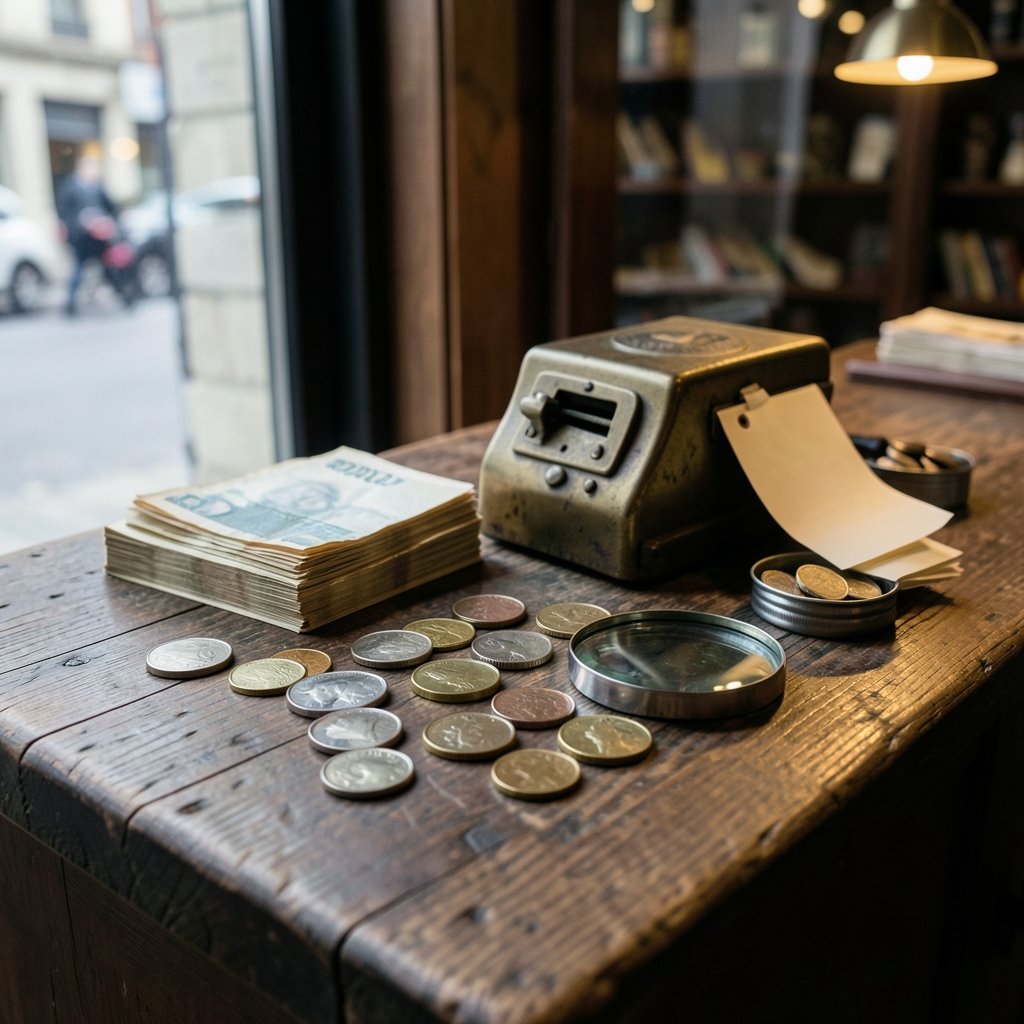
What do a dollar sign, a handshake, and the phrase “money talks” have in common? They are all money signs — different kinds of signals that tell us something about value, trust, or status. The term gets thrown around a lot, and it can mean wildly different things depending on who is using it. Someone might be talking about the symbol on a price tag. Someone else might mean the warning signs that a deal is a scam. A language lover might mean idioms like “cash cow.”
This guide sorts out the main meanings, shows where the symbols came from, and explains how to read the signals that money leaves behind. By the end, readers will be able to spot a money sign in a shop window, a contract, or a text message — and know what it is quietly telling them.
What Does “Money Signs” Actually Mean?
The phrase covers three broad territories.
Currency symbols are the glyphs that stand in for a currency: $, £, €, ¥, ₹. They are shorthand that lets a price be read at a glance.
Money idioms and expressions are the verbal signs — “a pretty penny,” “break the bank,” “funny money.” These phrases carry cultural attitudes about wealth, and they vary by country and generation.
Behavioral and warning signs are the cues that suggest money is involved, moving, or at risk. A sudden request for gift cards. A price that is too good. A contract with a strange clause.
Most confusion happens when people mix these up. A question about “money signs” in a financial-fraud context has nothing to do with typography. So the first practical step is to figure out which sense the speaker means before answering.
The Currency Symbols People See Every Day

Currency symbols are the most literal money signs. They are also the most misunderstood, because their origins are often murky.
The dollar sign: several competing stories
The $ symbol is everywhere, yet nobody can prove exactly where it came from. Three theories dominate.
The first points to the Spanish dollar and the “pillars of Hercules” motif that appeared on Spanish colonial coins — two columns with a ribbon wrapped around them. The second suggests a superimposed “P” and “S” for peso or pesos, with the loop of the P eventually lost. The third traces it to the Portuguese cifrão, a similar symbol used for currency. (Currency symbol)
Because the symbol evolved across centuries and continents, any single origin story should be treated as contested rather than settled. That uncertainty is itself a useful lesson: money signs are cultural artifacts, not mathematical facts.
Other common symbols
The pound sign (£) descends from a stylized “L” for libra, the Latin word for a Roman weight. The euro (€) is a modern invention, designed in the 1990s and deliberately modeled on the Greek epsilon to echo European civilization. The yen and yuan share the ¥ glyph, which is a genuine source of confusion in international trade.
A practical tip that saves real headaches: never rely on a bare symbol in an international document. Write the amount plus a three-letter currency code, such as 500 USD or 500 EUR. Codes remove the ambiguity that symbols create.
Placement and formatting vary by country
In the United States, the symbol goes before the number: $5. In much of Europe, it follows: 5 €. Thousands separators flip too — 1,000 in the US becomes 1.000 in Germany. Decimal points become commas.
This matters: a misplaced decimal mark has caused real invoicing errors. Anyone sending quotes across borders should confirm the local convention before hitting send and state the currency explicitly in the email body rather than only in the attachment.
Money Idioms: The Verbal Signs of Wealth
Idioms are money signs in the linguistic sense. They signal attitudes, not amounts.
| Expression | Rough meaning | Common region |
|---|---|---|
| Money talks | Wealth buys influence | Global |
| A pretty penny | An expensive amount | UK and US |
| Break the bank | Spend too much | Global |
| Cash cow | A reliable profit source | Business English |
| Funny money | Counterfeit or questionable cash | US and UK |
| Money for old rope | Easy earnings | British |
| Old money | Inherited wealth | Global |
The interesting part is what these phrases reveal. “Old money” versus “new money” is a status distinction, not a financial one. “Funny money” signals suspicion. “Money for old rope” carries a hint of envy. Each phrase encodes a social judgment about how the money was obtained.
For writers and marketers, idioms are useful because they are instantly recognizable. For anyone dealing with international audiences, they are risky — a phrase that lands well in London may mean nothing in Lagos or Lima.
Warning Signs: When Money Signals Trouble
The most consequential money signs are the ones that warn of fraud. Scams follow patterns, and those patterns are learnable.
Pressure and secrecy
Legitimate transactions rarely demand urgency. When someone insists a payment must happen in the next hour, or asks the buyer to keep the deal quiet, that is a signal worth slowing down for.
Unusual payment methods
Requests for gift cards, wire transfers to unfamiliar accounts, or cryptocurrency payments are classic red flags. The reason is simple: these methods are hard to reverse. Once the code is read aloud or the transfer clears, recovery becomes extremely difficult. Understanding how the gift card scam works and why victims rarely get their money back helps people recognize the pattern before they act.
Identity and account anomalies
Unexpected password reset emails, login alerts from unfamiliar locations, or a sudden request to “verify” account details are all money signs in disguise. They usually precede an attempt to move funds. Knowing where the money actually goes in identity threat detection makes it easier to see why banks invest so heavily in spotting these signals early.
Digital payment confusion
New payment rails create new signals. Central bank digital currencies, for example, would change how transactions are recorded and traced. Readers curious about that shift can explore how CBDC digital currency works as central bank money goes digital — useful context for judging which “instant payment” claims are plausible.
Money Signs in the Digital World
Money has always been a system of signs. A banknote is just paper; its value comes from collective agreement. Digital money takes that logic further, because most of it is invisible — a number in a database.
That makes verification more important, not less. A few practical habits help.
Check the sender before trusting the message. Display names are easy to fake. Look at the actual address or number.
Treat unsolicited opportunities as signals. Offers to “make money fast” with AI tools deserve scrutiny. Some are genuine; many are not. A grounded look at how to make money with AI separates realistic paths from hype.
Notice when communication goes quiet. In personal and professional relationships, silence is also a signal. People who wonder whether a message was received can check the honest signs in this guide to telling if someone blocked your number — a small but surprisingly common question.
Watch for device-level anomalies. Battery drain, unexpected data usage, and strange background activity can indicate spyware. These are the real signs covered in this explainer on how to check if your phone is being tracked.
Where Money Signals Get Read Professionally
Businesses read money signs for a living. Fraud teams, security analysts, and finance departments all interpret the same raw material — transactions, logins, invoices — looking for patterns that do not fit.
Threat intelligence is one example. Security teams pay for feeds that flag suspicious infrastructure before an attack lands. The economics are not trivial: a guide to where the money goes in threat intelligence costs in 2025 shows how budgets get allocated across feeds, analysts, and tooling.
The same interpretive skill applies to ordinary life. A wedding vendor asking for a large cash deposit with no contract is sending a signal. So is a venue that will not confirm dates in writing. Couples comparing options can use the practical checklist in this guide on how to choose a wedding venue without wasting money or sanity to read those signals before signing anything.
Common Mistakes People Make When Reading Money Signs
Experience shows a handful of errors come up again and again.
Mistaking a symbol for a guarantee. A currency symbol says nothing about whether the price is fair or the seller is real.
Ignoring the currency code. Assuming “$” means US dollars has caused errors in Canada, Australia, and Hong Kong.
Over-reading a single signal. One odd detail is noise. Three odd details together are a pattern.
Under-reading politeness. Scammers are often extremely polite and responsive. Good manners are not evidence of legitimacy.
Skipping the written record. Verbal agreements about money are the most common source of disputes. Put the amount, currency, date, and method in writing, even for small sums.
What actually works is boring: slow down, verify independently, and confirm through a second channel. Call the number on the official website rather than the one in the message. Ask a second person to look at the contract. These steps take minutes and prevent most losses.
A Short History of Money as a Sign
Money has taken many forms — shells, cattle, tally sticks, metal coins, paper notes, and now database entries. In every era, the physical object mattered less than the shared belief behind it.
That is why money signs matter. A coin’s stamp told users who guaranteed its weight. A banknote’s design signals authority and resists forgery. A digital balance signals nothing visible at all, which is exactly why fraud thrives in that space — there is no texture to check, no watermark to tilt toward the light.
Understanding this continuity helps. The symbols change; the underlying question does not. Who is making this promise, and what happens if they break it?
Conclusion
Money signs come in three flavors: the symbols on a price tag, the idioms in everyday speech, and the warning cues that precede loss. Each one is a form of shorthand, and each one rewards careful reading.
The practical takeaways are simple. Use currency codes alongside symbols. Treat urgency and secrecy as reasons to pause. Verify through a second channel before sending anything of value. And remember that a sign is never the thing itself — a dollar sign is not a dollar, and a confident offer is not a guarantee.
Read the signals, then check the substance behind them. That habit is worth more than any single symbol.
Frequently Asked Questions
What is the origin of the dollar sign?
No single origin is proven. The leading theories point to the Spanish “pillars of Hercules” design on colonial coins, a superimposed “P” and “S” for pesos, or the Portuguese cifrão. Because the symbol evolved across several countries over centuries, historians treat all three as plausible rather than settled.
Why do some countries put the currency symbol after the number?
Placement follows local reading conventions. In most of continental Europe, the amount is read first and the currency second, so 5 € feels natural. In the US and UK, the symbol leads. Neither is more correct; consistency within a document is what matters.
What are the most common money idioms in English?
Money talks, a pretty penny, break the bank, cash cow, funny money, and money for old rope are among the most frequent. Most carry a social judgment about how the money was earned or spent, which is why they can be risky with international audiences.
How can someone tell if a money offer is a scam?
Look for three signals together: unusual urgency, an irreversible payment method such as gift cards or wire transfer, and a request for secrecy. Any one is a caution; all three together is a strong reason to stop and verify through an independent channel.
Why should currency codes be used instead of symbols?
Symbols repeat. The dollar sign covers the US, Canadian, Australian, and Hong Kong dollars, among others, and the yen and yuan share a glyph. A three-letter code such as USD or CNY removes the ambiguity entirely, which matters in contracts and invoices.
Are money signs different from financial warning signs?
They overlap but are not identical. Money signs include symbols and idioms as well as behavioral cues. Financial warning signs are the subset that indicates risk — unusual payment requests, pressure tactics, or account anomalies. The term “money signs” is broader and more informal.



