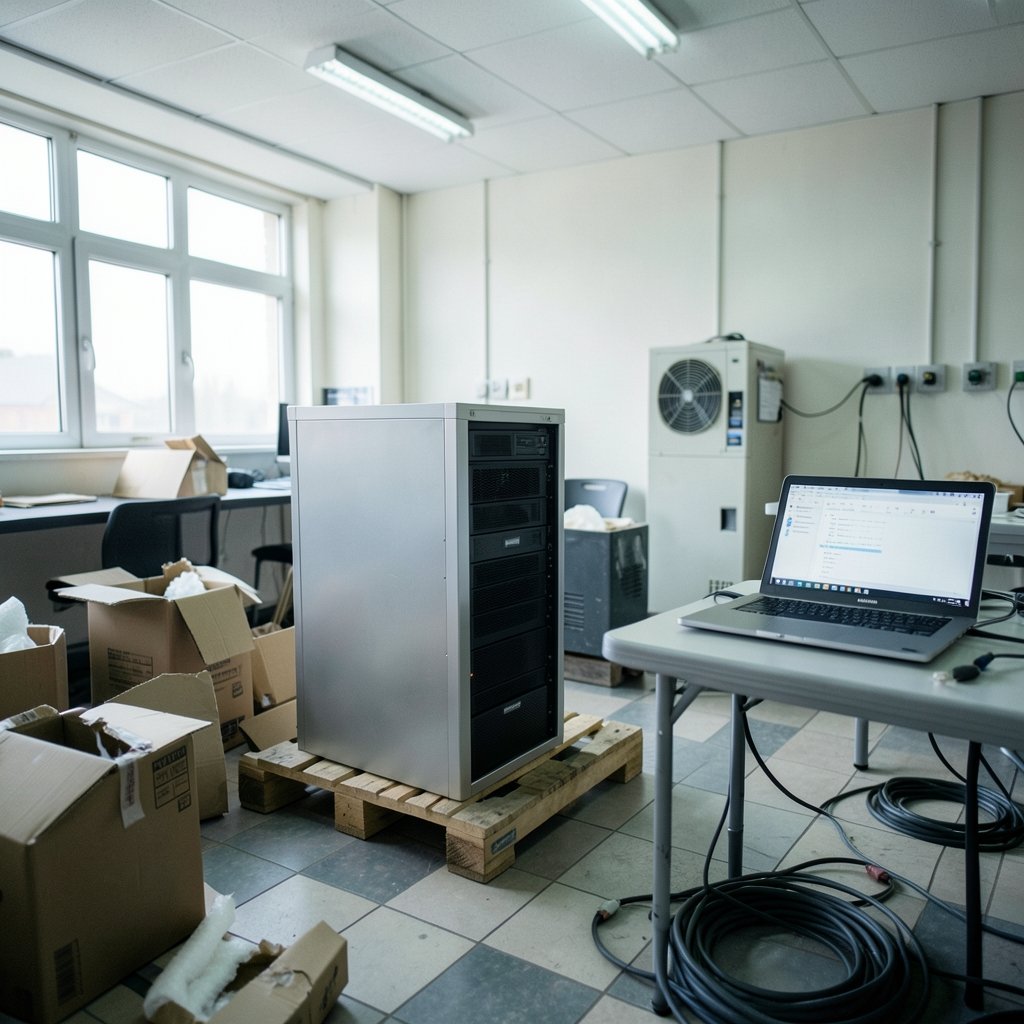
Can a company really buy artificial intelligence the way it buys a server rack — unpack it, plug it in, and get a working AI factory by Friday? That is the promise behind the “AI in a box” idea that keeps surfacing around Nvidia events, and it is the question worth asking before anyone signs a purchase order.
A word of honesty up front: the specific phrase “ABA technology fusion” attached to a Jensen Huang keynote at a GTC Berlin 2026 event is not something that can be verified against any official Nvidia source. Searches of Nvidia’s newsroom, the GTC event pages, and investor communications do not confirm a Berlin GTC with that branding, and the acronym itself has no established meaning in Nvidia’s public vocabulary. It may be a regional marketing label, a mistranslation, or a rumor that picked up momentum online. Rather than invent details, this article separates what is solid from what is speculative — and gives buyers a practical checklist for evaluating boxed AI systems, whatever the label on the crate. (Nvidia)
What “AI in a box” actually means in Nvidia’s world
Nvidia has used the term “AI factory” since roughly 2023–2024 to describe data centers built specifically to produce AI models and tokens rather than store files. The “in a box” variation is less a single product than a packaging philosophy. It shows up in three forms:
| Form | What the buyer receives | Typical buyer |
|---|---|---|
| Integrated appliance | A pre-built server or rack with GPUs, networking, and software pre-installed | Mid-size enterprise, research lab |
| Reference architecture | A validated blueprint the buyer hands to a hardware partner | Large enterprise, cloud provider |
| Cloud-hosted stack | The same software stack rented by the hour | Startups, pilot teams |
The appeal is obvious. Building an AI cluster from scratch involves procurement cycles, power planning, cooling design, and months of integration work. A boxed system compresses that into a delivery window. The catch is that “boxed” rarely means “finished” — it means the vendor has done the parts that are hardest to reverse-engineer.
This pattern is not unique to AI. It echoes how the industry has sold storage arrays, hyperconverged infrastructure, and edge computing appliances for years. The packaging changes; the integration burden usually just moves.
Why Jensen Huang keeps talking about factories, not chips
Huang’s public framing has shifted deliberately over the past few years. He talks less about individual GPUs and more about the full stack — chips, networking, software libraries, and the operational model that ties them together. That shift matters for anyone trying to parse a keynote headline.
When a CEO describes a factory rather than a component, three things happen commercially:
- The unit of sale gets bigger. A customer stops buying a part and starts buying a system, often with services attached.
- Lock-in deepens. Software layers, networking fabrics, and management tools tend to be tuned for one vendor’s products.
- The buying committee expands. Facilities, power, security, and finance all get a vote, along with the infrastructure team.
That is why keynote language and procurement reality often diverge. The keynote sells a vision of instant capability. The contract specifies power draw, lead times, support tiers, and exit terms. Buyers who confuse the two end up surprised.
For a sense of how fast the underlying hardware roadmap moves — and how quickly a “current” box can age — the reported chip supply chatter around devices like the Nintendo Switch 2 Lite and Samsung 8LPU+ silicon is a useful reminder that fabrication capacity is a shared, constrained resource. AI hardware competes for the same foundry slots.
The verification problem with event-specific claims
Conference rumors travel faster than conference agendas. A claim like “Huang announced X at GTC Berlin 2026” has a specific failure mode: it sounds precise, which makes it feel verified. It usually is not.
The reliable path is short and boring. Check the vendor’s official newsroom for dated announcements. Check the GTC event page for the actual agenda and speaker list. Check investor relations for prepared remarks and earnings-call transcripts, which are dated and archived. If a product name appears in none of those places, treat it as unconfirmed regardless of how many aggregator sites repeat it.
This is not pedantry. Procurement decisions built on unverified keynote claims have a habit of producing budget requests for products that do not exist in a sellable configuration. The same discipline applies to security claims — a reminder reinforced by incidents like the Rhysida ransomware breach affecting Berlin government systems, where the gap between assumed protection and actual exposure was the whole story.
What a boxed AI system genuinely solves
Setting the unverified branding aside, the underlying buyer problem is real. Here is what integrated AI systems legitimately fix, based on how the category has evolved.
Power and cooling planning
A modern GPU rack can draw tens of kilowatts. Liquid cooling is no longer exotic; it is often mandatory. Vendors who ship integrated systems usually ship a thermal design that has been tested as a unit. That is genuine value, because retrofitting cooling into an existing data hall is expensive and slow.
Software stack coherence
Driver versions, container runtimes, and model-serving frameworks interact in ways that produce obscure failures. A validated stack removes an entire class of “it worked in the lab” problems. The trade-off is that you inherit the vendor’s version cadence.
Time to first workload
The practical metric that matters is not delivery date but time to first production workload. A box that arrives in six weeks but takes four months to integrate has not saved anyone anything. Ask vendors for this number specifically, and ask for references who will confirm it.
Common mistakes buyers make
First-hand procurement experience across enterprise infrastructure points to a consistent set of errors. These recur regardless of vendor.
- Confusing the demo with the deployment. A keynote demo runs a curated model on curated data. Production runs messy data on a schedule, with users who file tickets.
- Skipping the power audit. Teams order the box before confirming the facility can supply and cool it. The equipment arrives; the electrical upgrade is eighteen months out.
- Ignoring the software renewal curve. Hardware is a capital expense; the software layer is often a subscription that grows. Model the five-year total, not the invoice.
- No exit plan. Ask what happens to your models, data, and tooling if you switch vendors. If the answer involves “start over,” price that in.
- Treating benchmarks as guarantees. Vendor benchmarks are real measurements of specific workloads. Yours will differ. Insist on a pilot with your own data.
How to evaluate any “AI in a box” claim
A practical sequence works better than a feature checklist. Run it in order.
- Confirm the product exists in a sellable configuration. Ask for a part number, a current quote, and a delivery lead time in writing.
- Get the power and thermal spec as a single document. Include steady-state draw, peak draw, coolant requirements, and rack weight.
- Request the software bill of materials. Every layer, every license, every renewal date.
- Run a paid pilot on your own workload. Define success criteria before it starts.
- Talk to two reference customers who are past the one-year mark. Ask about support responsiveness, not satisfaction scores.
- Model the five-year total cost including power, cooling, software renewals, staff training, and refresh.
If a vendor cannot clear step one, the rest is conversation. That single test filters out most of the noise around event-driven announcements.
The wider context: hardware bets and platform risk
Nvidia’s position depends on more than AI demand. The company has made large, public bets across several hardware categories, and those bets shape what gets prioritized internally. Watching how a company like Tesla structures its robotaxi, Semi, and Roadster hardware programs offers a useful parallel: platform commitments create long tails of support obligation, and customers inherit both the benefits and the risk.
The same logic applies to app-store economics and platform fees, where disputes over Apple’s contested App Store commission structure show how platform owners and platform dependents end up in prolonged conflict over margin. Buyers of closed AI stacks should expect similar tension over time. The vendor controls the roadmap; you control only your renewal decision.
Consolidation pressure is another factor. Workforce reductions and studio sales in the gaming sector, such as the reported Xbox layoffs and studio divestitures, demonstrate how quickly strategic priorities shift inside large technology organizations. A vendor’s commitment to a specific product line is a bet, not a guarantee.
What to watch instead of keynote headlines
If the goal is to make a sound decision, watch four signals rather than event coverage.
Dated announcements. A product with a press release date, a part number, and a shipping window is real. Everything else is a slide.
Partner availability. When multiple hardware partners list configurations with pricing, the category has matured. When only one vendor lists it, you are buying a pilot program.
Software release cadence. Frequent, documented updates signal an actively maintained stack. Silence signals the opposite.
Customer disclosures. Earnings calls from buyers, not sellers, are where deployment reality shows up. Companies disclose capital expenditure plans; those numbers are auditable.
For readers tracking the broader consumer and enterprise hardware landscape, the practical buying guides around the best phones of 2026 and Steam Deck stock alternatives follow the same principle: availability and verified specs beat announced ambition every time.
Conclusion
The phrase “ABA technology fusion AI in a box” tied to a Jensen Huang keynote at GTC Berlin 2026 cannot be confirmed against Nvidia’s official channels, and readers should treat it as unverified until a dated announcement appears in the company’s newsroom, GTC agenda, or investor materials. What can be confirmed is the broader direction: Nvidia has spent years selling the AI factory as a system rather than a chip, and integrated appliances genuinely solve real problems in power design, thermal engineering, and software coherence.
The practical takeaway is unglamorous. Ask for the part number. Ask for the power spec. Ask for the software bill of materials. Run a pilot on your own data. Talk to a customer who has lived with the system for a year. None of that requires attending a keynote, and all of it protects the budget. Boxed AI is a real category with real benefits — but the box is only the beginning of the work, and the buyers who understand that are the ones who get value from it.
FAQ
What is “AI in a box” in the context of Nvidia?
It is an informal label for AI infrastructure sold as an integrated unit rather than as separate components. Buyers typically receive pre-configured compute, networking, and a validated software stack. Nvidia’s more established framing is the AI factory: a data center designed to produce AI models and tokens. The “in a box” phrasing is marketing shorthand, not a formal product family.
Is there an official Nvidia GTC event in Berlin in 2026?

This cannot be confirmed from Nvidia’s official event pages or newsroom. Nvidia has held GTC events in Europe in past years, so a European GTC is plausible, but a specific Berlin 2026 event with a Huang keynote on this topic is unverified. Check the official GTC site and Nvidia newsroom directly for dated confirmation. (NVIDIA GTC Conference Overview)
What does “ABA technology fusion” mean?
There is no established meaning for this acronym in Nvidia’s public communications. It does not appear in the company’s newsroom, event materials, or investor disclosures based on available verification. Treat any specific claim built on this term as unconfirmed until a primary source defines it.
How long does it take to get a boxed AI system into production?
Delivery lead times vary widely by configuration and supply conditions. The more important number is time to first production workload, which includes delivery, installation, power and cooling commissioning, software integration, and testing. Ask vendors for that figure specifically and request references who will confirm it, because delivery date alone tells you very little.
What should I ask before signing a contract for integrated AI infrastructure?
Six things: a part number and written quote, a single power and thermal specification document, a complete software bill of materials with renewal dates, a paid pilot with pre-defined success criteria, two reference customers past the one-year mark, and a five-year total cost model that includes power, cooling, software, and training. If a vendor cannot supply the first item, stop there.
Are boxed AI systems worth it compared with building your own cluster?
It depends on your team and your timeline. Integrated systems genuinely reduce risk in thermal design and software coherence, and they shorten the path to a working deployment. Building internally gives more control and potentially lower long-term cost at scale. Organizations without deep infrastructure staff usually come out ahead buying integrated; organizations with large platform teams often do not.