
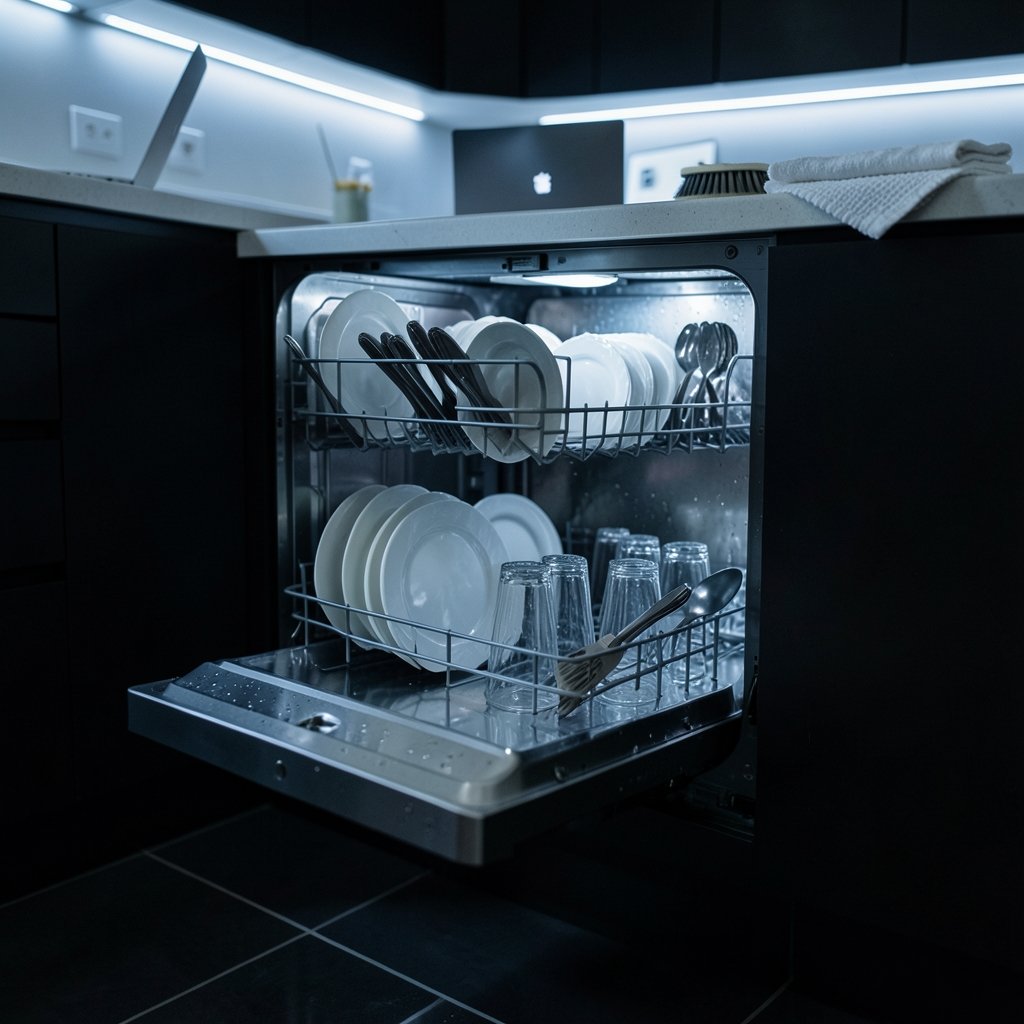
What if the most expensive appliance in your kitchen was also the one you understood the least? Most people spend hours comparing phones or laptops, then buy a dishwasher in twenty minutes because the old one finally gave up on a Sunday night. That backwards approach costs money every single month, because a poorly chosen dishwasher keeps charging you in electricity, water, and quiet frustration for the next decade.
This guide cuts through the spec sheets. It covers the numbers that actually matter, the features worth paying for, the ones that are mostly marketing, and the mistakes buyers make again and again. No single machine is “best” for everyone, but there is a best machine for your kitchen, your water, and your dishes. Here is how to find it.
Start With Size and Place Settings, Not Brand Names
The first decision is physical, not technical. A dishwasher has to fit the gap in your counter, and no feature list saves a machine that will not slide in. Standard full-size units are typically 60 cm wide in Europe and 24 inches in the US, with compact and slimline models at 45 cm or 18 inches. Measure the opening, the depth, and the height under the counter before reading a single review.
Capacity is measured in place settings, a long-standing convention that describes how many standard place settings the machine holds. A 12- or 14-place-setting rating is common for full-size models. Households of one or two people often do fine with a slimline unit, while families with teenagers should look at 13 settings or more. One practical tip: capacity claims assume a perfectly loaded basket. Bowls, tall glasses, and stockpots eat space fast, so look at basket flexibility, adjustable tines, and fold-down rows rather than trusting the headline number alone.
The Energy Label Is Your Best Friend, If You Read It Correctly
Since 1 March 2021, dishwashers sold in the EU carry a rescaled energy label with classes A to G. The old A+, A++, and A+++ grades are gone, which is why a machine that looks “only A” today may be more efficient than a former A+++ model. The label shows energy per 100 cycles and water consumption per cycle, and those ratings are based on the eco programme, not the intensive one.
In the US, ENERGY STAR certification works differently. Under Version 6.0, effective for models certified on or after 1 January 2018, a standard-size dishwasher must use no more than 270 kWh per year and about 3.5 gallons (roughly 13.2 litres) per cycle, with a higher allowance for compact models. That version may have been updated since, so check the current criteria before relying on the badge.
Here is the trap: EU and US figures are not directly comparable. One measures energy per 100 cycles, the other per year, and they test different programmes. Never put them in the same comparison table without a note. If you are shopping across markets, compare within a regime, not across it.
| What you are comparing | EU label | US ENERGY STAR |
|---|---|---|
| Energy unit | kWh per 100 cycles | kWh per year |
| Water unit | Litres per cycle | Gallons per cycle |
| Test programme | Eco | Normal |
| Grade scale | A to G | Certified or not |
Water and Noise: The Two Numbers Buyers Underweight
Modern full-size dishwashers commonly use roughly 9 to 14 litres per normal cycle, depending on the model and programme. That range is background, not a standard, so verify against the manufacturer’s spec sheet or your national label database. In hard-water areas, the built-in water softener matters far more than a litre here or there. Regenerated with dishwasher salt, it protects both cleaning performance and the machine’s longevity. If your water is hard, skipping salt is one of the most common and most expensive mistakes people make.
Noise is rated in dB(A), and the scale is logarithmic, so small numeric differences matter more than they look. Quieter models commonly sit around 39 to 44 dB(A), and very quiet machines reach the high 30s. If your kitchen opens onto a living area, or you run the machine at night in an open-plan home, pay for the lower number. If the dishwasher lives in a separate utility room, save the money.
Drying Matters More Than You Think
Drying is where cheap machines reveal themselves. The common approaches are residual heat drying, condensation drying, and zeolite or heat-pump drying, the last used by some premium brands. Zeolite drying can improve results noticeably, especially with plastic items that hold water, but it adds cost and complexity. Before buying, think about what you actually wash. A household heavy on plastic containers will notice drying performance far more than one that mostly runs glass and ceramic.
Programme Choice Beats Brand Claims
Here is a fact that surprises people: the programme you press matters more than the badge on the door. Eco programmes usually run longer at lower temperatures and use less energy than intensive or quick cycles. A machine with a great label score run on intensive every night will not deliver the savings printed on the sticker. The practical habit is simple: use eco as your default, save intensive for genuinely baked-on loads, and stop pre-rinsing dishes under a running tap. Scrape, don’t rinse.
Running a full load is generally more efficient than washing the same dishes by hand under running water, though results depend heavily on hand-washing habits. The dishwasher wins because it uses a controlled amount of hot water, not a continuous stream.
Features Worth Paying For, and Features That Are Noise
Cutlery trays versus baskets, third racks, adjustable upper baskets, delay timers, and half-load options all earn their keep in daily use. A third rack for utensils frees up the main baskets and is genuinely useful in family kitchens. A half-load setting helps small households avoid running a big machine for four plates.
Less convincing are app connectivity you will use twice, exotic wash zones with unclear benefit, and “smart” diagnostics that mostly exist to sell service plans. The features that age well are boring: a sturdy filter, a reliable door hinge, adjustable baskets, and a quiet motor.
Match the Machine to Your Actual Life
A retired couple and a family of five need different machines, and neither needs the same one as a flat-share of four young professionals who run the dishwasher every night. Think about load frequency, dish mix, kitchen layout, and noise tolerance before you think about brand loyalty. If you are also upgrading other appliances, the same logic applies elsewhere in the home. The thinking behind choosing the best espresso machine for home is surprisingly similar: match capacity and daily habits first, then pay for the features you will actually touch. Coffee buyers who prefer pods face the same trade-off, which is why the guide to the best nespresso machine focuses on routine rather than spec-sheet bragging rights.
Budget discipline matters too. Buyers who research carefully before spending tend to avoid the traps that catch everyone else, whether they are shopping for appliances or reading the mistakes money counting machine buyers get wrong before they spend. The pattern is universal: the expensive errors happen before the purchase, not after.
Installation, Running Costs, and the Repair-or-Replace Call
Factor installation into the budget. Integrated models with custom door panels cost more to fit than freestanding ones, and plumbing changes add up. Check whether your kitchen has a hot-water feed option, since some machines can take warm water and cut heating costs, though not every manufacturer supports it.
On repairs, a common rule of thumb is to replace a dishwasher when the repair cost approaches half the price of a new unit, or when the machine is roughly 8 to 10 years old. That is consumer advice, not a standard, but it holds up well in practice. A cheap fix on a five-year-old machine is usually worth it. An expensive fix on a ten-year-old machine usually is not.
Common Mistakes That Cost Real Money
The first mistake is buying on brand reputation alone. The second is ignoring water hardness, which quietly kills heating elements and leaves film on glasses. The third is oversizing: a two-person household with a 14-setting machine runs half-empty cycles and wastes the efficiency it paid for. The fourth is trusting the quick programme as a daily driver, when eco is both cheaper and gentler on dishes. The fifth is skipping the manual, which is where the salt settings, filter cleaning schedule, and loading diagrams actually live.
There is also a quieter mistake: assuming a machine that is efficient on paper will be efficient in your kitchen. Label figures come from controlled test programmes. Real-world savings depend on how you load, which cycle you choose, and whether you maintain the filter. A well-run mid-range machine beats a neglected premium one every time.
Conclusion
The best dishwasher machine is not the one with the longest feature list or the highest price tag. It is the one that fits your counter, matches your household size, suits your water hardness, runs quietly enough for your layout, and gets used on the eco programme most nights. Read the energy label properly, compare within one market’s regime, weigh drying performance against the dishes you actually wash, and treat installation and maintenance as part of the purchase price. Do that, and the machine you choose will quietly earn its keep for a decade, which is exactly what a good appliance should do.
Frequently Asked Questions
How many place settings do I need?
Match the rating to your household. One or two people usually do well with a slimline or 9 to 10-setting model, while families of four or more should look at 13 settings and up. Remember that capacity claims assume ideal loading, so basket flexibility matters as much as the headline number.
Is a higher energy class always worth the extra cost?
Not automatically. A better class saves energy per cycle, but the payback depends on how often you run the machine and which programme you use. Heavy users running eco daily will recover a price premium faster than occasional users. Compare energy per 100 cycles within one labelling regime, never across EU and US figures.
How much water does a modern dishwasher use per cycle?
Full-size models commonly use roughly 9 to 14 litres per normal cycle, depending on the model and programme. That range is general background rather than a standard, so check the manufacturer’s spec sheet or your national label database for exact figures.
Do I need dishwasher salt if my water is soft?
In soft-water areas, salt is often unnecessary or can be dialled down. In hard-water areas, the built-in softener and regular salt are essential for both cleaning results and machine longevity. Check your water hardness in °dH, °fH, or mg/L CaCO₃ and set the machine accordingly.
What noise level is considered quiet?
Quieter models commonly sit around 39 to 44 dB(A), and very quiet machines reach the high 30s. Because dB is a logarithmic scale, small numeric differences matter more than they appear. Open-plan kitchens benefit most from the lowest number you can afford.
When should I repair instead of replace?
A common rule of thumb is to replace when the repair cost approaches half the price of a new unit, or when the machine is roughly 8 to 10 years old. That is consumer advice rather than a standard, but it is a reasonable starting point for the decision.



