
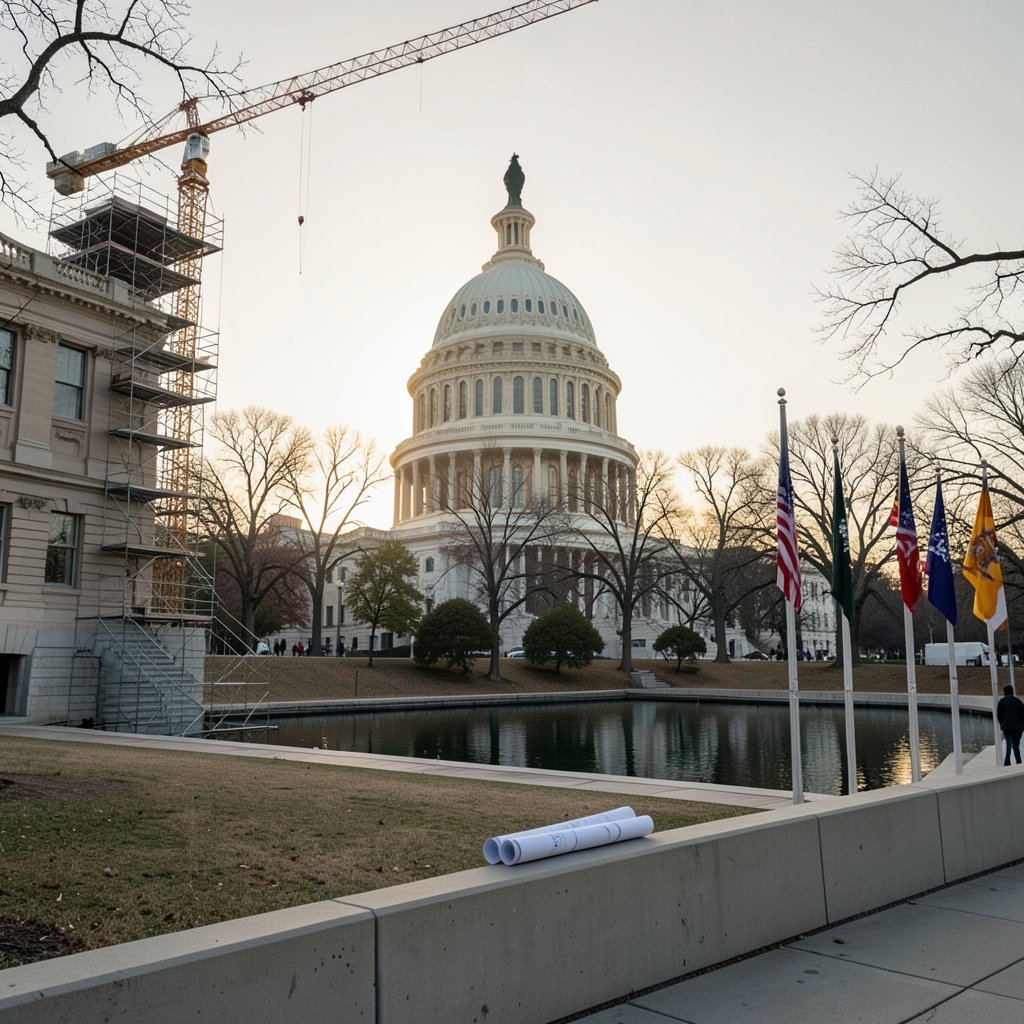
What happens when the people writing the rules for artificial intelligence barely use the technology themselves? That question sits at the center of nearly every major policy fight heading into 2027. After a midterm cycle that reshaped the political map, the year ahead looks less like a single regulatory wave and more like a dozen overlapping currents: a new Congress, emboldened state attorneys general, a European Commission pushing simplification, and companies caught in the middle trying to ship products across borders that no longer agree on what is legal.
The stakes are concrete. Data center construction, chatbot advertising, wearable devices, and the data used to train models all face new scrutiny. Here is what the policy and regulation news shaping tech in 2027 actually means for the people building, buying, and regulating technology.
Why 2027 Became the Pivot Year for Tech Policy
The midterm elections set the tone. Democratic gains, particularly in governorships across states like Texas, Ohio, and Georgia, created what one analyst team at Evercore ISI described as “new pauses and restrictions” for data center development. Tech bull Dan Ives put it bluntly: Democratic control, especially in the Senate, will create “some big hurdles” for AI and technology legislation inside the Beltway over the next two years.
That political shift matters because 2027 is when several long-delayed decisions come due. The 120th Congress is expected to set long-term technology rules by January 2027, according to Ally Page, executive director of the American Innovation Project, who argues that lawmakers need hands-on experience with AI and crypto before they regulate either. Public opinion is pushing them along: Pew found that half of Americans now use AI chatbots, up from one in three in 2024.
So the year opens with a mismatch. Voters want action, legislators want expertise, and industry wants predictability. None of those three are arriving on schedule.
Congress, AI, and the Fight Over Federal Rules

The legislative agenda carries several technology items into 2027, and they do not move at the same speed. Broadband infrastructure funding, Universal Service Fund reform, AI governance, and children’s online safety all sit on the docket, each with its own coalition and its own obstacles.
The AI debate is the loudest. Sen.-elect Abdul El-Sayed of Michigan proposed pausing the training and release of the most capable AI models until federal safeguards exist, banning the development of superintelligent systems and recursive self-improvement, and creating a Cabinet-level agency with authority to inspect AI laboratories, block dangerous model releases, and order shutdowns. Those proposals vary widely in scope and political viability, but together they signal where congressional attention is heading: independent evaluation of advanced models, mandatory reporting of significant risks and incidents, safeguards against misuse or loss of control, and the conditions under which government could step into development and deployment.
Even without consensus on specific requirements, these themes will shape the legislative debate. Companies that treat federal AI law as a 2028 problem are likely to be surprised by how much of it lands in 2027 committee work.
The Chatbot Advertising Question Nobody Has Answered
One of the more interesting subplots involves advertising inside AI assistants. Will a Democratic Congress eventually treat AI chatbots like search engines for ad disclosure and consumer protection? The open questions are unusually practical: can OpenAI charge companies to appear in ChatGPT recommendations, should AI firms be legally required to disclose paid placements, and who actually owns the data used to train these models?
An immediate overhaul of digital advertising is not coming overnight. But Google, Meta, OpenAI, and other large platforms should expect sharply increased scrutiny. Republicans have historically focused on investigating Big Tech’s structural moves, while Democrats tend to probe the underlying economics of digital advertising, user privacy, and the infrastructure powering these platforms. That difference in emphasis will determine which hearings happen and which bills advance.
States Move Faster Than Washington
While Congress debates, state legislatures and attorneys general are already acting. A blue wave in state elections will reshape state tech and AI regulation in 2027, with several areas moving quickly.
| Policy area | What is happening | Why it matters for tech |
|---|---|---|
| Automated decision-making | States are drafting rules on how automated systems make consequential choices | Compliance teams need audit trails beyond model cards |
| Wearables | Some states prohibit smart glasses in certain contexts; others regulate data collected from wearables | Device design and data retention must vary by state |
| Right to repair | A growing number of states require manufacturers to supply parts, tools, and repair information | Hardware makers face patchwork obligations |
| AI-specific enforcement | New AI laws add enforcement authority on top of consumer protection and privacy statutes | Attorneys general can act without waiting for new legislation |
State attorneys general have been active on enforcement involving technology and AI companies, using both long-established authorities and newer powers under AI-specific legislation. Many actions rest on deceptive-practices and consumer-protection laws, plus privacy and child-specific statutes where they exist.
The practical lesson: a company can be fully compliant with federal law and still face a state action over how it described a feature in marketing copy. Enforcement often starts with a claim, not a model.
Europe’s 2027 Agenda: Simplification, Not Retreat
The European Commission’s 2027 Work Programme leans on three pillars: competitiveness, sovereignty, and regulatory simplification. That means defending territorial integrity, building industrial capabilities, tackling the cost of living, and countering adversarial narratives will continue to drive the agenda, but with a lighter touch on paperwork where possible.
The Commission is also proposing to withdraw a stalled tax on significant digital presence, a signal that Brussels wants to reduce friction for digital businesses rather than pile on new levies. On children’s safety online and AI adoption, expect continued activity.
One date to circle: on 8 May 2027, the European Media Freedom Act enters into force. It aims to increase transparency around media ownership and establish safeguards for editorial independence and media pluralism, and it introduces a right for users to customize their media offer. For platforms that curate content, that is a product requirement, not merely a legal footnote.
The Polycentric Problem: One Model, Three Rulebooks
Perhaps the most underrated story is fragmentation. The global technology operating environment is splitting into geopolitical blocs with increasingly incompatible regulatory regimes, supply chain architectures, and technology standards. For any enterprise operating across the U.S., EU, and Chinese market zones, the same AI system, data infrastructure, or vendor relationship may be required, restricted, and prohibited at once, depending on jurisdiction.
That reality changes how teams work. A single global model launch is becoming a series of regional launches with different evaluations, documentation, and data handling. This is the same pattern showing up across other regulated industries, where overlapping rulebooks force companies to build for the strictest market and then carve exceptions. Anyone tracking how AI banking regulations in the US, EU, and UK differ will recognize the shape of the problem.
Sovereignty concerns are intensifying too. Governments are moving from regulating technological power to reducing dependence on it, chasing digital self-sufficiency while Silicon Valley’s social license erodes. For vendors, that means procurement questions increasingly sound like foreign policy questions.
What Actually Works in Practice
Policy compliance fails most often for boring reasons. Here are the mistakes that show up again and again, and what to do instead.
- Treating regulation as a legal-only function. Engineers who learn what automated decision-making rules actually require build better systems than teams that receive a memo six months late.
- Assuming federal preemption will save you. State attorneys general can act under consumer protection law regardless of what Congress does. Build for the strictest state, not the average one.
- Ignoring marketing language. Many enforcement actions begin with a claim about what a product does, not with the model itself. Review feature descriptions with the same rigor as code.
- Forgetting hardware. Right-to-repair laws and wearable restrictions affect device design, spare parts logistics, and data retention.
- Launching globally on one schedule. Regional sequencing is now standard practice for anything touching AI, data, or content curation.
For smaller teams without a policy staff, the practical answer is to pick a small set of jurisdictions that matter commercially and track only those. Chasing every state bill produces noise. Tracking the three states where you have customers produces decisions.
The same discipline applies to tooling. Teams that automate monitoring and reporting spend less time reacting. If your organization is still assembling compliance evidence by hand, the best AI tools for non-technical teams are worth a look, if only to see how much of the documentation burden can be shifted off people.
Where the Pressure Lands Next
Three areas deserve early attention.
First, children’s online safety keeps appearing on both sides of the Atlantic. It has bipartisan appeal in the U.S. and continued priority in Brussels, which makes it one of the few areas where new obligations are likely rather than merely debated.
Second, AI in consumer-facing recommendations. If chatbots get treated like search engines for advertising disclosure, the economics of AI assistants shift. Companies should model that scenario now rather than after a rule lands.
Third, data center siting and energy. State-level politics around construction are already producing delays, and the analyst view is that 2027 will be turbulent as developers adapt to a changed political landscape.
None of this happens in a vacuum. The broader shift toward ambient computing that disappears into daily life makes regulation harder, because the technology stops looking like a product and starts looking like an environment. Rules written for devices struggle with systems that are always on.
Conclusion
The policy and regulation news shaping tech in 2027 is not one story but several running in parallel. Congress is moving slowly toward federal AI rules while individual members push aggressive proposals. State attorneys general are enforcing existing consumer protection law today, no new statute required. Europe is simplifying some obligations while adding others, with the Media Freedom Act taking effect in May. And underneath all of it, the world is splitting into regulatory blocs that make a single global launch impractical.
For technology companies, the winning posture is unglamorous: know which jurisdictions actually matter to your revenue, build to the strictest of them, review your marketing claims as carefully as your models, and stop waiting for Washington to settle things. The organizations that treat 2027 as a year of adaptation rather than a year of delay will spend far less time reacting.
FAQ
What is the biggest tech policy change coming in 2027?
There is no single change. The most consequential developments are the 120th Congress setting long-term AI rules by January 2027, a wave of state-level AI and automated decision-making regulation backed by active attorneys general, and the European Media Freedom Act entering into force on 8 May 2027.
Will Congress pass federal AI legislation in 2027?
It is unclear. Proposals range from pausing training of the most capable models to creating a Cabinet-level agency with inspection and shutdown powers. Even without consensus, congressional attention to model evaluation, incident reporting, and misuse safeguards will shape the debate.
How do state laws affect tech companies if federal rules exist?
State attorneys general can enforce consumer protection, privacy, and child-specific statutes independently, and newer AI laws add authority on top. Many enforcement actions rest on deceptive-practices claims, so federal compliance alone does not guarantee safety.
What does the European Commission’s 2027 Work Programme focus on?
It centers on competitiveness, sovereignty, and regulatory simplification. The Commission is also proposing to withdraw a stalled significant digital presence tax while continuing work on AI adoption and children’s safety online.
What does a polycentric tech world mean for product launches?
It means the same AI system or data infrastructure may be required in one jurisdiction, restricted in another, and prohibited in a third. Companies increasingly sequence launches regionally with different evaluations and documentation rather than shipping one global version.
Which areas should companies watch most closely?
Children’s online safety, advertising disclosure inside AI assistants, and data center siting politics. Each has active momentum on at least one side of the Atlantic and could produce obligations faster than broader AI legislation.



