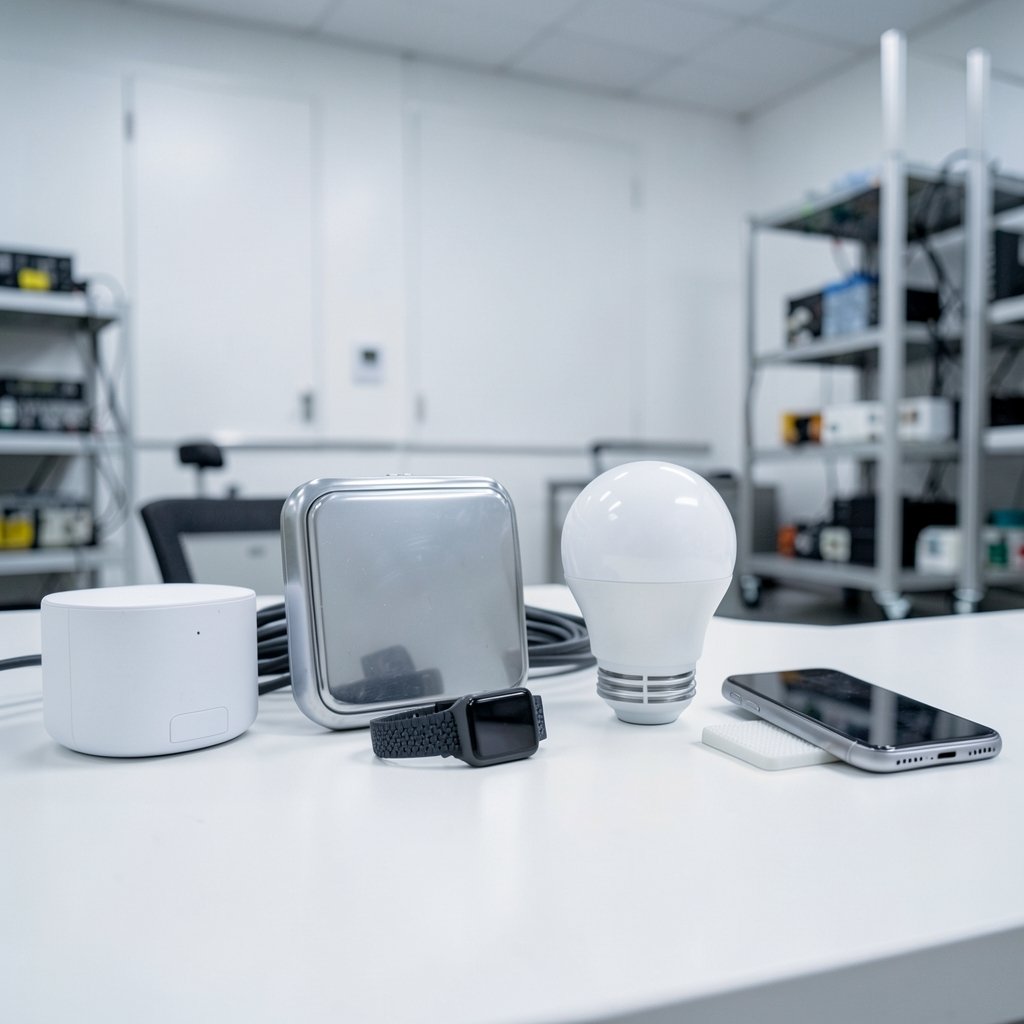
Quick Answer: What is ambient computing?
Ambient computing is a model of computing in which technology fades into the background of everyday environments and responds to people through sensors, voice, and context rather than screens and keyboards. In plain terms, it means the computers around you stop looking like computers: they sit in walls, speakers, lights, watches, and appliances, and they act on your behalf with minimal direct input. You already meet it in smart speakers, connected thermostats, and phones that suggest a route before you ask.
It overlaps with but is not identical to related ideas such as ubiquitous computing, the Internet of Things, and edge computing. Those terms describe infrastructure, hardware, or where processing happens; ambient computing describes the overall experience of an environment that quietly senses and adapts.
Before adopting ambient systems, compare device interoperability, data collection and retention policies, cloud dependence, update support, security history, and total cost of ownership.
In 1991, a Xerox PARC researcher named Mark Weiser wrote that “the most profound technologies are those that disappear.” Three decades later, that prediction has quietly come true in millions of homes. The average modern household now holds dozens of internet-connected devices, many of which never show a traditional interface at all. That disappearing act is the heart of what the industry calls ambient computing — and it is changing how people relate to technology far more than any single gadget launch.
Where the idea came from

Ambient computing did not appear overnight. Its intellectual ancestor is ubiquitous computing, the term Weiser coined in a 1991 paper and expanded in 1993. His vision was of rooms that sense occupants and adjust themselves, with computation woven into fabric, walls, and furniture.
Around 2001, the European Union’s Information Society Technologies Advisory Group popularized the close cousin term ambient intelligence, describing environments that sense and respond to people unobtrusively. The European Commission then funded ambient intelligence research within its Sixth Framework Programme, running from 2002 to 2006. That public funding push helped move the concept from academic papers into policy and product roadmaps.
What changed since then is not the vision but the plumbing. Low-power sensors, cheap wireless radios, on-device machine learning, and reliable voice recognition have made ambient systems practical rather than speculative. The same hardware trends that power the latest breakthroughs in quantum computing headlines are, at the other end of the spectrum, making tiny always-on chips affordable enough to embed in a light switch.
A working definition, and why definitions wobble
There is no single standardized definition of ambient computing. Vendors, analysts, and academics each shade the term differently. Some treat it as a marketing umbrella for always-on, context-aware services. Others treat it as a technical category defined by embedded sensing plus autonomous response.
A practical definition that holds up across most usage: ambient computing is an environment of networked, embedded devices that sense context and act on a person’s behalf with little or no explicit instruction. The emphasis lands on three things — embeddedness, context awareness, and low-friction interaction.
That definition is deliberately loose, and the looseness matters. If you are evaluating products, ask vendors what they mean before comparing specs. An “ambient computing platform” from one company may be a voice-assistant system; from another, it may be a sensor network with an analytics dashboard. The label tells you less than the architecture does.
Ambient computing vs. the terms it gets confused with
Popular articles routinely conflate five related ideas. They are not the same, and the differences affect real purchasing and policy decisions.
| Term | Core focus | Typical example |
|---|---|---|
| Ambient computing | Experience of an environment that senses and adapts | A room that dims lights and lowers music when you start a call |
| Ubiquitous computing | Computation present everywhere, often invisible | Weiser’s original vision of embedded computing |
| Pervasive computing | Computing spread through daily life and objects | Mobile and wearable computing research |
| Internet of Things | Networked physical objects with sensors | Connected thermostats, doorbells, industrial sensors |
| Edge computing | Where processing happens, near the data source | A camera that runs recognition on-device |
The cleanest way to hold them apart: the Internet of Things is mostly about connectivity, edge computing is about location of processing, and ambient computing is about the human experience that results when the first two mature. Ambient systems usually depend on IoT hardware and edge processing, but neither one automatically produces an ambient experience.
This distinction also explains why ambient computing is often discussed alongside artificial intelligence. Ambient environments generate continuous streams of context data, and making sense of that data requires models that run locally and cheaply. For a deeper look at that intersection, see how quantum computing could change artificial intelligence; for the near-term version happening on devices today, what is neuromorphic computing covers the low-power chip designs that make always-on sensing viable. (Ambient intelligence)
The technologies that make it work
Four building blocks carry most ambient systems.
Sensing. Ambient environments need to know something about the world: presence, temperature, light, sound, motion, location. Modern micro-electromechanical sensors cost cents and sip power, which is why they appear in everything from light bulbs to washing machines.
Connectivity. Wi-Fi, Bluetooth Low Energy, and cellular IoT standards let devices talk without wires. Matter and Thread, two interoperability efforts backed by major platform vendors, aim to stop the smart home from fragmenting into incompatible islands.
On-device intelligence. Running models locally reduces latency and keeps raw data off the network. A doorbell that recognizes a package without uploading video is both faster and more private than one that round-trips to a data center.
Natural interfaces. Voice, gesture, and automatic triggers replace menus. The best ambient interface is the one you never consciously operate.
What it looks like in practice
Ambient computing shows up in more places than most people notice.
In the home, a thermostat learns a household’s schedule and pre-cools before occupants arrive. A speaker recognizes a wake word, answers a question, and then goes quiet. Lights shift color temperature through the evening to support sleep.
In cars, keyless entry, automatic climate adjustment, and driver-monitoring systems form an ambient layer around the driver. In retail, shelf sensors track stock without anyone scanning. In healthcare, wearable monitors stream vitals to clinicians and flag anomalies between appointments.
In workplaces, badge systems, room-booking sensors, and presence-aware lighting adjust to occupancy. The pattern repeats: the technology recedes, and the environment simply behaves.
Practical tips, and the mistakes people actually make
First-hand experience with ambient systems tends to produce the same lessons. Here is what works and what trips people up.
Start with one vendor family, not five. The most common mistake is buying devices from four vendors and expecting them to cooperate. Check interoperability certifications before purchase, not after.
Audit what each device records. Many ambient devices log continuously by default. Review retention settings and turn off cloud uploads where local processing is available.
Test the offline behavior. Unplug your router and see what still works. A surprising number of “smart” devices become dumb bricks without a connection.
Watch the update horizon. Ambient devices sit in homes for years. A vendor that stops shipping security patches turns a convenience into a liability.
Beware the novelty trap. Voice control is genuinely useful for timers, music, and lights. It is genuinely frustrating for anything with more than three options. Buy for the tasks you repeat daily, not the demo you saw once.
Budget for the subscription layer. Many ambient services bundle storage or advanced features behind monthly fees. The sticker price rarely tells the full story.
Privacy, security, and the regulatory backdrop
Ambient computing runs on context data, and context data is personal data. A sensor that knows when a room is occupied also knows when it is empty. A voice assistant that hears a wake word is, by design, always listening for it.
In Europe, the governing framework is the General Data Protection Regulation, adopted in 2016 and applicable from 25 May 2018. It imposes requirements around lawful basis, data minimization, and user rights that ambient deployments must respect. Other jurisdictions have their own regimes, and they increasingly treat always-on sensing as a category deserving specific attention.
Security deserves equal weight. Every connected device is an attack surface, and ambient environments multiply that surface across a home or building. Practical defenses include network segmentation, changing default credentials, disabling unused features, and preferring devices with published vulnerability-disclosure policies.
The honest assessment: ambient computing trades a measure of privacy for convenience, and the trade is not always a good one. The right question is not whether a device collects data, but whether the benefit justifies what it collects.
How ambient computing relates to the next wave of hardware
The term is drifting toward newer computing paradigms. Quantum and neuromorphic architectures get most of the press, but the near-term story is more mundane: better batteries, cheaper sensors, and smaller models.
Still, the long arc matters. If quantum hardware eventually delivers on its promises, the contrast with today’s machines will be stark — a gap explored in quantum computing vs classical computing. And anyone who wants the fundamentals before following that story should start with what is quantum computing and how does it work. Ambient computing sits at the opposite end of the spectrum: unglamorous, incremental, and already embedded in daily life.
Where this is heading
Three trends look durable.
Interoperability standards will consolidate. Fragmented ecosystems are expensive for vendors and frustrating for buyers. Shared standards reduce both problems, and the industry has largely accepted that.
Processing will keep moving to the edge. Latency, bandwidth, and privacy all push computation toward the device. The result is ambient systems that work offline and leak less data.
Regulation will tighten around sensing. Expect more scrutiny of always-on microphones, cameras, and presence detection, particularly in workplaces and public spaces.
What is less clear is whether “ambient computing” survives as a distinct term or gets absorbed into whatever the industry calls the next iteration. Either way, the underlying shift — technology that recedes into the environment — is not reversing.
Conclusion
Ambient computing is best understood not as a product category but as a direction of travel. The vision dates to Mark Weiser’s work at Xerox PARC in the early 1990s and to European ambient intelligence research in the early 2000s. The enabling technology arrived much later, and it arrived quietly, in the form of cheap sensors, low-power chips, and voice interfaces good enough to trust with small tasks.
For anyone evaluating ambient systems today, the practical advice is unglamorous: pick one vendor family, check interoperability before buying, audit what each device records, test offline behavior, and plan for the update horizon. The technology works best when it disappears, and it fails worst when it disappears from your awareness while still collecting data. Balance is the whole game.
Frequently asked questions
Is ambient computing the same as the Internet of Things?
No. The Internet of Things describes networked physical objects with sensors. Ambient computing describes the experience that emerges when those objects sense context and act on a person’s behalf without explicit instruction. An IoT deployment can exist without any ambient experience, and ambient systems typically depend on IoT hardware underneath.
Does ambient computing require artificial intelligence?
In practice, yes. Ambient environments generate continuous streams of noisy context data, and turning that into useful action requires models that can classify, predict, and filter. Much of that intelligence now runs on-device rather than in a data center, which reduces latency and keeps raw sensor data local.
Is ambient computing a privacy risk?
It can be. Always-on sensing means devices capture context continuously, including information people did not consciously share. The risk depends on what is collected, where it is stored, how long it is retained, and who can access it. Data minimization, local processing, and clear retention limits substantially reduce exposure.
What is the difference between ambient computing and edge computing?
Edge computing describes where processing happens — near the data source rather than in a distant data center. Ambient computing describes what the user experiences when an environment senses and adapts. Ambient systems usually rely on edge processing, but edge computing alone does not create an ambient experience.
Do ambient devices still work without an internet connection?
It varies widely. Devices that run recognition and automation locally can keep working offline, while those that depend on cloud services often lose core functions when the connection drops. Testing this before purchase is one of the most useful checks a buyer can make, because marketing materials rarely state it clearly.
What should someone check before buying ambient devices?
Compare interoperability certifications, data collection and retention policies, whether processing happens locally or in the cloud, the vendor’s security update commitment, subscription costs for advanced features, and the device’s behavior when offline. Buying within a single vendor family first avoids most compatibility headaches.