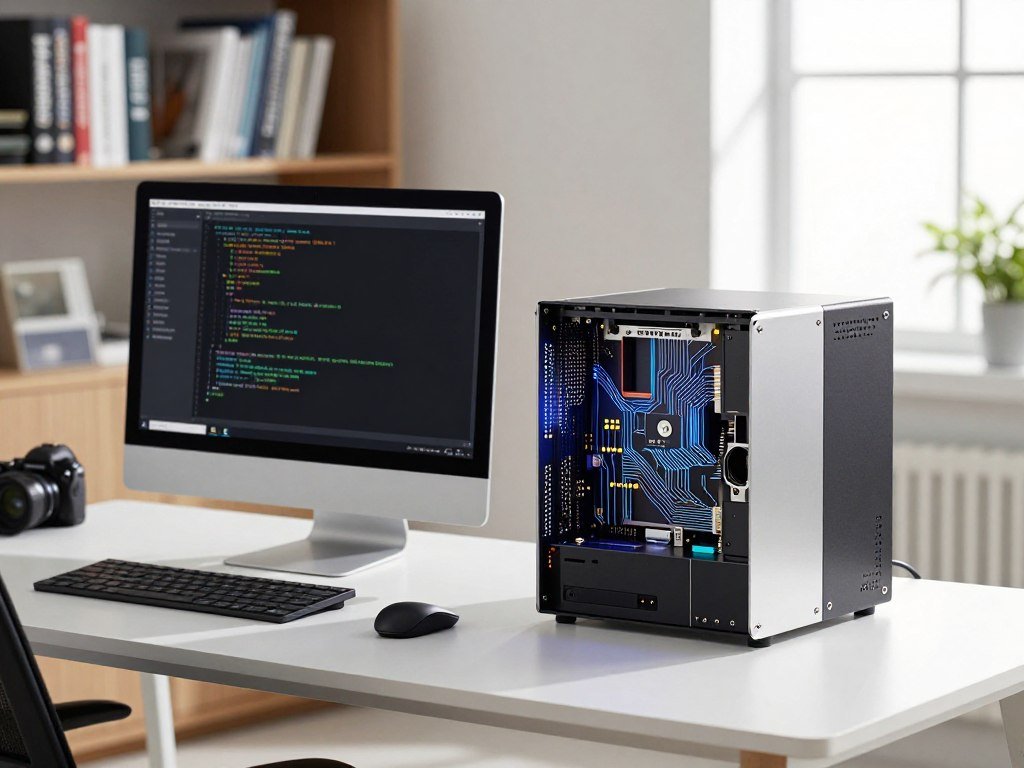
For everyday computing, a classical computer is still the practical choice; a quantum computer is a specialized tool for a narrower set of problems. That difference matters when you work with data, choose technology, or weigh big claims about speed.
Quantum interference is the way quantum-state amplitudes combine to reinforce some measurement outcomes and cancel others. More qubits alone do not guarantee a faster answer, and today’s quantum machines do not replace the computers used for daily work.
This comparison explains the key ideas in plain terms and shows how to judge reported results. You will see where each approach fits, what current hardware can do, and why a fair test needs more than a large qubit count.
Key Takeaways
- Classical computers remain the practical choice for general-purpose work.
- Quantum processors may help with selected types of problems.
- Qubits do not give a machine access to every answer at once.
- Performance depends on the algorithm, hardware, and test conditions.
- Many useful workflows will combine classical and quantum systems.
A fair comparison starts with the kind of problem each machine is built to solve.
Quantum Computing vs Classical Computing: The Core Difference
A classical computer stores information as definite bits; a quantum computer processes qubits whose states follow quantum mechanics. The key difference is how each system represents and changes information.
Classical computers use bits set to 0 or 1, then apply deterministic Boolean operations such as AND, OR, and NOT. A quantum computer uses qubit states and returns classical results when its qubits are measured.
The table works as a simple classical vs. quantum computing diagram. A “normal computer” means a classical computer, whether it uses an Intel or Apple processor architecture.
| Feature | Classical computer | Quantum computer |
|---|---|---|
| Information unit | Bit, 0 or 1 | Qubit, superposition of states |
| Typical operation | Boolean logic | Quantum gates |
| Output | Repeatable result | Measurement outcome |
| Best fit | General-purpose workloads | Selected problem classes |
Quantum computers are not faster versions of normal computers. Their value depends on whether a quantum method suits the task.
The table is a guide, not a full account of how either machine works. Classical processors also differ in design, speed, and software support, so compare them by workload rather than label alone.
For example, an Intel and an Apple silicon computer may handle the same task differently because their processor architectures differ. The best choice depends on the software and work you need to run, as explained in this Intel versus Apple silicon comparison.
The NIST explanation of quantum computing also describes why measurement gives limited information from a quantum system.
For routine tasks such as web browsing, the classical computer remains the straightforward choice.
How Do Qubits Process Information?
A quantum circuit changes a prepared quantum state through a sequence of gates before measurement turns its result into readable data. Each gate changes the state in a planned way, shaping the outcomes the circuit can produce.
Qubit basis states are written |0⟩ and |1⟩. A quantum state can include amplitudes linked to both basis states, but that does not mean a machine reads every possible answer at once.

Superposition and entanglement describe the state
A Hadamard gate can create superposition by changing the amplitudes tied to |0⟩ and |1⟩. The amplitudes affect the likelihood of later measurement results.
A CNOT gate can create entanglement between qubits. Entangled qubits have linked outcomes, so measuring one gives information about the other beyond what separate states would show.
These effects follow quantum mechanics, but they do not let a quantum computer display all possible answers as a readable list. The circuit must shape the state so useful results become more likely.
Interference and measurement shape the answer
Quantum interference is the way quantum-state amplitudes combine to reinforce some measurement outcomes and cancel others. A circuit can use this effect to raise the likelihood of outcomes that help solve its task.
Measurement then returns classical information, such as a 0 or 1 for each measured qubit. Because outcomes can vary, a program may run the circuit many times and study the resulting distribution.
For a clear overview of qubits, gates, and measurement, the NIST guide to quantum mechanics in computing explains the basic ideas in accessible terms.
- Superposition: a quantum state with amplitudes for basis states.
- Entanglement: linked quantum states with related measurement outcomes.
- Interference: the combining of amplitudes that changes outcome likelihoods.
The useful information is the outcome distribution shaped by the circuit, not a printed list of every possible answer.
When Is a Quantum Computer Faster?
A quantum computer is faster only when a suitable algorithm can turn quantum effects into fewer useful computation steps. That advantage is narrow, not a general boost for everyday computing.
Quantum speedups apply to particular algorithms and problem classes, not computing as a whole. Classical parallelism and strong classical algorithms still matter when comparing total runtimes.

For example, Grover’s algorithm gives a square-root speedup for unstructured search. In a search space of 1,000,000 items, it needs roughly 1,000 oracle steps, compared with about 500,000 checks on average for classical search.
An oracle is a step that checks a possible answer. This comparison counts oracle queries, not the time needed to run a full program on current quantum hardware.
A quantum processor must also be prepared, controlled, and measured. Those steps can add time, so fewer algorithm steps do not automatically mean a shorter wall-clock runtime.
A small experiment on a three-qubit processor tested Grover search across different oracle cases. The Grover search study helps show the gap between a theoretical query advantage and a real hardware test.
- Grover’s algorithm: unstructured search across possible answers.
- Shor’s algorithm: integer factoring, with cryptographic effects discussed later.
- Quantum simulation: selected calculations involving quantum systems.
Each example depends on a matching algorithm and a problem that can be expressed in a useful form. A quantum method may offer no gain if the input, output, or hardware limits outweigh its query savings.
Compare the same problem, accuracy target and end-to-end workflow before treating a speed claim as practical.
Which Problems Suit Quantum Computers?
Quantum simulation is a natural candidate because the system being modeled is quantum-mechanical too. That match may help with calculations that are hard to represent on classical computers.
Molecules, materials, and chemical reactions all involve quantum behavior. A quantum processor could represent parts of these systems directly, though useful results still depend on error rates and the quality of the classical comparison.

Simulation and sampling
In October 2025, Google said its Willow processor ran the Quantum Echoes algorithm 13,000 times faster than the best classical algorithm on one of the world’s fastest supercomputers.
Google described Quantum Echoes as a verifiable quantum advantage with possible scientific uses. The result concerns that algorithm and test, not a broad lead across science or business workloads.
Researchers can also use sampling methods to study the outcomes of complex quantum systems. A useful test must state what the processor calculated, how accuracy was measured, and which classical method served as the comparison.
Optimization and other early applications
Routing, scheduling, and sampling are possible targets for quantum methods. They are not guaranteed wins, since classical solvers already handle many hard cases well.
In March 2025, D-Wave reported simulating programmable spin-glass materials in minutes. The company said the task would take nearly a million years on Oak Ridge’s Frontier supercomputer.
A later classical approach outperformed D-Wave on a subset of those problems. That result shows why benchmark details matter: a claim can depend on the selected test cases and the classical method used.
AI, finance, and logistics are possible application areas, not proof of routine quantum advantage. For AI, a useful comparison needs a named task and a result that beats current classical methods under fair conditions.
Computational work in these fields often starts with data that classical computers already manage well. A quantum method would need to deliver value after accounting for input preparation and output analysis.
Treat each claimed advantage as specific to its algorithm, test problem and classical comparison.
What Do Today’s Quantum Processors Actually Do?
Today’s machines are specialized processors whose qubit counts alone do not show how useful they are for a particular task. Architecture matters, as do connectivity, speed, and the quality of operations.
Quantum processors use different hardware approaches, or modalities. No single modality has established dominance in commercial development as of 2026.
Hardware modalities trade different strengths
Superconducting qubits, trapped ions, photonics, neutral atoms, and silicon spin qubits each have different operating needs and design tradeoffs. Their speed, connectivity, and control methods vary.
Superconducting systems use circuits cooled to very low temperatures. Trapped-ion processors use charged atoms, while photonic systems process light. Neutral-atom and silicon spin-qubit approaches use other ways to encode and control quantum states.
A quantum processor and a supercomputer are not direct rivals on every task. A supercomputer combines many classical processors, while a quantum processor is built for selected quantum workloads.
| Processor | Approach | Qubits or topology | Reported result or role |
|---|---|---|---|
| Willow | Superconducting | 105 qubits | 20 million QUOPS per second |
| IBM Nighthawk | Superconducting | 120 qubits, square lattice, four-degree connectivity | Connected qubit layout |
| Intel Tunnel Falls | Silicon spin qubits | 12 qubits | Silicon spin-qubit chip |
| Rigetti Ankaa-3 | Superconducting | 84 qubits | 99.0% median iSWAP and 99.5% median fSim fidelity |
| D-Wave Advantage2 | Quantum annealing | More than 4,400 qubits, Zephyr topology, 20-way connectivity | Specialized optimization and sampling |
QUOPS compares useful computational capability
QUOPS measures useful computational operations per second for a chosen benchmark. It offers one way to compare processors by the work they complete, rather than counting qubits alone.
A September 2026 comparison of physical processors from Quantinuum, Google, and IBM found that capability must grow by five orders of magnitude to meet recognized useful quantum-computing challenges.
The benchmark’s useful challenge calculations needed roughly 250 million to 340 million QUOPS. The highest score on physical hardware was 1,824 QUOPS, while Quantinuum Helios-1 scored more than 1,500.
Google and IBM superconducting processors scored around 200 QUOPS. Willow handled 20 million operations per second by this measure, while Helios-1 handled larger calculations but moved ions more slowly.
Those figures measure different strengths: throughput and calculation size are not the same. The QUOPS benchmark study gives the methods and results behind this comparison.
Qubit count is not a performance ranking
IBM Heron r1 has 133 qubits, while Heron r2 and r3 have 156 each. IBM Condor has 1,121 qubits, a scaling milestone rather than a production system.
Rigetti Cepheus-1-36Q uses 36 qubits across four interconnected nine-qubit chiplets. Its reported median two-qubit gate fidelity is 99.5%, a measure of how closely those operations match their intended results.
D-Wave Advantage2 uses quantum annealing, a model aimed at optimization and sampling. It is not a general-purpose, universal gate-based processor, so its qubit count cannot rank it directly against one.
A meaningful comparison names the workload and measures the quality, connectivity and speed needed to run it.
Why Are Quantum Computers Still Error-Prone?
A quantum calculation can fail when noise corrupts its delicate states before the circuit finishes. Even small disruptions can change the result, especially in a long sequence of operations.
Environmental interactions, temperature changes, and electromagnetic interference can disturb quantum states. Noise limits how deep a circuit can run before its errors overwhelm useful results.
Noise shortens useful circuit depth
Different hardware has different operating needs. Superconducting systems need cryogenic cooling, while photonic systems can operate at room temperature.
Errors can arise during gates, while qubits interact, or when the processor reads a result. A circuit with many operations has more chances to collect errors before measurement.
That is why a processor’s raw qubit count does not show how much work it can finish accurately. A smaller system with better control may run a useful circuit more reliably than a larger, noisier one.
Error correction builds logical qubits
A physical qubit is a hardware unit that can be affected by noise. A logical qubit is quantum error correction’s reliable encoded unit, built from multiple physical qubits.
Error correction uses extra measurements to detect and correct certain errors without simply copying an unknown quantum state. The added checks require more physical qubits and extra operations.
In December 2024, Google’s 105-qubit Willow processor demonstrated below-threshold quantum error correction. This means errors fell as the error-correcting code grew, a sign of progress rather than proof that a large fault-tolerant machine is ready.
The result matters because error correction is a key step toward longer calculations. It does not show that current machines can already run every useful algorithm at large scale.
A useful error-correction milestone shows a path forward, but it does not by itself establish broad practical advantage.
Can Quantum Computers Break Passwords and Encryption?
Current quantum computers cannot practically break RSA-2048, but future fault-tolerant machines could change the public-key security picture. The risk is future-facing, and it differs from ordinary password guessing.
Shor’s algorithm could threaten public-key cryptography such as RSA if a sufficiently large fault-tolerant quantum computer becomes available. Researchers estimate that breaking one 2048-bit RSA key would need a machine with millions of physical qubits.
Public-key cryptography faces the larger future risk
Current systems cannot practically break modern 2048-bit RSA encryption. A factoring demonstration with a 50-bit number is far smaller than factoring a 2048-bit key.
Shor’s algorithm targets the math behind some public-key systems. It does not directly guess an ordinary account password or reveal a password stored in a secure vault.
Grover’s algorithm gives a square-root speedup against symmetric cryptography, which makes exhaustive search less costly in theory. It does not break symmetric encryption outright.
Good password habits still matter for account safety. Use unique, randomly generated passwords and multifactor authentication; a password manager for secure logins can help manage them.
Post-quantum standards prepare classical systems
Post-quantum cryptography is designed to protect data on classical systems from future attacks by quantum computers. NIST finalized its first three standards in 2024.
- FIPS 203: Module-Lattice-Based Key-Encapsulation Mechanism Standard, or ML-KEM.
- FIPS 204: Module-Lattice-Based Digital Signature Standard, or ML-DSA.
- FIPS 205: Stateless Hash-Based Digital Signature Standard, or SLH-DSA.
The NIST post-quantum cryptography standards describe these tools and the work of moving systems to them.
Organizations protecting long-lived sensitive data can begin assessing their cryptography and migration needs before a capable attack machine exists.
How Will Classical and Quantum Systems Work Together?
Classical computers are expected to remain the workhorses, with quantum processors serving as specialized co-processors where a suitable algorithm offers an advantage. Most of the workflow will still run on classical systems.
Quantum computing is not expected to replace classical computers for everyday work. A quantum computer can in principle simulate classical computation, but that is not usually an efficient reason to use one.
Classical computers handle the surrounding workload
Classical computers can prepare data, run operating systems, manage storage and networking, and interpret results. They also send instructions to a quantum processor and collect its output.
This division suits tasks where a quantum calculation forms one small part of a larger process. A research team may need classical tools to clean inputs and check results before any quantum step begins.
AI describes methods and applications, while quantum computing describes a way to process information. The fields can overlap, but quantum processors are not a general replacement for classical computers or today’s AI hardware.
For practical examples of AI tools and their uses, see this guide to free ChatGPT options. AI can also support tasks such as content work and business automation, as shown in ideas for earning income with AI.
AI models need data and testing suited to their tasks. A step-by-step guide to training an AI model covers that process on classical computing systems.
Quantum processors target selected subroutines
A quantum processor can handle a specialized calculation inside a classical workflow. The classical computer prepares the input, sends the quantum instructions, then interprets the measured result.
The Variational Quantum Eigensolver, or VQE, and the Quantum Approximate Optimization Algorithm, or QAOA, are examples of hybrid quantum-classical algorithms.
These methods use classical and quantum steps in a loop. A classical system can adjust inputs based on earlier results, while the quantum processor evaluates a selected part of the problem.
Choose a quantum component only when a defined workload justifies its added control and infrastructure.
That decision should include the time needed to prepare data, run the quantum circuit, and assess its output.
Conclusion
The practical choice is not which technology wins overall, but which one fits the problem. Classical computers remain the right choice for general-purpose work, while quantum processors may help with selected problems.
Any claimed advantage needs a named task and a fair classical comparison. A large qubit count or a striking benchmark alone does not establish a useful result.
Start by identifying a real computational bottleneck in your work. Then check whether a quantum algorithm has shown an advantage for that exact problem, with a suitable accuracy target and test.
Start with the workload, then judge the machine by the result it can deliver.
FAQ
Is ChatGPT a quantum computer?
No, ChatGPT runs on classical computing infrastructure. Its AI model processes text using conventional hardware, not qubits. Quantum computing could become relevant to selected future research, but that possibility does not make current chat tools quantum systems. You can compare ChatGPT with other everyday assistants by trying each tool on the tasks you need.
Is quantum bigger than AI?
No, quantum computing and AI are different categories. Quantum computing is a way to process information, while AI covers methods and applications that perform tasks such as writing, prediction, or image analysis. They can overlap if researchers apply quantum methods to an AI task. That does not make either field a larger version of the other.
What company is leading in quantum computing?
No single company leads across every hardware approach or measure. In the QUOPS benchmark, Quantinuum Helios-1 scored more than 1,500, while Google and IBM superconducting processors scored around 200. Other rankings may favor different measures, such as throughput, qubit quality, or connectivity. A useful comparison names the task and the performance measure first.
Can quantum computers crack a password?
A quantum computer does not automatically reveal passwords. Grover’s algorithm offers a square-root search speedup for certain search tasks, not an outright break of symmetric cryptography. Password safety still depends on strong, unique passwords and secure account settings. Quantum computers today cannot practically break modern encryption systems such as RSA-2048.
Can a quantum computer run classical software?
In principle, a universal quantum computer can simulate classical computation. Ordinary software is usually more practical on classical hardware, which already runs operating systems, browsers, and everyday applications well. A quantum processor needs specialized instructions and careful control. Teams are more likely to use one for a selected calculation than to move a full software system onto it.