Quick Answer: How does wireless charging work?
Wireless charging works through inductive coupling: a coil inside the charging pad carries alternating current, which creates an oscillating magnetic field that induces a current in a matching coil inside your phone. That induced current refills the battery without any metal-to-metal contact. You mostly meet this technology in the Qi standard, the near-universal format built into phones, earbud cases, and car mounts. (Inductive charging)
A newer version called Qi2 adds magnets that snap the coils into alignment, improving efficiency and reducing wasted heat. Some pads use resonant coupling instead, which allows more distance and lets one pad charge several devices at once.
Before buying any charger, compare wattage, Qi2 or MagSafe certification, alignment method, heat management, case compatibility, and whether a power adapter is included.
In 1831, Michael Faraday noticed that a moving magnet could push electricity through a wire without touching it. Nearly two centuries later, that single observation is the reason you can drop a phone onto a pad and walk away while the battery fills. No plug, no port, no fiddling with a cable in the dark. The trick is that nothing magical happens — wireless charging is ordinary electromagnetism dressed up in sleek plastic.
The Core Mechanism: Two Coils and a Magnetic Field
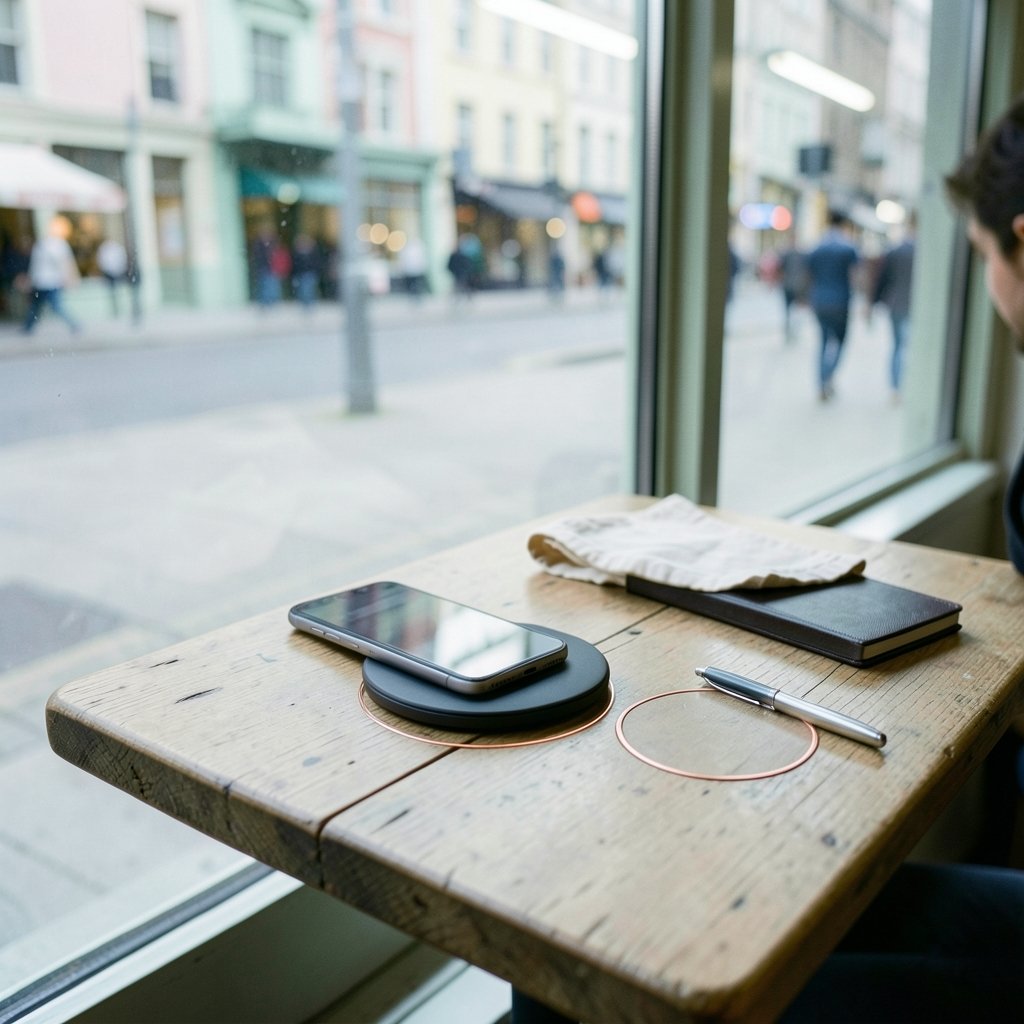
Every standard wireless charger contains a transmitter coil; every compatible phone contains a receiver coil. When you place the phone on the pad, the two coils sit a few millimeters apart.
Here is the sequence, step by step:
- The pad converts wall power into alternating current at a high frequency, typically in the range of 100 to 205 kHz for Qi chargers.
- That current flows through the transmitter coil and generates an oscillating magnetic field.
- The field reaches the receiver coil in the phone and induces a voltage there — the same principle as a transformer.
- The phone’s charging circuitry converts that induced AC back into the direct current the battery needs.
Because the transfer depends on the magnetic field, the coils must line up reasonably well. Shift the phone half an inch off-center and efficiency drops, with the lost energy turning into heat. That is why so many chargers now include magnets or molded cradles to hold the phone in the sweet spot.
The physics itself is settled science; the engineering challenge is doing it quickly, safely, and without cooking the battery. For a broader look at how the accessory ecosystem around phones has evolved, see this guide to the best wireless chargers for iPhone and Android.
What Is Qi, and Why Does It Matter?
Qi (pronounced “chee”) is the wireless charging standard maintained by the Wireless Power Consortium, an industry group founded in 2008. The first Qi specification appeared in 2010, and it has since become the default language that chargers and phones use to negotiate power levels.
The handshake matters more than people realize. When a phone lands on a pad, the two devices exchange tiny data packets over the magnetic field itself. The phone reports what it can accept; the pad adjusts. If a foreign object — a coin, a key, a paper clip — sits between them, the pad detects the disturbance and cuts power. This foreign object detection is a safety feature, not a marketing bullet.
In 2023, the consortium introduced Qi2, which borrows the magnetic alignment approach Apple popularized with MagSafe on the iPhone 12 in 2020. The magnets serve one purpose: keeping the coils concentric so less energy escapes as heat. In practice, Qi2 chargers feel more forgiving because the phone snaps into place rather than requiring careful placement.
Inductive vs. Resonant Coupling
Not all wireless power uses the same method. The two main approaches behave quite differently:
| Feature | Inductive coupling | Resonant coupling |
|---|---|---|
| Coil distance | Very small (millimeters) | Larger (centimeters) |
| Alignment sensitivity | High | Lower |
| Multi-device charging | Usually one device per coil | Several devices per pad |
| Typical use | Phone pads, earbud cases | Some multi-device pads, experimental systems |
| Efficiency | Generally higher at close range | Falls off with distance |
Resonant systems tune both coils to the same frequency, which lets energy jump a wider gap. The trade-off is complexity and cost, which is why most consumer chargers stick with straightforward induction.
How Efficient Is Wireless Charging, Really?
Wireless charging is less efficient than a cable — that part is not in dispute. Energy is lost at every stage: converting wall power to high-frequency AC, radiating the magnetic field, and converting back to DC inside the phone. The gap between what leaves the wall and what reaches the battery varies enormously by device, distance, and alignment, so treat any single “percent efficiency” figure with suspicion unless it comes from a measured test of your specific hardware.
What you can count on:
- Misalignment costs you. A phone placed off-center wastes more energy as heat than one snapped into place.
- Thick cases hurt. Cases beyond roughly 3 mm, or ones containing metal plates, can block the field or trigger foreign object detection.
- Heat is the enemy. Repeated charging in a hot environment stresses the battery over time, which is why well-designed pads throttle power when temperatures climb.
For people who charge while moving around — at a desk, in a gym bag, on a nightstand — the convenience usually outweighs the efficiency loss. If you are choosing earbuds that live in a charging case, this roundup of the best wireless earbuds for working out covers how case charging fits into daily use.
A Short History: From Tesla’s Coils to Your Nightstand
Nikola Tesla demonstrated wireless power transmission concepts in the 1890s, and his name still gets attached to every explainer on the subject. It is worth being clear: Tesla’s experiments are not the basis of the Qi chargers on sale today. They were dramatic demonstrations of the same underlying physics, but modern wireless charging grew out of transformer design and standardized consumer electronics.
The real timeline is more recent and more corporate:
- 2008: The Wireless Power Consortium forms to build a single charging standard.
- 2010: Qi 1.0 is published.
- 2015: The AirFuel Alliance forms from the merger of two rival wireless power groups, pushing resonant and RF approaches.
- 2020: Apple ships MagSafe on the iPhone 12, reintroducing magnetic alignment to a mass audience.
- 2023: Qi2 arrives, folding magnetic alignment into the open standard.
The pattern is familiar: competing formats, one winning broad adoption, then consolidation around the winner’s best ideas.
Practical Tips That Actually Make a Difference
Most wireless charging complaints trace back to setup rather than hardware. A few habits separate a smooth experience from a frustrating one.
Check the power adapter. Many pads ship without a wall brick, and a weak adapter caps charging speed no matter how capable the pad is. Match the adapter to the pad’s rated input.
Take the case off if charging is slow. Cases with magnets designed for MagSafe are fine; thick rugged cases and anything with a metal plate are not.
Avoid charging on soft surfaces. Pads need airflow. A charger buried under a pillow or blanket traps heat, and the phone will slow or stop charging to protect itself.
Do not stack devices. Placing a phone on top of earbuds on top of a pad confuses the coil alignment and can trip foreign object detection.
Use the phone’s own alignment aid. iPhones snap to MagSafe magnets; many Android phones now support Qi2 and do the same. Trust the magnet, not your eye.
Watch for the charging indicator. If the phone buzzes repeatedly or the screen flickers between charging and not charging, the coils are misaligned or something is interfering.
People often assume a pad that feels warm is broken. Mild warmth is normal; a pad that is hot to the touch is not. If your charger runs hot with a particular phone, the pairing is the problem, not necessarily the charger.
Where Wireless Charging Is Heading
The next wave is about range and ubiquity. Qi2’s magnetic profile is spreading beyond phones into earbud cases, cameras, and even some kitchen gadgets. Meanwhile, researchers continue to work on resonant systems that charge multiple devices across a desk surface without precise placement.
Regulators are paying attention too. Wireless power transfer falls under electromagnetic exposure rules, and agencies in the United States and Europe set limits on how much field strength consumer devices may emit. Those rules shape what companies can ship, which is one reason truly long-range charging remains mostly experimental rather than something you can buy at a big-box store.
The broader lesson from the industry is that standards win. Qi succeeded because a hundred competing proprietary chargers could not solve the consumer’s real problem, which was one pad that works with everything. The same dynamic plays out across consumer tech — from charging to AI tools, where new workflows keep reshaping how people spend their time, as covered in this look at how AI is creating more work rather than less.
Common Mistakes and Misconceptions
A few beliefs about wireless charging refuse to die. Here is what the physics actually supports.
“Wireless charging damages your battery faster.” Heat accelerates battery aging, and wireless charging generates more heat than a cable. But a well-designed pad with thermal throttling is unlikely to cause dramatic harm. The bigger risk is charging in a hot car or under a pillow.
“Any pad works with any phone.” Qi is broadly compatible, but fast charging is not. A phone and pad must agree on a power profile to hit top speeds.
“Magnets in the phone ruin the camera or storage.” Modern phones use solid-state storage with no magnetic sensitivity to worry about, and the magnets involved are small and shielded.
“You can charge through anything.” Metal blocks the field entirely. So do thick cases, wallets with magnetic clasps, and anything between the coils.
“Wireless charging is slower, so it is pointless.” It is slower in most cases, yes. It is also the difference between charging your phone at your desk and never charging it at all, because the friction of plugging in is exactly what stops people from doing it.
Conclusion
Wireless charging comes down to two coils, an oscillating magnetic field, and a standard that lets devices from different manufacturers speak the same language. Faraday’s induction principle does the heavy lifting; Qi and Qi2 handle the coordination, safety checks, and alignment that make the experience feel effortless. The technology is less efficient than a cable and always will be, but it removes a small daily friction that adds up over years.
The practical takeaway is simple. Buy a charger that matches your phone’s standard, give it a capable power adapter, keep the coils aligned, and let it breathe. Do those four things and the pad on your desk will quietly do its job for years — no cable required.
FAQ
Does wireless charging work through a phone case?
Usually, yes, as long as the case is under about 3 mm thick and free of metal plates or magnetic mounts not designed for charging. Cases built for MagSafe or Qi2 include alignment magnets and work reliably. Thick rugged cases, folio wallets, and anything with a metal backplate can block the field or trigger the charger’s safety cutoff.
Why does my phone get warm on a wireless charger?
Some warmth is normal because energy lost in the transfer becomes heat. Excessive heat usually points to misalignment, a thick case, a soft surface blocking airflow, or a pad and phone that do not agree on power levels. If the pad is hot to the touch rather than mildly warm, reposition the phone or try a different charger.
Is wireless charging slower than charging with a cable?
In most cases, yes. A cable delivers power directly with fewer conversion losses, so it typically wins on speed, especially with high-wattage fast charging. Wireless pads have closed much of the gap for everyday charging, but a cable remains the faster option when you need a quick top-up before leaving the house.
Can one wireless charger charge two phones at once?
Some can. Multi-device pads usually contain separate transmitter coils, one per device position, so each phone gets its own charging zone. Pads based on resonant coupling can sometimes charge several devices across a wider area. Stacking two phones on a single coil does not work and may trigger a safety shutdown.
Does wireless charging harm your phone’s battery over time?
The main concern is heat, not the wireless transfer itself. Batteries age faster when repeatedly charged at high temperatures, so a pad with thermal management and good airflow is kinder to the battery than one that runs hot. Charging overnight on a cool nightstand is generally fine.
What is the difference between Qi and MagSafe?
Qi is the open industry standard maintained by the Wireless Power Consortium and works across brands. MagSafe is Apple’s implementation, which adds a ring of magnets for alignment and supports Apple-specific accessories. Qi2, introduced in 2023, brings magnetic alignment into the open standard, so the practical gap between the two has narrowed considerably.