
What if two countertop materials with almost the same name behaved like total opposites in your kitchen? That is exactly the trap with quartz vs quartzite. One is a factory-made product. The other is a rock pulled from the ground. They look similar in a showroom, cost similar amounts in many markets, and get confused constantly, yet they age, stain, and handle heat in very different ways. Pick the wrong one for your cooking habits and you will find out the hard way. This guide breaks down what each material actually is, how they compare on the things that matter, and where the marketing gets slippery.
What Quartz and Quartzite Actually Are
The names sound like siblings. Geologically, they are barely related.
Quartzite is a natural metamorphic rock. Sandstone that is rich in quartz gets buried and subjected to intense heat and pressure over long periods. The quartz grains recrystallize and fuse together, so the finished rock breaks across the grains rather than around them. That fusion is why quartzite is tough. It is quarried in blocks, sliced into slabs, and polished.
Quartz countertops are not a rock at all. The material sold under that name is engineered stone: roughly 90 to 95 percent crushed quartz mineral mixed with polymer resin and pigments, cast in a factory into slabs. Exact ratios vary by manufacturer, and no single figure covers every brand. The mineral quartz itself is silicon dioxide, SiO₂, one of the most common minerals in the Earth’s crust. But the slab on the showroom floor is a composite, not a mineral specimen.
This is where most confusion starts. In retail, “quartz” almost always means engineered stone. “Quartzite” always means the natural metamorphic rock. Some sellers blur the line, mislabel slabs, or use “quartzitic” loosely. If a price seems too good for natural stone, ask what the slab actually is.
Quartz vs Quartzite at a Glance
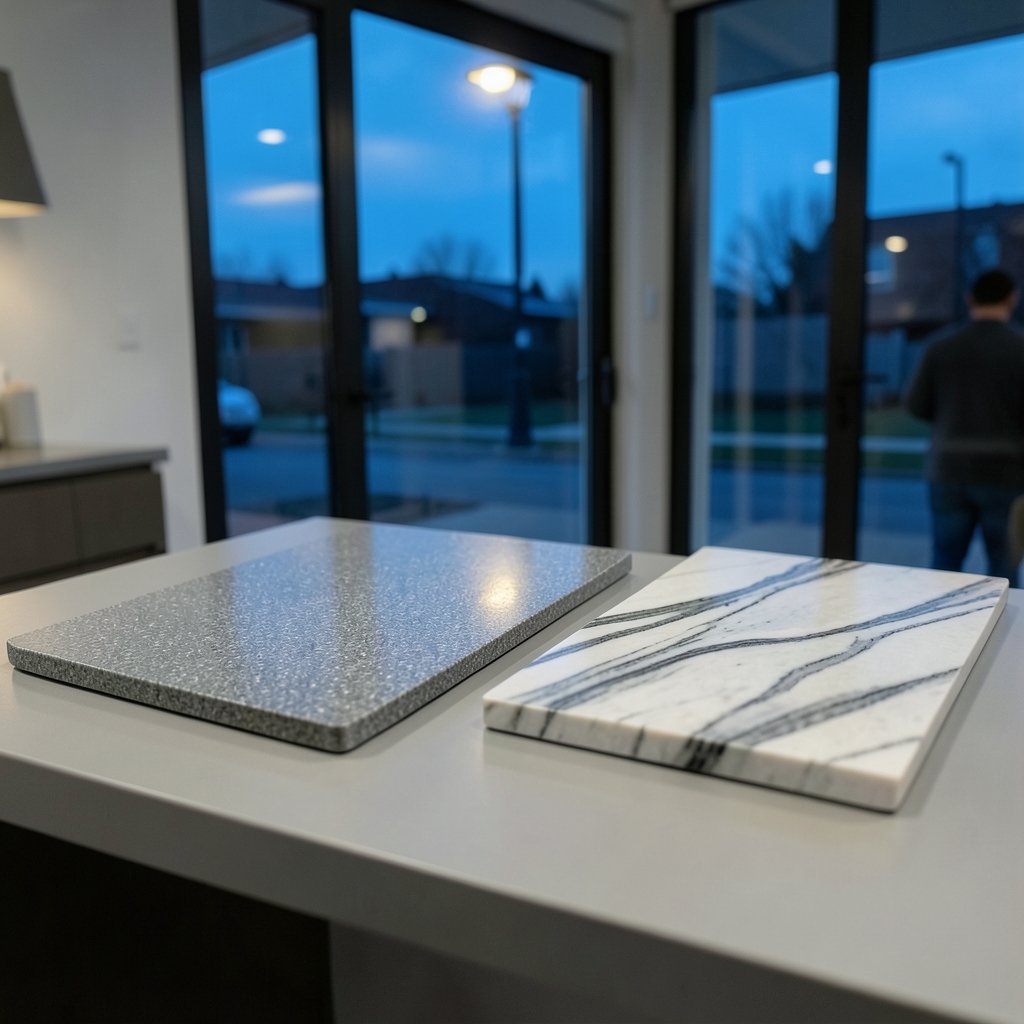
| Feature | Engineered Quartz | Natural Quartzite |
|---|---|---|
| What it is | Crushed quartz plus resin | Metamorphic rock |
| Look | Consistent, uniform patterns | Unique veining, no two slabs alike |
| Hardness | High surface hardness, softer resin binder | Very hard throughout |
| Heat tolerance | Limited; resin can scorch or crack | High; behaves like natural stone |
| Porosity | Non-porous in most products | Porous until sealed |
| Sealing needed | No | Yes, typically periodic |
| Stain resistance | Excellent | Good when sealed |
| Seam visibility | Subtle, blends well | More visible due to veining |
| Repairability | Chips can be filled but rarely invisible | Chips can be repaired by a stone pro |
| Best for | Busy family kitchens, uniform design | Heat-heavy cooking, one-of-a-kind looks |
Heat, Stains, and Everyday Wear
Heat is the sharpest dividing line. Engineered quartz surfaces can be damaged by sustained high heat, and manufacturers commonly advise using trivets and keeping hot pans off the surface. The resin binder is the weak point. A pot straight from the oven can leave a scorch mark or a crack that no polish will fix. Quartzite, being rock, handles heat far better. It is essentially quartz mineral bonded by nature rather than glue, so a hot pan is far less of a crisis. Still, no stone likes thermal shock, so trivets remain smart.
Staining flips the story slightly. Most engineered quartz is non-porous, so spilled wine or oil sits on top and wipes away. Quartzite is porous in its natural state and is usually sealed for countertop use, with resealing recommended periodically depending on the stone and the sealer. How often? Advice varies wildly, and much of it is commercial. A busy kitchen with a light-colored, heavily veined slab may need more attention than a dark, dense one. Claims that quartzite “never stains” are not reliable. Spills left overnight on an unsealed or worn seal can leave marks.
Hardness matters for scratches. Quartz mineral scores 7 on the Mohs scale, and quartzite is largely made of it. Both resist knife marks well, though neither is a cutting board. The difference is what happens after damage. A chip in engineered quartz can be filled, but the patch rarely disappears completely because the pattern is printed through the slab. A chip in quartzite can often be repaired by a stone fabricator who matches the surrounding material.
Design, Consistency, and the Slab Lottery
Engineered quartz wins on predictability. Manufacturers produce consistent lots, so the slab you approve looks like the slab that arrives. Patterns range from subtle speckle to dramatic marble imitation. That consistency makes it easy to plan a kitchen, match a backsplash, and replace a damaged section later.
Quartzite wins on character. Every slab is a one-off, with natural veining that can look like marble, sand, or storm clouds. The catch is the slab lottery. What you see in the warehouse is what you get, and the next shipment will differ. Buyers who fall in love with a photo online are often disappointed. The practical rule: choose your actual slab in person, in natural light, and check both faces if possible. Seam placement also matters more with quartzite because bold veining makes seams obvious. A good fabricator plans seams around the pattern instead of placing them at the shortest distance.
Cost, Maintenance, and What Actually Works
Price varies too much by region and slab to quote firm numbers, but the patterns are stable. Engineered quartz sits in a mid-to-premium range with predictable pricing. Quartzite often costs more, especially dramatic slabs, and fabrication is trickier because the stone is hard on tools. Expect higher labor charges.
Maintenance is where practical experience beats brochure claims. What works for quartzite:
- Seal the slab soon after installation, following the fabricator’s product recommendation.
- Test water absorption yearly by leaving a small water bead on an inconspicuous spot; if it darkens the stone quickly, reseal.
- Wipe up oil, wine, and citrus promptly, even on sealed surfaces.
- Use trivets and cutting boards anyway, because no sealer stops thermal shock or a determined knife.
- Clean with mild soap and water, not acidic or abrasive products.
Common mistakes people make with quartzite include treating it as maintenance-free, using vinegar-based cleaners that degrade sealer, and skipping the water test for years. With engineered quartz, the common mistakes are placing hot cookware directly on the surface and assuming “quartz” means natural stone. If you are also sorting out basic kitchen measurements while planning a remodel, getting the small conversions right early saves headaches later, and a clear reference like this guide to how many cups are in a quart can help when you are comparing container sizes and recipe batches during the planning stage.
One more practical point: both materials are heavy. Cabinets and floor support need checking before either slab goes in, and professional fabrication is not optional for quartzite.
Health and Safety: The Silica Question
Here is the part brochures skip. Cutting, grinding, and polishing both engineered quartz and natural stone release respirable crystalline silica dust, a recognized occupational hazard that can cause silicosis. Engineered quartz has drawn particular regulatory attention because of its high crystalline silica content. Australia moved to ban engineered stone benchtops following silicosis cases among stonemasons, with the ban announced in December 2023 and taking effect in most states from 1 July 2024, though implementation varied by jurisdiction.
For homeowners, the risk sits mainly with fabrication, not daily use. A finished, installed countertop is not a dust hazard. But it is worth asking your fabricator how they control dust: water-fed tools, ventilation, and proper respiratory protection. If a shop shrugs at the question, shop elsewhere. This is also a reason to avoid DIY cutting of either material.
How to Choose Without Regret
Match the material to how you actually live, not how you wish you lived.
Choose engineered quartz if you want a uniform look, low maintenance, strong stain resistance, and predictable replacement. It suits rental properties, busy families, and anyone who wants the kitchen to look the same in ten years.
Choose quartzite if you cook with high heat, want a one-of-a-kind natural surface, and accept periodic sealing. It suits people who love stone character and do not mind a little upkeep.
Whichever you pick, verify the label. Ask for the material name in writing, confirm whether the slab is natural or engineered, and inspect it before fabrication. That single step prevents most of the confusion the two names create. For a deeper look at how liquid volumes and container sizes compare in everyday kitchen planning, this explanation of quart measurements in US and UK systems is a handy companion when you are scaling recipes or sizing containers.
Conclusion
Quartz and quartzite share a name root and little else. Engineered quartz is a controlled, low-maintenance composite with a resin binder that dislikes sustained heat. Quartzite is a natural metamorphic rock with unique beauty, strong heat tolerance, and a genuine need for sealing. Neither is universally better. The right choice depends on your cooking style, tolerance for upkeep, and appetite for natural variation. Decide those first, verify the slab in person, and ask your fabricator the uncomfortable questions about dust control and seams. Do that, and the near-identical names stop being a trap and start being a simple fork in the road.
Frequently Asked Questions
Is quartzite better than quartz for a kitchen countertop?
Neither is better in every case. Quartzite handles heat better and offers unique natural patterns, but it needs periodic sealing. Engineered quartz is non-porous and more consistent, but its resin binder can be damaged by sustained heat. The better choice depends on your cooking habits and how much upkeep you want.
Can I put a hot pan directly on quartzite?
Quartzite tolerates heat far better than engineered quartz because it is natural stone rather than resin-bound composite. Even so, thermal shock can crack any stone, so trivets are still the safe habit. Never place a hot pan directly on engineered quartz.
Does quartzite need to be sealed?
Yes, in most cases. Quartzite is porous in its natural state and is usually sealed for countertop use, with resealing recommended periodically. Frequency depends on the stone and the sealer, and advice varies widely. A simple water-bead test can tell you when it is time to reseal.
Why is engineered quartz sometimes called just quartz?
Retail shorthand. The countertop material is engineered stone made mostly of crushed quartz mineral mixed with resin, but sellers shorten it to “quartz.” Quartzite always refers to the natural metamorphic rock. Because the labels are inconsistent, always confirm in writing what material a slab actually is.
Is engineered quartz safer or riskier than natural stone?
For daily kitchen use, both are safe once installed. The real hazard is silica dust during cutting, grinding, and polishing, which affects fabricators more than homeowners. Engineered quartz has drawn particular regulatory attention because of its high crystalline silica content, and Australia moved to restrict engineered stone benchtops following silicosis cases among stonemasons.
Can chips and scratches be repaired on these surfaces?
Chips in quartzite can often be repaired by a stone fabricator who matches the surrounding material. Chips in engineered quartz can be filled, but the repair is rarely invisible because the pattern runs through the slab. Both resist knife scratches well, though neither replaces a cutting board.
One last consideration: resale and perception. Buyers rarely distinguish quartz from quartzite, but they do notice condition, seam quality, and whether a countertop feels solid and well installed. A modest quartzite slab with clean seams and a current seal outperforms a dramatic one installed badly. Keep your fabricator’s material name, sealer product, and installation date on file; future owners and future you will thank you. Whichever surface ends up in your kitchen, the decision ages well when it is based on verified material, honest expectations, and a fabricator who answers hard questions before the template is made, not after.



