Quick Answer: What is ray tracing and does it matter?
Ray tracing is a rendering method that simulates how light actually travels by following individual light rays as they bounce off objects, and it matters because it can make games and 3D scenes look dramatically more realistic. You’ll find it in modern graphics cards, game settings menus, film production, and architectural visualization tools.
It differs from rasterization, the older technique that draws scenes polygon by polygon and fakes lighting with tricks. Ray tracing calculates real reflections, shadows, and refractions, but it demands far more computing power.
Before you buy hardware or switch on a setting, weigh cost, frame rate impact, upscaler support, game compatibility, and whether the visual gain is worth it to you.
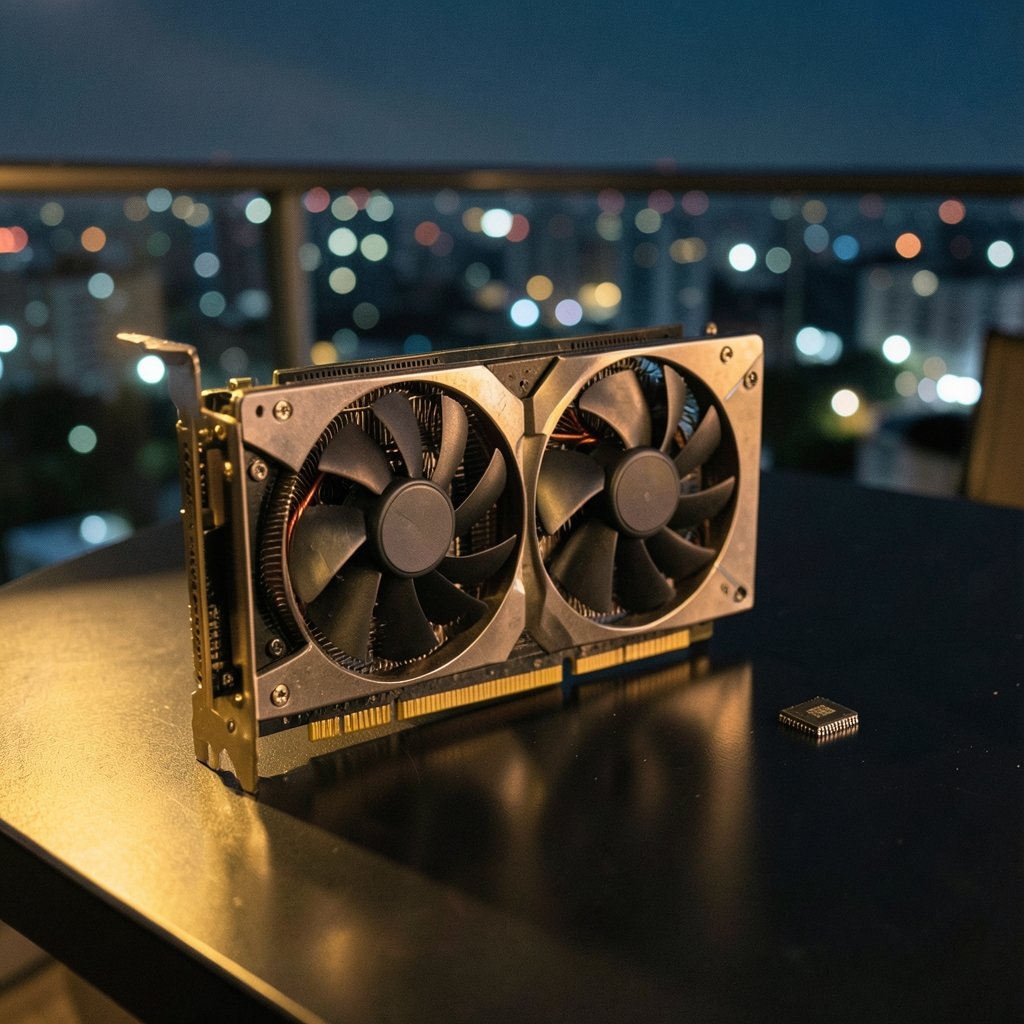
In August 2018, a piece of hardware smaller than a fingernail changed how computer graphics works. Graphics cards built with dedicated ray-tracing cores began shipping that autumn, and within two years both major console families carried the same capability. Yet years later, plenty of players still toggle the setting off without a second thought. That gap between hype and habit is exactly what makes this topic worth unpacking.
The basic idea: following light instead of faking it

Ray tracing is a rendering technique that simulates light paths by tracing rays from the camera through each pixel into a scene. At every point where a ray hits geometry, the renderer calculates shading and, in recursive versions, spawns secondary rays for reflections and shadows.
The technique isn’t new. Turner Whitted published “An Improved Illumination Model for Shaded Display” in Communications of the ACM in June 1980, describing recursive ray tracing for reflections and shadows. Four decades later, the math is largely the same. What changed is the hardware.
Rasterization vs. ray tracing
Most games still use rasterization for primary visibility: geometry is projected onto the screen and filled in pixel by pixel. Lighting effects are approximated with tricks like shadow maps and screen-space reflections. These are fast and clever, but they break down. Reflections vanish at screen edges. Shadows get blurry or flicker.
| Feature | Rasterization | Ray tracing |
|---|---|---|
| How it works | Projects polygons onto the screen | Traces rays through the scene |
| Reflections | Faked, often screen-space only | Computed from actual geometry |
| Shadows | Shadow maps with artifacts | Physically accurate |
| Cost | Low | High |
| Maturity | Decades of optimization | Still maturing |
The honest summary: rasterization is a bag of illusions that works astonishingly well. Ray tracing replaces some of those illusions with simulation. On screen, the difference shows up most in wet streets, glass, and dark interiors lit by a single window.
Path tracing and the rendering equation
The physically based variant is path tracing. James Kajiya’s 1986 paper “The Rendering Equation” formalized how light transport can be computed by tracing many random paths per pixel. The catch is convergence: you need a huge number of samples for a clean image, which is why real-time path tracing was long considered impractical.
This distinction matters when you read marketing copy. A game advertising “ray tracing” may trace one ray per pixel for a single effect. A game advertising “path tracing” or “full ray tracing” is doing something far heavier. They are not the same claim, and reviewers who lump them together do readers a disservice.
How real-time ray tracing became possible
Real-time use demanded dedicated silicon. NVIDIA announced RTX GPUs with dedicated ray-tracing cores at Gamescom in August 2018, and the first consumer cards, the RTX 20-series, shipped in September 2018. Microsoft had announced the DirectX Raytracing API, known as DXR, in March 2018, giving developers a common programming interface.
AMD followed with its RDNA 2 architecture, announced in October 2020 and launched in November 2020. Sony’s PlayStation 5 and Microsoft’s Xbox Series X and Series S, both released in November 2020, include hardware ray-tracing support. Within roughly two years, the feature went from exotic to expected.
Hybrid rendering is the norm
Almost every game labeled “ray traced” is actually hybrid. Rasterization handles primary visibility, and ray tracing handles selected effects: reflections, shadows, ambient occlusion, or global illumination. That’s why two games with the same label can look wildly different and cost wildly different amounts of performance.
Full path tracing in real time remains limited to lighter scenes or setups assisted by upscaling and denoising. If you’re comparing titles, check which effects are traced rather than whether the box says ray tracing.
The denoiser and upscaler dependency
Here’s the part marketing decks skip. Real-time ray tracing is typically paired with denoisers and temporal upscalers such as NVIDIA DLSS, AMD FSR, and Intel XeSS. A noisy, low-sample image gets cleaned up and reconstructed at a higher resolution.
This matters for two reasons. First, performance claims often assume upscaling is on, so a benchmark at native resolution tells a different story. Second, image quality depends heavily on how good the denoiser is. A weak denoiser produces shimmering, smearing, or ghosting behind moving objects. That’s a common frustration among players who expected crisp results and got visual noise instead.
Practical tip: when you enable ray tracing, test it in motion, not in a photo mode. Ghosting and flicker hide in stills and reveal themselves the moment the camera moves.
Does ray tracing actually matter? The honest case
It matters, but not equally for everyone. Here’s how to think about it.
For visual fidelity, yes. Ray-traced reflections and global illumination can transform a scene’s mood. A neon-lit street reflecting in puddles is the cliché for a reason: it’s genuinely hard to fake convincingly.
For competitive play, usually no. If you’re chasing frame rates in a fast shooter, the cost rarely justifies the gain. Many players disable ray tracing and raise refresh rates instead. There’s no shame in that; the setting exists to be toggled.
For hardware buying decisions, it’s a factor, not the factor. Ray-tracing performance varies enormously between GPU tiers, and vendor benchmarks are typically first-party and should be treated as such. Look for independent frame-time measurements across several titles, not a single bar chart.
If you’re weighing a purchase against other entertainment spending, the same logic applies as with any hobby buy: match the hardware to the games you actually play. Enthusiasts comparing lineups often browse roundups of the best racing games to see which titles lean hardest on lighting effects, and lists of the best PS5 racing games are useful because console ray tracing is fixed hardware: you get what the developer shipped.
Common mistakes people make
- Judging by screenshots. Compression hides noise and ghosting. Watch video.
- Testing only in a tutorial area. Early levels are often the lightest.
- Ignoring the CPU. Some ray-traced modes shift load to the processor and bottleneck there.
- Forgetting the display. Ray tracing on a 60Hz panel with a weak GPU is a slideshow.
- Assuming all “RT” labels are equal. Check which effects are traced.
Where else ray tracing shows up
Gaming gets the headlines, but ray tracing is standard in offline film rendering, product design, and architectural visualization. It’s also used in acoustics and radio propagation modeling, where “rays” stand in for sound or signal paths. The underlying idea, tracing paths through an environment to see what arrives where, travels well beyond pixels.
That breadth is why the concept keeps resurfacing in adjacent tech conversations. The same rendering pipelines that produce ray-traced frames feed the visual output people discuss when they ask what AI inference is and why it matters, since both hinge on dedicated accelerators doing enormous parallel math. And as more rendering and sharing happens online, community norms around crediting and discussing footage have become their own topic, which is part of what netiquette is and why it matters in practice.
A quick analogy that sticks
Think of rasterization as painting a mural on a wall: fast, convincing from the right angle, but flat if you walk around it. Ray tracing is closer to building a diorama with real mirrors and lamps. More work, more convincing, and much heavier to move.
How to evaluate ray tracing before you spend
- Identify the effect. Is the game tracing reflections, shadows, global illumination, or full path tracing? The cost scales accordingly.
- Check the upscaler. Confirm which upscaling tech the game supports and how it looks at your resolution.
- Find independent benchmarks. Look for frame-time data across multiple titles, not one showcase scene.
- Match to your display. A high refresh rate monitor changes the calculus entirely.
- Try before you commit. Many games let you toggle the setting mid-session; use that.
If you mostly play arcade-style driving titles, the visual payoff from ray-traced reflections on car paint is real but modest, and free browser-based options scratch the itch without a GPU upgrade at all. Plenty of players get their fix through car games free to play, or browse free online auto games that find racing and driving titles, precisely because the hardware barrier disappears. For a family-friendly offline alternative, a horse racing board game needs no graphics card whatsoever, which is its own kind of argument about where entertainment value actually lives.
And if you’re curious how ray tracing fits into the broader racing-game conversation, including titles that lean on it heavily, it’s worth reading up on what the GTA 6 gameplay leak revealed about street racing, since open-world lighting is one of the areas where the technique earns its keep.
The bottom line on whether it matters
Ray tracing matters as a capability and less as a checkbox. It has moved from research paper to console standard in about four decades, and from announcement to mass-market hardware in roughly two years. That’s fast. But the technology’s value depends on the specific game, the specific effect, and the specific hardware underneath.
The balanced view: it’s a genuine leap in realism for cinematic and atmospheric titles, a costly luxury for competitive ones, and a standard production tool everywhere else. Treat vendor performance claims with skepticism, test in motion, and decide with your own eyes. If the difference doesn’t move you, save the money and raise your frame rate. That’s a perfectly rational choice.
Frequently asked questions
Is ray tracing the same as path tracing?
No. Path tracing is a physically based form of ray tracing) that traces many random light paths per pixel to approximate global illumination. It’s far more expensive, which is why real-time path tracing is limited to lighter scenes or setups that lean on upscaling and denoising. A game can advertise ray tracing while tracing only reflections or shadows.
Do I need a special graphics card for ray tracing?
In practice, yes. Real-time ray tracing relies on dedicated hardware: NVIDIA’s RT cores introduced with RTX in 2018, AMD’s RDNA 2 architecture from 2020, and the ray-tracing units inside the PlayStation 5 and Xbox Series X and Series S. Older GPUs can run some effects in software, but performance is usually poor.
Does ray tracing hurt frame rate?
Substantially, yes. Traced effects can consume a large share of frame time, which is why games pair ray tracing with upscalers and denoisers. The exact cost varies enormously by title and by which effects are enabled. Enabling only reflections is usually cheaper than enabling full global illumination.
Is ray tracing worth turning on?
It depends on the game and your priorities. For atmospheric, cinematic titles, the improvement in reflections and lighting can be striking. For fast competitive games, the frame-rate cost usually outweighs the visual gain. Try toggling it mid-session and judge in motion rather than from screenshots.
Why do ray-traced games sometimes look noisy or blurry?
Real-time ray tracing uses relatively few samples per pixel, producing a noisy image that a denoiser cleans up. Temporal upscalers then reconstruct detail at a higher resolution. Weak denoisers cause shimmering, smearing, or ghosting behind moving objects. Image quality therefore depends as much on software quality as on raw hardware power.
Can ray tracing be used outside of video games?
Yes, extensively. It’s standard in offline film rendering, product design, and architectural visualization, where accuracy matters more than real-time speed. Variants of the technique are also used in acoustics and radio propagation modeling, tracing paths through an environment to predict what arrives where.
Conclusion
Ray tracing is one of those technologies that sounds like marketing until you see it done well: a rain-slicked street reflecting neon, a glass tower bending the skyline behind it, a room lit by a single window. The concept dates to 1980, the rendering equation to 1986, and the consumer hardware to 2018. What’s changed is that the capability is now everywhere, from high-end GPUs to both current console families.
Does it matter? For visual ambition, yes. For every buyer, not necessarily. The sensible approach is unglamorous: identify which effects a game actually traces, check independent benchmarks rather than first-party charts, test the setting in motion, and weigh the frame-rate cost against what you personally notice on screen. Hardware is a tool, not a trophy. Buy the one that serves the games you play, and toggle the settings until the picture looks right to you.