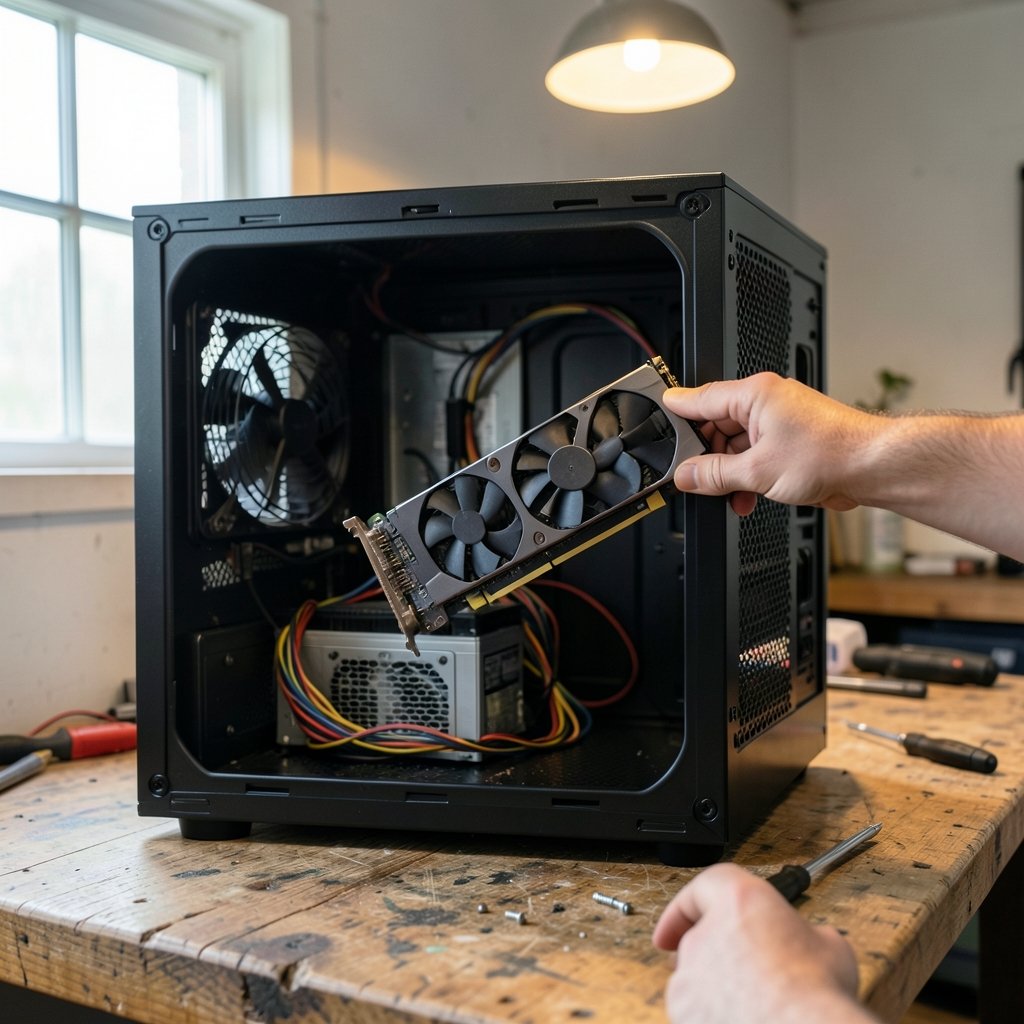
What happens when two mid-range graphics cards stop being shiny new launches and start fighting for the same upgrade budget a year later? That is the real question behind the RX 9070 XT vs RTX 5070 Ti matchup in 2026. Both cards arrived in early 2025, both target the same 1440p-to-4K buyer, and both have had time for drivers to mature and prices to drift.
This comparison cuts through the launch-day hype. It covers architecture, raw performance, ray tracing, upscaling, VRAM, power draw, pricing, and the practical mistakes buyers make when choosing between them.
The Short Answer Before the Deep Dive
The Radeon RX 9070 XT (RDNA 4) launched at a widely reported $599 and generally wins on raster value per dollar. The GeForce RTX 5070 Ti (Blackwell) launched at $749 and generally wins on ray tracing, DLSS features, and creator workloads. Both ship with 16GB of VRAM.
Neither card is a bad buy. The right pick depends on what you actually play and create, not on which brand logo you prefer.
Architecture and Specs Side by Side
AMD built RDNA 4 around efficiency and a redesigned ray tracing pipeline. NVIDIA built Blackwell around AI acceleration and its tensor core ecosystem. Here is how the two stack up on paper.
| Feature | RX 9070 XT | RTX 5070 Ti |
|---|---|---|
| Architecture | RDNA 4 | Blackwell |
| Reported launch MSRP | $599 | $749 |
| VRAM | 16GB | 16GB |
| Upscaling tech | FSR (with frame generation) | DLSS (with multi-frame generation) |
| Strength | Raster value | Ray tracing, AI features |
| Best for | Pure gaming budgets | Gaming plus creation |
The spec sheet tells only half the story. Driver maturity matters just as much, and by 2026 both cards have had roughly a year of optimization behind them.
Raster Performance: The AMD Home Turf
In traditional rasterized games, the two cards land close enough that pricing decides the winner. The 9070 XT was consistently framed in 2025 coverage as the value play against the 5070 Ti, and that framing has aged reasonably well.
A few practical points matter more than any single benchmark:
- Resolution changes the gap. At 1080p, CPU limits can flatten differences. At 1440p and 4K, the cards separate more clearly.
- Game engines matter. Titles built on engines that favor AMD hardware can swing results by double digits.
- Frame pacing beats averages. A card that hits a slightly lower average but delivers smoother frame times often feels better in practice.
If someone mostly plays competitive shooters at 1080p or 1440p, the 9070 XT’s price advantage is hard to argue with. If they want headroom for heavier titles, both cards are viable.
Ray Tracing and Upscaling: Where NVIDIA Pulls Ahead
Ray tracing remains NVIDIA’s clearest advantage. Blackwell’s RT cores handle heavy ray-traced workloads more gracefully, and DLSS has a deeper feature set, including multi-frame generation.
AMD’s FSR has improved substantially, and frame generation is now part of the package. But the practical gap shows up in three places:
- Image quality at lower render resolutions. Upscalers do their hardest work at 1440p and below.
- Feature support in new releases. DLSS tends to arrive first and get patched fastest.
- Ray-traced heavy hitters. Path-traced and fully ray-traced titles stress RT hardware far more than hybrid implementations.
For players who leave ray tracing off, this section matters less. For players who turn it on whenever a game offers it, the 5070 Ti justifies part of its price premium here.
VRAM, Bandwidth, and Future-Proofing
Both cards carry 16GB of VRAM, which is the sensible floor for 1440p gaming with high textures and a reasonable ceiling for most 4K work. That parity removes what used to be AMD’s easiest talking point.
What still differs is how each vendor manages memory compression and cache. AMD’s approach leans on large on-die caches to reduce pressure on the memory bus. NVIDIA’s approach leans on compression efficiency. In practice, both handle 16GB competently at 1440p.
The bigger future-proofing question is texture-heavy titles. Games shipping in 2026 increasingly assume 12GB as a minimum and 16GB as comfortable. Neither card is stranded, but neither has slack to waste either.
Power, Thermals, and Build Quality
Power draw shapes the total cost of ownership more than people expect. It affects the power supply someone needs, the case airflow required, and the noise floor of the whole build.
| Consideration | RX 9070 XT | RTX 5070 Ti |
|---|---|---|
| Board partner variety | Broad | Broad |
| Cooler size | Large triple-fan common | Large triple-fan common |
| PSU planning | Check connector and wattage | Check connector and wattage |
The practical advice here is unglamorous but important. Measure the case clearance before buying a triple-fan card. Confirm the power supply has the right connectors and enough headroom. Buy from a board partner with a reputation for quiet coolers rather than chasing the cheapest listing.
Anyone weighing a bigger upgrade should also track how supply is shifting across the market. Reports around the Nvidia RTX 50 Super delay in 2026 show how launch timing ripples into pricing for existing cards. Similarly, news that Asus is set to reorder its RTX OEM lineup in Q4 2026 can affect which models stay on shelves and at what price.
Pricing Reality in 2026
Launch MSRPs are history. What matters is street pricing today, and that number moves for boring reasons: retailer stock, regional taxes, bundle promotions, and currency shifts.
A realistic way to judge value is to compare the price gap against the performance gap. If the 9070 XT sells meaningfully below the 5070 Ti and the raster gap is small, the AMD card wins on pure frames per dollar. If the gap narrows to a few percent, the NVIDIA feature set becomes much easier to justify.
Buyers should also watch for the used and refurbished market. A year-old card with a transferable warranty can undercut both new options. The tradeoff is risk, so buying from a seller with a return window is essential.
Common Mistakes Buyers Make
Experience with mid-cycle GPU purchases surfaces the same errors again and again.
- Trusting a single benchmark video. One game, one resolution, one driver version proves very little.
- Ignoring the monitor. A 1440p 165Hz panel and a 4K 60Hz panel demand different priorities.
- Forgetting the platform. An older CPU can bottleneck either card at 1080p.
- Overpaying for features never used. Someone who never enables ray tracing is paying for hardware they will not touch.
- Skipping the PSU check. A new GPU that trips a marginal power supply ruins the whole upgrade.
- Buying at the worst moment. Launch windows and shortage periods inflate prices. Patience usually pays.
The fix is simple: list the five games played most, note the monitor’s resolution and refresh rate, then compare benchmarks for those specific titles.
What About Waiting for the Next Generation?
Timing questions dominate mid-cycle buying. Rumors about future launches always swirl, and 2026 is no exception. Coverage of a second leaker pointing to an RTX 6000 delay into 2028 suggests the next flagship generation may be further out than some buyers assume.
That changes the calculus. If the successor generation is genuinely years away, waiting has a real cost: months or years of lower frame rates. Buyers who need performance now should weigh that against speculative future gains. Those still deciding between tiers can read a breakdown of whether to buy the RTX 5090 now or wait for an RTX 5080 24GB for a parallel look at how timing affects value.
There is also the enthusiast angle. Some buyers squeeze extra life from older hardware rather than upgrade at all, and reporting on the RTX 3090 BF16 unlock reaching 129.6 TFLOPS shows how much untapped capability older cards can still hold for compute-minded users.
Who Should Buy Which Card
The decision tree is shorter than the spec sheets suggest.
Choose the RX 9070 XT if:
- Rasterized gaming is the priority.
- The price gap at the local retailer is significant.
- Ray tracing is rarely or never enabled.
- The budget is firm and every dollar counts.
Choose the RTX 5070 Ti if:
- Ray-traced titles are a regular part of the library.
- DLSS and multi-frame generation will actually be used.
- Video editing, 3D rendering, or AI workloads are part of the mix.
- The price premium is small relative to the total build cost.
Neither answer is wrong. The mistake is buying based on brand loyalty instead of a specific use case.
Conclusion
The RX 9070 XT vs RTX 5070 Ti debate in 2026 comes down to a familiar trade: AMD offers more raster performance per dollar, while NVIDIA offers a stronger feature stack for ray tracing and creative work. With 16GB of VRAM on both sides and a year of driver maturity behind them, neither card embarrasses itself.
Buyers should anchor the decision to their monitor, their game library, and the actual street price on the day of purchase. Check benchmarks for the specific titles played, confirm the power supply and case clearance, and avoid buying during shortage spikes. Do that, and either card will serve well for years.
FAQ
Is the RX 9070 XT faster than the RTX 5070 Ti in raster games?
They land close in traditional rasterized games, and results vary by title and resolution. The 9070 XT’s main advantage is price rather than a large raw performance lead.
Does the RTX 5070 Ti have more VRAM than the RX 9070 XT?
No. Both cards ship with 16GB of VRAM, so memory capacity is not a deciding factor between them.
Which card is better for ray tracing?
The RTX 5070 Ti generally handles ray-traced workloads better thanks to Blackwell’s RT cores and the DLSS feature set, including multi-frame generation.
Is DLSS better than FSR in 2026?
DLSS still holds an edge in image quality at lower render resolutions and in how quickly new games support it. FSR has closed much of the gap and now includes frame generation.
Should I wait for the next GPU generation instead of buying now?
That depends on timing. Reports suggest the next flagship generation may be delayed, so waiting could mean a long stretch with older hardware. Buyers who need performance now should weigh that against uncertain future gains.
What power supply do I need for these cards?
Check the board partner’s recommended wattage for the specific model, confirm the connector type, and leave headroom for the rest of the system. Triple-fan versions of both cards are physically large, so verify case clearance before buying.
One last practical note: driver maturity cuts both ways. AMD’s software stack has stabilized considerably over the past generation, and the launch-window issues that once defined RDNA releases are largely absent from the 9070 XT. NVIDIA’s drivers remain the safer bet for day-one game support and professional application certification, but the gap is narrower than forum arguments suggest. Whichever card is chosen, update drivers cleanly, avoid beta branches unless a specific fix is needed, and keep a rollback plan. A stable system with slightly lower benchmark scores beats a marginal driver advantage that crashes mid-session. Buy for the games played today, with enough headroom for the next two years, and the choice becomes straightforward either way.