
What if the most expensive CPU on the shelf turns out to be the one your motherboard refuses to boot? That is the scenario thousands of gamers are walking into as they weigh a Ryzen 9950X3D2 against a 9850X3D, staring at a $899 versus $499 price gap and wondering whether the extra $400 buys frames or just bragging rights. The honest answer is that neither chip exists in a vacuum. Compatibility, not raw specs, decides whether your upgrade works at all. This guide walks through how to check that before you spend a dollar. (Ryzen 9800x3d vs 9850x3d check compatibility before 2027)
A quick honesty note up front: specific spec sheets and launch pricing for both of these parts are still moving targets, and any figure quoted today should be treated as provisional until you confirm it against the manufacturer’s own product page. What does not change is the method. If you learn the checklist, you can apply it to whatever silicon actually ships.
Why the $400 Gap Matters More Than the Benchmark Bar
Gaming benchmarks grab headlines, but they rarely reflect the machine you actually own. A chip that leads by 15 percent in a reviewer’s open-air test bench can land within noise on a board with an older chipset, slower memory, or a BIOS that never got updated.
The $899 versus $499 split is really a question about diminishing returns. The top-tier part usually carries extra cores and cache aimed at creators and streamers who render while they play. The mid-tier part often keeps the same gaming-focused cache design and trims the parts that do not move frame rates. For pure gaming, the cheaper chip frequently delivers most of the experience.
That said, “frequently” is doing heavy lifting. The only way to know is to check three things in order: socket and chipset support, BIOS version, and the rest of your platform. Skip any one and you risk a build that posts but throttles, or worse, does not post at all.
Start With the Socket, Not the Model Number
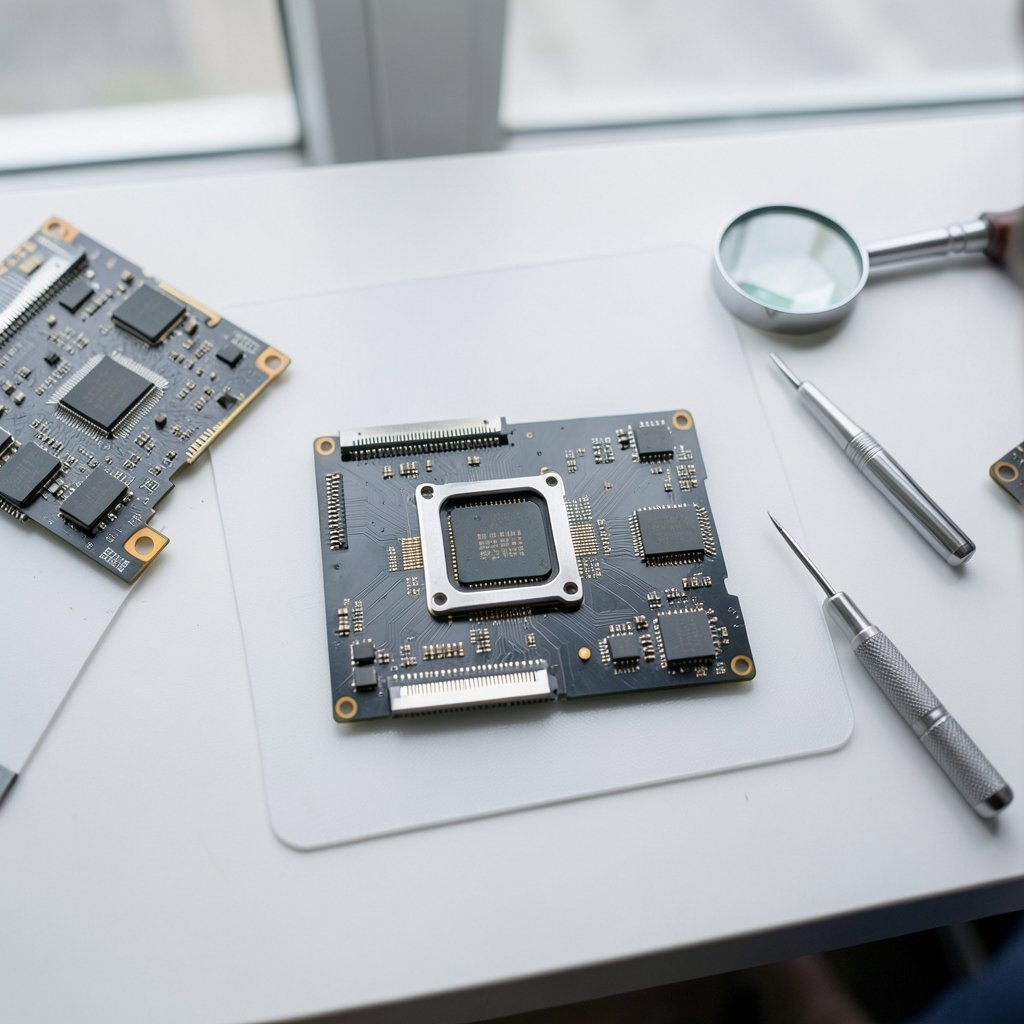
Every compatibility check begins at the socket. AMD’s desktop line has moved between AM4 and AM5, and the two are physically and electrically incompatible. AM5 arrived in 2022 alongside the Ryzen 7000 series, and AMD positioned it as a long-lived platform intended to carry multiple CPU generations.
The practical rule: if your board is AM4, neither of these chips is an option, full stop. If your board is AM5, you are in the conversation, but the conversation is not over. Socket fit is necessary, not sufficient.
This is the same trap people fall into when comparing graphics cards without checking power and slot clearance. If you are planning a broader rebuild, it helps to read up on how to check compatibility before an upgrade for the RTX 4090 vs RTX 5080, because the lessons about power headroom and physical fit transfer directly to CPU shopping.
The Chipset Question Nobody Asks
Two boards can share an AM5 socket and behave completely differently. The chipset, whether B650, X670, B850, or X870, determines power delivery design, PCIe lane allocation, and how quickly vendors push BIOS support for new processors.
Budget chipsets are not bad. They are simply built to a price, and a flagship CPU with a high core count can expose weak VRMs under sustained all-core loads. Before buying the $899 part, check whether your board’s power stages were designed for that class of chip. The motherboard vendor’s CPU support list, often called a QVL, is the authoritative source. It names exact models and the minimum BIOS revision required.
BIOS Updates: The Step That Saves Builds
Here is the mistake that bites more people than any other: buying a new CPU for an existing board and discovering the board’s factory BIOS predates the chip. The system powers on, fans spin, and nothing displays.
New processor support almost always arrives through a BIOS update, and that update must be applied before the new chip goes in. Many mid-range and high-end boards include a USB flashback feature that can update firmware without a CPU installed. If yours has it, use it. If it does not, you may need a compatible older CPU to boot far enough to flash.
A sensible order of operations:
- Identify your exact motherboard model, including revision number.
- Open the vendor’s support page and find the CPU support list.
- Confirm your intended CPU appears, and note the minimum BIOS version.
- Download that BIOS and any required intermediate versions.
- Flash the BIOS with your current CPU still installed.
- Verify the version in the BIOS screen before swapping hardware.
- Install the new CPU, then clear CMOS and reconfigure memory profiles.
Skipping step six is common and costly. People flash, assume it worked, and then troubleshoot the wrong component for an hour.
Memory, Power, and Cooling Add Up
AM5 platforms use DDR5, not DDR4, so a memory kit from an older build will not carry over. AMD’s EXPO profiles are the standard for one-click memory tuning, and enabling them is usually worth a few percent in games. But fast memory kits place extra load on the CPU’s memory controller, and stability varies by board and BIOS.
Power deserves equal attention. Modern graphics cards produce transient spikes well above their rated draw, and a CPU upgrade can push a marginal power supply over the edge. Check your PSU’s wattage against the combined load of CPU and GPU, then add headroom. An 80 Plus certification tells you about efficiency, not about whether the unit handles spikes gracefully.
Cooling is the third leg. If you are moving from a modest chip to a high-core-count part, your existing cooler may no longer be adequate. The choice between liquid and air comes down to case clearance, noise tolerance, and sustained load patterns, and it is worth reading a proper comparison of AIO vs air cooler compatibility before 2027 upgrade decisions, since mounting hardware and radiator space are the usual failure points.
What the Extra $400 Actually Buys
Assuming both chips land on the same socket and both boot on your board, the decision becomes about workload. The table below frames the tradeoff without pretending to know final benchmark numbers.
| Factor | Ryzen 9950X3D2 (approx. $899) | Ryzen 9850X3D (approx. $499) |
|---|---|---|
| Typical target buyer | Gamers who also stream, render, or compile | Pure gaming and general use |
| Core count expectation | Higher, aimed at productivity | Lower, tuned for games |
| Gaming difference | Often modest over the cheaper chip | Close in most GPU-bound titles |
| Motherboard demands | Stronger VRM and cooling preferred | More forgiving on mid-range boards |
| PSU headroom needed | Higher | Moderate |
| Upgrade risk | Higher cost if compatibility fails | Lower cost if compatibility fails |
The pattern is consistent across generations: the halo chip wins benchmarks and loses on value. If your display is 1440p or 4K and your GPU is the bottleneck, the gap between these two chips shrinks toward zero. At 1080p with a top-tier GPU, the gap widens, but so does the case for spending the difference elsewhere.
Don’t Forget the Rest of the Stack
A CPU is one part of a chain. Storage carries more weight than people expect because games increasingly stream assets from disk. If you still use a SATA drive, the money saved by choosing the $499 chip may be better spent on faster storage. Checking NVMe vs SATA compatibility before upgrade 2027 planning will show why the interface, rather than capacity alone, changes load times.
Operating system support is another quiet gate. Windows 11 maintains a supported processor list, and chips outside it may install but miss updates. Check that list before committing.
For anyone also weighing a platform switch, the AMD vs Intel CPU compatibility question deserves its own pass, since cooler mounting, memory generation, and board longevity differ between the two camps. And if you are building a fresh machine around either chip, planning the software side early pays off, which is why a review of Tauri vs Electron compatibility before a 2027 upgrade is useful for developers who game on the same box.
A Practical Pre-Purchase Checklist
Before any money changes hands, run this sequence:
- Confirm socket generation on your current board.
- Look up your exact board model on the vendor’s CPU support list.
- Record the minimum BIOS version for the target CPU.
- Flash the BIOS and verify the version string.
- Check memory kit speed against the board’s qualified list.
- Calculate combined CPU and GPU power draw, then compare to PSU wattage.
- Confirm cooler compatibility, including mounting brackets and clearance.
- Verify OS support for the processor.
- Only then compare prices and benchmarks for your resolution.
Steps one through four eliminate most disasters. Steps five through eight eliminate the slow, annoying problems that make people think they bought a bad chip.
Conclusion
The Ryzen 9950X3D2 versus 9850X3D decision is not really a $899 versus $499 question. It is a compatibility question wearing a price tag. The expensive chip only makes sense if your board, BIOS, memory, power supply, and cooler are all ready for it. The cheaper chip is often the smarter buy for gaming, and the savings can go toward the parts that actually hold a system back.
Treat every spec and price you see as provisional until you confirm it on the manufacturer’s own page. Then run the checklist. A machine that boots, stays cool, and holds its clocks will beat a theoretically faster chip that never leaves the box.
FAQ
Is the Ryzen 9950X3D2 worth $400 more than the 9850X3D for gaming alone?
For gaming alone, usually not. The premium tier typically adds cores and cache that benefit streaming, rendering, and compilation more than frame rates. At 1440p or 4K, where the graphics card does most of the work, the difference between the two chips tends to shrink to a few percent. Buy the expensive part for mixed workloads, not for pure play.
Will either chip work in my existing AM4 motherboard?
No. AM4 and AM5 are different sockets and are not interchangeable. Both of these processors belong to the AM5 generation, so an AM4 board cannot host them regardless of BIOS version. If you are on AM4, plan for a new board and DDR5 memory as part of the upgrade budget.
Do I always need a BIOS update before installing a new CPU?
Not always, but often enough that you should check every time. Boards manufactured after a processor launches may ship with compatible firmware, but inventory sits in warehouses for months. The safe move is to visit your motherboard vendor’s support page, confirm the minimum BIOS version for your exact model, and flash it before swapping hardware.
How do I know if my power supply can handle the upgrade?
Add the processor’s power draw to your graphics card’s draw, then add roughly 30 percent headroom for transient spikes and future additions. Compare that total to your PSU’s continuous wattage rating, not its peak rating. If you are within 100 watts of the limit, a larger unit is cheap insurance against random shutdowns under load.
Can I reuse my DDR4 memory with these processors?
No. AM5 platforms use DDR5 memory exclusively. DDR4 modules will not fit the slots and will not work electrically. Budget for a DDR5 kit, and check your motherboard’s qualified memory list so you can enable EXPO profiles without stability problems.
What is the single most common mistake people make when upgrading?
Buying the CPU first and checking compatibility second. The correct order is board support list, then BIOS version, then memory and power, and only then the purchase. Reversing that order is how people end up with a processor they cannot boot and a return window they have already missed.



