
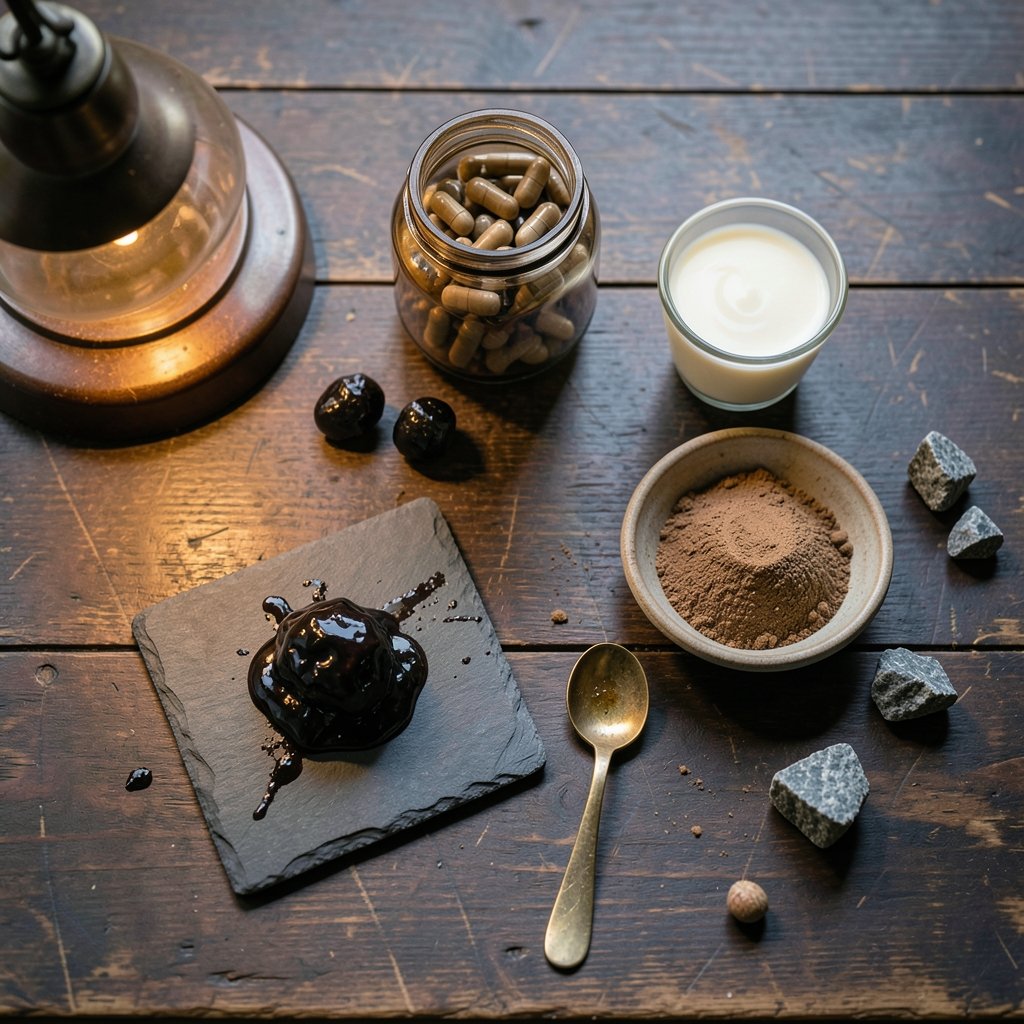
Quick Answer: What is shilajit?
Shilajit is a dark, sticky, resin-like substance that seeps from cracks in rocks in high mountain ranges such as the Himalayas, Altai, Caucasus, and Tibet, and it has been used for centuries in Ayurveda and other South Asian traditional medicine. People buy it as a powder, capsule, or soft resin and take small amounts daily, usually dissolved in warm milk or water.
It is not the same as a vitamin or a single herbal extract. Shilajit is a complex mix of humic substances (mainly humic and fulvic acids), minerals, and organic compounds, and its makeup shifts with the source and the season. Similar substances sold under names like mumijo or mumiyo come from Central Asia, though whether they are truly equivalent is still debated.
Before buying, check the source region, third-party purity testing, heavy-metal screening, fulvic acid content, form (resin versus capsule), dosage instructions, and price per serving.
A Sticky Black Resin With a Long History
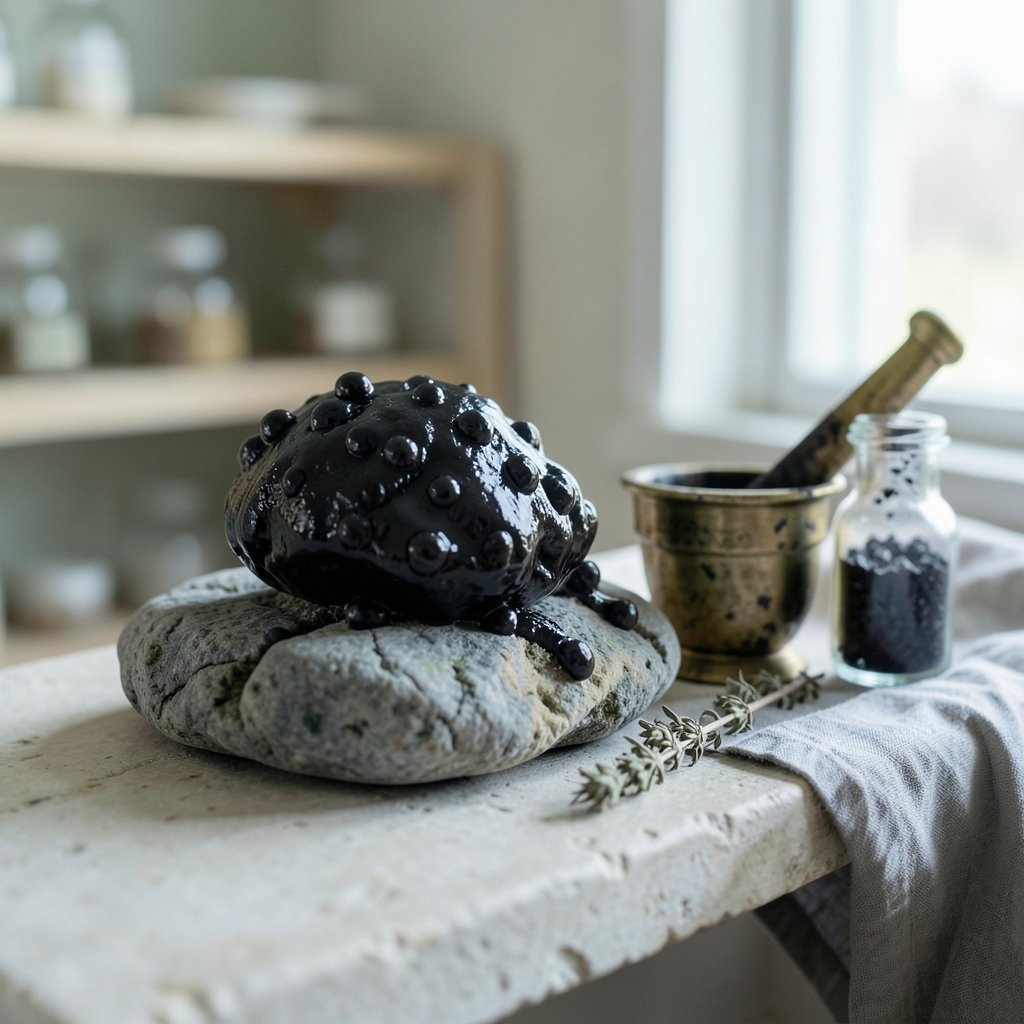
What if a lump of tar-like rock sweat could supposedly do everything from boost energy to sharpen memory? That is essentially the pitch behind shilajit, one of the stranger substances in the supplement world. It looks less like medicine and more like something you would scrape off a cliff, which is more or less what people do.
The name comes from Sanskrit and is often translated as “conqueror of mountains” or “destroyer of weakness.” That etymology gets repeated constantly in marketing copy, though pinning down one authoritative source for it is harder than it sounds. What is clearer is the role shilajit plays in Ayurveda, where it is classically described as a rasayana, a rejuvenative category of preparation. It also appears in the Ayurvedic Pharmacopoeia of India, which sets official standards for how it should be identified and prepared.
The substance itself forms as plant material and minerals break down over long periods in mountain rock. As water moves through crevices, it carries dissolved organic matter that collects and thickens into the dark resin. In warm months, it softens and oozes out; local collectors scrape it from rock faces, then purify it by dissolving and filtering it repeatedly. That purification step matters, because raw resin arrives mixed with grit, soil, and whatever else was on the rock.
What Shilajit Is Actually Made Of
Here is where expectations often collide with reality. Shilajit is not one compound with a fixed formula. It is a mixture, and the mix varies widely depending on where it came from and when it was harvested. That variability is the single biggest challenge for anyone trying to judge quality.
Broadly, the composition breaks into three groups:
| Component | What it is | Why it matters |
|---|---|---|
| Humic substances | Large, complex organic molecules formed from decomposed plant matter | The main active fraction; includes fulvic acid and humic acid |
| Minerals and trace elements | Iron, zinc, magnesium, potassium, and many others | Content depends heavily on the rock and soil of the source region |
| Other organic compounds | Various small molecules from plant breakdown | Contributes to the substance’s color, smell, and behavior |
Fulvic acid gets the most attention. It is a smaller humic molecule that dissolves readily and binds to minerals, and many products advertise a fulvic acid percentage on the label. That number is only as meaningful as the lab method behind it, and testing methods are not standardized across the industry. Two jars claiming 60 percent fulvic acid may have been measured in completely different ways.
Because composition varies by source and season, standardization is genuinely difficult. This is not a marketing problem alone; it is a chemistry problem. A resin harvested in one valley in one month is not chemically identical to one from another range in another season.
How People Use It
Traditional use and modern supplement use look quite different. In classical Ayurvedic practice, shilajit is typically prepared and combined with other ingredients under guidance, not spooned out of a jar at random. Modern users more often take a small pea-sized portion of resin dissolved in warm milk or water, or swallow a capsule with a stated extract amount.
Practical points that come up again and again:
- Warm liquid helps resin dissolve; cold water leaves gritty bits floating.
- Resin is messy and sticky, so a dedicated small spoon keeps things tidy.
- Capsules are easier to dose consistently but usually contain an extract, not whole resin.
- Taking it with food is common, partly because the taste is earthy, bitter, and hard to describe politely.
The taste deserves a warning. First-time users often describe it as bitter, smoky, and faintly like old leather or tar. If a product tastes sweet or completely neutral, that is worth questioning rather than celebrating.
What the Evidence Actually Supports
This is the part where balance matters most. Human clinical evidence on shilajit is limited and mostly comes from small trials. Claims about testosterone, fatigue, or cognition are not established by large, independent studies. That does not mean the substance is worthless, but it does mean confident marketing language runs well ahead of the science.
A few things are reasonable to say. It has a long record of traditional use. It contains minerals and humic substances that researchers find biologically interesting. And it is being studied, with peer-reviewed work appearing in the literature on a range of topics. Anyone who wants to dig into primary trials and reviews can search the published literature directly and read the studies rather than the summaries.
What is not reasonable is treating shilajit as a proven treatment for any condition. It is a supplement, not a drug, and the evidence base does not support strong medical claims.
Safety, Purity, and the Contamination Problem
If there is one section to read twice, it is this one. Shilajit comes out of the ground, and ground comes with baggage. Heavy metals, grit, and microbial contamination are real concerns for any earth-derived product, and shilajit is no exception. Some products on the market have been found to be adulterated or to contain heavy metals.
In the United States, shilajit sold as a dietary supplement falls under the Dietary Supplement Health and Education Act of 1994. Under that framework, the U.S. Food and Drug Administration does not approve dietary supplements for safety or efficacy before they are marketed. That puts a lot of responsibility on the buyer. The same pattern holds in many other countries, where supplements sit in a lighter regulatory lane than medicines.
What actually works in practice, based on how careful buyers approach this:
- Look for a certificate of analysis from a third-party lab, rather than only a purity claim on the label.
- Check that heavy metals were specifically tested, rather than only microbial counts.
- Prefer sellers who name the source region and the harvest or production batch.
- Be skeptical of prices that seem too low for a substance that is labor-intensive to collect and purify.
- Avoid loose resin from unfamiliar sources with no testing documentation at all.
The most common mistake is buying the cheapest resin available online and assuming “natural” means “clean.” Natural substances from rock crevices are exactly the kind of thing that benefits from lab testing.
Shilajit vs. Similar Substances
The naming gets confusing fast. Across Central Asia and Siberia, related or similar substances are sold as mumijo or mumiyo, and the term salajit also appears. Whether these are the same thing as Himalayan shilajit is debated among researchers and sellers alike. Some argue they are regional variants of a similar geological product; others treat them as distinct materials.
| Name | Typical region | Notes |
|---|---|---|
| Shilajit | Himalayas, Tibet, South Asia | The Ayurvedic term; appears in Indian pharmacopoeial standards |
| Mumijo / mumiyo | Altai, Central Asia, Siberia | Similar resinous substance; equivalence debated |
| Salajit | Various | Alternate spelling or regional name seen in commerce |
For a buyer, the practical takeaway is simple: ask what the product actually is, where it was collected, and what testing backs it up. A label using three different names interchangeably is not automatically dishonest, but it is a sign to read more carefully.
How to Judge Quality Before You Buy
Regulation is light and marketing is loud, so a short checklist does more work than any single claim on a jar. The factors that separate careful purchases from impulse buys are mostly about documentation, not hype.
Source transparency comes first. A seller who names a specific mountain region and can describe collection and purification is easier to trust than one who simply says “Himalayan.” Testing comes second, and it should cover heavy metals and identity, rather than only a fulvic acid number. Form matters too: resin is closer to the traditional material, while capsules usually contain an extract standardized to a stated percentage, and each has tradeoffs in convenience and consistency.
Dose labeling is another tell. Products that state clearly how much resin or extract a serving contains, and how many servings the package holds, tend to be more serious than those that bury the details. Finally, price per serving is a better comparison tool than the sticker price, since jar sizes and extract strengths vary so much.
For anyone comparing options or reading up on related traditional preparations, resources such as OCCCY can help put the terminology in context before money changes hands.
Common Mistakes People Make
A few missteps show up over and over. Dissolving resin in cold water and then deciding the product is gritty and fake is one; warm liquid is the fix. Expecting immediate effects is another. Supplements of this kind are typically taken over weeks, and anyone promising instant transformation is selling a story.
Mixing shilajit with a shelf full of other supplements without tracking what changed is a third. If someone starts three new products in the same week, they learn nothing about which one did what. Starting one thing at a time is dull advice, but it is the only way to notice cause and effect.
The biggest mistake, though, is skipping the label entirely. A surprising number of buyers cannot say what region their resin came from, what the fulvic acid claim is based on, or whether any lab tested it. Those three questions take two minutes to ask and prevent most of the disappointment people report.
Conclusion
Shilajit is a dark, mineral-rich resin from high mountain rock, used for centuries in Ayurveda as a rejuvenative preparation and sold today as a dietary supplement in resin, powder, and capsule form. Its appeal is easy to understand: a natural substance with a long history and an air of mountain mystery. Its reality is more complicated. The composition varies by source and season, human evidence is limited and mostly from small trials, and because supplements are not approved for safety or efficacy before sale in the United States, purity depends heavily on the seller.
None of that makes shilajit a scam. It makes it a product that rewards careful buying. Check the source, demand third-party testing that includes heavy metals, understand whether you are getting resin or extract, and keep expectations grounded in what the evidence actually shows. Do that, and the strange black resin from the rocks becomes a reasonable, well-understood purchase rather than a leap of faith.
FAQ
Is shilajit safe to take every day?
Daily use is common in traditional practice and in modern supplement routines, usually in small amounts. The bigger question is what is in the specific product, since contamination with heavy metals has been reported in some products. Anyone with health conditions, anyone taking medication, and anyone pregnant or breastfeeding should talk to a healthcare professional before starting, because supplement regulation does not guarantee safety.
Does shilajit really boost testosterone?
The claim is popular, but human evidence is limited and comes mostly from small trials. Large, independent studies that would establish a testosterone effect do not exist in the published literature. Treat strong testosterone claims as marketing until better research supports them, and do not use shilajit as a substitute for medical evaluation of low testosterone.
What does shilajit taste like?
Resin is earthy, bitter, smoky, and often described as tasting like old leather or tar. That flavor is a signature of the raw material, which is why most people dissolve it in warm milk or water rather than eating it straight. A product that tastes sweet or bland is worth questioning, since it may be heavily diluted or mixed with fillers.
Can I take shilajit with other supplements?
There is no well-established list of interactions, largely because research is limited. The practical approach is to introduce one new supplement at a time so any effect or side effect can be traced. Anyone taking prescription medication, especially anything with a narrow dosing window, should check with a pharmacist or doctor first rather than stacking products and hoping for the best.
How do I know if my shilajit is pure?
Ask for a third-party certificate of analysis that covers heavy metals and identity testing specifically, rather than only microbial counts. Look for a named source region and batch information. Be wary of very low prices, loose resin with no documentation, and labels that make sweeping health claims. Purity is a paperwork question more than a taste or texture question.
Is Himalayan shilajit better than Altai mumijo?
It is not clearly established that one is better. Himalayan shilajit is the version tied to Ayurvedic tradition and Indian pharmacopoeial standards, while mumijo from the Altai and Central Asia is a related or similar substance whose equivalence is still debated. Quality within each category varies more than the category labels suggest, so testing and source transparency matter more than the mountain on the jar.



