
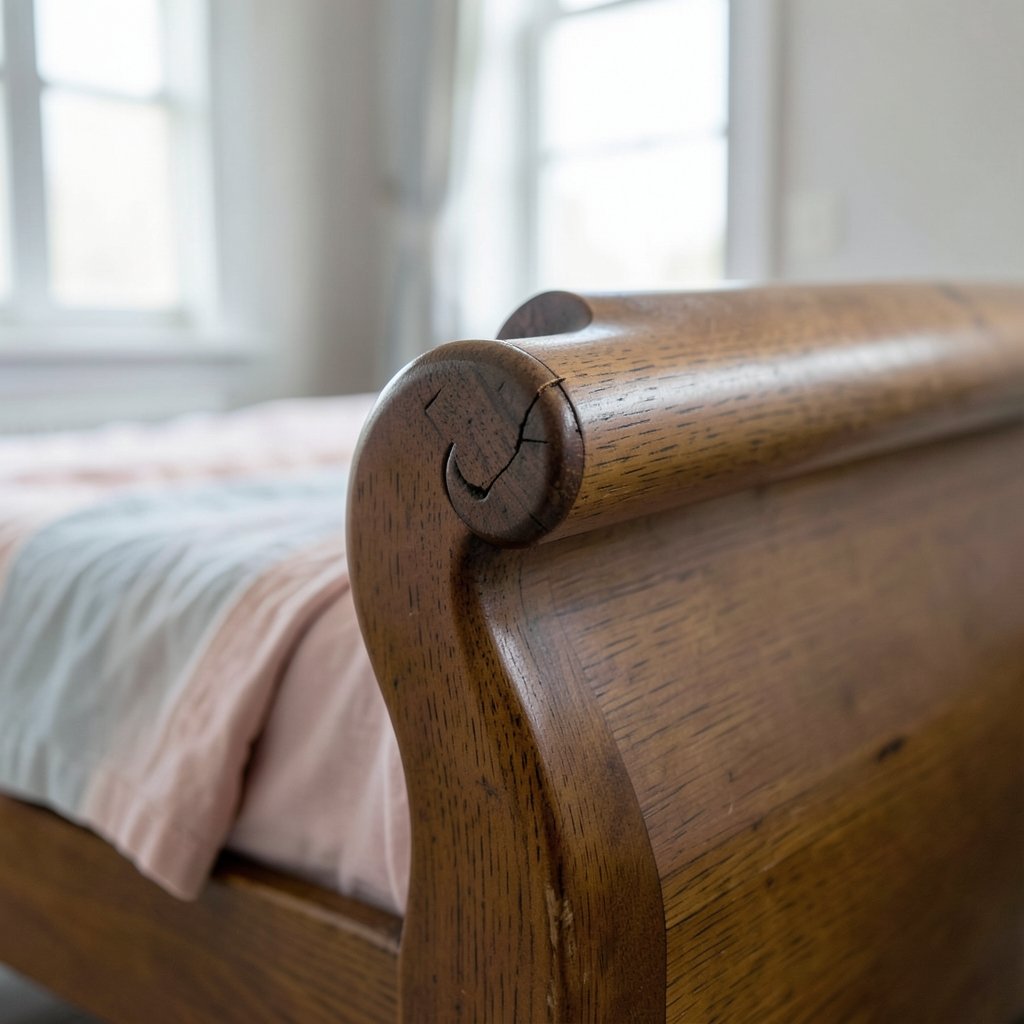
What do you picture when someone says “sleigh bed”? For most people it is a grand wooden bed with ends that sweep outward like the runners of a horse-drawn sleigh. That picture is accurate, but it hides a surprising amount of nuance. The same label is used for genuine early nineteenth-century antiques, for mid-century reproductions, and for brand-new beds that arrive flat-packed in three boxes.
That matters if you are shopping, inheriting a piece, or trying to date something you already own. A “sleigh bed” is a shape, not a period, a maker, or a quality grade. Understanding where the shape came from, how the curve is actually built, and what to inspect before you buy will save you from expensive mistakes. This guide covers the history, the construction, the practical fit issues, and the buying checks that separate a solid piece from a decorative one.
Where the sleigh bed shape came from
The sleigh bed is usually grouped with Empire style, the furniture vocabulary that flourished in France around 1804 to 1815 and spread to the United States in the following decades. Empire design borrowed heavily from classical Greek and Roman forms and from Napoleonic imperial imagery, favoring heavy symmetry, bold curves, and rich woods. Scrolled bed ends fit that language neatly.
The origin story is not settled, though. The standard account credits French cabinetmakers working in the Empire period, with American makers copying and adapting the form. Some furniture historians instead trace the development to American cabinetmakers working in the Empire style on their own terms. Treat “French origin” as the conventional account rather than proven fact, and be suspicious of any listing that states it as certainty.
The American version tends to differ in proportion. Where French examples often keep the outward scroll relatively restrained, American sleigh beds frequently push the headboard higher and the roll more pronounced, with mahogany as the classic wood and walnut appearing later. Attribution to a specific maker is usually uncertain, because many surviving pieces are unsigned.
A shape, not a period label
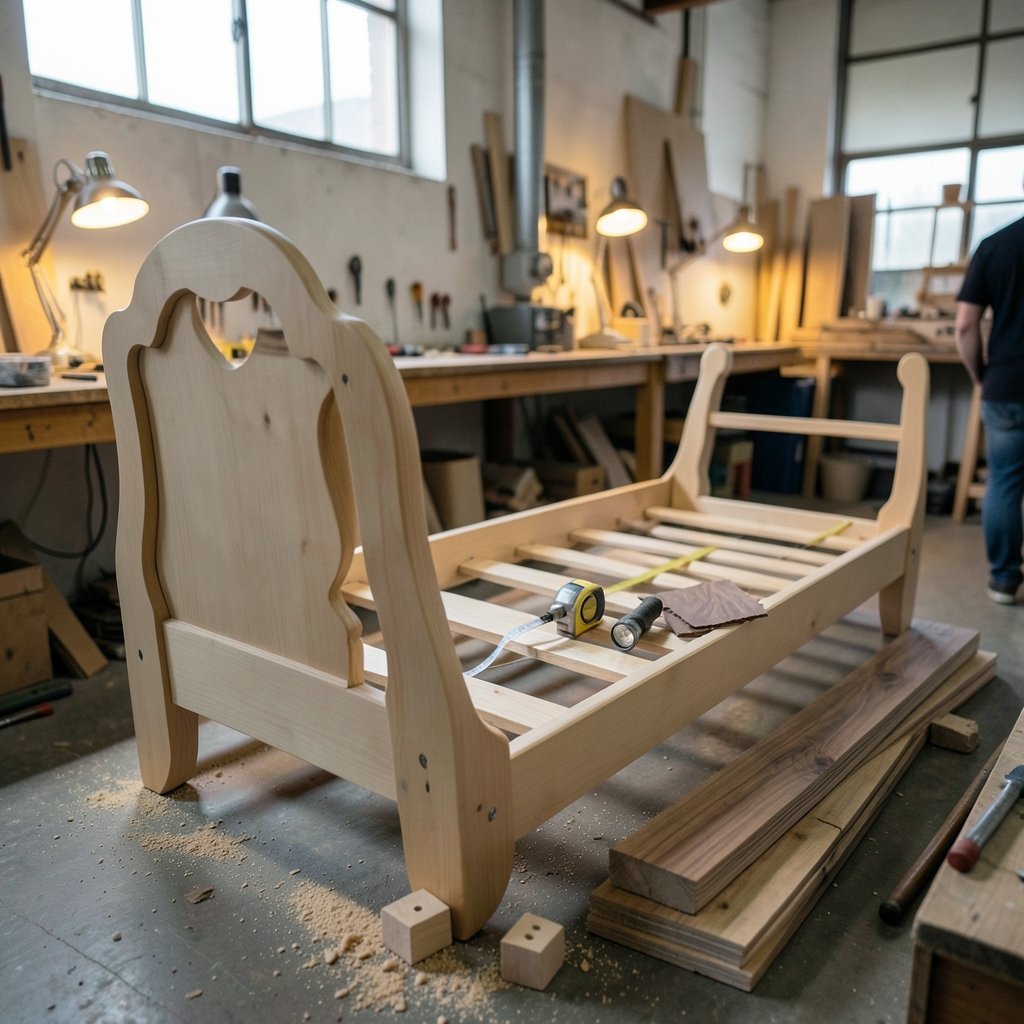
Here is the single most useful thing to understand before you shop: “sleigh bed” describes a silhouette, not an era. A bed with scrolled ends could be:
- An Empire-period piece from the early 1800s
- A later nineteenth-century piece made in the same style
- A late twentieth-century reproduction
- A contemporary bed built last year
The term tells you the ends curve outward. It tells you nothing about age, materials, joinery, or value. Sellers sometimes lean on the label to imply antiquity, so ask directly what the piece is and how that was determined.
Sleigh beds were revived in late twentieth-century reproduction furniture and remain a standard catalog shape today. Modern versions vary widely in materials and dimensions, from solid wood to veneer to fully upholstered frames. That variety is exactly why the label alone cannot carry much weight.
How the curved ends are actually built
The outward roll is structural as well as decorative. Curved headboards and footboards are usually solid wood, sometimes veneered, and either shaped from thick stock or built up in sections and joined. That construction choice affects weight, stability, repairability, and price.
| Construction | What it means | What to watch for |
|---|---|---|
| Solid shaped stock | Thick timber cut and shaped into the curve | Heavy; check for cracks along the grain at the tightest part of the roll |
| Built-up sections | Curved form assembled from several pieces | Look for visible seams and any lifting at the joints |
| Veneered core | Thin decorative wood over a secondary base | Edges and the outer face of the roll are where lifting starts |
| Upholstered frame | Padding and fabric over a shaped frame | Ask what the frame is made of; the curve hides it |
The curve also changes how the bed sits in a room. A pronounced outward roll at the head means the top of the headboard leans away from the wall, leaving a gap. That gap collects dust, and on some frames it means the bed cannot sit flush against the wall at all. Measure the depth of the roll before you commit to a floor plan.
Practical fit: the mistake most buyers make
The most common sleigh bed mistake is buying on looks and discovering the fit problem afterward. Two issues come up again and again.
First, footboard height. A tall scrolled footboard looks dramatic, but it blocks the view of a television from the bed and can make a small room feel closed in. It also makes getting in and out slightly more awkward for anyone with limited mobility, since you cannot sit on the edge and swing your legs down as easily.
Second, mattress fit inside the curve. Because the ends curve, the usable internal length can be tighter than the nominal mattress size, and the curve can interfere with thicker mattresses. If the mattress sits high, the visual proportion of the scroll changes and the bed can look top-heavy. Confirm the actual internal dimensions rather than assuming a standard size will drop in.
There is a related point about comfort that applies to any bed frame: the surface the mattress rests on matters as much as the frame around it. A slatted or platform base needs even support and correct spacing so the mattress does not sag between slats. If you are setting up a new frame from scratch, this explanation of 3d printer bed leveling mesh explained your first layer is about a different kind of bed entirely, but the underlying principle is the same one that governs mattress support: a flat, evenly supported surface prevents problems later. Check the slat spacing and add a center rail on larger sizes if the frame does not include one.
What to inspect before you buy
Whether you are looking at an antique or a new bed, a short inspection catches most problems. Work through these checks in order.
- Rock the frame gently. A sleigh bed should feel solid. Wobble usually means loose joints or a missing center support.
- Run a hand along the inside and outside of each roll. You are feeling for cracks, splits, lifted veneer, or filler hiding a repair.
- Look at the joints where the curve meets the side rails. This is a high-stress area on any bed and the first place trouble shows.
- Check the hardware. Modern bolts and brackets are fine, but confirm they are tight and not stripped. On older pieces, look for added brackets that suggest a past repair.
- Ask about the finish. A heavily refinished surface can hide repairs and reduces value on antiques. Original finish, even worn, is usually preferable.
- Measure everything. Internal length and width, footboard height, headboard height, and the depth of the outward roll at the top.
For antique pieces, dating and attribution questions are genuinely difficult, and unsigned furniture is common. If provenance matters to you, get an opinion from someone who handles decorative arts professionally rather than relying on a seller’s description.
Materials, price, and what you actually get
Sleigh beds span an enormous price range, and the spread is mostly about materials and joinery rather than the shape itself. The silhouette is easy to produce, which is why it appears at every price point.
At the lower end, expect veneered panels over engineered wood, stapled or cam-lock assembly, and a curved end that is more of a molded shell than a shaped solid. These beds can look perfectly good and serve fine in a guest room. The trade-off is repairability: if the curve takes a knock, there is little to fix.
In the middle, solid wood frames with proper bolts and a center rail appear. This is where most buyers land, and it is the sweet spot for durability if the joinery is sound.
At the top, hand-shaped solid stock, traditional joinery, and careful finishing. The curve is genuinely carved or shaped rather than molded, and the piece is heavy in a way that signals mass.
One caution: “solid wood” is used loosely in listings. It can mean the visible surfaces are solid while internal parts are not. Ask specifically which parts are solid and which are not.
Styling a curved bed without fighting it
The scroll is a strong shape, and the room needs to accommodate it rather than compete with it. A few practical approaches work well.
Keep the wall behind the headboard simple. A large, busy artwork directly above a scrolled headboard creates visual clutter because both are competing for the same space. A plain painted wall or a subtle wallpaper lets the curve read clearly.
Choose bedding that follows the line. A duvet that stops short of the footboard scroll looks intentional; one that bunches against it looks like a fit problem. Tucking or folding at the foot keeps the silhouette visible.
Mind the proportions of the room. A sleigh bed is a substantial object, and in a small room the outward roll at the foot eats floor space. If the room is tight, a lower footboard or a version with a gentler curve will feel better than a dramatic scroll.
Conclusion
The sleigh bed is one of the most recognizable shapes in furniture, and one of the most misunderstood. Its outward-scrolling ends connect it to Empire design of the early nineteenth century, but the label has been applied so widely since that it no longer signals age or quality on its own. What it signals is a silhouette, and the real questions are the ones underneath: how the curve is built, whether the frame is solid, how the bed fits your room, and what the internal dimensions actually are.
Buy with those questions in hand and the shape becomes an asset rather than a surprise. Measure the roll, check the joints, confirm the mattress fit, and treat any claim about origin or maker as something to verify rather than accept. Do that, and a sleigh bed will earn its place as the focal point of the room for a very long time.
FAQ
What defines a sleigh bed?
A sleigh bed has a headboard and footboard that both curve outward at the top, echoing the runners of a horse-drawn sleigh. The form is usually associated with French and American Empire furniture of roughly 1800 to 1830. It is a shape description rather than a period or maker label, so the same term covers antiques, reproductions, and brand-new beds.
Is a sleigh bed always an antique?
No. Sleigh beds were revived in late twentieth-century reproduction furniture and remain a standard catalog shape today. Modern versions vary widely in materials and dimensions, including solid wood, veneer, and fully upholstered frames. The term alone cannot date a piece, so ask for specifics rather than assuming age from the shape.
Did the sleigh bed originate in France?
The standard account credits French cabinetmakers working in the Empire period, with American makers adapting the form. Some furniture historians instead trace it to American cabinetmakers working in the Empire style. Treat the French origin as the conventional story rather than settled fact, and be cautious of listings that present it as certainty.
How can I tell if a sleigh bed is well made?
Rock the frame to check for wobble, run a hand along the inside and outside of each roll to feel for cracks or lifted veneer, and inspect the joints where the curve meets the side rails. Confirm whether the visible surfaces are solid wood and ask which internal parts are not. Sound joinery and a center support rail matter more than the finish.
Will a sleigh bed fit against the wall?
The outward roll at the top of the headboard means the upper part leans away from the wall, leaving a gap that collects dust. On some frames the bed cannot sit flush at all. Measure the depth of the roll before committing to a floor plan, and check the internal length and width against your mattress rather than assuming a standard size will fit.
Does a tall footboard cause problems?
It can. A tall scrolled footboard blocks the view of a television from the bed and can make a small room feel closed in. It also makes sitting on the edge and swinging your legs down slightly more awkward. In a tight room, a lower footboard or a gentler curve usually works better than a dramatic scroll.



