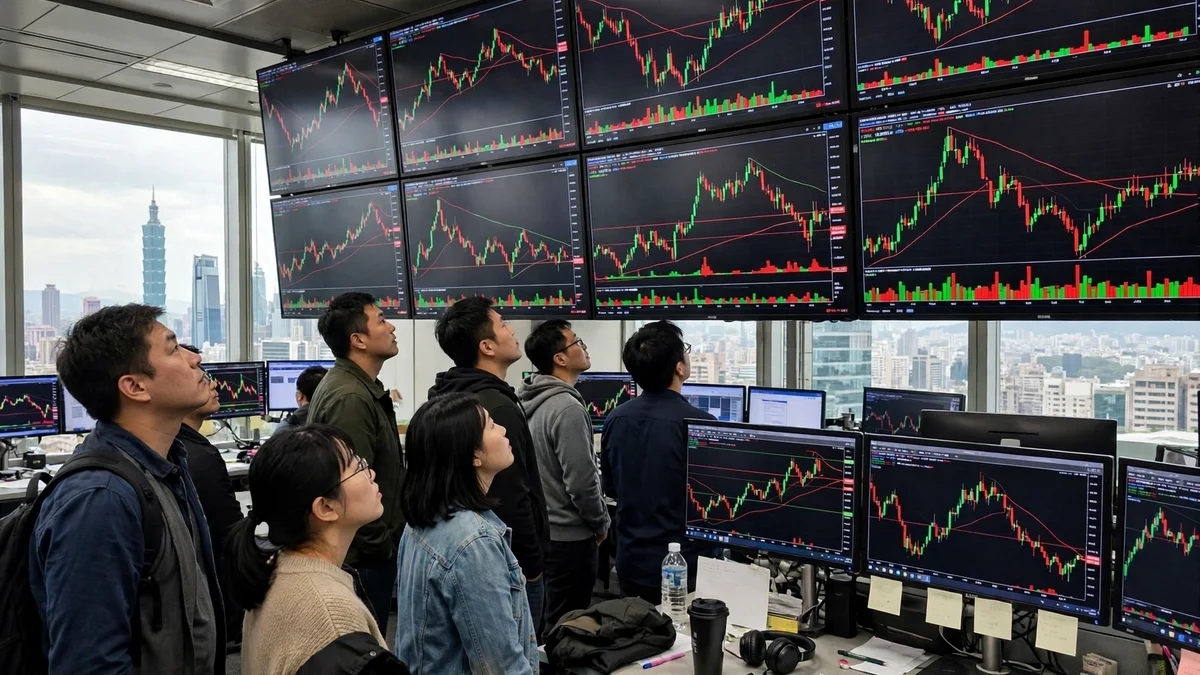
Foreign money is leaving Taiwan stocks at a record pace, and November is on course to be the worst month yet for overseas selling. Foreign investors had net sold NT$1.09 trillion of Taiwanese shares in November, about $33.1 billion, according to data compiled by Bloomberg and reported on November 27. That already tops October’s then-record outflow of NT$994 billion, with one trading session still to come.
The selling is not a quiet drift out of a small market. Taiwan is the centre of the world’s advanced chip supply, and its stock market has become the clearest gauge of how investors now feel about the artificial intelligence trade. When doubts about AI valuations grow louder, Taiwan is where large overseas funds cut their exposure first, and November showed that pattern at full force.
The figures also tell a story about a month of violent swings rather than a steady fall. The benchmark Taiex index dropped about 21% from its record high on October 6 and is down about 13% for the month, yet it also posted one of its biggest one-day gains on record in the middle of the rout. Foreign funds kept selling through the rebound.
Key takeaways
- Foreign investors net sold NT$1.09 trillion ($33.1 billion) of Taiwan stocks in November, a record that tops October’s NT$994 billion outflow, according to Bloomberg data.
- The Taiex benchmark has fallen about 21% from its record high on October 6 and is down about 13% for the month.
- Drivers cited in the reporting include AI valuation worries, heavy tech positioning, tighter US chip curbs, rising US interest rate expectations and tariff uncertainty.
- Domestic mutual funds bought a net NT$314.1 billion through November 26, partly offsetting the foreign selling.
- The November total was still provisional when reported, with the final trading session on November 30 still to come.
| Detail | Figure | Source |
|---|---|---|
| Foreign net selling, November | NT$1.09 trillion ($33.1 billion) | Bloomberg data |
| Foreign net selling, October | NT$994 billion, then a record | Bloomberg data |
| Taiex fall from October 6 record high | About 21% | Bloomberg reporting |
| Taiex change for November | Down about 13% | Bloomberg reporting |
| Domestic mutual fund net buying to November 26 | NT$314.1 billion | Taiwan Stock Exchange data |
| Taiwan dollar move in November | Down about 1.5% against the US dollar | Bloomberg reporting |
| Foreign net selling, November 1 to 26, main board | NT$1.092 trillion; bought NT$7.11 trillion, sold NT$8.20 trillion | Taiwan Stock Exchange data |
What Happened in November
The headline is simple: foreign investors dumped a record amount of Taiwanese stocks in November. Their net selling totalled NT$1.09 trillion, or $33.1 billion, according to data compiled by Bloomberg and reported on November 27. That passed October’s NT$994 billion outflow, which had itself set a monthly record at the time.
The Taiwan Stock Exchange figures behind the total give the same picture at a finer grain. Foreign investors, including investors from the mainland area, net sold NT$1.09 trillion in shares on the main board from November 1 to 26. They bought NT$7.11 trillion of shares and sold NT$8.20 trillion. The daily figures show the selling was broad across the month rather than concentrated in a single panic session, with net sales on most trading days.
It is also worth noting that the selling did not happen in isolation. Korea’s market went through its own sharp reversal earlier in the rout, as covered in the account of the Korean stocks boom and bust, and the wider tech sell-off has hit chip-linked markets across Asia. Taiwan stands out because of the size of the flows and because its market is so closely tied to AI hardware demand.
The Numbers Behind the Record

The scale of November’s outflow becomes clearer when it is set against October. October’s NT$994 billion was already a record, passing the previous high set in March, according to reporting on the earlier month. November’s NT$1.09 trillion is roughly NT$98 billion, or about 10%, larger again.
The market moves match the flow. The Taiex has fallen about 21% from a record high reached on October 6, and it is down about 13% for November. A fall of that size in a major benchmark in under two months is a serious drawdown, and it explains why the outflow has drawn so much attention. It is not a small correction in a niche market; it is a large fall in the market most closely tied to the AI boom.
What Drove the Selling
Bloomberg’s reporting points to several drivers rather than a single trigger. The outflows reflect lingering jitters over AI valuations and heavy tech positioning, adding pressure to a sector already weighed down by tighter US chip curbs, rising US interest rate expectations and tariff uncertainty. Together, they give a clear reason to cut exposure to the most crowded part of the market.
The AI valuation question is the heart of it. Investors spent much of the year paying high prices for companies tied to AI infrastructure, on the expectation that spending on data centres and chips would keep rising fast. In November, that confidence wobbled, as doubts about whether hyperscaler spending will pay off spread through the market.
Charu Chanana, chief investment strategist at Saxo Markets, was quoted in the Bloomberg reporting as saying investors are showing greater interest in alternative sources of earnings, income and growth, including Europe and India equities and US value and defensive sectors. She added that year-end profit-taking is also taking a toll. That comment captures the rotation: money is not only leaving Taiwan, it is moving towards parts of the market that look less crowded and less dependent on a single theme.
Why Taiwan Felt It Most
Taiwan’s market is concentrated in a way that makes it sensitive to the AI trade. The island makes most of the world’s advanced chips, and its benchmark is dominated by semiconductor and electronics companies. When global funds want to reduce AI exposure quickly, selling Taiwan stocks is the fastest way to do it, because that is where the exposure sits.
The rout in the wider tech sector spread the pressure. Reporting on the sell-off notes that the technology decline deepened as large AI-linked names fell, including the slide covered in the report on the deepening tech rout. Taiwan does not move on its own news alone; it moves with global sentiment about the companies that buy its chips. When those buyers fall, the suppliers fall with them, and foreign funds treat the two as one trade.
China’s role adds another layer. Beijing’s statements of support for markets have been watched closely by investors in the region, as covered in the account of China’s statement of support for markets, and any shift in US-China chip policy lands directly on Taiwanese companies. That exposure is structural, not a November event, but it raises the stakes of every policy headline for a fund holding Taiwan stocks.
Domestic buyers provided some offset, but not enough to change the direction. Domestic mutual funds net bought NT$314.1 billion through November 26, according to exchange data, taking the other side of part of the foreign selling. That buying shows local confidence, or at least a willingness to buy at lower prices, but it covered less than a third of the foreign outflow. The market fell anyway, which tells its own story about the balance of flows.
How the Month Swung So Violently
November’s daily moves were unusually large. The Taiex fell 2,393.60 points on November 20 to close at 36,033.29, then jumped 3,310.46 points on November 24 to 40,122.35, before dropping again the next day. A market that can fall sharply, rise by a record amount and fall again within a week is a market where leveraged positions and forced selling are at work.
Taiwan’s central bank was watching the flows closely. Governor Yang Chin-long said on November 10 that foreign institutional investors had moved about $10 billion out of Taiwan since November began, following outflows of about $28 billion in October. The central bank’s figures cover a different window than the exchange totals, so they cannot be matched directly to the NT$1.09 trillion figure.
What It Means for Investors
For investors holding Taiwan stocks or global chip funds, the record outflow is a warning rather than a verdict. It shows that foreign funds, which had been large buyers during the AI boom, are now large sellers, and that the selling has continued through rebounds. A market can recover from an outflow, but it rarely does so while the largest holders are still leaving.
A Checklist for Watching the Taiwan Market
- Wait for the final November total after the November 30 session before quoting the month as closed, since the reported figure was provisional.
- Watch whether foreign funds keep selling in December or start to return, because two record months need a third data point to become a trend.
- Track the Taiex against its October 6 record high, since the 21% fall is the clearest measure of the damage so far.
- Watch the Taiwan dollar, because further weakness would signal that repatriation of sale proceeds is still under way.
- Follow AI valuation news and US chip policy, since those are the drivers the reporting cites for the outflow.
- Compare foreign flows with domestic mutual fund buying, because local funds have been the main offset to the exit.
Frequently Asked Questions
How much did foreign funds sell in Taiwan in November?
Net selling totalled NT$1.09 trillion, about $33.1 billion, according to data compiled by Bloomberg. That tops October’s then-record outflow of NT$994 billion. The figure ran through November 27, with one trading session left in the month, so the final total may be higher.
Why are foreign funds selling Taiwan stocks?
According to the Bloomberg reporting, the outflows reflect jitters over AI valuations and heavy tech positioning, plus tighter US chip curbs, rising US interest rate expectations and tariff uncertainty. Year-end profit-taking and a rotation towards other markets were also cited.
How far has the Taiex fallen?
The benchmark has fallen about 21% from a record high reached on October 6, and it is down about 13% for November.
Did anyone buy while foreign funds sold?
Yes. Domestic mutual funds net bought NT$314.1 billion through November 26, according to Taiwan Stock Exchange data, partly offsetting the foreign selling. That buying covered less than a third of the outflow, so the market still fell.
What happened to the Taiwan dollar?
It fell about 1.5% against the US dollar in November, underperforming Asian peers, as global funds converted stock-sale proceeds into foreign currencies for repatriation. The currency move is a consequence of the outflow rather than a separate event.
Is the November record final?
No. The figure was reported on November 27 with the final trading session on November 30 still to come, and the exchange’s detailed total ran through November 26. The record could still grow, so the final monthly figure should be checked before the month is quoted as closed.
The Bottom Line
November was the month foreign money left Taiwan stocks at a record pace, and the record matters because it followed another record in October. Net selling of NT$1.09 trillion, a Taiex down about 21% from its peak, and a Taiwan dollar sliding as proceeds were repatriated all point the same way: the AI trade that lifted Taiwan to a record high in October unwound hard in November.
Whether the selling stops in December depends on the same forces that drove it: AI valuations, chip policy, interest rates and tariffs. Domestic buyers stepped in, the market still produced a record rally in the middle of the fall, and the final November total was not yet in when the record was reported. The outflow is a fact; what it becomes next is still open, and the flows in the first weeks of December will be the first real answer.