
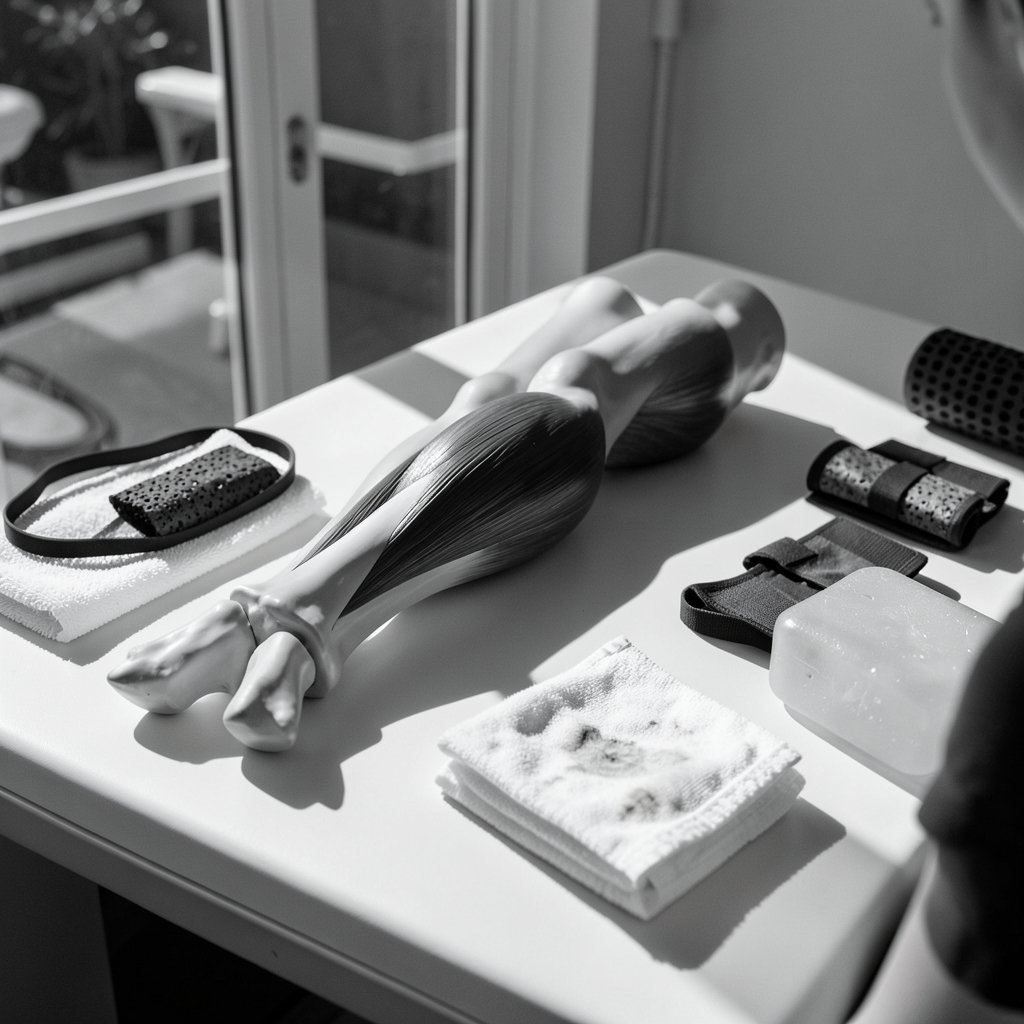
What if one of the most talked-about muscles in knee rehab is also one of the most misunderstood? The vastus medialis muscle sits on the inner side of your thigh, gets blamed for a long list of knee problems, and is the target of countless exercises that promise to “switch it on.” Yet even researchers still argue about what it actually does. This article walks through the anatomy, the function, the rehab claims, and the practical training advice, with a clear eye on what is solid and what is still up for debate.
Where the Vastus Medialis Sits and What It Connects To
The vastus medialis is one of the four heads of the quadriceps femoris, the big muscle group on the front of the thigh. The other three are the rectus femoris, the vastus lateralis, and the vastus intermedius. As the name suggests, the vastus medialis is the medial, or inner, head. It forms the teardrop-shaped bulge just above the knee on the inside of the leg.
Anatomically, it arises from the intertrochanteric line and the medial lip of the linea aspera of the femur, the long ridge running down the back of the thigh bone. From there, its fibers run downward and converge on the quadriceps tendon, which attaches to the patella (kneecap). The patella then connects to the tibial tuberosity of the shin bone through the patellar ligament. In other words, the vastus medialis does not attach directly to the lower leg. It pulls on the kneecap, and the kneecap pulls on the shin.
Like the rest of the quadriceps, it is supplied by the femoral nerve, with nerve roots at L2 to L4. That shared nerve supply is one reason the four heads tend to work as a team rather than as independent operators.
The VMO Question
The lower, more oblique portion of the muscle is often called the vastus medialis obliquus, or VMO. For decades, many clinicians described the VMO as a distinct muscle with a special job: pulling the kneecap inward to keep it from tracking too far to the outside. That idea shaped years of rehab practice.
The evidence, however, is not settled. Systematic reviews have found limited and conflicting support for the claim that the VMO is a separate muscle belly or that it can be activated selectively. Cadaver studies also show real variation between people in how distinct the oblique fibers are and in the angle they take. The honest summary is this: the VMO is a useful clinical label for the distal, oblique fibers, but treating it as a proven separate muscle goes beyond what the research supports. Good practitioners hold the idea loosely.
What the Vastus Medialis Actually Does
The muscle’s main job is straightforward: it extends the knee, along with the other quadriceps heads. It also contributes to patellar tracking and stabilization, helping guide the kneecap as the knee bends and straightens.
Some studies suggest the vastus medialis is relatively more active during the final degrees of knee extension, the last part of straightening the leg. This is why you will see trainers and therapists asking people to focus on “locking out” the knee with control, or to hold a straight-leg position and squeeze. It is a reasonable cue, though it does not prove the muscle works alone.
The quadriceps as a group is also active during walking, stair climbing, squatting, and rising from a chair. The vastus medialis plays its part in all of these, but it rarely acts in isolation. That point matters for anyone trying to “target” it, because the body does not really work that way.
Why the Vastus Medialis Gets So Much Attention in Knee Pain
Two clinical situations keep this muscle in the spotlight.
The first is patellofemoral pain syndrome (PFPS), often called runner’s knee. Weakness or dysfunction of the vastus medialis is commonly discussed as a contributing factor, and rehab programs often include exercises aimed at it. The catch is that the evidence for isolated VMO training is weak. Programs that strengthen the whole quadriceps and hip, improve movement patterns, and gradually load the knee tend to do better than programs built around one muscle.
The second is atrophy after knee injury or surgery. Quadriceps wasting, including the vastus medialis, is well documented after ACL injury and after periods of knee immobilization. This is one of the more robust findings in the literature. The muscle shrinks quickly when the knee is rested, and it takes consistent work to build it back. Anyone who has had knee surgery knows the feeling of looking down and seeing one thigh noticeably smaller than the other.
A practical takeaway from both situations: the vastus medialis matters, but it is not a magic switch. Rebuilding it means loading the whole leg, respecting pain, and progressing gradually. That is less exciting than a single “VMO activation” trick, but it is what tends to work.
How to Train the Vastus Medialis in Practice
There is no shortage of advice online about “hitting the inner quad.” Some of it helps. Some of it wastes time. Here is what tends to hold up in practice.
Exercises that load the quadriceps well
| Exercise | Why it works | Practical tip |
|---|---|---|
| Terminal knee extension | Trains the last part of straightening, where the vastus medialis is relatively active | Use a band or a towel under the knee; move slowly and squeeze at the end |
| Straight-leg raise | Loads the quadriceps with minimal knee bending | Keep the knee locked and the leg straight; stop if the back arches |
| Wall sit | Builds endurance across the whole quadriceps | Start with short holds and a shallow angle, then progress |
| Step-down | Trains control under body weight | Use a low step first and keep the knee tracking over the middle toes |
| Leg press or squat | Loads the quadriceps through a full range | Go to a depth you can control without pain |
Common mistakes people make
The biggest mistake is chasing a “burn” in one spot and assuming it means the right muscle is working. Muscles do not switch on in isolation just because you will them to. Another common error is doing high-rep “VMO” drills with a bent knee and never loading the muscle through a full range, which limits strength gains. A third is pushing through sharp knee pain because a video said the exercise was safe. Pain is information, not an obstacle to ignore.
A fourth mistake is skipping the hip. The quadriceps does not control the knee alone. Hip strength and control affect how the whole leg moves, and many knee programs now include hip work for that reason. If you are building a routine, treat the vastus medialis as one part of a bigger picture rather than the whole story.
What actually works
Consistency beats cleverness. A simple program done three times a week for several weeks will outperform a complicated one done twice and abandoned. Progress the load gradually, keep the range of motion comfortable, and give the muscle time to recover. If you are recovering from injury or surgery, work with a clinician who can tailor the plan to your knee. And if you are documenting your progress or building an online fitness presence, a clear, well-written profile helps you share what you learn; this guide on how to write a social media bio that converts followers covers the basics. (Make money from social media realistic paths that pay)
The Vastus Medialis Versus the Other Quadriceps Heads
It helps to see the four heads side by side, because their differences explain a lot of the confusion.
| Head | Location | Notable role |
|---|---|---|
| Vastus medialis | Inner thigh | Knee extension; patellar stabilization |
| Vastus lateralis | Outer thigh | Knee extension; the largest of the four |
| Vastus intermedius | Deep, under the rectus femoris | Knee extension |
| Rectus femoris | Front, middle of the thigh | Knee extension and hip flexion |
The rectus femoris is the odd one out because it crosses two joints, the hip and the knee. The three vasti cross only the knee. That is why the vastus medialis is sometimes described as a pure knee extensor, while the rectus femoris does double duty. It also explains why hip position can change how the quadriceps feels during an exercise.
The vastus lateralis, on the outer side, is often the strongest and most dominant head. The balance between the inner and outer heads is part of why patellar tracking gets so much attention. But balance is not something you fix by picking one muscle and ignoring the rest. It comes from loading the leg sensibly and letting the nervous system sort out the coordination.
What the Research Still Cannot Settle
It is worth being clear about the open questions, because a lot of confident advice online outruns the evidence.
Whether the VMO is a truly separate muscle remains contested. Whether it can be selectively trained remains contested. Whether targeting it specifically improves patellofemoral pain better than general quadriceps strengthening is not established. These are not small quibbles; they affect how rehab should be designed.
What is well supported is that quadriceps strength matters for knee function, that the muscle atrophies after injury and immobilization, and that structured strengthening helps people recover. Those facts are enough to build a sensible plan on. The finer details are still being worked out, and that is normal in anatomy and rehab research.
If you are the kind of person who likes to dig into the primary literature, anatomy references and clinical overviews are a reasonable starting point, and peer-reviewed summaries are better than forum posts. The same instinct applies to any health topic you research online. For example, if you are comparing tools and platforms while building a fitness or coaching audience, a clear-eyed look at costs helps you avoid surprises, much like this breakdown of VLC media player cost in 2026 and whether free downloads hide fees. Good decisions come from good sources.
Conclusion
The vastus medialis is a small but important part of the quadriceps. It extends the knee, helps guide the kneecap, and wastes away quickly after injury or surgery. It is also the subject of a long-running debate about whether its oblique lower fibers form a separate muscle that can be trained on its own. The balanced answer is that the muscle matters, general quadriceps strengthening works, and isolated “VMO” tricks are oversold. Train the whole leg, progress gradually, respect pain, and let the evidence guide you rather than the loudest voice on the internet.
FAQ
What is the vastus medialis muscle?
It is one of the four heads of the quadriceps femoris, located on the inner side of the thigh. It arises from the femur, joins the quadriceps tendon, and inserts into the kneecap and then the shin bone. Its main job is extending the knee, and it also helps stabilize the kneecap.
Is the VMO a separate muscle?
That is disputed. The vastus medialis obliquus is the name for the lower, oblique fibers of the muscle. Some clinicians describe it as a distinct muscle with a special role in patellar tracking, but systematic reviews have found limited and conflicting evidence for that claim. Treat it as a useful clinical label rather than a settled anatomical fact.
Can you isolate the vastus medialis with exercise?
Not really. The quadriceps heads share a nerve supply and work together, so exercises can emphasize the vastus medialis somewhat but cannot switch off the other heads. Cues like terminal knee extension and straight-leg raises are reasonable, but general quadriceps strengthening is the more reliable approach.
Why does the vastus medialis shrink after knee surgery?
Quadriceps atrophy, including the vastus medialis, is well documented after ACL injury and after periods of knee immobilization. The muscle loses size quickly when the knee is rested. Rebuilding it takes consistent, progressive loading over weeks and months, usually guided by a clinician.
Does a weak vastus medialis cause knee pain?
Weakness or dysfunction is commonly discussed in patellofemoral pain syndrome, and rehab often targets the muscle. However, the evidence that isolated VMO training relieves pain better than general strengthening is weak. Hip strength, movement patterns, and load management also matter.
How often should you train the quadriceps?
For most people, two to three sessions per week with gradual progression is a sensible starting point. Consistency over several weeks matters more than a complicated routine. If you are recovering from injury or surgery, follow the plan set by your clinician rather than a generic program.



