
A lease offer is easiest to judge when you compare the vehicle, mileage allowance, and cash due upfront alongside the monthly payment. Volkswagen lease deals can look simple at first, yet the advertised payment may leave out charges you will pay at signing or later. Customers should compare the full commitment before choosing a vehicle.
The right shortlist starts with your daily routine and the amount you can spend each month. Compare the model, lease term, annual mileage allowance, and amount due at signing using current inventory and written offer details. Credit approval and incentive rules can also change which terms apply to you.
A useful budget includes more than the lease payment. Set aside room for insurance, fuel or charging, and routine ownership costs. Start with a monthly budget that leaves room for insurance, fuel or charging, and routine ownership costs.
Key Takeaways
- Compare the full lease commitment, not only the advertised monthly payment.
- Match the vehicle, lease term, mileage allowance, and upfront amount.
- Read offer conditions before relying on an incentive or payment.
- Keep room in your budget for insurance, energy, and upkeep.
- Use current inventory to build a practical vehicle shortlist.
What Do Volkswagen Lease Deals Include?
A Volkswagen lease includes coverage under the Volkswagen New Vehicle Limited Warranty, with optional Lease-End Protection available separately. Warranty coverage applies under its terms, while Lease-End Protection is an added product with separate terms.
The warranty does not replace your duties under the lease agreement. You remain responsible for required care, payments, and other duties stated in the contract. The warranty addresses covered defects, not every cost or event during the lease.
Read optional Lease-End Protection as a separate product, not as part of the New Vehicle Limited Warranty.
Customers should review the vehicle’s warranty details and the protection terms before accepting either. Coverage may depend on the vehicle and the date it entered service. A warranty booklet can explain covered parts, exclusions, and service steps in plain terms.
Keep the booklet with your lease papers so the terms are easy to find. Check the warranty booklet and lease paperwork for the coverage dates and exclusions that apply to the specific vehicle.
Which Volkswagen Model Fits Your Driving Needs?
A driver with tight parking and mostly solo commutes may prioritize a different vehicle than a household carrying passengers and gear. Your routine is a useful starting point, because body style affects space, parking, and energy needs.
Match the vehicle type to the job you need it to do most often. Volkswagen models shoppers may see include Jetta, Tiguan, Atlas, Atlas Cross Sport, Golf GTI, ID.4, and ID. Buzz. Names and trims in live inventory can vary.

Match the vehicle type to your routine
A sedan such as the Jetta may suit commuting and tighter parking. An SUV can offer a higher seating position and more room, while an electric vehicle needs a workable charging plan.
The Golf GTI may interest drivers who want a compact hatchback with a sportier feel. The ID.4 and ID. Buzz are electric models to check against current listings, not promises of availability.
Compare passenger and cargo needs
Count the people who ride with you most weeks, then consider car seats, sports gear, luggage, or pets. The Atlas, Tiguan, and Atlas Cross Sport offer different layouts, so compare actual cargo space and seating needs.
Do not assume that two SUVs with similar names have the same cabin or cargo room. A test fit with your usual gear can reveal a tight cargo opening or a difficult rear-seat reach.
Check the exact model year and trim
Trim names can change equipment, price, and the lease quote. A 2026 Volkswagen Atlas listing, for example, may differ from another model year or trim in features and terms.
Use this comparison to narrow the type of vehicle, then check the listing for details that matter to your household. A sedan may be easier to park, while an SUV may suit a larger group or bulky cargo.
| Vehicle type | Typical fit | Main trade-off | What to confirm |
|---|---|---|---|
| Sedan | Solo commutes and tight parking | Less cargo height | Seat and trunk space |
| SUV | Passengers and larger gear | More room to park | Seats, cargo layout, trim |
| EV | Drivers with charging access | Charging needs planning | Range, charging, model year |
Confirm the model year and trim on the actual vehicle listing before comparing its lease terms.
How Should You Choose a Lease Term and Mileage Plan?
A driver whose commute grows after a job change can outpace an allowance that once seemed comfortable. Choose a lease term and annual mileage allowance around your likely use, not an unusually quiet month.
The contract controls permitted miles and any charge for exceeding them. Volkswagen Financial Services offers multiple mileage plans and lease terms. Lessees can also add miles during the lease under applicable terms.

Estimate miles per year by adding regular commuting and repeat trips. Include travel to family, weekend activities, and seasonal drives that happen most years. A long commute five days a week can matter more than occasional errands.
Use this four-part estimate before reviewing a quote:
- Commute miles on a usual workweek
- Regular weekend or family travel
- Anticipated changes in driving habits
- The quoted mileage allowance
For example, a new job with a longer route can change annual use for the whole lease term. A move, school schedule, or family change can do the same.
Think in yearly totals rather than using one busy week as your guide. If you take a long road trip each summer, include those miles even when most weeks are quiet.
Review the mileage language in the lease before you agree to the plan. The written contract states the permitted miles and the charge for excess miles.
Choose the allowance from a realistic year of driving, not just the miles on a typical workweek.
What Makes Up a Volkswagen Lease Payment?
Two vehicles with similar sticker prices can have different lease payments because their residual values and contract terms differ. Residual value is the lessor’s projected value of the vehicle at the end of the lease, used in calculating the lease payment.
The payment generally reflects the agreed vehicle price, residual value, lease term, taxes, and fees. MSRP is the manufacturer’s suggested retail price, a reference point rather than the final agreed price.
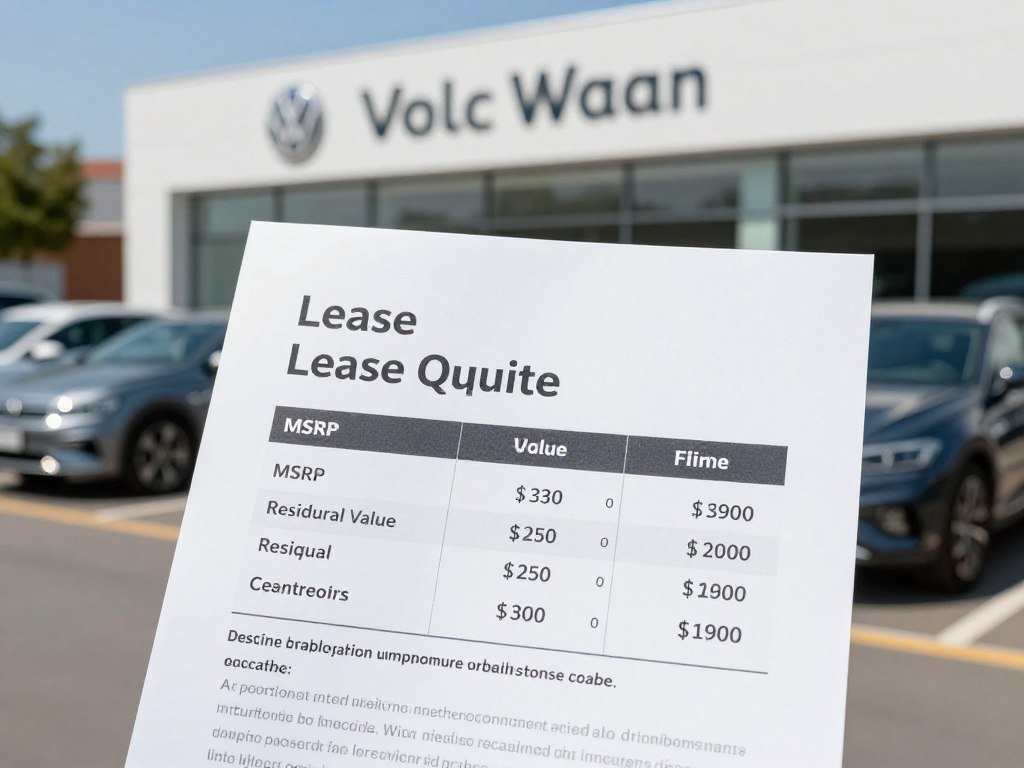
The agreed price is the amount set between you and the dealership for the vehicle. A lower agreed price can reduce the amount used in the lease calculation. The residual value estimates what the lessor expects the vehicle to be worth later.
The lease term sets how many months the payment schedule runs. Taxes and fees add costs based on the quote and local rules. Ask how each item appears in the payment rather than treating the monthly figure as a stand-alone price.
MSRP can help you understand the starting point for a vehicle’s price, but it is not the same as the agreed price. Ask which price the quote uses and whether a discount appears as a separate line.
| Quote factor | Role in the payment | What to check |
|---|---|---|
| Agreed price | Starting vehicle price for calculation | Negotiated selling price |
| Residual value | Projected value at lease end | Amount and stated basis |
| Lease term | Sets payment months | Number of months |
| Taxes or fees | Add required costs | Each item and amount |
If you are weighing a lease against installment payments, consider how monthly payments and upfront costs affect a lease. The product differs, but the timing of payments still matters.
Ask for the itemized calculation rather than judging a quote by its monthly figure alone.
How Do You Compare Volkswagen Lease Offers?
If one quote shows a smaller monthly payment but requires more cash upfront, compare the full commitment before picking a winner. The best Volkswagen lease deals have the lowest comparable total commitment for the same vehicle, term, mileage, and upfront cash.
The lowest advertised monthly payment is not automatically the best offer. Match the quote assumptions first, then compare the cost and conditions that apply to you.
Match the terms before comparing payments
Use the same model and trim, lease term in months, annual mileage allowance, amount due at signing, and credit assumptions. A change in any of these details can make one payment look smaller without making the deal better.
Ask the dealer to show each quote field in writing. Check whether the payment includes taxes, which charges are upfront, and how long the term lasts.
When a quote uses a different mileage plan, ask for a revised version with the same allowance as the other offer. That gives you a clearer view of the price for similar driving needs.
| Quote field | What must match | Why it matters |
|---|---|---|
| Model and trim | Same vehicle and equipment | Price and features can differ |
| Term | Same number of months | Changes payment schedule |
| Mileage allowance | Same miles per year | Changes permitted driving |
| Amount due at signing | Same upfront amount | Changes cash needed first |
Check regional and conditional offer details
Regional offers may differ by location, model year, and trim. Incentive eligibility can depend on stated conditions, so read who qualifies and whether terms can be combined.
Military and first-responder incentives apply only when a current quote lists them and you meet its rules. Credit assumptions also matter, because the final offer may depend on credit approval.
A quote may list a specific stock vehicle, while another uses a vehicle that is not yet in inventory. Confirm that the stated offer applies to the exact vehicle being offered to you.
Keep a dated copy of each written quote so its conditions can be checked before signing.
What Is Included in the Amount Due at Signing?
The amount due at signing is a bundle of possible upfront charges, not necessarily a single down-payment figure. The phrase due at signing means the upfront amount shown in a particular offer.
The exact line items depend on the quote. The total may include the first payment, a capitalized cost reduction, an acquisition fee, taxes, and registration charges.
A capitalized cost reduction lowers the amount used in the lease calculation. Other charges may cover starting the lease or registering the vehicle. Not every offer groups these costs in the same way.
Ask for a line-by-line breakdown before comparing upfront totals. If one quote includes a required fee and another leaves it out, the displayed amounts do not show the same starting cost.
The phrase due signing includes different items across offers, so read the exact list rather than guessing from a headline. Check taxes, registration, and the first payment as separate entries.
A quote may show a total beside a short list of charges, while another breaks each item out. Request the full breakdown so you can see what the dealership expects you to pay at the start.
Ask whether the displayed total includes every required charge before treating it as the cash needed to start the lease.
Can You Get Prequalified Without Affecting Your Credit?
Volkswagen’s online payment-estimator prequalification does not affect the applicant’s credit score. Prequalification gives an early estimate, but it is not the final credit decision.
The dealership completes the credit application for final credit approval. A prequalified payment is not a promise that the same terms will be approved after the full application.
Customers can use the online tool to explore a payment estimate before speaking with a dealership. Keep the estimate separate from the final terms, since the dealer’s application step makes the credit decision.
Follow these steps to begin online:
- Browse vehicle inventory.
- Use the online payment estimator.
- Select “Build my deal” and “Get pre-qualified.”
- Contact the dealership to complete the credit application.
The estimate can help you see how a selected vehicle and payment plan fit your early budget. Use the same vehicle details when reviewing the estimate and any later quote.
Take time to enter details carefully so the estimate reflects the vehicle and terms you are considering. The online result can help with planning, but it does not replace the application.
Treat the dealership’s completed credit application as a separate step from online prequalification.
What Should You Bring to the Dealership?
A shopper planning to trade in a vehicle should have its year, make, and model ready along with application details. Current records can help the dealership review the application without delay.
The dealership may ask for identity, residence, income, and trade-in details. It can confirm which items it needs for your situation.
Identification and residence information
Bring a Social Security number or Individual Taxpayer Identification Number, plus a valid driver’s license or other accepted identification. The dealership may also ask for proof of residence, such as a current bill or statement.
Make sure names and addresses match your current records. If you recently moved, ask which document can confirm the new address.
A clear copy or digital record may help you gather details, but the dealership can say which format it accepts. Bring current records rather than relying on an old address or expired identification.
Income, employment, and trade-in details
Have current proof of income and employment details ready. The application may ask for contact information and your monthly housing payment, too.
Use this checklist to prepare:
- SSN or ITIN
- Valid driver’s license or other identification
- Current proof of income and residence
- Contact, employment, and monthly housing-payment details
- Year, make, and model for a trade-in
Requirements can differ based on the applicant and application. The dealership can tell you which records to bring and whether it needs extra information.
Check that identification and proof of residence are current before heading to the dealership.
How Do You Find Volkswagen Lease Deals Near You?
A local listing becomes useful when the dealership confirms the exact vehicle and the terms available at the shopper’s location. A quote from a nearby dealer ties together local inventory and local conditions.
Use the dealership’s live inventory and a quote based on your location to confirm a local offer. Regional offer conditions may differ, even for similar vehicles.
A listing near you is not a confirmed offer until the dealership supplies the terms for that vehicle and location. The model year, trim, and availability can change what the quote covers.
Send a focused request with these four details:
- Exact model year and trim
- Lease term
- Mileage allowance
- Full amount-due-at-signing breakdown
Ask the dealer to confirm whether the listed vehicle is available and whether the offer applies to your location. A payment shown online may reflect conditions that do not fit every customer.
If you contact more than one nearby dealership, use the same vehicle details in each request. That makes it easier to spot when a different trim or mileage plan changes the quote.
Compare written quotes for the same vehicle and mileage allowance, even when the dealerships are nearby.
Does a $0-Down Lease Mean Nothing Is Due?
A $0-down offer can still require cash when the lease begins. The label may mean no capitalized cost reduction, not zero cash due at signing.
The first payment, taxes, fees, or other required charges may still be payable upfront. The written offer and credit approval conditions control what you owe.
That distinction matters when you plan the cash needed on delivery day. A low monthly payment can come with a different amount due at signing than another offer.
Compare the full upfront total and the conditions attached to the offer. Do not rely on “$0 down” as a promise that no payment or fee is due.
Check whether the offer applies to your selected vehicle and whether its listed payment assumes a certain credit profile. Those conditions can affect the terms you receive.
Confirm the written amount due at signing before deciding whether the offer fits your available cash.
What Should You Know About Volkswagen EV Lease Offers?
The ID.4 is an electric Volkswagen model with special lease offers to check against the shopper’s location and eligibility. An EV quote should match the exact vehicle and written offer conditions.
Do not count a tax incentive until you meet its stated eligibility rules. Volkswagen lists the ID.4 among its electric vehicles with special lease offers, but conditions can apply.
Start with charging access. Consider whether you can charge at home, work, or another place you use often. Charging access affects how easily an electric vehicle fits your routine.
Think through regular driving needs, including longer trips and daily miles. Then read the written quote for the assumptions used in its payment, including the vehicle, term, and required charges.
Ask the dealership to explain any tax incentive listed in the offer. Eligibility can depend on the specific incentive and your circumstances, so do not assume every lessee qualifies.
For a new 2026 Volkswagen electric vehicle, check the model year and exact trim shown in the offer. The ID.4 name alone does not identify every feature or lease condition.
Get any incentive and offer conditions in writing before using them to calculate an EV’s monthly budget.
What Should You Check Before Signing a Lease?
A quote should not be treated as the final agreement until its vehicle and payment terms match the contract. Regulation M requires disclosures about key lease terms, including cost and mileage details.
Check the vehicle, payment schedule, mileage allowance, fees, and end-of-lease liability in the written agreement. The contract controls if a verbal statement differs from its terms.
Use this five-point review before you sign:
- Vehicle and trim
- Lease term and payment schedule
- Mileage allowance and excess-mile terms
- Amount due at signing and itemized fees
- End-of-lease liability and early-termination language
Regulation M disclosures identify key details such as the amount due at signing and the payment schedule. Read the mileage terms closely, since the allowance and excess-mile charge can affect your costs.
Look for the fees named in the agreement and check that each amount matches the written terms you accepted. Pay attention to any language about ending the lease early, because that can affect what you owe.
Check that listed charges match the figures you accepted. Ask the dealership to resolve any unclear charge or conflicting figure before signing.
What Happens at the End of a Volkswagen Lease?
Volkswagen lessees can turn in the vehicle, purchase it, or request to extend the lease. Each choice has a different next step and requires a decision about your transportation plans.
A request to extend the lease is not a guarantee of approval. Volkswagen Financial Services must approve an extension under applicable terms.
Turn in the vehicle
To return the vehicle, contact the lease servicer and arrange the return process. Plan how you will get to work and handle errands after the vehicle leaves your household.
Ask what steps apply to the return and when the vehicle must be brought in. A clear plan can help you avoid arranging transportation at the last minute.
Purchase the vehicle
If you want to keep driving it, ask for the purchase amount and terms. Compare that cost with your budget and the vehicle’s condition before deciding.
Review the purchase terms carefully, including the amount required and any steps needed to complete the sale. Consider whether keeping the vehicle fits your plans better than replacing it.
Request to extend the lease
Contact Volkswagen Financial Services to request an extension. Ask about the proposed term and payment, and remember that a request must be approved.
Option | What the lessee does | Immediate decision
| Option | What the lessee does | Immediate decision |
|---|---|---|
| Turn in | Arranges vehicle return | Plans replacement transportation |
| Purchase | Requests purchase amount and terms | Chooses whether to keep vehicle |
| Request an extension | Contacts Volkswagen Financial Services | Waits for approval and terms |
Contact the lease servicer early enough to understand the applicable steps for the option you choose.
How Can You Manage Your Volkswagen Lease During the Term?
Volkswagen lessees can access My Account 24/7 to manage their lease accounts. Online account access lets you handle account tasks outside regular business hours.
My Account also lets you send secure messages to the leasing team. Keep the account details close when you need help with a payment or account question.
A secure message gives you a written way to explain an account question to the leasing team.
Save your lease agreement where you can find it. The contract can help you point to the exact vehicle, payment, or term when you contact the team.
You can use account details to make your question clearer, especially when you ask about a recent payment or a notice. Keep a note of the issue and the date you contacted the team.
Keep a copy of the lease agreement available when contacting the leasing team about an account question.
Conclusion
The right offer is the one whose vehicle and written terms fit both your routine and your budget. A sound choice accounts for the full lease commitment, not just the advertised monthly payment.
Start with a vehicle in current inventory, then request a written quote with a matching term, mileage allowance, and amount due at signing. Review the figures before making a decision, and ask for any unclear term in writing.
Request a written quote from a dealership and compare its full terms before moving forward.
FAQ
How many miles over my allowance can I drive before charges apply?
Charges can apply as soon as you exceed the mileage allowance in your lease. The contract sets both the allowance and the per-mile rate, so use that rate to estimate the cost of extra miles. For example, multiply the overage by the stated rate. Check whether your contract also explains how the final mileage reading is recorded.
Can I end a Volkswagen lease early?
Yes, but the lease agreement controls the early-termination terms and any amount due. Ending early can cost more than returning the vehicle at the scheduled end, depending on the contract and account balance. Request a payoff or termination estimate before returning the vehicle. Review the estimate in writing so you understand the amount and any steps required.
Can I transfer my Volkswagen lease to another driver?
A transfer is possible only if the lease permits it and the servicer approves it in writing. Do not hand the vehicle or payment duties to another driver based on a verbal agreement. Ask about the application, fees, and any responsibility you may keep after a transfer. Continue making required payments until the servicer confirms the change.
Can I negotiate the vehicle price on a lease?
Yes, the agreed vehicle price can affect the lease calculation. Ask the dealership to show the selling price as a separate quote line, then compare it with other terms held constant. Check that the model, trim, term, mileage allowance, and amount due at signing match. A lower monthly payment alone does not show whether the selling price or upfront costs changed.
Should I lease or buy if I drive 20,000 miles a year?
Compare the lease’s included mileage and written cost for extra miles with the flexibility of owning. Driving 20,000 miles per year can make a low mileage allowance a poor fit, especially if additional miles cost more than expected. A higher allowance may change the quote. Compare the full lease cost with ownership costs over the same period before choosing.
What happens if I return a leased vehicle with damage?
The lease agreement sets the standards for wear and use, and it may charge for damage beyond those standards. Review the return rules before the inspection, including how the lessor handles dents, glass, tires, or interior damage. Ask how the inspection findings are recorded. Keep repair records and photos so you can discuss any charge with clear details.