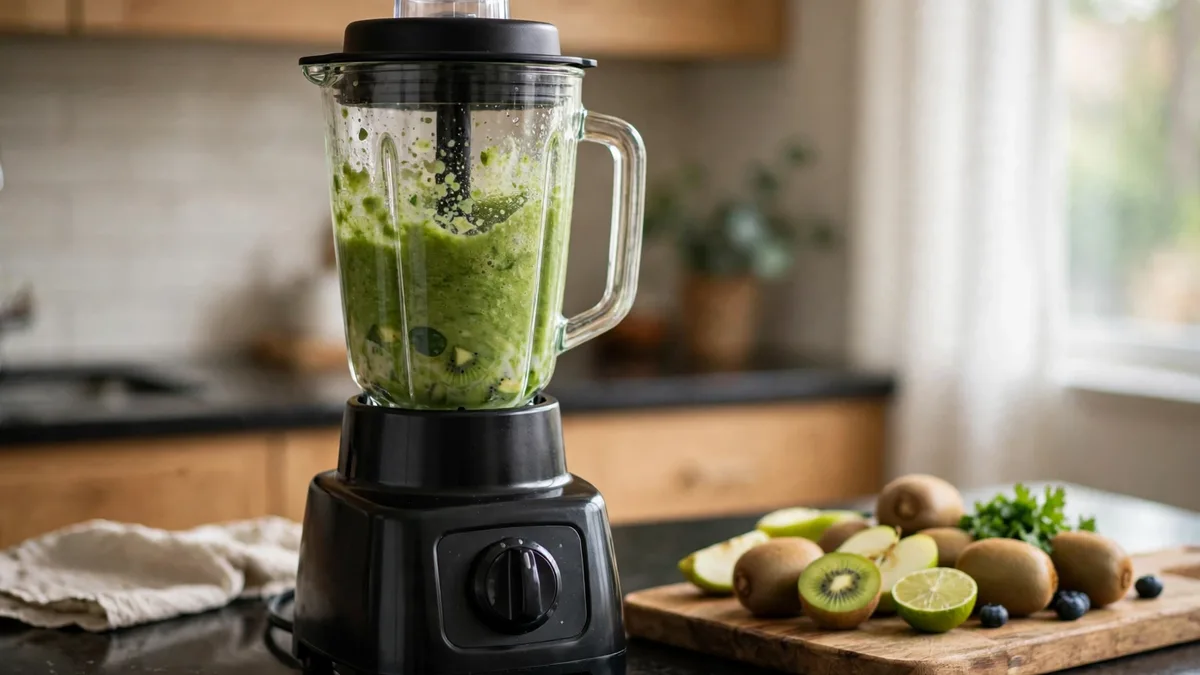
A blender is a kitchen appliance that spins sharp blades at high speed to chop, mix and liquefy food. It turns solid ingredients such as fruit, vegetables, ice and nuts into smoothies, soups, sauces and batters in under a minute. The basic design has barely changed in decades: a motor in the base, a removable jar on top, and blades at the bottom that pull food down and cut it again and again.
Blenders range from small personal models that blend a single smoothie in a travel cup to large countertop machines that can crush ice and grind nuts. The differences come down to power, jar size, blade design and controls. Once you understand those four things, choosing between models becomes much simpler.
This guide explains what a blender does, how it works, the main types, and how to pick one that fits your kitchen. It focuses on the everyday jobs a blender actually does well.
Key takeaways
- It works by spinning blades at high speed, pulling food into a vortex that chops and mixes it evenly.
- Power matters for hard jobs: about 500 watts handles smoothies, while ice and frozen fruit need 1,000 watts or more.
- Jar size should match your usual batch, since a jar that is too large will not blend small amounts well.
- Layering ingredients in the right order, liquids first and frozen items last, prevents the blades from stalling.
- Cleaning is quickest when you rinse and blend soapy water straight after use, before food dries onto the blades.
Blenders at a glance
| Detail | What to know |
|---|---|
| What it does | Chops, mixes, purees and liquefies food with fast-spinning blades |
| Typical power | About 300 to 500 watts for personal models, 1,000 to 1,500 watts for full-size models |
| Jar size | About 500 millilitres for personal cups, 1.5 to 2 litres for countertop jars |
| Blade speed | Thousands of revolutions per minute, with pulse and variable speed settings |
| Best for | Smoothies, soups, sauces, batters, dressings and crushed ice |
| Not ideal for | Kneading dough, slicing vegetables, or grinding large amounts of dry grain |
| Cleaning | Rinse, then blend warm soapy water for 30 seconds and rinse again |
| Typical price range | From about $30 for a personal blender to more than $400 for a high-power model |
What a blender is
A blender is an electric appliance that uses a fast-spinning blade to break food into small pieces and mix it into a smooth liquid or paste. You put ingredients in the jar, fit it onto the motor base, and press a button. Within seconds, fruit and milk become a smoothie, and the same action turns cooked vegetables into soup, or oil and vinegar into a dressing.
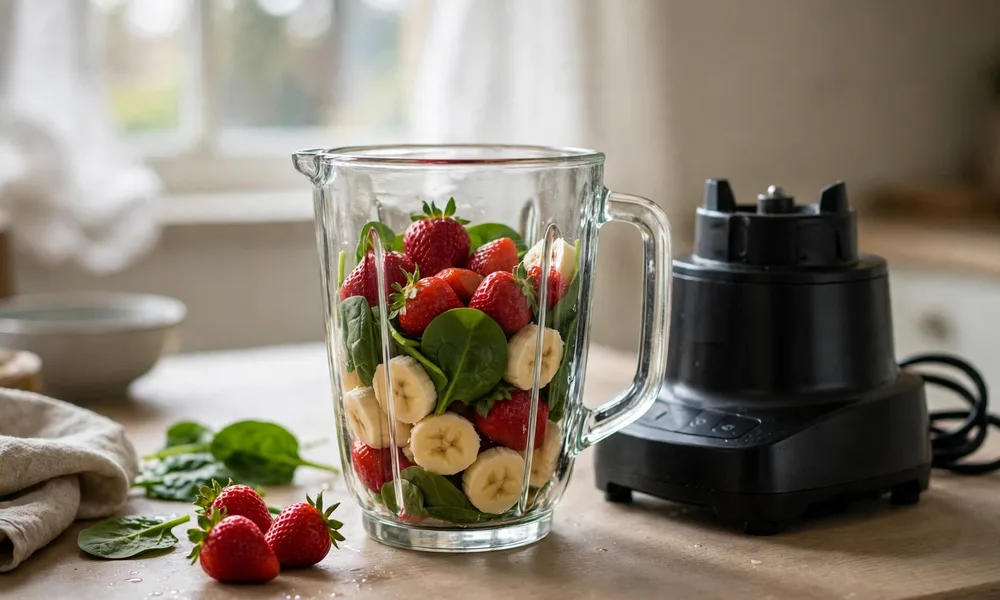
Every blender has the same core parts. The base holds the motor and the controls, the jar holds the food, the blade assembly sits at the bottom of the jar, and the lid keeps everything inside. Most jars are glass or tough plastic with measurement marks, and the lid usually has a removable cap in the centre, so you can add ingredients while the blender runs.
The key idea is the vortex. As the blades spin, they push food outward and upward, and it falls back down into the centre, where the blades cut it again. A good blender keeps this cycle going, so everything passes through the blades many times in a few seconds. A weak blender stalls instead: the blades spin in a pocket of air while chunks sit untouched at the edges.
How a blender works
Inside the base, an electric motor turns a small drive gear that connects to the blade assembly. When you press a speed button, the motor spins the blades at thousands of revolutions per minute. The blades are usually short and blunt-edged rather than razor sharp, because they work by impact and speed, smashing food apart rather than slicing it. That is why a blender can work well for years even though the blades look dull.
Power, measured in watts, decides what the blender can handle. A 300-watt personal blender will manage soft fruit, yoghurt and milk, but it will struggle with ice and frozen berries. A 1,000-watt countertop model can crush ice, blend frozen fruit and grind nuts into butter. Like the processor in a laptop, which our guide to what a laptop is explains in simple terms, the motor sets the ceiling on what the machine can do.
Speed settings give you control over texture. Low speeds suit chunky salsas and starting a blend without splashing, while high speeds produce the smoothest smoothies and soups. A pulse button runs the motor in short bursts, useful for chopping nuts or making salsa, where you want pieces rather than a puree.
Order matters when you load the jar. Liquids go in first, then soft ingredients, then hard and frozen items last. If the blender stalls, stop it, stir, add a little more liquid, and start again on low. Filling past the maximum line is another common mistake: food needs room to circulate.
Types of blenders
Countertop blenders are the standard full-size models, with a large jar on a heavy base. They suit households that make smoothies, soups and sauces regularly, and they handle the widest range of jobs. Their drawback is size: they need a permanent spot, and the large jar is wasteful for single servings.
Personal blenders use a small cup, usually about 500 millilitres, that doubles as a travel bottle. You blend in the cup, then swap the blade for a drinking lid and take it with you. They are cheap, compact and easy to clean, but they have small motors and cannot crush ice or blend large batches.
High-performance blenders are the premium countertop models, with motors of 1,000 watts or more, thick jars and long warranties. They can crush ice, make nut butter, grind grains and heat soup through friction. They cost several times more than a basic model, so they suit people who blend every day.
Immersion blenders, also called stick blenders, are handheld: a motor in the handle drives a small blade at the end of a wand, and you blend directly in a pot or jug. They are ideal for pureeing soup in the pot or making a quick dressing, and they store in a drawer. They cannot match a countertop blender for smoothies or ice, but they are the cheapest option for small jobs.
Benefits and drawbacks
The main benefit is speed and versatility. A blender turns a pile of ingredients into a finished smoothie or soup in about a minute, with very little skill needed. It also makes healthy eating easier: fruit, vegetables, nuts and seeds can be blended into a drink or a sauce in seconds.
The drawbacks are noise, size and cleaning. Blenders are loud, especially high-power models crushing ice. A full-size model takes up counter space, and the jar, lid and blade assembly all need washing. Some parts are dishwasher safe, but the blade assembly usually needs hand washing, and dried food is much harder to remove.
There are also limits: it cannot knead dough, slice vegetables neatly, or replace a food processor for grating and shredding. Overloading it with dry ingredients can strain the motor, and blending very hot liquids in a sealed jar is risky, because steam builds pressure and can push the lid off.
Real-world uses and who it suits
In a family kitchen, a blender is a daily tool. Morning smoothies are the most common job, followed by soups, sauces, pancake batter and salad dressings. Parents use them for baby food, and anyone on a fitness routine uses them for protein shakes. A countertop model fits best, because it handles larger batches and tougher ingredients.
For a single person or a student, a personal blender is usually the better buy. It is cheap, small and fast to clean, and it makes exactly one serving. The trade-off is power: frozen fruit and ice will test a small motor, so use partly thawed fruit or add extra liquid. Small cafes use commercial blenders with heavy motors and sound covers, because they blend all day.
Blender vs food processor
The most useful comparison is with a food processor, because the two look similar and often sit side by side in shops. A blender is built for liquids: its tall jar and fast blades make smooth purees, drinks and soups. A food processor has a wide, shallow bowl and interchangeable discs, and it is built for solid food: chopping, slicing, grating and kneading dough. Neither replaces the other.
If your main jobs are smoothies, soups and sauces, a blender is the better buy, and it costs less. If your main jobs are chopping vegetables, making pastry or grating cheese, a food processor earns its place. Some households own both, using the blender daily and the processor weekly. Our roundup of the best coffee makers for 2027 takes the same approach of matching a machine to the job it does best, in a different corner of the kitchen.
Checklist: before you buy a blender
- Decide on countertop, personal, high-performance or immersion, based on your usual batch size.
- Check the wattage: about 500 watts for smoothies, 1,000 watts or more for ice and frozen fruit.
- Pick a jar size that matches your household, and check whether the jar is glass or plastic.
- Look for simple controls, a pulse button, and a lid that seals well and is easy to remove.
- Check which parts are dishwasher safe, and whether the blade assembly comes out for cleaning.
- Confirm the warranty length and the cost of a replacement jar before you commit to a brand.
Frequently asked questions
What can you make in a blender?
Smoothies, soups, sauces, dressings, batters, dips and crushed ice are the main jobs. High-power models can also make nut butter, while personal models are best kept to drinks and soft foods.
How much power does a blender need?
About 300 to 500 watts is enough for soft fruit and liquids. For ice, frozen fruit and nuts, look for 1,000 watts or more. More power also means the motor strains less.
Can you put hot liquid in a blender?
Yes, but with care. Let soup cool slightly, fill the jar no more than halfway, hold the lid down with a folded towel, and start on low. Steam builds pressure in a sealed jar, so never blend boiling liquid with the lid closed.
Why does my blender stall?
It usually means the blades are spinning in air or the mixture is too thick. Stop, stir, add a little more liquid, and restart on low. Loading liquids first and frozen items last prevents most stalls.
How do I clean a blender properly?
Rinse the jar straight after use, then fill it halfway with warm water and a drop of washing-up liquid, blend for 30 seconds, and rinse again. For dried food, soak the jar first.
Is a glass or plastic jar better?
Glass is heavier, scratch resistant and does not hold smells, but it can break if dropped. Plastic is lighter and tougher, but it can scratch and stain over time. Both work well, so choose based on weight and how you store it. Our explainer on what a printer is shows how a motor and a simple mechanism can do a surprising amount of work.
The bottom line
A blender is a machine: fast blades, a strong motor and a jar shaped to keep food moving through them. Power decides what it can handle, jar size decides how much it can make, and loading order decides whether it blends smoothly or stalls. Choose the type that matches your usual batch.
For most households, a mid-range countertop blender with about 1,000 watts is the sweet spot between price and performance, while a personal blender suits a single daily smoothie. Whichever you buy, rinse it straight after use.