What Is AI Drift Detection?
AI drift detection is the practice of watching a machine learning model after it goes live and spotting the moment its performance starts to slip. A model that scored well in testing can quietly get worse in production as the real world changes around it: customers behave differently, language shifts, products change, and the data the model sees drifts away from the data it was trained on.
The idea is simple, even if the methods behind it can get technical. A team sets a baseline for how the model should behave, then keeps measuring live behaviour against that baseline. When the gap grows too wide, an alert fires and someone investigates.
This guide explains what AI drift detection is, how it works, the main types of drift it watches for, and the methods teams use to measure it. It is written for anyone who works with AI systems but does not build models for a living: product managers, operations leads, and engineers who need to know whether the model they depend on is still telling the truth.
Key takeaways
- AI drift detection compares live model behaviour against a known baseline and raises an alert when the gap grows too wide.
- The three main types are data drift, concept drift, and prediction drift, and each one needs a different detection method.
- Statistical tests, performance tracking, and simple distribution checks are the core tools, and most teams combine more than one.
- Detection only helps if alerts lead to action: investigation, retraining, or a rollback to a safer version.
- Small teams can start with basic checks on inputs and outputs, and add more advanced monitoring as their models become more important.
| Type of drift | What changes | How it is detected |
|---|---|---|
| Data drift | The input data shifts away from training data | Distribution checks on live inputs |
| Concept drift | The meaning of the data changes over time | Accuracy tracking against labelled outcomes |
| Prediction drift | The model’s outputs shift in pattern | Output monitoring and score distribution checks |
| Model drift | Overall performance degrades in production | Business metrics and error-rate trends |
What AI drift detection means
AI drift detection is a monitoring discipline, not a single tool. It covers every check a team runs to answer one question: is this model still behaving the way it did when we trusted it?
It helps to separate detection from the drift itself. Drift is the problem: the slow change in data or behaviour that makes a model less accurate. Detection is the early-warning system. The fix comes later, once the alert has done its job.
Detection also sits inside a wider practice. Our guide to AI drift explains the problem itself in detail, including why models go stale and what the warning signs look like.
How drift detection works
The process starts with a baseline. When a model launches, the team records how its inputs looked and how its outputs behaved: the average values, the spread of scores, and the accuracy on a held-out test set.
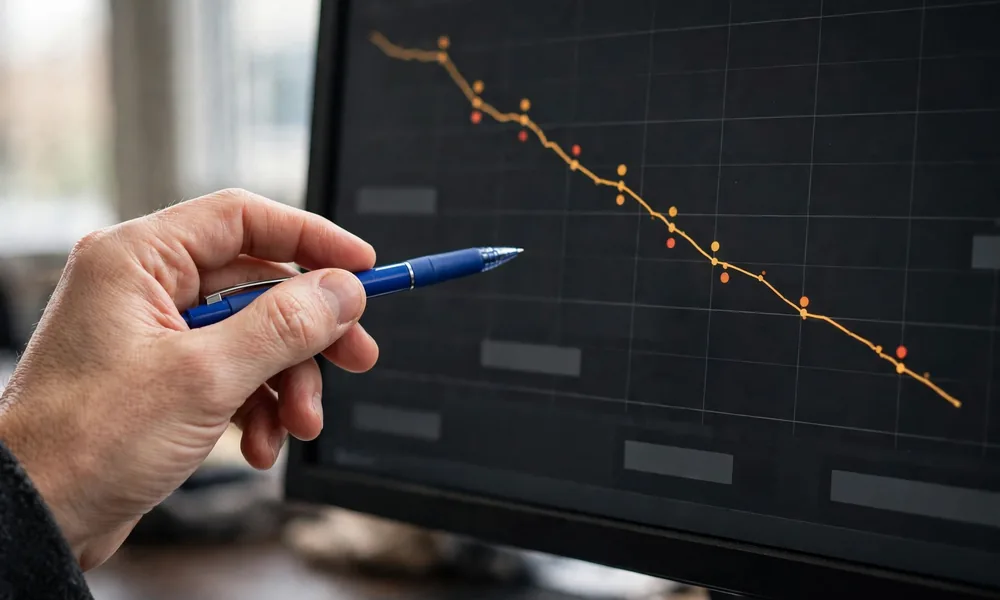
Next comes regular measurement. On a schedule the team chooses, the system samples live inputs and outputs and compares them with the baseline. The comparison might be a simple statistical test, a check of average prediction scores, or a full review of accuracy where labelled results are available.
Finally, thresholds turn measurements into alerts. A team decides in advance how big a change counts as a problem, for example a 3 percent drop in accuracy or a shift in input distribution beyond a set limit. When a measurement crosses the line, an alert goes to the model owner.
The main types of drift detection
Data drift detection watches the inputs. It compares the live data flowing into the model with the training data, feature by feature, and flags anything that has moved. A fraud model trained on purchases from one region, for instance, will behave oddly when a new market opens and the mix of transactions changes. Distribution checks and statistical distance measures are the usual tools here, and they work even when nobody knows the correct answer for each prediction.
Concept drift detection watches the relationship between inputs and outcomes. Sometimes the data looks the same but the meaning has changed: a word that once signalled a happy customer now appears in complaints, or a spending pattern that once meant fraud is now normal behaviour. It usually needs labelled outcomes, such as confirmed fraud cases or customer feedback, so the team can see accuracy falling even while the data looks stable.
Prediction drift detection watches the outputs. If a recommendation engine suddenly starts suggesting the same few items to everyone, or a credit model starts approving far more applications than it used to, something has shifted. Output monitoring is cheap and fast, and it often catches problems first, though it cannot say why the outputs changed.
Methods and metrics teams actually use
Statistical tests are the workhorse of drift detection. Tests with names like Kolmogorov-Smirnov and Population Stability Index compare two distributions and return a single number describing how far apart they are. Most monitoring tools include them out of the box, and they are a sensible starting point for any team.
Performance tracking is the most direct method, and the hardest to maintain. Where the true outcome becomes known later, such as whether a loan was repaid or a recommended product was bought, the team can measure accuracy directly and watch it over time.
Simpler checks deserve more credit than they get. Tracking the average and range of each input feature, counting missing values, and watching the share of predictions in each category can reveal most drift with almost no tooling. A dashboard with these basic numbers, reviewed weekly by the model owner, catches a surprising share of real problems, and it costs far less than a specialist platform. Teams that outgrow it can add AI observability tooling later, once they know which signals matter for their models.
Benefits and risks of drift detection
The main benefit is time. Catching drift in week two instead of month six means fewer bad decisions, fewer unhappy customers, and a smaller retraining job. It also builds trust: a team that can show its models are watched and measured will find it easier to win approval for the next AI project than one that cannot say how its models are performing.
Detection also makes retraining cheaper and smarter. Instead of retraining on a fixed calendar, teams retrain when the data says the model needs it, and they know exactly which features have shifted, so the new training data can target the gap.
The risks are real, though. False alarms are the biggest: thresholds set too tight will page engineers for harmless seasonal shifts, and alert fatigue soon follows. There is also a privacy angle, since monitoring requires storing samples of live data, which may include personal information. Teams should agree what gets stored, for how long, and who can see it, and the ISO 42001 standard for AI management gives a useful framework for those decisions.
Real-world uses of drift detection
Fraud detection is one of the clearest examples. Fraudsters change tactics constantly, so a fraud model that is not watched will start missing new patterns within weeks.
Recommendation systems show the same pattern in a gentler form. Tastes change with seasons, trends, and new products, so a shop or streaming service that never checks its recommender will slowly start suggesting stale or irrelevant items.
Healthcare and hiring show why detection matters beyond revenue. A screening model trained on one population can drift badly when it meets another, and the consequences are not just lost sales. In these settings, drift detection is part of responsible deployment: a check that the model still works fairly and accurately for the people it actually serves.
Drift detection vs model monitoring
Drift detection and model monitoring are often confused, but they are not the same thing. Model monitoring is the wider job: watching everything about a model in production, from latency and uptime to data quality and business impact. Drift detection is one part of that job, focused specifically on change over time.
Think of monitoring as the hospital and drift detection as one of its tests. A model can be up, fast, and free of errors while still drifting, because drift does not break systems, it quietly makes them wrong. That is why a healthy monitoring setup includes both: the operational checks that catch outages, and the drift checks that catch slow decline.
Drift detection checklist
- Baseline recorded at launch, covering inputs, outputs, and accuracy.
- Checks scheduled at least weekly, with data drift, concept drift, and prediction drift all covered.
- Thresholds set in advance, tight enough to catch real drift without constant false alarms.
- Every alert has a named owner and a clear next step, such as investigate, retrain, or roll back.
- Live data samples stored safely, with agreed limits on what is kept and who can see it.
- Detection results reviewed regularly, and retraining driven by the data, not the calendar.
Frequently asked questions
How is drift detection different from testing a model?
Testing happens before launch, on data the team already has. Drift detection happens after launch, on live data the team has never seen. Testing proves a model worked once; detection checks whether it still works, week after week, as the world changes.
How often should drift checks run?
It depends on how fast the model’s world changes. Daily checks suit fraud and pricing models, where behaviour shifts quickly. Weekly checks are enough for slower systems like content recommendations. The right cadence is the one that catches drift before users feel it.
Do small teams need drift detection?
Yes, and it does not need to be expensive. Basic checks on input averages, missing values, and output patterns can be built with a spreadsheet or a simple script. The habit of checking matters more than the tooling, and it scales up as the models become more important.
What happens when drift is detected?
The team investigates first, because not every shift means the model is broken. If the model has genuinely degraded, the usual fixes are retraining on fresh data, adjusting the model, or rolling back to a previous version while the problem is understood.
Can drift detection prevent all model failures?
No. It catches gradual decline well, but it cannot predict sudden shocks, such as a new regulation or a market crash that changes behaviour overnight. It is an early-warning system, not a guarantee, and it works best alongside good testing and human oversight.
Which metrics matter most?
Accuracy matters most where labelled outcomes exist, because it measures what users actually experience. Where outcomes are delayed or unknown, input distribution checks and prediction drift scores are the best early signals. Most teams track both, and let the business impact decide which one triggers action.
The bottom line
AI drift detection is how teams keep their models honest after launch. It is not glamorous work, and it rarely gets the attention that building a new model does, but it is what separates a model that keeps working from one that quietly goes stale.
If you run even one model in production, set up the basics this week. Record the baseline, pick a weekly check, and name the person who gets the alert.