What Is AI Warehouse Automation?
AI warehouse automation is the use of artificial intelligence, robots and connected software to move, store, pick and pack goods inside a warehouse with less manual work and fewer errors. It is not a single machine or a single piece of software: robots carry shelves and parcels, cameras and sensors watch the floor, and software decides what happens next, from where a product is stored to which order is picked first.
The idea has been building for years, but it has moved quickly as robots have become cheaper and warehouse software easier to connect. A decade ago, automation meant fixed conveyor lines and a handful of large machines. Today it can mean a fleet of small mobile robots that rearrange themselves around the day’s orders, guided by software that updates its plan every few minutes.
This article explains what AI warehouse automation is, how the pieces work together, the main types in use today, and where it makes sense, for anyone weighing an investment or managing a warehouse in 2027.
Key takeaways
- AI warehouse automation combines robots, computer vision and warehouse software into one coordinated system.
- The software decides the plan, the robots do the moving, and sensors and cameras feed both with live information.
- It cuts picking errors and walking time, but it needs clean inventory data and a well-organised floor to work.
- Most warehouses adopt it in stages, starting with one zone or one process rather than the whole building.
- The business case depends on order volume, labour costs and error rates, not on the technology alone.
| Item | What it means |
|---|---|
| Core idea | Software, robots and vision working together to move and pick goods |
| Main parts | Mobile robots, robotic arms, cameras, sensors and a warehouse management system |
| Biggest gain | Faster, more accurate picking with less walking and fewer errors |
| Biggest requirement | Accurate inventory records and a floor layout robots can navigate |
| Best fit | High-volume e-commerce and retail warehouses with many small orders |
| Main risk | High upfront cost and disruption if the rollout is rushed |
The Concept: Software, Robots and Vision Working Together
At its simplest, AI warehouse automation answers three questions all day long: where should each product sit, which order should be picked next, and which machine or person should do it. The warehouse management system holds the inventory record and the order queue, the AI layer reads that data plus live signals from the floor and turns it into a plan, and the robots and people on the floor carry it out.
The difference from older automation is flexibility. A fixed conveyor moves goods along one path whether it is the best path or not. An AI-driven fleet of mobile robots can change its routes as orders arrive and send more robots to a busy zone. That matters most in e-commerce warehouses, where the order mix changes by the hour.
Computer vision is the third leg of the system. Cameras read barcodes and labels, check that the right item is in the right box, spot damaged packaging, and watch for people or obstacles in a robot’s path.
How It Works: From Order to Dispatch
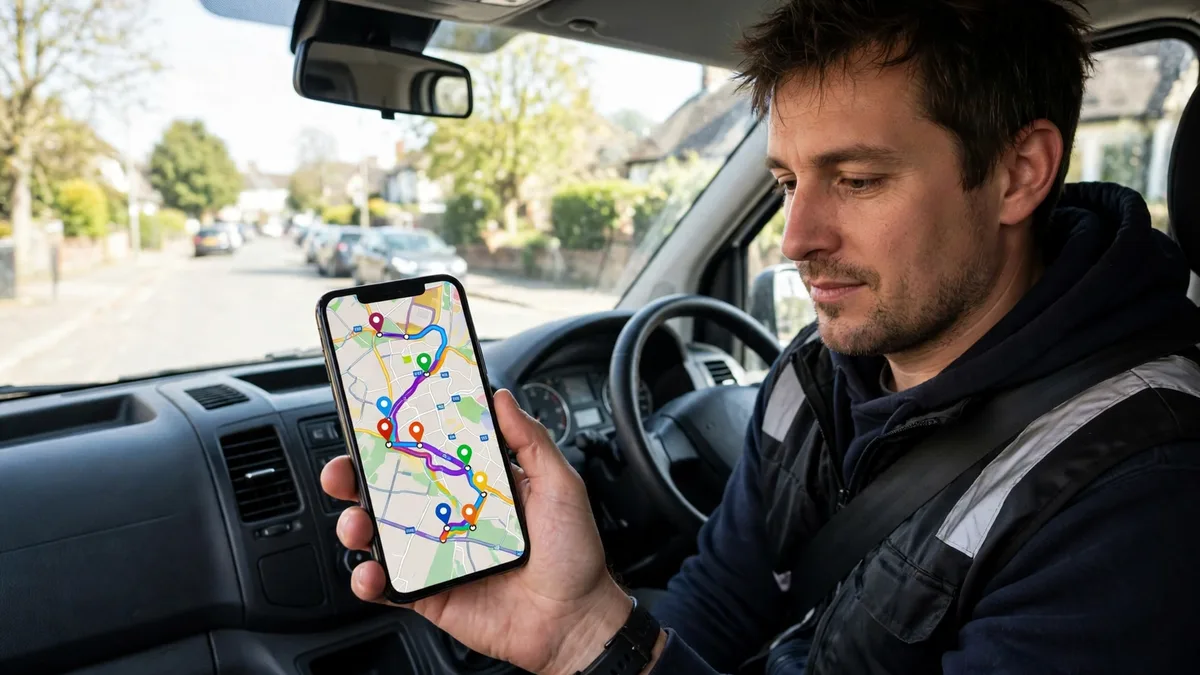
A typical flow starts when an order arrives in the warehouse system. The software groups it with other orders going to the same area, checks stock, and decides the picking route. With goods-to-person robots, a mobile robot drives a shelf or tote to a picking station, where a worker or a robotic arm takes the item. With person-to-goods picking, the software sends a worker along the shortest route with a handheld device telling them what to take.
After picking, the order moves to packing, where vision systems can check contents and suggest the right box size, cutting wasted packaging and shipping cost. The packed order is labelled, sorted by carrier and loaded. At every stage the software updates the inventory record, so the next order is planned against real numbers rather than yesterday’s count.
Behind the scenes, the system also manages the robots themselves: charging schedules, traffic on the floor, and maintenance alerts when a robot’s performance drops. A single stalled robot in a busy aisle can slow the whole operation if nobody notices it quickly.
Types of AI Warehouse Automation
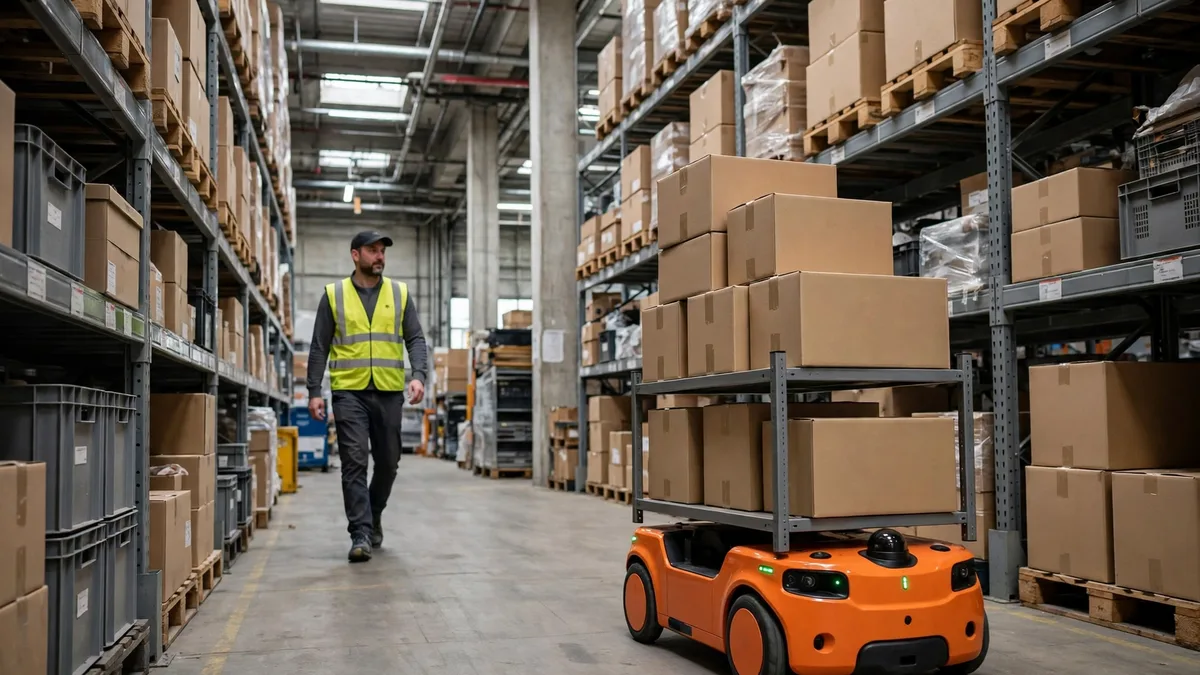
Autonomous mobile robots are the most common starting point. These flat, wheeled robots slide under a shelf or tote, lift it, and carry it to a picking station. They navigate with cameras, lasers and floor markers, and they can be added a few at a time, a lower-risk first step than rebuilding the whole warehouse.
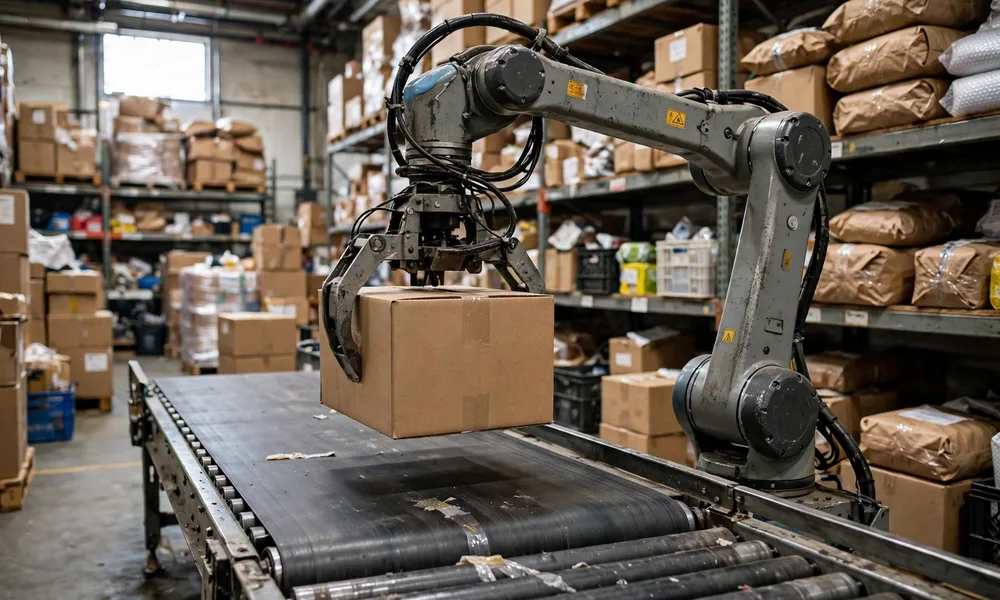
Robotic picking arms handle the actual grasping of items. They use vision to identify a product, work out how to grip it, and place it in a tote or box. They work best with uniform, sturdy items and struggle with soft, irregular or fragile goods, so many warehouses use them for a subset of products.
Automated storage and retrieval systems are the heavy end of the range: tall racking with cranes or shuttles that store and fetch pallets or totes in dense, high-bay layouts. They suit warehouses with limited floor space and a large, stable product range, but they cost more and take longer to install.
Then there is the software-only layer, which some warehouses adopt before buying any robots at all. AI slotting decides where products should live based on how often they are ordered together, AI forecasting predicts demand so stock is in the right place before a rush, and AI labour planning matches staff to the day’s workload. For many smaller warehouses, this layer alone delivers a useful gain at a fraction of the cost of hardware.
Benefits and Risks
The clearest benefit is speed and accuracy in picking. Robots cut the walking that eats up most of a picker’s shift, and vision checks cut the mis-picks that lead to returns and reshipments. Warehouses that automate picking well report fewer errors, faster turnaround, and steadier output across a shift.
There are real risks too. The upfront cost is high, and the payback depends on order volume staying strong. A warehouse that automates for a peak that never returns can end up with expensive equipment standing idle. Integration is another risk: robots, vision systems and warehouse software come from different vendors, and making them work together takes time and testing.
Staffing changes need honest handling. Automation usually changes jobs rather than removing them overnight: fewer hours walking aisles, more hours supervising machines, handling exceptions and maintaining equipment. That shift needs training and a clear plan, because a workforce that feels blindsided will resist the change.
Real-World Uses in 2027
E-commerce fulfilment is the biggest use case. Online retailers with thousands of small orders a day use mobile robots and goods-to-person picking to keep dispatch times short, especially during sales peaks when volumes can double in a week. Grocery warehouses use similar systems, with the added complexity of chilled zones and short shelf lives.
Third-party logistics providers use automation to serve many clients from one building. The software can switch between clients’ products and priorities through the day, and robots can be moved between zones as demand shifts. Retailers use it in distribution centres that feed stores, where the same logic applies: put fast-moving goods where they are quickest to reach, and let software plan the day.
Smaller warehouses are finding their own entry points. A business with one warehouse and a few thousand orders a week might start with AI slotting and a small robot fleet in the fastest-moving zone, then expand as the numbers prove themselves. The pattern is the same everywhere: start where the volume and the errors are highest, measure, and grow from there.
AI Warehouse Automation vs Traditional Warehousing
A traditional warehouse relies on people walking aisles, pick lists, and a supervisor’s judgement about what to do next. It is flexible and cheap to set up, and it works well when volumes are low and the product range is stable. Its limits show up as volume grows: walking time rises, errors creep in, and adding staff stops helping because the aisles get crowded.
An AI-automated warehouse trades flexibility of setup for flexibility of operation. Once installed, it adapts to changing orders quickly, keeps error rates low, and scales by adding robots rather than floor space. The trade-off is cost, complexity and dependence on data: if the inventory record is wrong, the robots will confidently fetch the wrong thing.
Most warehouses end up somewhere in between, with automation in the busiest zones and manual work elsewhere. That hybrid is usually the sensible answer, because it puts the expensive technology where it earns its keep and leaves the rest alone. Connected robots and cloud software also widen what needs protecting, and the same principles in what cybersecurity means for a business apply to warehouse systems as much as to office networks. A good CRM system for a small business helps a growing warehouse business keep orders, customers and service in step. AI tools for legal teams are a useful reminder that automation is spreading through every department, not just the warehouse floor.
Checklist: Is AI Warehouse Automation Right for You?
- Volume check: order numbers are high enough, and steady enough, to justify the investment.
- Data check: inventory records are accurate and updated in real time.
- Error check: picking mistakes and returns are a real cost today, not a rare annoyance.
- Space check: the floor layout can give robots clear, unobstructed routes.
- Budget check: upfront cost, integration and maintenance are all funded, not just the purchase price.
- People check: staff have a training plan and a clear picture of how their roles will change.
Frequently Asked Questions
How much does AI warehouse automation cost?
Costs range from a modest software subscription for AI slotting and forecasting to a major capital project for robots and high-bay storage. Mobile robot fleets sit in the middle and can start small. Always budget for integration, training and maintenance on top of the headline price.
Does it work for small warehouses?
Yes, in stages. Software-only tools such as AI slotting and demand forecasting work at almost any size, and a small fleet of mobile robots can serve one busy zone. Full automation rarely pays for a small warehouse, but targeted automation often does.
Will robots replace warehouse workers?
Robots take over the repetitive moving and lifting, but people remain essential for exception handling, quality checks, maintenance and supervision. Most automated warehouses employ a similar number of people in different roles.
How long does it take to set up?
Software-only tools can be live in weeks. A mobile robot pilot typically takes a few months from order to steady running, while a full storage and retrieval system can take a year or more including building work. Plan for a bedding-in period after go-live.
What happens if the system goes down?
A good setup has a fallback: manual picking from printed lists, spare robots, and a support contract with a clear response time. Ask vendors about this before signing.
Can AI warehouse automation handle fragile or odd-shaped goods?
Partly. Vision-guided arms handle many standard items well, but soft, fragile or irregular products are still best picked by people. Most warehouses automate the easy majority of their range and keep manual stations for the rest.
The Bottom Line
AI warehouse automation is a coordinated system, not a single machine: software plans, robots move, cameras check, and people supervise and handle the exceptions. When the data is clean, the volume justifies the cost, and the rollout is staged, it delivers faster, more accurate fulfilment.
It is not a fit for every warehouse, and it is not a fix for bad inventory records or a chaotic floor. The warehouses that gain most start with a clear problem, such as picking errors or slow dispatch, measure a small pilot honestly, and expand only when the numbers support it.