

NFC, short for Near Field Communication, is a wireless technology that lets two devices exchange small amounts of data when they are held very close together, usually within a few centimetres. It is the technology behind tapping a phone or card to pay at a shop till and touching a phone to a train gate to travel.
NFC is built into almost every modern smartphone, and it also appears in bank cards, travel cards, smartwatches, door locks, and product tags. When you pay with your phone, the phone and the terminal talk over NFC for less than a second and exchange an encrypted payment token.
The technology grew out of radio-frequency identification, or RFID, the system used in security badges and warehouse tags. NFC standardised a short-range version of that idea so phones could both read tags and act as tags themselves, and it has quietly become one of the most used wireless technologies in daily life.
Key takeaways
- NFC is a short-range wireless technology that works over a few centimetres.
- It powers contactless payments, transit tickets, access cards, and quick device pairing.
- NFC devices can read tags, exchange data with each other, or act as a card themselves.
- Payments use encrypted tokens rather than your real card number, so the number is never shared with the shop.
- NFC uses very little power and works even when one side, such as a tag, has no battery at all.
NFC at a glance
| Detail | What is known |
|---|---|
| Full name | Near Field Communication |
| Range | Up to about 4 centimetres in practice, up to 10 centimetres in theory |
| Frequency | 13.56 MHz |
| Typical speed | 106, 212, or 424 kilobits per second |
| Power | Very low; passive tags need no battery and draw power from the reader |
| Standardised | 2003, based on RFID technology; NFC Forum founded in 2004 |
| Main uses | Contactless payments, transit tickets, access control, pairing, smart tags |
| Found in | Smartphones, bank cards, travel cards, smartwatches, locks, posters, product labels |
What NFC actually is
NFC is a set of protocols that allows two devices to exchange data when they are within a few centimetres of each other. It works by magnetic induction: one device creates a small electromagnetic field, and the other picks it up to send data back. Because the range is so short, it suits deliberate actions such as paying, entering a building, or tapping a poster for more information.
NFC is closely related to RFID, but it is not the same thing. RFID is a broad family used to identify objects at a distance, from warehouse pallets to pets’ microchips. NFC is a specific, short-range branch that adds two-way communication: an NFC phone can both read a tag and behave like a tag, which makes phone-to-phone sharing and phone-as-card payments possible.
The short range is a feature, not a flaw. A terminal only talks to the card or phone held directly against it, not to the phone in the next person’s pocket, which makes accidental payments unlikely and eavesdropping hard. NFC was designed for moments when you deliberately bring two things together.
NFC standards are published by the NFC Forum, an industry group of phone makers, payment networks, and chip manufacturers.
How NFC works
An NFC exchange involves an initiator and a target. The initiator, usually a phone or a terminal, generates a radio field at 13.56 MHz, and the target, such as a bank card, responds within it. In active mode both devices generate fields; in passive mode only the initiator does, and the target draws power from it to reply. That is how a paper-thin tag with no battery can still answer a phone.
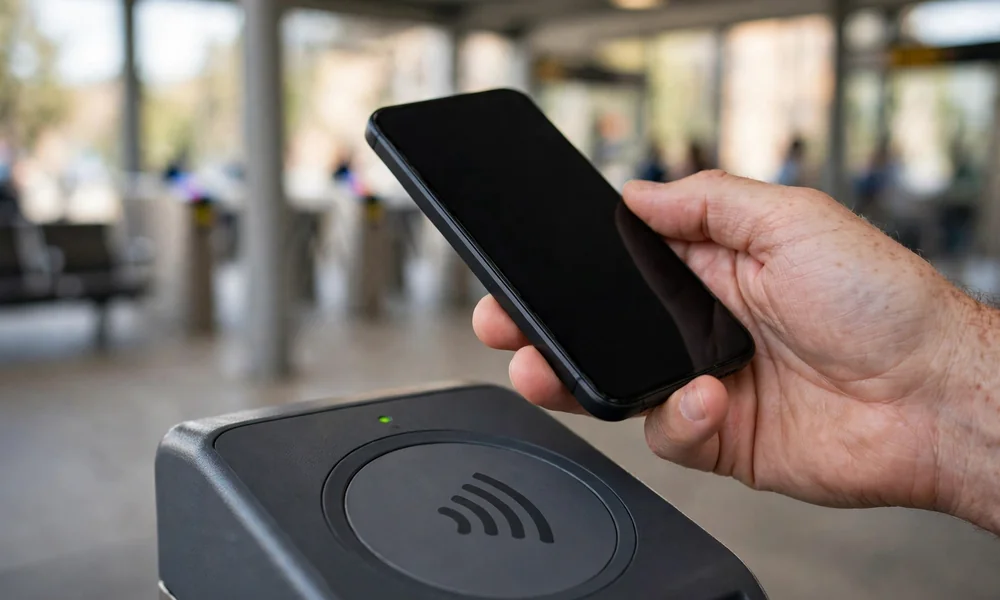
NFC supports three modes. Reader and writer mode lets a phone read a tag, such as a poster that opens a website. Peer-to-peer mode lets two phones exchange a contact or a link by touching them together. Card emulation mode lets a phone act as a contactless card, which is how mobile payments and digital transit tickets work.
Paying with your phone takes less than a second. You hold the phone near the terminal, the two devices exchange an encrypted token that stands in for your card number, and the terminal sends it to your bank for approval. Your real card number is never sent to the shop, so a stolen token cannot be used to clone your card.
Setting up NFC is simple: switch it on in the phone settings and add payment cards to the wallet app, where the bank verifies them once. After that, paying is a matter of unlocking the phone and holding it near the terminal.
Types of NFC tags and devices
NFC tags come in several types that differ in memory, speed, and features. Type 1 tags are simple and cheap and appear in posters. Type 2 tags are the most common, with enough memory for a web address or a short message, and they are used in stickers, business cards, and product labels. Type 3 tags are faster and hold more data, and they are common in Japan for transit and payment cards.
Type 4 tags support stronger security and are used in transport cards and access badges. Type 5 tags are used in libraries, retail, and industrial tracking, where a slightly longer read distance is useful. For most everyday uses, the difference is invisible: you tap, and the right thing happens.
Beyond tags, NFC lives in three kinds of devices. Phones and watches are the most common active devices, since they can read tags, share data, and emulate cards. Payment terminals and transit gates are fixed readers that power passive cards and tags, while passive devices such as bank cards carry a chip and an antenna but no battery.
Active and passive NFC
Active NFC devices generate their own radio field and can both send and receive, while passive devices only respond inside another device’s field. A phone is active when it pays or reads a tag; a bank card is passive, with no battery, and only works when held against a terminal. That is why contactless cards are thin, cheap, and never need charging.
Benefits and risks of NFC
The main benefit of NFC is speed and simplicity. A payment takes a second, a transit gate opens with a tap, and pairing a speaker can be done by touching the phone to it instead of opening settings menus. For shops and transport systems, that speed means shorter queues.
NFC is also efficient and secure by design. Passive tags use no power, phones use very little for a brief tap, and the short range limits who can listen in. Payments add tokenisation and the phone’s lock screen, so a lost phone cannot be used to pay without unlocking it first.
The risks are real but manageable. Someone with a reader held close to your pocket could, in theory, read a contactless card, but the range is only a few centimetres and payment tokens cannot be reused to make purchases. A second risk is tag tampering: a sticker placed over a genuine tag could send a phone to a malicious website, so check the address before opening anything an unknown tag suggests.
There are also practical limits. NFC moves data slowly, so it is useless for streaming music or sending large files; it is a trigger and a handshake, not a pipe. And not every phone or card supports it: some budget phones still ship without NFC, and some older cards lack a contactless chip.
Where NFC is used in everyday life
Contactless payment is the use most people know best. Bank cards, phones, and smartwatches all use NFC to pay at tills, vending machines, and parking meters, and the best smartphones all include NFC as standard.
Public transport is the second major use. Cities around the world let riders tap a phone or card at the gate instead of buying a paper ticket, and the fare is calculated automatically. The same idea works for building access, hotel room keys, and event tickets. Smartwatches with NFC make this even simpler, since the watch is already on your wrist when you reach the gate.
NFC also appears in quieter places. Museums place tags beside exhibits so visitors can tap for more detail, and some speakers and headphones use NFC to start Bluetooth pairing with a single touch. 5G phones combine NFC for the tap with fast mobile data for everything that follows.
NFC compared with Bluetooth and QR codes
NFC, Bluetooth, and QR codes are often used for similar jobs, but they work differently. Bluetooth connects devices over several metres and keeps the connection open for streaming audio or sharing files. NFC works over a few centimetres and completes a single quick action, such as a payment. A QR code is a printed pattern a camera reads, needing a clear line of sight.
Each has a place. Use NFC when the action should be instant and deliberate: paying, entering a gate, or pairing a device. Use Bluetooth when two devices need to stay connected, such as headphones playing music. Use a QR code when you need to share information with anyone who has a camera, such as a menu or a ticket. In practice, the three often appear together: an NFC tap can start a Bluetooth connection.
Checklist: using NFC safely and well
- Keep your phone locked with a PIN, fingerprint, or face unlock so a lost phone cannot be used to pay.
- Check the web address or action before accepting anything an unfamiliar NFC tag suggests.
- Set up payment cards only in your phone’s official wallet app, never through a link from a message or email.
- Know your bank’s contactless limit and when a PIN or biometric check is required for larger amounts.
- Turn NFC off if you rarely use it, and switch it back on when you need to pay or travel.
- If your card is lost or stolen, report it to your bank immediately so the contactless feature can be blocked.
Frequently asked questions
Does NFC work without the internet?
Yes, for most uses. Reading a tag or opening a gate needs no internet connection, though a payment terminal needs a connection to the bank to approve the transaction.
Can someone steal money by scanning my card in my pocket?
It is extremely unlikely. A reader would need to be within a few centimetres of your card, and the data it could read is a one-time token, not your card number. Banks also limit contactless payments and can block suspicious activity.
Do I need to open an app to pay with NFC?
Usually not. On most phones, unlocking the phone and holding it near the terminal is enough, and the wallet app handles the payment in the background.
What is the difference between NFC and RFID?
RFID is the broader family of radio identification technologies, used for everything from warehouse tags to pet microchips. NFC is a short-range, two-way branch of RFID that lets phones both read tags and act as tags.
Does NFC drain the battery?
Barely. NFC is only active during a tap, which lasts less than a second, and passive cards and tags use no battery at all.
Why does my phone not have NFC?
Some budget phones leave NFC out to keep the price down. If your phone lacks it, you can still pay with the physical contactless card itself, which has its own NFC chip.
The bottom line
NFC is a small technology with an outsized role in daily life. It does not stream video, cover a house with signal, or move large files, and it was never designed to. Its job is the brief, deliberate tap: pay, enter, pair, identify.
For most people, NFC is already part of the routine: the tap at the coffee shop, the gate at the station, the watch that pays for lunch. Understanding how it works is enough to use it with confidence every day.



