What Is Quantum Computing for Business?
Quantum computing for business is the use of quantum computers, and the software built for them, to solve commercial problems too slow or too complex for ordinary computers. Instead of bits, quantum computers use qubits, which can represent many possible states at once, letting them explore huge numbers of combinations in parallel — useful for optimising delivery routes, modelling new materials, and analysing financial risk.
Most businesses will not buy a quantum computer any time soon. The machines are expensive, delicate, and still limited in what they can do reliably. Instead, companies access them through the cloud, run small pilot projects with a vendor, or use quantum-inspired software on classical hardware while the technology matures. The practical question is not whether it works in theory, but where it could create an advantage before competitors get there first.
This guide explains quantum computing in plain language, how it differs from the computers businesses already use, where it is actually being applied today, and what the risks are, plus what a sensible first step looks like for a company that wants to prepare without overspending on hype.
Key takeaways
- Quantum computers use qubits instead of bits, letting them explore many possible answers at once for certain kinds of problems.
- They will not replace ordinary computers; they are specialists for optimisation, simulation, and specific kinds of analysis.
- Most businesses access quantum computing through cloud services and pilot projects rather than buying hardware.
- Real commercial uses already exist in finance, logistics, pharmaceuticals, and materials science, though most are still experimental.
- The biggest near-term business risk is security: quantum computers could eventually break today’s encryption, so planning for post-quantum security should start now.
What Quantum Computing Actually Is
A classical computer stores information as bits, each one a 0 or a 1, and processes them in sequence. A quantum computer stores information as qubits, which exploit two properties of quantum physics: superposition and entanglement. Superposition means a qubit can be in a combination of 0 and 1 at the same time, so a group of qubits can represent many possible values simultaneously. Entanglement links qubits together so that the state of one is connected to the state of another, letting the system work with relationships between values rather than one value at a time.
In practical terms, a quantum computer can evaluate many possible solutions in a single run, where a classical computer would try them one after another. That is the source of the famous “speedup” claims, but it only applies to certain kinds of problems. A quantum computer is not faster at everything; it would be a poor choice for a spreadsheet, a website, or file storage, and it will never replace the everyday systems businesses rely on.
To understand the hardware difference, it helps to know what ordinary processors do. Our explainer on what a GPU is describes how specialised processors handle parallel work today; quantum processors take that parallelism in a fundamentally different direction, using physics rather than simply adding more cores.
How Quantum Computing Works, in Plain Terms
A quantum computation starts by preparing qubits in a known state, then applying a sequence of operations called quantum gates. Each gate changes the probabilities of the possible outcomes, nudging the system toward the right answer and away from wrong ones. At the end, the qubits are measured, collapsing them into ordinary 0s and 1s a classical computer can read.
Because measurement is probabilistic, a quantum program is usually run many times and the most common result is taken as the answer. Engineers also use error correction, running extra qubits to detect and fix mistakes caused by noise, heat, and vibration. Today’s machines are extremely sensitive, kept colder than outer space, and even tiny disturbances can corrupt a calculation.
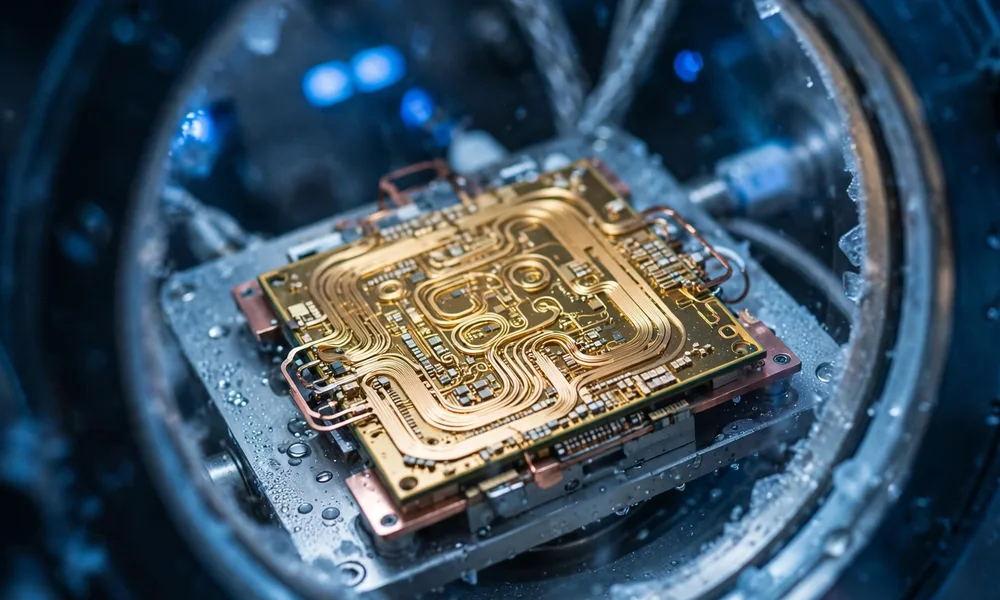
The software layer matters as much as the hardware. Developers write quantum algorithms using vendor frameworks, test them on simulators running on classical computers, then run the promising ones on real quantum hardware through the cloud. That hybrid workflow is how almost all business pilots operate today.
Types of Quantum Computing
There are several approaches to building quantum computers, differing in maturity, cost, and the problems they handle best. Gate-based quantum computers are the most general-purpose type: they run programmable circuits of quantum gates and can in theory tackle any problem with a known quantum algorithm. Companies such as IBM, Google, and IonQ build machines of this kind, and they are the ones most business pilots use.
Quantum annealers, built by companies such as D-Wave, are specialised machines designed for optimisation problems. They work by finding the lowest-energy state of a system, which corresponds to the best solution among many options. They are less flexible than gate-based machines, but they are already used for scheduling and routing problems where a good answer quickly matters more than a perfect one.
A third category is quantum-inspired computing, which is not quantum at all. It borrows ideas from quantum algorithms and runs them on powerful classical hardware, including GPUs and specialised chips. For many businesses this is the most useful option today: it delivers some of the benefit without the cost or fragility of real quantum hardware, using infrastructure the company already owns.
Benefits and Risks for Businesses
The main benefit is solving problems that are currently impractical. In logistics, quantum optimisation can find better delivery routes across thousands of stops. In finance, it can price complex derivatives and model portfolio risk under far more scenarios than classical methods allow. In drug discovery and materials science, it can simulate molecules too complex for classical computers, potentially shortening research cycles that now take years.
There are also real risks. The technology is expensive and immature, and many pilots produce results a good classical algorithm could match for less money. Talent is scarce, and vendor lock-in is a concern, since each provider’s hardware and software stack works differently and moving a project between vendors can mean rewriting it.
The most widely discussed risk is security. A sufficiently powerful quantum computer could break the public-key encryption that protects online banking, email, and business data today. That day is not here yet, but the threat matters now because data stolen today could be decrypted later, so businesses handling sensitive data should already be tracking post-quantum cryptography standards. Our guide to what cybersecurity is explains the foundations of the security systems that quantum computing will eventually force companies to upgrade.
Real-World Business Uses Today
Finance is the furthest along. Banks use quantum and quantum-inspired methods to optimise trading strategies, detect fraud patterns, and run risk simulations with more variables than classical systems can handle in the time available. These are mostly pilots, but several large banks now have dedicated quantum teams and published results.
In logistics and manufacturing, companies use quantum annealing to optimise vehicle routing, factory scheduling, and supply chains. Airlines have tested quantum approaches to flight scheduling and crew assignment, where small gains across thousands of flights mean significant savings. In pharmaceuticals, researchers use quantum simulation to model how molecules interact, aiming to identify promising drug candidates before expensive lab testing.
Energy companies are exploring quantum computing for grid optimisation and battery chemistry, trying to design better materials for storage and transmission. These projects are early, but they share a pattern: the value comes from problems with enormous numbers of combinations, where even a modest improvement is worth a lot of money.
Quantum Computing vs Classical Computing
The honest comparison is that the two are complements, not competitors. Classical computers are fast, reliable, cheap, and good at almost everything a business does day to day, from accounting to customer service to running a website. Quantum computers are fragile, expensive, and only better at a narrow set of problems — but for those problems the advantage can be dramatic.
That is why the industry talks about hybrid computing: a classical system handles the ordinary work, calls out to a quantum processor for the hard sub-problem, and then integrates the result. Our explainer on what a local LLM is covers a similar pattern of keeping specialised AI work close to the business while using cloud services for the heavy lifting.
For decision makers, the useful question is not “which is better” but “which problems in our business involve searching through an enormous number of combinations, and would a better answer be worth paying for?” If the answer is none, quantum computing can safely wait. If it is a short list of high-value problems, a small pilot is worth exploring.
Frequently Asked Questions
When will quantum computing be useful for ordinary businesses?
For most companies, the honest answer is not yet, but sooner than many expect for specific industries. Finance, logistics, pharmaceuticals, and energy already run pilots with measurable results, while most other sectors are likely five to ten years away. Quantum-inspired software on classical hardware is useful today and is a sensible starting point for businesses wanting early experience without hardware costs.
Do I need to buy a quantum computer?
No. Almost every business that uses quantum computing accesses it through the cloud, paying for time on a vendor’s machine as they pay for cloud servers. Buying hardware only makes sense for research institutions and a handful of very large technology companies, and cloud access lets you try different vendors’ machines without committing to one.
How much does a quantum pilot project cost?
Costs vary widely, but a small pilot typically runs from tens of thousands to a few hundred thousand dollars, including vendor access, consulting, and staff time. Cloud access itself can be cheap for short experiments; the larger cost is usually the people, since quantum expertise is scarce and expensive. Starting with a narrowly defined problem keeps the budget under control.
Will quantum computing break my company’s encryption?
Not today, but it is a real future risk. Current quantum machines are far too small and error-prone to break the encryption businesses use. However, data encrypted now could be stored and decrypted later, so organisations with long-lived sensitive data should begin planning a migration to post-quantum cryptography, following standards being finalised by bodies such as NIST.
What skills does my team need to explore quantum computing?
You need a mix of domain knowledge and technical skill. The most valuable people are those who understand your business’s hard problems and can translate them into a form a quantum algorithm can work on. You do not need physicists on staff; vendors provide the quantum expertise, while your team provides the problem and judges whether the results are actually useful.
Is quantum computing just hype?
Partly, but not entirely. There is plenty of hype, and some claims about timelines and capabilities are exaggerated. At the same time, the underlying science is real, hardware improves every year, and large companies are already spending serious money on it. Follow the results, not the headlines, and invest in proportion to the value of the specific problems it could solve for you.
The Bottom Line
Quantum computing for business is a real technology with a narrow but growing set of practical uses, not a magic solution for every problem. Its strength is exploring huge numbers of combinations for optimisation, simulation, and risk analysis; its limits are cost, fragility, and a shortage of skilled people. For most companies, the right move is to learn the basics, identify one or two problems where a better answer would be valuable, and run a small cloud-based pilot before committing serious money.
The other move that matters now is security planning. Even if your business never runs a quantum calculation, the eventual arrival of powerful quantum machines will change how encryption works, and migrating to post-quantum standards takes years. Watch the technology, test it where it fits, and prepare your defences early, and your business will be ready whether that future arrives in five years or fifteen.