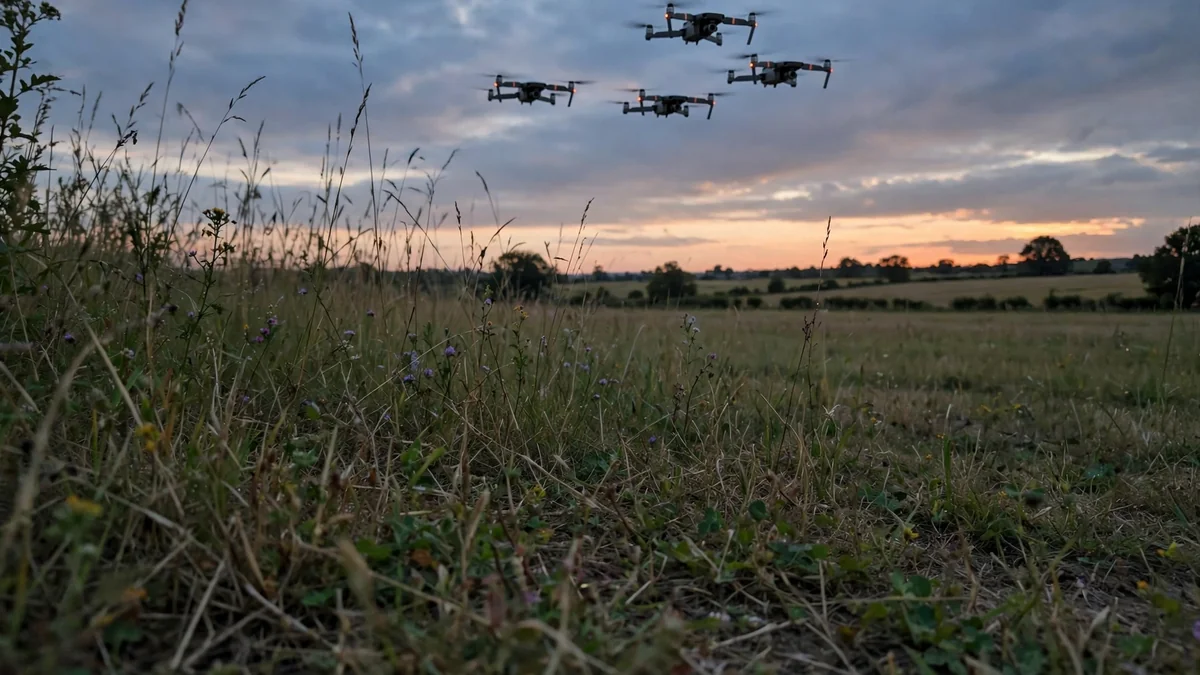
What Is Swarm AI?
Swarm AI is a way of building artificial intelligence in which many small, simple agents work together to solve a problem none of them could handle alone. Instead of one large model making every decision, a swarm splits the work across dozens or hundreds of agents that share information and adjust to each other’s actions.
In 2027, swarm AI has moved from research papers into practical systems. Delivery drones coordinate their routes in real time, warehouse robots divide picking tasks without a central controller, and software agents split complex jobs such as research and customer support between specialised workers. The appeal is resilience: if one agent fails, the rest carry on, and if the task grows, more agents can join without redesigning the system.
Swarm AI is also easy to misunderstand. It is not a single product, a single company, or a synonym for multi-agent systems in general, although the two ideas overlap. It is a design pattern with its own trade-offs: swarms can be harder to predict, harder to debug, and harder to hold accountable than a system with one clear decision-maker.
Key takeaways
- Swarm AI uses many simple agents working together, with useful behaviour emerging from their interaction rather than from a central controller.
- Its strengths are resilience, scalability, and speed on tasks that can be split into parallel pieces.
- Its weaknesses are unpredictability, debugging difficulty, and unclear accountability when something goes wrong.
- Real uses in 2027 include drone fleets, warehouse robots, traffic management, and teams of software agents.
- Swarm AI is a design pattern, not a product: the same idea can be built with very different technologies.
The concept behind swarm AI
The core concept is simple: simple rules, repeated by many agents, produce complex results. Each agent follows a small set of local rules, such as staying close to neighbours, avoiding collisions, or moving towards a signal. No agent sees the whole picture, and no agent is in charge. The useful behaviour emerges from thousands of small interactions, and engineers call this emergent behaviour.
Biology provides the oldest examples. Ants leave chemical trails that guide other ants to food, and the trail grows stronger as more ants use it, which naturally selects the shortest route. Swarm AI borrows these mechanisms and turns them into code. This differs from traditional software, where a central controller gathers information, makes a plan, and issues instructions. A swarm has no centre, so it adapts continuously as each agent reacts to what is nearby. Our explainer on what AI mesh is covers a related idea, a network of connected AI systems that share information.
How swarm AI works in practice

A working swarm has four parts: agents, rules, communication, and a goal. The agents are the individual workers, which might be drones, robots, or software programs. The rules tell each agent how to behave in common situations, such as what to do when it meets an obstacle. Communication is how agents share what they have found, through messages, a shared map, or a signal left in the environment.
In operation, the swarm runs in a loop. Each agent senses its surroundings, checks messages from neighbours, applies its rules, and acts. Then the environment changes, because other agents have also acted, and the loop repeats. A search-and-rescue drone swarm, for example, spreads out to cover ground, shares the locations it has already checked, and concentrates where a signal was detected.
Designers test swarms in simulation before deploying them, because the behaviour of a swarm is hard to predict from the rules alone. A small change in one rule can produce a large change in the outcome, and a swarm that works with fifty agents may behave differently with five hundred. Even so, real deployment reveals surprises, so swarm systems in 2027 are rolled out gradually, with a way to pause or recall the swarm.
The main types of swarm AI
Robot swarms are the most visible type. Groups of drones, warehouse robots, or underwater vehicles coordinate physical movement to cover an area, carry loads, or map a space. Their rules focus on spacing, collision avoidance, and task allocation: which robot picks up which item, or which drone covers which part of a field.
Software agent swarms are the fastest-growing type in 2027. Here the agents are programs that split digital work: one agent researches a topic, another checks the facts, a third drafts the result, and a fourth reviews it. Unlike a single chatbot answering one question at a time, a software swarm can work on many parts of a job in parallel. This pattern shows up in coding assistants, customer support systems, and research tools.
A third type is the optimisation swarm, which solves mathematical problems rather than moving robots or writing text. Algorithms inspired by ants, bees, and particle swarms search for good solutions to problems such as scheduling deliveries, designing networks, or tuning machine learning models. Each candidate solution is an agent, and the swarm’s rules guide the search towards better answers.
Benefits and risks of swarm AI
The clearest benefit is resilience. A swarm has no single point of failure: if one drone runs out of battery or one software agent crashes, the rest redistribute the work and continue. This makes swarms attractive for jobs where failure is costly, such as disaster response or continuous warehouse operation.
The risks are real and should not be glossed over. The first is unpredictability: emergent behaviour is powerful, but it is also hard to guarantee, and a swarm can settle into a pattern the designer did not intend. The second is debugging. When a single system fails, you can inspect its decision; when a swarm fails, the cause may be spread across hundreds of interactions. The third is accountability: if a swarm of drones damages property, it is not obvious which agent, or which human, is responsible.
There are also practical costs. Swarms need communication infrastructure, whether radio links between drones or message passing between software agents, and that infrastructure can become the bottleneck. Security matters too: an attacker who can inject false signals into a swarm can mislead many agents at once. Our guide to running an AI pilot project in 2027 explains how to test a new AI approach on a small scale first.
Real-world uses in 2027
Drone fleets are the best-known use. Farmers use drone swarms to survey fields and spray crops, with each drone covering a section and sharing its map with the others. Search-and-rescue teams use them to cover large areas quickly after disasters, and light-show companies fly hundreds of drones in coordinated patterns. In each case, the swarm’s advantage is coverage: a single drone would take hours to do what a swarm does in minutes.
Warehouses and factories use robot swarms to move goods. Hundreds of small robots carry shelves, sort packages, and recharge themselves in rotation, coordinated by simple rules about traffic flow and task queues. If one robot stops, others route around it.
Software swarms are appearing in offices. A customer support swarm might have agents that classify a query, look up the account, draft a reply, and check it against policy before sending. A research swarm might split a question into sub-questions, search different sources, and combine the findings. That division of labour is also the theme of our article on AI agents taking on middleman chores, which looks at how agents handle routine work between people and systems.
Swarm AI compared with other approaches
| Approach | How it works |
|---|---|
| Swarm AI | Many simple agents follow local rules; behaviour emerges from interaction, with no central controller |
| Single large model | One model handles the whole task; easier to test and explain, but a single point of failure |
| Multi-agent system | A few specialised agents coordinated by a planner; more structured than a swarm, less flexible |
| Centralised control | One controller gathers data, plans, and issues orders; predictable, but slow to adapt to change |
| Best for swarms | Parallel tasks across a large area, changing environments, and jobs where one failure must not stop the work |
| Worst for swarms | Tasks needing one exact answer, strict accountability, or a full explanation of every decision |
| Key risk | Unpredictable emergent behaviour and difficulty tracing a failure to a single cause |
| Key strength | Resilience and scalability: agents can join, leave, or fail without stopping the swarm |
The comparison shows that swarm AI is not a replacement for other approaches but a tool for a specific shape of problem. A single model is better when you need one clear answer and a clear explanation. A swarm wins when the work is spread out, the environment keeps changing, and the system must keep going even as individual agents fail.
Checklist: judging swarm AI honestly
Use these checks before you trust a swarm system or buy into a vendor’s claims about one.
- Ask whether the task is genuinely parallel: a swarm only helps when the work can be split.
- Check what happens when an agent fails: the swarm should carry on, not stall or repeat the work.
- Look for a human override: there must be a way to pause, recall, or stop the swarm.
- Ask how the swarm is tested: simulation results and gradual real-world rollout are both essential.
- Check accountability: someone must own the outcome when the swarm gets it wrong.
- Compare with simpler options: a single model or a planned multi-agent system may do the job better.
Frequently asked questions
Is swarm AI the same as multi-agent AI?
They overlap but are not the same. Multi-agent AI is the broader idea of several agents working together, often with a coordinator or a plan. Swarm AI is a specific kind of multi-agent system in which many simple agents follow local rules with no central controller, and the result emerges from their interaction.
Do swarm AI systems need a central controller?
No, and that is the point. A true swarm has no centre: each agent acts on local information and messages from neighbours.
What is an example of swarm AI in everyday life?
Drone light shows are the most visible example, with hundreds of drones holding formation in the sky. Warehouse robots that divide picking tasks between themselves are another, and optimisation software that schedules deliveries using ant-inspired algorithms is a third, quieter one.
Is swarm AI safe?
It can be, when it is tested in simulation, rolled out gradually, and given a human override. The main safety concern is unpredictability: a swarm can behave in ways its designers did not expect, so safety depends on limits, monitoring, and the ability to stop it.
Can small teams use swarm AI?
Yes, mainly through software agent swarms, which are available in tools that split research, drafting, and review between agents.
Will swarm AI replace single large AI models?
No. Swarms and large models solve different problems, and many systems combine them: a swarm of agents, each powered by a large model, working together on a task. The future is more likely to be a mix of both than a winner-takes-all contest.
The bottom line
Swarm AI is a design pattern, not a product: many simple agents, following local rules, producing useful behaviour that no single agent could manage alone. Its strengths are resilience, scalability, and speed on parallel work, and its weaknesses are unpredictability, debugging difficulty, and unclear accountability.
The honest way to judge any swarm claim is to ask what the agents are, what rules they follow, what happens when one fails, and who is responsible when the swarm gets it wrong. If those questions have clear answers, the swarm is worth a closer look. If they do not, the system is a slogan rather than a solution, and a simpler approach will serve you better.