

Ask a growing business what is holding it back and the answer often involves square footage. The team is crowded, the meeting room is always booked, and there is nowhere quiet to take a call. The obvious fix presents itself: a bigger office. More desks, more rooms, more space to grow into.
It feels like the natural next step, and for some businesses it is. But in most cases the space is not the problem. The team is crowded because everyone has to be in the same room at the same time to get anything done. The meeting room is always booked because every decision needs a meeting.
This is the case for better tools before a bigger lease. A business that can work well from a smaller footprint, with the right software carrying the coordination that used to need a room, will usually outperform one that rents its way out of the same problems.
Key takeaways
- A bigger office is often a response to coordination problems, not space problems: too many meetings, too little written down, too much waiting on other people.
- Rent is a fixed cost that rises every year, while the tools that shrink your footprint cost a fraction of one month’s rent.
- Hybrid work only works when the tools work: shared documents, clear task ownership, and one place for decisions.
- The right test is how many hours a week your team spends waiting for a room, a person, or an answer.
- A smaller office with good tools beats a bigger office with bad habits, because the habits follow you to the new space.
What the bigger-office reflex actually looks like
It starts with a good quarter. Orders rise, two new people join, and suddenly the office that felt generous feels tight. Desks fill up, the kitchen doubles as a meeting room, and someone is always looking for a quiet corner. The property search begins before anyone has asked why the current space feels small.
Follow the work for a week and a different picture appears. Half the meetings in the booked-out meeting room could have been a written update. A decision waits three days because the one person who can make it is in back-to-back meetings. None of these are shortages of square footage. They are shortages of tools and habits, and no amount of extra space fixes them.
The lease itself is the trap. Commercial rent is a fixed cost that only goes up, usually on a multi-year term with a deposit, fit-out costs, and a break clause that is harder to use than it looks. A business that signs a five-year lease for space it needs this quarter is betting that its headcount, its working style, and its market will all stay still for five years. They rarely do.
There is a subtler cost too: when space is plentiful, nobody has to think about whether a meeting is needed, because there is always a room free. When desks are plentiful, nobody has to think about who needs to be in the building. Abundance removes the pressure that forces good habits.
Why tools shrink the office you need
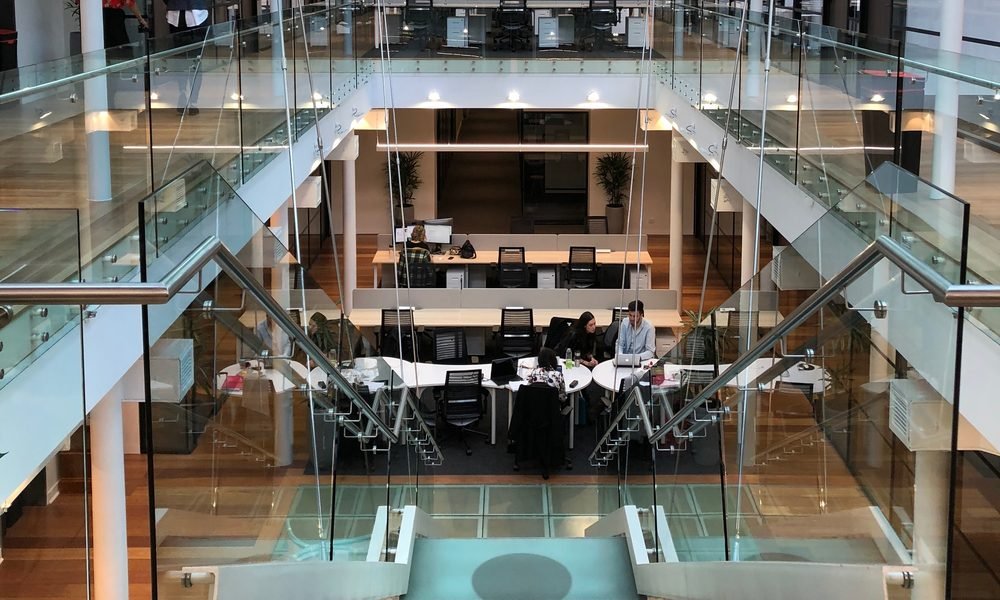
The tools that shrink an office are not glamorous. They are a shared task list where every job has an owner and a date, a shared document store where the latest version is the only version, and a chat tool where decisions are written down instead of spoken in a corridor.
Start with meetings. A team that writes its updates down before it meets finds that most meetings get shorter, and a surprising number disappear entirely. The meeting room stops being the bottleneck because decisions stop needing a room. The same applies to the working day: when a task has a clear owner and a clear next step, nobody needs to walk across the office to ask what is happening.
Then there is the hybrid pattern that makes a small office work. If half the team is remote on any given day, the office needs roughly half the desks, and the desks it has can be shared. Hot-desking only works when the tools work: a booking system for desks and rooms, a shared calendar that shows who is in, and files that live in the cloud rather than on one person’s laptop. The best tools for remote team communication are worth comparing on exactly this basis: which specific coordination problem each one removes, rather than which has the longest feature list.
None of this means the office disappears. Some work is genuinely better in person: a difficult conversation, a first week with a new hire, a planning session that needs a whiteboard and a whole afternoon.
What the maths of a lease really says
The numbers make the case more plainly than any argument about culture. In most cities, a single extra desk in a rented office costs hundreds of dollars a month once rent, service charges, utilities, and furniture are counted. A team of ten that upgrades to space for fifteen is paying for five empty chairs, every month, for years. The software that would let the same ten people work well from the smaller space costs a small fraction of that.
There is also the hidden maths of the commute. A bigger office in a cheaper area can look like a saving until the team spends an extra hour a day travelling to it, an hour paid for in energy, goodwill, and work that does not get done. A smaller office in a good location, used fewer days a week, often costs less in total than a large office nobody enjoys travelling to.
The honest test is simple. Before signing for more space, a business should be able to say how many hours a week its team loses to waiting: waiting for a room, waiting for a person, waiting for an answer. If the answer is small, the space is probably fine and something else is wrong. If the answer is large, the fix is usually a tool or a habit, not a lease.
It is worth saying plainly that this is not the same argument as spending more on software in general. A bigger software budget does not fix a space problem either, and a team that buys tools without diagnosing the bottleneck ends up with the same mess in more tabs. The top tools for remote team collaboration are useful only when each one is tied to a specific job: one place for tasks, one place for files, one place for decisions.
The caveats that matter
A smaller office is not right for every business. A business that serves customers in person, such as a clinic, a showroom, or a workshop, needs the space its customers walk into. A team doing hands-on work with physical materials needs room for the materials. And a business in a genuine growth spurt, hiring every month, may truly need more desks. The argument here is aimed at the common case: a desk-based team whose space feels tight because its coordination is loose.
| Detail | What is known |
|---|---|
| Cost of extra space | Hundreds per desk per month, locked in for years, plus deposit and fit-out |
| Cost of better tools | A fraction of one month’s extra rent, cancellable monthly |
| Meeting-room pressure | Usually a sign that updates are not written down, not that rooms are scarce |
| Hot-desking | Works only with desk booking, shared calendars, and cloud files |
| Hybrid working | Halves the desks needed on a given day, if the tools carry the coordination |
| When more space is right | Customer-facing premises, physical work, or sustained monthly hiring |
| When tools are the answer | Waiting for rooms, people, or answers is eating hours every week |
| The risk of a big lease | Five years of fixed cost for a way of working that may change in one |
One more caution: hybrid work needs a written policy, not just good intentions. Without agreed days, clear expectations, and one place where decisions live, a smaller office becomes a source of friction: people turn up to find no desk, or stay home and miss the conversation that mattered. How to create a remote work policy for your team covers the practical side.
Checklist: deciding between space and tools honestly
- Count the hours your team loses each week waiting for a room, a person, or an answer before looking at property listings.
- List the meetings that could be a written update, and shorten them for two weeks.
- Price the extra space fully: rent, service charges, utilities, furniture, deposit, and fit-out, over the whole lease term.
- Price the tool fix the same way, and compare one month of rent with one year of software.
- Write down who needs to be in the office, on which days, and for what kind of work, before choosing a size.
- Trial the smaller footprint first: a month of hot-desking will tell you more than any floor plan.
Frequently asked questions
Does this mean offices are dead?
No. Some work is better in person, and a good office is worth paying for. The argument is against renting more space than the work requires, not against having an office at all. A smaller office used well beats a larger one used badly.
How small can an office realistically get?
It depends on the work, but a hybrid team that is in two or three days a week can often share desks at a ratio of roughly seven desks for every ten people.
What tools matter most for a smaller office?
Three kinds: one shared task list with owners and dates, one shared file store with a single latest version, and one written record of decisions. Everything else is optional. The tools matter less than the habit of using them every day.
Will my team accept hot-desking?
They will if it is done properly: a simple booking system, enough desks on busy days, and no surprises. What people resist is not sharing desks but turning up to find nowhere to sit, which is a planning failure rather than a hot-desking failure.
What if we are genuinely hiring every month?
Then more space may be right, but hire against the new way of working, not the old one. A team that coordinates in software needs fewer desks per hire than one that coordinates in meetings.
Is a big office ever a good investment?
Yes, when the space itself earns money: a showroom, a clinic, a workshop, or a venue. For a desk-based team, the office is a cost, not an investment.
The bottom line
A bigger office feels like progress because it is visible: new desks, new rooms, a new address to announce. But for most desk-based teams, the space was never the constraint. The constraint was coordination, and coordination is a software problem with a software price, not a property problem with a five-year lease attached.
Before signing for more square footage, fix the way the work flows, try the smaller footprint for a month, and count what the team actually gains. If the tools work, the office you already have is probably big enough.
Note: This is an opinion piece. Rent levels, lease terms, and hybrid working norms vary widely by city and industry, so the figures here are illustrative; check local rates and your own team’s working patterns before making a property decision.


