What if the assistant everyone relies on still can’t hand you a verified fact, a working spreadsheet, or a memory of last week’s conversation? That gap between expectation and reality is where most AI disappointment lives.
ChatGPT is genuinely impressive. It drafts, summarizes, brainstorms, and explains. But a lot of people treat it like an oracle that knows everything, remembers everything, and never gets anything wrong. It doesn’t. Even as models get more capable, the underlying limits stay stubborn, and knowing them saves you from embarrassing mistakes.
Below are ten things ChatGPT still can’t do reliably, why each one matters, and which tools actually fill the gap. Think of it as a reality check with a practical toolkit attached.
1. It can’t know what happened after its training cutoff
ChatGPT’s knowledge has a cutoff date. Anything after that is invisible unless a browsing tool is switched on, and browsing is a separate capability that can fail, be disabled, or return stale results. The model also can’t tell you reliably where its cutoff sits, so it may answer a current-events question with total confidence and total wrongness.
What works instead: dedicated search engines built for retrieval. Perplexity, Google with AI summaries, and Bing’s chat mode all pull live pages and show sources. For fast-moving topics like prices, sports, or regulations, start there. If you want a structured way to compare how these assistants handle factual output, this breakdown of how to perplexity vs chatgpt evaluate output quality 2027 covers the trade-offs.
Common mistake: asking ChatGPT “what’s the latest on X” and trusting the answer. Always check whether browsing is active, and even then verify the date on any source it cites.
2. It can’t guarantee factual accuracy

Hallucination is not a bug that got patched out. The GPT-4 technical report documented it as an open problem back in March 2023, and later models improved the rate without eliminating it. The model predicts plausible text, and plausible text is sometimes false.
This matters most in high-stakes work: medical questions, legal language, financial figures, citations. A fabricated statistic reads exactly like a real one.
What works instead: treat ChatGPT as a first draft generator, not a fact source. Cross-check numbers against primary documents, and use retrieval-based tools when accuracy is non-negotiable. If you’re judging output quality across models, a comparison of how to claude vs chatgpt vs gemini evaluate output quality 2027 helps you see which systems hedge and which commit.
3. It can’t reliably cite real sources
Ask ChatGPT for sources and you may get references that look perfect: author, journal, year, page numbers. Some of them don’t exist. This became famous in 2023 when lawyers submitted a brief containing fabricated case citations and were sanctioned by a federal court.
Even when a citation is real, the model may attach it to the wrong claim. That’s worse than no citation, because it borrows authority it hasn’t earned.
What works instead: Google Scholar, PubMed, JSTOR, and direct searches on publisher sites. For legal material, use Westlaw or CourtListener. Build the habit of pasting a suspected citation into a search engine before you use it anywhere public.
4. It can’t run code or crunch your spreadsheet natively
The base model doesn’t execute anything. Code execution comes through a sandboxed tool, historically called Code Interpreter and now folded into data analysis features. When that tool is unavailable, ChatGPT will happily write Python that looks right and never run it, which means logic errors survive unnoticed.
What works instead: for real computation, use a proper environment. Jupyter notebooks, Google Colab, or a local Python install give you actual execution and visible errors. For spreadsheet work, Excel and Google Sheets with their built-in formulas beat a chat window every time.
Practical tip: if you do use the data analysis tool, ask it to show intermediate outputs. If it can’t display them, it probably didn’t compute them.
5. It can’t remember everything across sessions by default
Memory features arrived in 2024, but they’re opt-in, limited, and vary by plan and region. Without them, each new chat starts cold. The model won’t recall your project, your preferences, or the correction you made yesterday.
People overestimate this constantly. They assume continuity that isn’t there, then wonder why the assistant repeats a mistake it “already learned.”
What works instead: keep a running brief document with your context, tone rules, and standing instructions, and paste it at the start of important sessions. Tools with project or workspace features, like Claude’s projects or custom GPTs with knowledge files, hold context more reliably than a bare chat.
6. It can’t see, hear, or read images perfectly
Multimodal input exists, and it’s useful. But accuracy on charts, handwriting, dense tables, and spatial reasoning is uneven, as multimodal evaluations have repeatedly shown. A photo of a handwritten receipt may come back with transposed digits. A complex chart may be misread.
What works instead: for documents, run OCR first with a dedicated tool, then feed clean text. For charts, extract the underlying data and paste the numbers. For images where detail matters, describe what you see and ask the model to work from your description rather than the picture.
7. It can’t act in the physical world
ChatGPT has no body, no robot arm, no ability to flip a switch in your house. Integrations happen through APIs and plugins, not native embodiment. Any claim that an AI “did something” in the physical world usually means a human wired up a connection.
What works instead: home automation platforms like Home Assistant, workflow tools like Zapier or Make, and purpose-built robotics for industrial tasks. These are deterministic systems that do what you configure, which is exactly what you want for anything touching the real world.
8. It can’t protect your privacy automatically
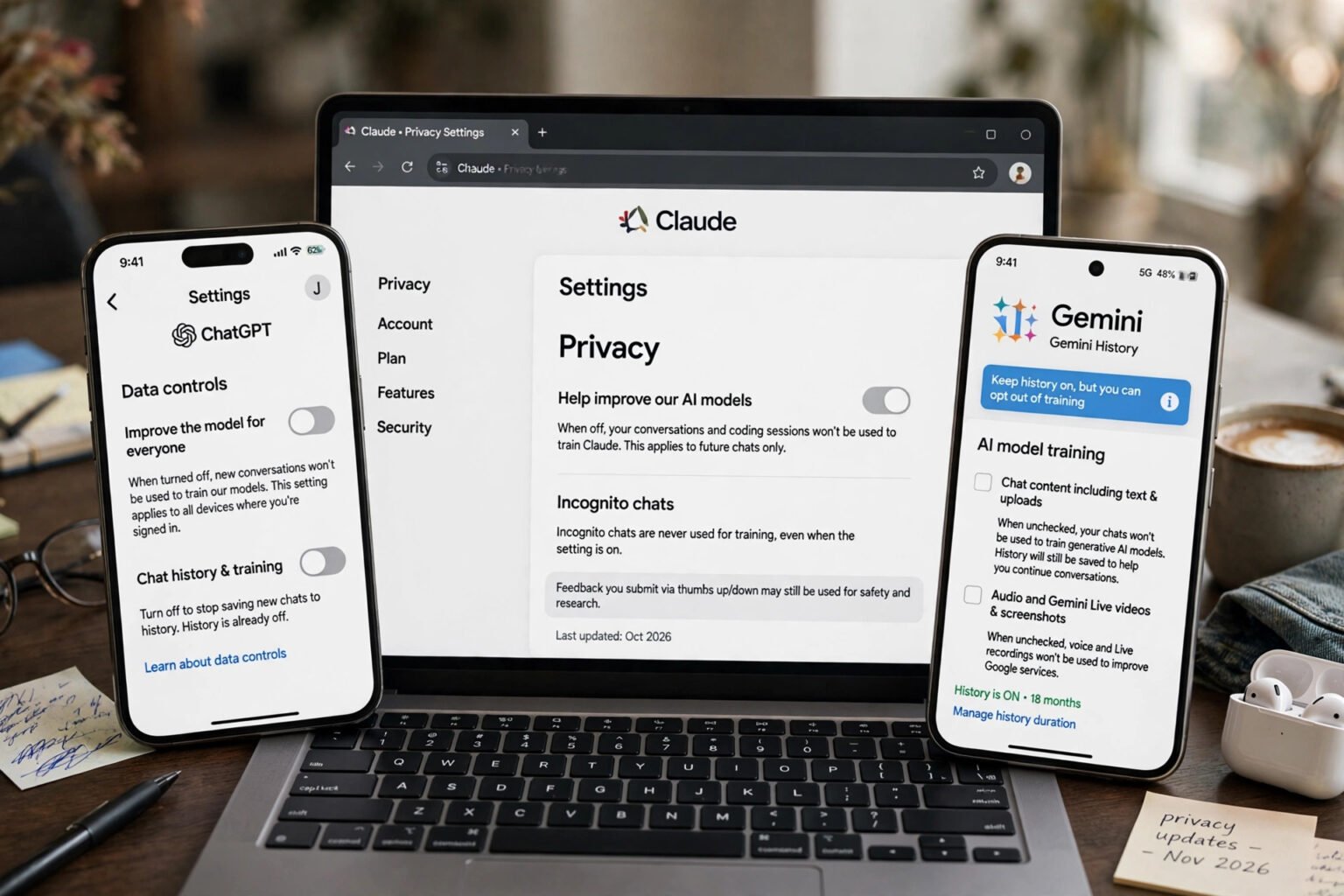
What you type may be stored, reviewed, or used depending on your settings and plan. Enterprise and API terms differ from consumer terms, and defaults aren’t always private. Pasting client data, medical details, or credentials into a chat window is a real risk.
What works instead: check your data controls before you paste anything sensitive. For regulated industries, use enterprise deployments with contractual protections, or run open-weight models locally so nothing leaves your machine.
Common mistake: assuming deleting a chat deletes the data everywhere. Retention policies are longer and messier than most people expect.
9. It can’t replace licensed professional judgment
Medical, legal, and financial advice sit in restricted territory for good reason. Usage policies limit high-stakes guidance, and the model lacks accountability, licensure, and the ability to examine you or review your actual contracts. It can explain concepts well. It can’t be your doctor.
What works instead: use ChatGPT to prepare questions and understand terminology before an appointment or consultation, then take the decisions to a qualified professional. That combination outperforms either alone.
10. It can’t judge its own output objectively
Ask ChatGPT whether its answer is good and you’ll usually get praise. Models are poor at grading themselves because they lack an independent reference point. This is why evaluation is its own discipline, with separate judge models, rubrics, and blind comparisons.
What works instead: structured evaluation. Use a second model as a judge, define explicit criteria, and run blind tests. Comparisons like how to gemini vs chatgpt evaluate output quality 2027 show how much scores shift when you change the judge. For voice interfaces specifically, there’s a useful look at how to evaluate chatgpt voice vs grok voice vs gemini live 2027 that applies the same rigor to spoken output.
How the main tools compare on these gaps
| Gap | ChatGPT’s limit | Better tool for the job |
|---|---|---|
| Live information | Cutoff date, browsing optional | Perplexity, Google, Bing chat |
| Factual accuracy | Hallucination persists | Primary sources, retrieval tools |
| Real citations | Can fabricate references | Google Scholar, PubMed, CourtListener |
| Code execution | Sandboxed tool, not native | Jupyter, Colab, local Python |
| Long-term memory | Opt-in, limited, varies | Project workspaces, context briefs |
| Image precision | Uneven on charts and handwriting | OCR tools, manual data extraction |
| Physical action | No embodiment | Home Assistant, Zapier, robotics |
| Privacy | Depends on settings and plan | Local open-weight models, enterprise tiers |
| Professional advice | Restricted and unaccountable | Licensed doctors, lawyers, advisors |
| Self-evaluation | Poor at grading itself | Separate judge models, blind rubrics |
What actually works in practice
The pattern across all ten gaps is the same: ChatGPT is a strong reasoning and drafting engine, and it’s weak wherever the task requires ground truth, execution, persistence, or accountability. The people who get the most from it stop asking it to be everything.
A workflow that holds up looks like this. Use search tools to gather current facts. Use ChatGPT to structure, draft, and explain. Use code environments to compute. Use a second model to critique. Use humans for decisions that carry risk. Each tool does what it’s actually good at, and the seams between them are where quality lives.
The other practical habit is skepticism calibrated to stakes. For a party invitation, let the model riff. For a contract clause or a dosage question, verify everything. The model’s confidence level tells you nothing about its accuracy, so your checking effort has to come from the consequences of being wrong.
If you want to go deeper on judging model output rather than guessing, comparisons of how to grok vs chatgpt vs gemini evaluate output quality 2027 and how to claude vs chatgpt evaluate output quality 2027 give you concrete criteria instead of vibes. And for a broader view of where the major assistants diverge, this analysis of how to deepseek vs chatgpt vs gemini judge output quality 2027 is worth the read.
Conclusion
ChatGPT in 2027 is better than it was, and it still can’t do the ten things above. That’s not a knock. It’s a map. The tool is a language engine, and language engines don’t browse, compute, remember indefinitely, or take responsibility. Once you accept that, the frustration evaporates and the workflow gets sharper: let ChatGPT do the thinking-in-words, and hand the rest to tools built for it. The people who master that division of labor will quietly outperform everyone still waiting for one chatbot to do it all.
FAQ
Can ChatGPT access the internet in 2027?
Only through a separate browsing tool, and only when that tool is enabled and working. It isn’t a guaranteed native capability. For anything time-sensitive, use a dedicated search tool and check the dates on the sources you find.
Why does ChatGPT make up fake citations?
Because it generates plausible text rather than retrieving verified records. A citation-shaped string is statistically likely after a claim, so the model produces one. Always verify a reference in a search engine or academic database before using it.
Does ChatGPT remember previous conversations?
Sometimes, depending on whether memory is enabled and which plan you’re on. By default, treat each session as a fresh start. Keep a context document with your standing instructions and paste it in when continuity matters.
Can ChatGPT run code and analyze files?
It can through a sandboxed data analysis tool, not natively. When the tool is active, it executes Python and returns results. When it isn’t, it writes code without running it, so errors go unnoticed. Use a real environment for anything important.
Is it safe to paste confidential information into ChatGPT?
Not by default. Data handling depends on your settings, plan, and region, and consumer defaults are not built for confidential material. For sensitive work, use enterprise terms with contractual protections or run a local model.
Will ChatGPT replace doctors, lawyers, or financial advisors?
No. It lacks licensure, accountability, and the ability to examine your situation directly, and usage policies restrict high-stakes advice. It’s excellent for understanding terminology and preparing questions before you consult a qualified professional.