Have you ever sat in a meeting while someone said “we’ll ship the MVP to the edge, then check the CDN cache” and quietly hoped nobody would ask you to repeat it back? That experience is familiar. Tech vocabulary grows faster than most people can absorb it, and the words pile up: some are old ideas with new names, some are genuinely new, and a few are just marketing wearing a lab coat.
This glossary explains 50 terms in plain language, grouped the way you would actually meet them. Each entry tells you what the thing is, and where useful, what people get wrong about it. Treat it as a reference you can skim rather than a book you read once.
The Basics: Hardware, Software and the Stack
These words come up in almost every tech conversation, yet they are the ones people are most embarrassed to ask about.
Hardware is the physical stuff: the chip, the screen, the cables. Software is the instructions that tell the hardware what to do. Firmware sits between them: permanent-ish code baked into a device, like the software inside a printer or a router.
CPU (central processing unit) is the general-purpose brain of a computer. GPU (graphics processing unit) was built to draw images, but it turned out to be excellent at doing many small calculations at once, which is why it became the engine of modern AI.
RAM is short-term working memory: fast, cheap to lose, and wiped when power goes off. Storage (a hard drive or SSD) keeps data permanently. Confusing the two is the single most common beginner mistake. A slow computer is often short on RAM, not short on storage.
The cloud just means someone else’s computers, reached over the internet. A server is a computer that answers requests from other computers. A data center is a building full of them.
Tech stack is the combination of languages, frameworks and services a product is built on. A framework is a ready-made base that saves developers from building everything from scratch, the way a house frame saves you from cutting every beam yourself. Full-stack describes a developer comfortable on both the visible side and the hidden side.
Frontend is everything a user sees and clicks: buttons, forms, layouts. Backend is the machinery behind it: servers, logic, databases. Database is an organized store of information a program can search and update.
API (application programming interface) is a menu that lets one program request things from another without knowing how it works inside. SDK (software development kit) is a box of tools for building on a particular platform. CLI (command-line interface) is a program you drive by typing commands instead of clicking. GUI (graphical user interface) is the clickable version.
IDE (integrated development environment) is the app where programmers write and test code. Open source means the code is published so anyone can read, use or improve it. Repository is where that code lives, along with its history.
Internet, Web and Networking Terms
The internet is the global network of networks. The web is one service that runs on it, made of pages linked together. They are not the same thing, even though most people use the words interchangeably.
IP address is a device’s numeric address on a network. DNS (domain name system) is the phone book that turns a name you type into that number. DHCP is the system that hands out addresses automatically so you do not have to type them.
Bandwidth is how much data a connection can carry at once. Latency is how long a message takes to arrive. A connection can have huge bandwidth and terrible latency, which is why video calls stutter even on a fast line.
CDN (content delivery network) is a global network of servers that keeps copies of website content and serves each visitor from the server closest to them, so pages load faster.
VPN (virtual private network) routes your traffic through another company’s server, hiding your activity from your internet provider and from the network you are on. It does not make you anonymous, and the VPN company can still see what your provider used to see.
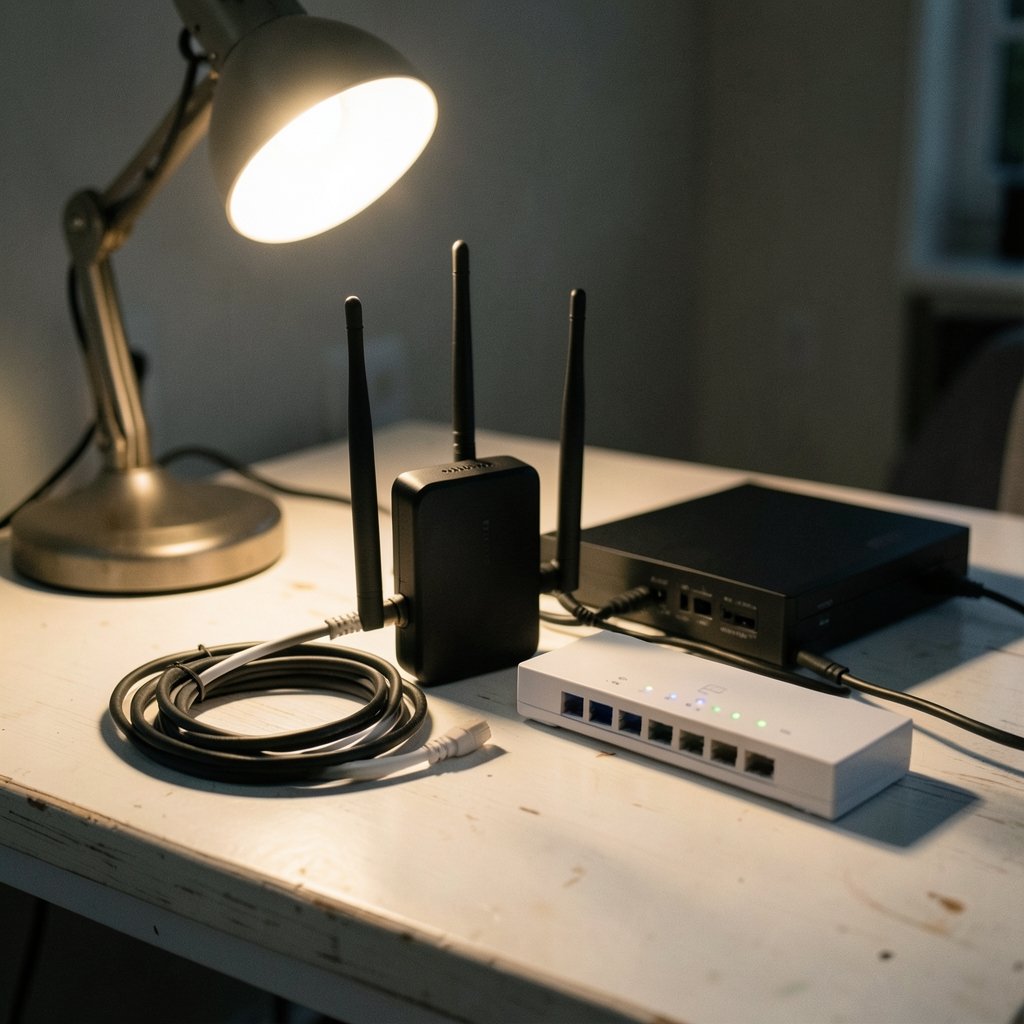
Router directs traffic between networks. Modem converts your provider’s signal into something your home network can use. Ethernet is the wired version of a network connection. Bluetooth is a short-range wireless link for pairing devices. Wi-Fi is the wireless local network most homes run on.
Proxy is a middleman server that forwards requests on your behalf. Firewall filters traffic in and out of a network. Load balancer spreads incoming work across several servers so none of them collapses.
DDoS (distributed denial of service) is an attack that floods a service with junk traffic until it falls over. Phishing is a scam that tricks you into handing over passwords or payment details, usually by pretending to be someone you trust.
If you want to see how these networking ideas fade into the background of daily life, the shift toward ambient computing explained invisible tech reshaping daily routines is a good place to start.
Security and Privacy Words Worth Knowing
Encryption scrambles data so only someone with the right key can read it. AES (advanced encryption standard) is one of the most widely used encryption methods. End-to-end encryption means only the sender and receiver can read a message, not the service in the middle.
MFA (multi-factor authentication) adds a second check at login, like a code or a tap on your phone. It is the single best thing most people can switch on. Passkey is a way to sign in without a password at all: your device proves it is you with a fingerprint, face or PIN, so there is nothing for a scammer to steal.
Password manager is an app that remembers and generates strong passwords so you do not have to. Certificate authority is an organization that vouches for a website’s identity, which is what the padlock in your browser reflects. CSP (content security policy) is a rule set that tells a browser which sources it may load, blocking many injection attacks.
CVE (common vulnerabilities and exposures) is a public catalog of known security flaws. Zero-day describes a flaw attackers exploit before a fix exists. Ransomware locks up files and demands payment. Malware is the umbrella term for hostile software.
APT (advanced persistent threat) is a patient, well-resourced attacker who stays hidden inside a network for a long time. Botnet is a network of hijacked devices used to attack others.
AI and Machine Learning, Without the Hype
Artificial intelligence is the broad label for software that performs tasks we associate with human judgment. Machine learning is one way to build it: instead of writing rules, you show a model examples and it learns patterns.
Model is the trained system that produces answers. Training is the process of building it. Inference is using it. Parameter is an internal setting the model tunes during training; bigger models have more of them, though more is not automatically better.
LLM (large language model) is a model trained on enormous amounts of text to predict and generate language. Prompt is the instruction you give it. Token is a chunk of text, roughly a word fragment, that the model processes.
Hallucination is when a model states something false with total confidence. Fine-tuning is extra training that adapts a general model to a specific job. RAG (retrieval-augmented generation) means the model looks things up in a trusted source before answering, which cuts down on invented facts.
Agentic AI describes systems that take steps toward a goal—calling tools and checking results—rather than only answering. The mechanics are easier to follow in a plain explanation of agentic AI explained simply how it works, and the same logic applies to the broader leap described in quantum computing explained simply it it matters for problems classical machines cannot crack.
Two more terms complete the set. Algorithm is a step-by-step recipe for solving a problem; every app runs on them. Bias, in this context, means a model’s output is skewed by skewed training data, not that the machine has opinions.
Business, Data and Money Terms
SaaS (software as a service) is software you rent monthly over the internet instead of installing. PaaS and IaaS are the platform and infrastructure versions of the same idea. DBaaS is a database run for you by a provider.
MVP (minimum viable product) is the smallest version of a product that can test whether anyone wants it. KPI (key performance indicator) is the number you judge success by. Churn is the share of customers who leave. ARR (annual recurring revenue) is yearly subscription income.
CRM (customer relationship management) is the system that tracks every interaction with customers and prospects. API-first describes a product designed so its interface is available to other software from day one.
CDBC (central bank digital currency) is a digital form of national money issued by a central bank, distinct from crypto. BTC is Bitcoin. CEX and DEX are centralized and decentralized exchanges. AML (anti-money laundering) covers the checks financial firms run to stop dirty money moving through them, and it is a big reason AI banking regulations 2027 us eu uk rules explained matters to anyone building financial tools.
Big data means datasets too large for ordinary tools. Data lake stores raw data; data warehouse stores cleaned, structured data. ETL (extract, transform, load) is the pipeline that moves data from one to the other.
Working Methods and Everyday Office Terms
Agile is a way of working in short cycles with frequent feedback instead of one long build. Sprint is one of those cycles, usually a couple of weeks. Scrum is a specific agile framework with defined roles and ceremonies. Kanban is a visual board showing work moving through stages. Standup is a short daily check-in.
CI/CD (continuous integration and continuous deployment) automates testing and releasing code so changes ship safely and often. Deployment is putting new software live. Rollback is undoing it.
Regression is when a change breaks something that used to work. Bug is a defect; patch is a small fix. Beta means software released early for real-world testing. Legacy describes old systems still in use, often because replacing them is painful.
Technical debt is the future cost of choosing a quick fix now. Scalability is how well a system handles growth. Uptime is the share of time a service is working; SLA (service level agreement) is the promise about it.
Two-factor and MFA are the same idea under different names. SSO (single sign-on) lets one login open many tools.
How to Actually Learn This Vocabulary
Reading a list is a start, not a finish. The people who sound fluent in tech meetings are rarely memorizing definitions; they are attaching each word to something concrete they have seen.
Three habits work better than flashcards.
- Pick five terms a week and find one real example of each in a product you already use.
- When you hear an unfamiliar word, write down the sentence around it. Context makes the definition stick.
- Explain the term out loud to someone outside tech. If you cannot, you do not know it yet.
The most common mistake is treating acronyms as knowledge. Knowing that API stands for application programming interface tells you nothing useful. Knowing that it is a menu one program uses to ask another for something is what lets you follow the conversation.
A second mistake is assuming every new term means something new. Many are repackaged ideas: the cloud is rented servers, a CDN is a cache in more places, and agentic AI is automation with a feedback loop. Spotting the old idea underneath is a genuine skill.
A third is trusting a single source. Glossaries disagree, definitions drift, and vendors stretch words to fit their products. Cross-check anything that affects a decision, especially numbers, prices and rules. When a term touches law or dates, check the official page rather than a summary, the way you would verify July 2027 calendar dates weekdays holiday rules explained before booking anything.
Conclusion
Fifty terms is a lot to hold at once, and nobody expects you to. The useful move is to notice which handful show up in your own work, learn those properly, and let the rest sit as recognition rather than recall. Vocabulary is a tool for following ideas, not a test you pass once. Start with the words you hear this week, attach each one to something real, and the next meeting will feel a lot less like a foreign language.
Frequently Asked Questions
What is the difference between the internet and the web?
The internet is the global network of connected computers. The web is one service that runs on top of it, made of pages linked together. Email and video calls also travel over the internet without being part of the web.
Do I really need a VPN?
A VPN is useful on public Wi-Fi and hides your activity from your internet provider. It does not make you anonymous, and the VPN company can see the traffic your provider used to see. For most home users, strong passwords, MFA and updated software matter more.
What does API actually mean in plain English?
An API is a menu that lets one program ask another for something without knowing how it works inside. When an app shows you a map, it is usually asking a mapping service through an API rather than building maps itself.
Is an LLM the same thing as AI?
No. AI is the broad category. An LLM is one type of AI model trained on huge amounts of text to generate language. It is powerful at language tasks and unreliable at anything needing verified facts unless it is connected to a trusted source.
Why do people say the cloud is just someone else’s computer?
Because it is accurate. Cloud services are servers in data centers owned by a provider, rented by the hour or month. The convenience is real, but so is the dependency: your data sits on hardware you do not control.
What is technical debt in simple terms?
Technical debt is the future cost of a quick fix. Choosing the fast solution now often means slower work later. Some debt is sensible when you need to ship, but it has to be paid down or it slows everything that follows.