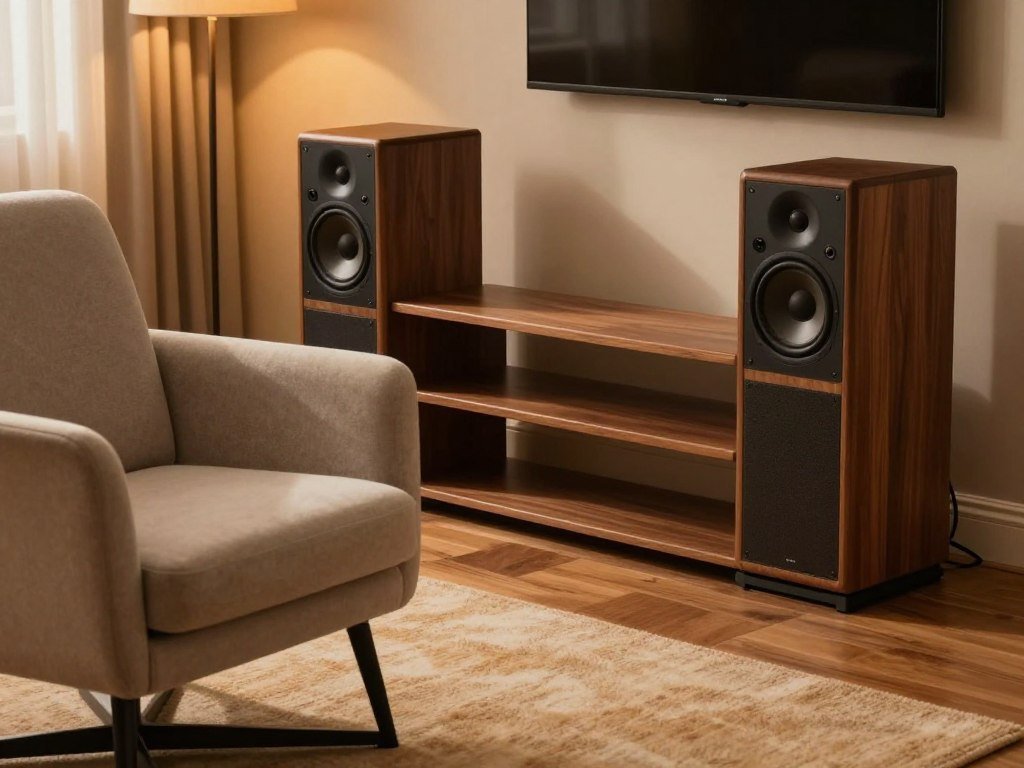
A good match starts with your budget, available space, and the equipment you already own. The best bookshelf speakers can suit a small desktop, a living room, or a more demanding home audio system. Sensitivity is a rating that compares how much sound a speaker produces from a given electrical input. The choices here cover passive and powered models, compact desktop systems, and higher-priced options. Matching the speaker to your room and existing equipment matters as much as its price.
Key Takeaways
- Choose powered speakers for built-in amplification and simpler systems.
- Choose passive speakers when you want a separate amplifier.
- Check the connections your TV, computer, or turntable needs.
- Match speaker size and output to your room and listening distance.
- Compare sensitivity and impedance when selecting an amplifier.
- Decide first whether you want built-in amplification or the freedom to choose a separate amp.
Best Bookshelf Speakers for Every Budget
For a passive pair that can play loudly without demanding a powerful amplifier, the Klipsch RP-600M II is the standout starting point. Its 94.5 dB sensitivity means it can produce high volume with less amplifier power than a lower-sensitivity speaker. That makes it a practical choice when loud listening is a priority.
The RP-600M II costs $449 per pair and uses a 1-inch titanium horn tweeter with a 6.5-inch Cerametallic driver. Those parts describe its design, not a promise that every listener will prefer its sound. Your room, music, and other equipment still shape the result.
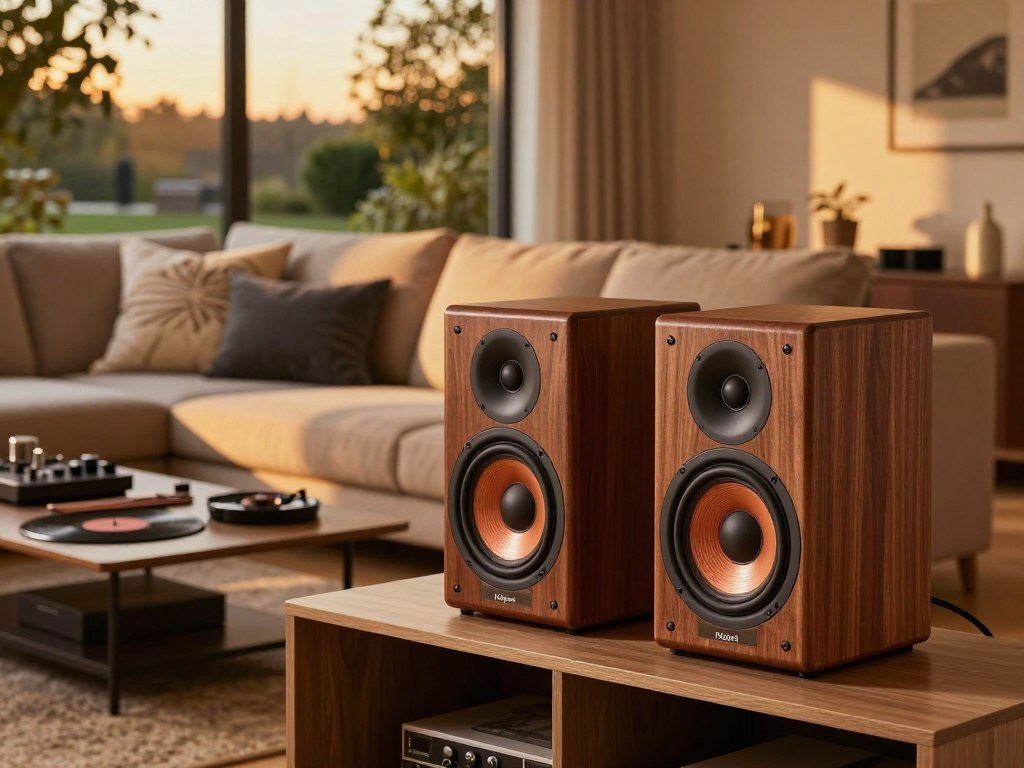
The best bookshelf speakers in 2024 remain a useful starting point, but older recommendations do not always reflect current model availability. Check whether a model is still sold, then compare its connections and system needs with your own.
There is a wide range of options, from inexpensive passive pairs to premium monitors. Some picks need a separate amplifier, while powered models include amplification. The price alone does not tell you which system will work best in your room.
A passive pair can be a good fit if you already own an amplifier or want to choose components separately. Powered speakers can reduce the number of boxes and cables. Desktop systems suit close listening, while larger models may better fit a main listening space.
Use the product categories as a way to narrow your search, rather than treating one model as a universal winner. A small room and a computer desk call for different choices than a larger room used for music and TV.
A shortlist is most useful when its picks are grouped by the job each one needs to do.
Best Budget Bookshelf Speakers Under $1,000
The Dali KUPID and ELAC Debut Reference DBR62 give budget-conscious buyers two distinct passive-speaker options at $600 and $700 per pair. Both are passive, so each needs a separate amplifier. Their driver sizes and sensitivity ratings help show how their designs differ.
The KUPID uses a 26mm soft-dome tweeter and a 4.5-inch paper-and-wood-fiber driver. Its sensitivity is 83 dB, and its impedance is 4 ohms. ELAC’s DBR62 has a 1-inch soft-dome tweeter, a 6.5-inch aramid-fiber driver, and 86 dB sensitivity.

| Model | Pair price or status | Useful distinction |
|---|---|---|
| Dali KUPID | $600 per pair | 83 dB, 4 ohms, 26mm soft-dome tweeter, 4.5-inch paper-and-wood-fiber driver |
| ELAC Debut Reference DBR62 | $700 per pair | Passive, 1-inch soft-dome tweeter, 6.5-inch aramid-fiber driver |
| Paradigm Premier 200B | Discontinued | Replacement is the Premier 220B v2 |
The best bookshelf speakers under $200 may be hard to compare with these models because their listed pair prices exceed that budget. Buyers with less than $200 should compare complete 2.0 desktop systems with entry-level passive pairs. Check whether a listing covers one unit or a pair before judging its price.
Look at the full system cost, not only the speaker price. A passive pair needs amplification, while a desktop system may include it. Cabinet size and the location where you plan to listen also affect which budget choice makes sense.
The Paradigm Premier 200B is no longer sold, so its replacement is the Premier 220B v2. A model name can stay familiar even as its version changes. Check that a replacement model is the exact version you intend to buy before comparing listings.
Best Bookshelf Speakers From $1,000 to $1,600
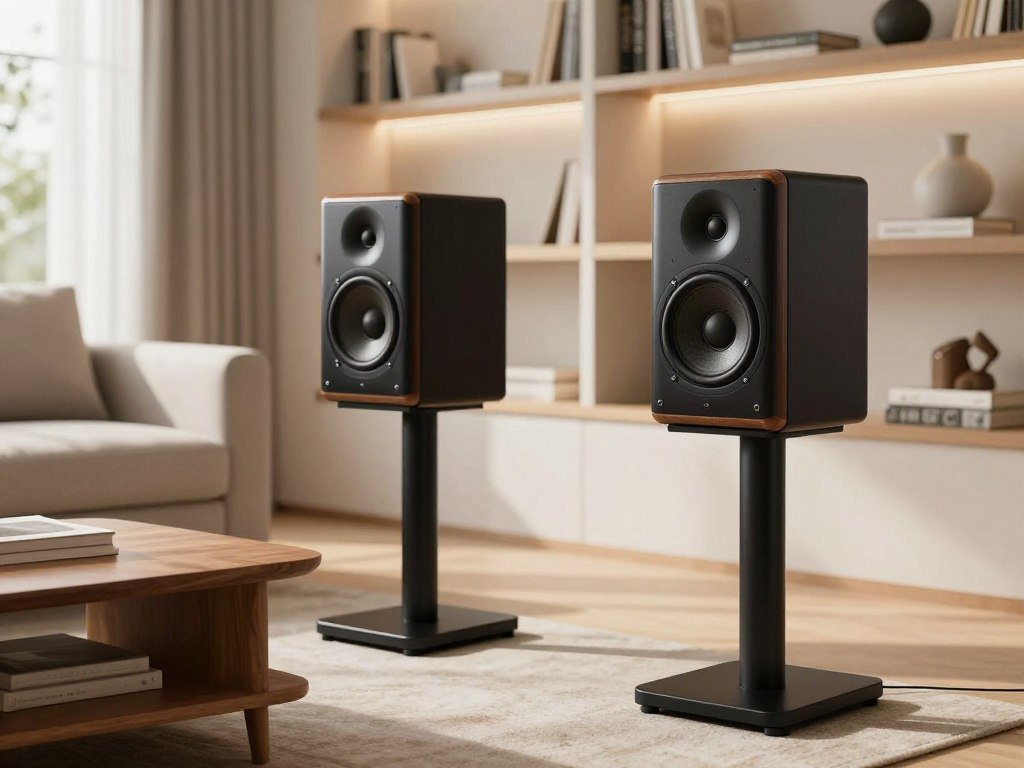
At this level, compare the driver layout and the cost of any dedicated stands alongside the speaker price. The Focal Theva N1 costs $1,098 per pair, but its dedicated stands add $249 per pair. That extra cost can change the total budget for a complete setup.
The Fyne Audio F500S costs $1,299 per pair and uses an IsoFlare concentric point-source driver. The MartinLogan Motion XT B100 costs $1,600 per pair and is a passive bookshelf model. These design facts identify real differences, but they do not prove one speaker will sound better to you.
| Model | Pair price | Distinguishing design |
|---|---|---|
| Focal Theva N1 | $1,098, stands $249 per pair | Dedicated stands are a separate purchase |
| Fyne Audio F500S | $1,299 | IsoFlare concentric point-source driver |
| MartinLogan Motion XT B100 | $1,600 | Passive bookshelf model |
The Dali Sonik 1 offers another way to compare design features without ranking models by price. It has a 29mm soft-dome tweeter and a 13cm pulp-and-wood-fiber mid/bass driver. Its rear port is part of the cabinet design.
The Sonik 1 has 6-ohm impedance and 86 dB sensitivity. Those figures help describe its electrical demands, but they do not predict sound quality on their own. Think about whether its design and system requirements suit your listening room.
Dedicated stands can affect both the total cost and the setup you have in mind. A stand-mount speaker may also work on furniture, depending on the room and model. Include stands in the budget when the model’s setup depends on buying them separately.
Best Powered Bookshelf Speakers for Streaming and TV
For a TV-centered system, start by checking whether the speaker offers HDMI ARC or eARC, then match its other inputs to your sources. The right connection can simplify a setup with a TV, streaming device, or turntable. HDMI ARC and eARC are related, but your TV and speaker must support the same connection.
HDMI ARC sends audio from a TV to connected audio gear. HDMI eARC supports advanced audio formats and can simplify audio connections, as described in the HDMI specification overview. A TV with ARC does not gain eARC features simply because a speaker has an eARC input.

| Model | TV connection | Other supported sources or features |
|---|---|---|
| ELAC Debut ConneX DCB61 | HDMI ARC | Phono input, Bluetooth, 6.5-inch woofer |
| Klipsch The Fives II | HDMI eARC | Phono input, Google Cast |
| SVS Prime Wireless Pro | HDMI eARC | Play-Fi, AirPlay 2 |
| Edifier S1000W | Not specified for TV | Wi-Fi, AirPlay 2, Bluetooth |
The ELAC Debut ConneX DCB61 adds a phono input and Bluetooth, while its 6.5-inch woofer handles the speaker’s low and middle range. The Klipsch The Fives II combines eARC with a phono input and Google Cast. These features suit different source setups.
SVS Prime Wireless Pro supports Play-Fi and AirPlay 2 alongside HDMI eARC. The Edifier S1000W supports Wi-Fi, AirPlay 2, and Bluetooth, though its TV connection is not specified here. Choose it based on your streaming needs, not an assumed TV input.
Kanto TUK is another powered option. It supports Bluetooth aptX HD, a USB DAC, and a phono input. Those connections may suit you if your system centers on a computer, a turntable, or Bluetooth audio instead of TV sound.
Check the ports on your actual devices before buying, since names alone do not guarantee compatibility. Confirm that the TV and speaker share the connection you plan to use.
Best Bookshelf Speakers for PC and Desktop
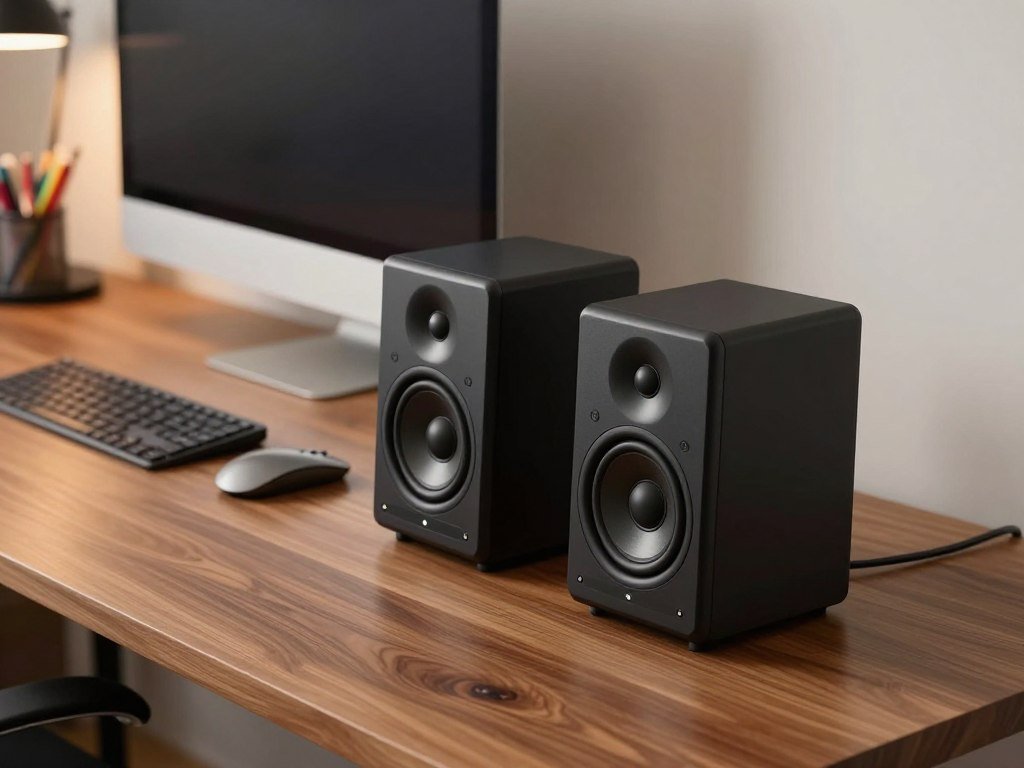
A PC desk usually benefits most from a powered pair with the inputs your computer and other desk devices actually use. Near-field listening means you sit close to the speakers, so cabinet size and a simple connection matter. Choose a desktop system by its inputs and desk footprint, not its label alone.
The Kanto ORA is a powered desktop speaker with Bluetooth and a built-in subwoofer crossover. That crossover helps route low frequencies when a subwoofer is part of the system. The Creative T100 is a 2.0 desktop system rated at 40W.
Best Bookshelf Speakers for PC Desks
For the best bookshelf speakers for PC use, compare what each system connects to and how much desk space it takes. The T100 has a listed frequency response of 50-20,000 Hz. Its inputs include 3.5mm analog, optical, and Bluetooth 5.0.
The ORA offers Bluetooth and a built-in subwoofer crossover, while the T100 gives you several wired input choices. Neither set of features makes one a better match for every computer. Check which ports your PC has and whether you want to connect other devices.
Creative Pebble Pro is another compact 2.0 option with 3.5mm analog, USB-C, and Bluetooth 5.3 inputs. Its USB-C connection suits a desk that uses compatible computers or devices. Bluetooth adds a wireless source without taking up another cable connection.
Desktop Systems With More Than One Source
The Onkyo Creator Series GX-30ARC supports USB-C, optical, RCA, Bluetooth 5.3 LE, 3.5mm Aux, and HDMI connections. That wider set can suit a desk shared by a computer, console, and other sources. The Creative Pebble Pro keeps the input list simpler.
The SVS Ultra Evolution Nano is a passive desktop option recommended for use with a subwoofer. It still needs an amplifier, so include that component in the system plan. A passive speaker does not become powered just because it sits on a desk.
Some desktop speakers are small enough to sit close to a monitor, while larger cabinets may crowd a work surface. Check desk space for both speaker cabinets before settling on a desktop system.
Best Bookshelf Speakers for Audiophiles
Premium choices make the most sense when you can name the sound or design feature you want to prioritize. The MoFi SourcePoint 8 is recommended for point-source imaging, while the Falcon Acoustics M10 suits intimate music selections. Choose by listening case and design, not by price alone.
The Chesky Audio LC1 costs $999 per pair and uses a 3D-printed cabinet. The GoldenEar BRX costs $1,499 per pair and uses a folded-ribbon tweeter. These features give you specific points to compare when narrowing a premium shortlist.
| Model | Pair price | Distinguishing feature or listening fit |
|---|---|---|
| Chesky Audio LC1 | $999 | 3D-printed cabinet |
| GoldenEar BRX | $1,499 | Folded-ribbon tweeter |
| MoFi SourcePoint 8 | $2,750 | Concentric driver and point-source imaging |
| Falcon Acoustics M10 | $3,200 | Intimate music selections |
| Bowers & Wilkins 705 S3 | $3,399 | Carbon Dome tweeter and Continuum driver |
The MoFi SourcePoint 8 costs $2,750 per pair. Its 8-inch concentric driver and 1.25-inch soft-dome tweeter support its point-source design. That layout is a distinct reason to consider it, especially if imaging is high on your list.
The Falcon Acoustics M10 costs $3,200 per pair and is particularly suited to intimate music selections. Bowers & Wilkins 705 S3 costs $3,399 per pair. It combines a 1-inch Carbon Dome tweeter with a 6.5-inch Continuum driver and has 88 dB sensitivity.
The Bowers & Wilkins 705 S3 Signature costs $3,800 per pair and differs from the standard model with a two-section carbon-dome tweeter. The shared name does not make the versions interchangeable. Compare the exact model and its price before deciding which design fits.
The best bookshelf speakers for audiophiles depend on the room, system, and music each listener favors. The best bookshelf speakers of all time cannot be set by a permanent ranking, since those needs differ. Treat any all-time ranking as a shortlist, then judge the actual model against your own listening needs.
Which Bookshelf Speakers Have the Strongest Bass?
A larger mid/bass driver and cabinet can give a compact speaker more room to produce weighty low frequencies. Physical size matters, but a small cabinet has limits. Driver size, enclosure design, and listening conditions all affect bass response.
The passive SVS Ultra Evolution Nano uses a 5.25-inch glass-fiber driver and has 85 dB sensitivity. Those are useful design facts, but they do not provide a measured bass extension or prove how deep it will play in your room.
- Driver size affects how much air the speaker can move.
- Enclosure design shapes low-frequency output and rolloff.
- Room size and listening distance affect perceived bass.
A bass-reflex design uses a port to shape low-frequency response, while a sealed cabinet rolls off differently. The port and cabinet act together as a resonant system. The bass-reflex enclosure explanation describes how tuning affects that behavior.
A larger driver does not guarantee stronger bass in every room, and a ported model is not always better than a sealed one. Cabinet tuning, the speaker’s intended use, and your listening level all matter. Compare the speaker’s bass claims with the size of the room and the listening level you need.
What Works Best in a Small Room?
In a tight room, the speaker’s physical footprint and the space available around it matter as much as its sound. The Dali KUPID measures 23.7 x 14 x 19.5 cm and weighs 5.8 kg. Those dimensions make it easier to assess against a shelf or small stand.
The KUPID has a rear port, five finishes, and included wall-fixing screws and wall brackets. The rear port needs room behind the cabinet, while the included hardware offers another mounting option. A compact cabinet can fit a small room, but it does not guarantee deep bass or make every shelf suitable.
Think about the space you have for the whole speaker, not only the front panel. A shelf may be wide enough yet too shallow, or it may leave little room for the rear port. Wall mounting can save furniture space, but the hardware and wall location must work for your room.
A small room does not need the smallest possible speaker in every case. The right size depends on the available spot and how you plan to use it. Measure the intended spot, including the clearance needed behind a rear-ported cabinet.
Can Bookshelf Speakers Fill a Large Room?
A capable stand-mount can work in a larger room, but the listening distance and volume you expect are decisive. Room-filling sound depends on the speaker design, amplifier capability, and how loudly you listen. No bookshelf design is guaranteed to suit every large room.
The Wharfedale Super Linton costs $2,699 per pair, including stands. It is a passive three-way speaker with a 1-inch soft-dome tweeter, a 5-inch Kevlar midrange driver, and an 8-inch Kevlar woofer.
The Wharfedale Super Denton costs $1,400 per pair and is a three-way monitor. Its arrangement includes a 6.5-inch Kevlar woofer, a 2-inch soft-dome midrange, and a 1-inch soft-dome tweeter.
The Super Linton includes stands and has the larger 8-inch woofer, while the Super Denton uses a smaller woofer with separate midrange and treble drivers. These specifications describe different designs, not a guarantee of greater output or better sound in every space.
For either model, consider how far you sit from the speakers and how much volume you use. The amplifier also needs enough power for the intended level. Check that the chosen model can reach your usual listening level without sounding strained.
Should You Choose Passive or Powered Speakers?
Choose passive speakers if you want a separate amplifier in the system, and powered speakers if you want amplification built into the pair. That basic split helps you plan the number of components and how much choice you want. Powered does not mean wireless.
Bookshelf speaker, stand-mount speaker, and monitor are common names for this speaker type. Most bookshelf models use a two-way design with a tweeter and one mid/bass driver. The main system choice is whether an amplifier sits inside or outside the speaker.
When a Passive Design Makes Sense
Passive bookshelf speakers need an external amplifier or an integrated amp. That setup lets you choose the speaker and amplifier as separate parts. You can also keep an amplifier you already own if it suits the speakers.
A passive system has more separate components to connect and house. In return, you can select each part for your own needs. Your speaker choice does not lock you into a built-in amplifier.
When Built-In Amplification Is the Better Fit
Powered bookshelf speakers have amplifiers built in, so they can reduce the number of separate boxes in a system. Active designs can also use matched amplifiers and crossovers. Technical systems may include electronics for limiting and speaker protection, as explained in Klippel’s overview of active loudspeaker systems.
Built-in amplification does not mean a speaker has Bluetooth or Wi-Fi. Some powered models offer those features, but others rely on wired connections. Check the inputs that match your source rather than guessing from the word “powered.”
- Count the audio components you already own.
- Identify the source connections your system needs.
- Decide whether future component changes matter to you.
Make the system choice before paying for features your other equipment already supplies.
Which Speaker Specifications Should You Check?
Sensitivity and impedance are the two specifications to check first when matching a passive speaker to an amplifier. Both affect system fit, but they describe different things. Check the speaker’s lowest impedance as well as its nominal rating.
Sensitivity compares a speaker’s output from a given electrical input. Models rated at 84-86 dB generally need more amplifier power for high listening levels than higher-sensitivity designs. The rating helps compare output, but it does not describe every part of performance.
Sensitivity and Amplifier Power
A higher sensitivity rating means a speaker can produce more sound from the same input, compared with a lower-rated model. For example, a 94.5 dB speaker can play loudly with less amplifier power than one rated at 84-86 dB.
Your usual volume also matters. A system used for quiet listening has different demands from one expected to play at high levels. Use sensitivity as a comparison, then consider the amplifier’s stated ability.
Impedance and Current Delivery
Impedance describes the electrical load a speaker places on an amplifier. Speakers that dip to 4 ohms or below need an amplifier able to supply plenty of current. A low impedance can place greater demands on the amplifier.
Check these details before pairing a passive model with an amp:
- Speaker sensitivity rating.
- Speaker minimum impedance.
- Amplifier stability at that load.
- Your intended listening level.
The amplifier should be able to handle the speaker’s lowest impedance during use. Match the amplifier to the speaker’s lowest impedance, not just its nominal rating.
How Should You Place Bookshelf Speakers?
Start with rigid stands that put the tweeters close to ear height at your listening seat. That starting point gives you a sound setup for stereo listening. Placement affects both bass and stereo imaging.
Pull the speakers away from the wall to begin, then toe them in slightly toward the listening seat. These steps offer a useful starting position, not a fixed distance for every room. Small changes can alter how music sounds from your seat.
- Use rigid stands for stable support.
- Set the tweeters near seated ear height.
- Begin with the speakers pulled away from the wall.
- Toe them in slightly toward the listening seat.
Listen to music you know as you adjust the speakers. A small shift can change the stereo image, while moving them nearer a wall can affect bass. Your room and furniture shape the result, so avoid treating one distance as a rule.
Make one placement change at a time so you can hear what it alters.
Do Bookshelf Speakers Need a Subwoofer?
Add a subwoofer when you want deeper bass than the bookshelf pair can provide on its own. It is optional, not a requirement for every system. A subwoofer can extend deep bass and let small woofers work less hard.
A well-matched bookshelf pair can still serve listeners who do not need the lowest frequencies. Adding one or two subwoofers gives you options, but the result depends on how well the subwoofer works with the speakers and room.
- Decide whether you are missing deep bass.
- Check whether your system can integrate with a subwoofer.
- Consider whether the room has a workable subwoofer location.
A subwoofer changes the low-frequency role of the bookshelf pair. The speaker can focus more on its main range when the system shares the work. That can reduce strain on small woofers, but poor integration can make the full system sound uneven.
One subwoofer may be enough for your listening needs, while some rooms or systems can benefit from two. Start with one well-integrated subwoofer unless your room or system gives you a clear reason to add a second.
Conclusion
The right pair is the one that fits your system and listening space, not simply the one with the highest price. Consider the room and source connections alongside your budget. Passive speakers need an amplifier that can drive them.
A powered pair can simplify your setup, while a passive model gives you separate component choices. Neither approach is best for every listener. Your current equipment and the sources you plan to connect should guide the decision.
Take one practical step before buying: measure the spots where the speakers will sit. Then write down the connections your system needs. Measure your available space and write down your must-have inputs before choosing a model.
FAQ
What is the 83% rule for speakers?
There is no widely recognized 83% rule for speakers. The Dali KUPID’s 83 dB sensitivity rating is a sound-output measure, not a percentage or a rule. Sensitivity compares how much sound a speaker produces from a given electrical input. It can help you compare speaker output, but amplifier power and listening level still matter.
Are bookshelf speakers good for turntables?
Yes, bookshelf speakers can work well with turntables when the connections match. A powered model with a phono input can connect directly to a turntable. Passive speakers need an amplifier and a suitable phono stage, which may be built into the amplifier or supplied as a separate component. Check the turntable’s output and the speaker system’s inputs before connecting them.
Who makes the best HiFi speakers?
No single maker makes the best HiFi speakers for every listener. Your budget, room, system type, and sound preferences all shape the right choice. One buyer may need a powered pair for a TV, while another wants passive speakers and a separate amplifier. Compare individual models and their features instead of choosing by brand name alone.
What are the best audiophile bookshelf speakers in 2026?
The MoFi SourcePoint 8 is a choice for listeners focused on point-source imaging, while the Falcon Acoustics M10 suits intimate music selections. Those are distinct listening cases, not a universal ranking for 2026. The right option also depends on your room, amplifier, and preferred music. Compare the exact model and its current availability before making a decision.
Which speaker brand has the best sound quality?
No brand has the best sound quality for every listener or every room. Sound quality is not an objective brand-wide ranking, because individual models use different designs and suit different systems. Compare speakers at a similar price, with the connections you need. Your room and preferred music can matter as much as the maker’s name.
Which is the No. 1 speaker brand?
There is no single No. 1 brand across all speaker types and budgets. A useful choice depends on whether you need powered or passive speakers, which sources you use, and how much you plan to spend. A brand with a strong TV model may not be your best fit for a passive stereo system. Compare products built for your intended use.
Is JBL or Bose better?
Neither JBL nor Bose is automatically better for every system. Compare the specific models by purpose, connections, room fit, and price. A compact powered model may suit a desk, while a passive pair may suit a stereo system with an amplifier. The brand name alone cannot show which speaker fits your equipment and listening needs.
What are the top 5 best speaker brands?
Five established brands represented in these recommendations are Klipsch, Dali, ELAC, Wharfedale, and Bowers & Wilkins. This is a practical shortlist, not a ranked industry verdict. Each brand offers models with different designs, prices, and system needs. Compare the specific speaker’s features and connections with your room and equipment before choosing.