

Have you ever wiped down a nightstand, a TV screen, or a dark wood shelf and found a fine, chalky film that seems to reappear overnight? That powdery coating is one of the most common complaints about home humidifiers, and it can turn a helpful appliance into a daily cleaning chore. The good news is that the white dust is predictable, explainable, and almost always fixable without buying a new machine. (Best at home teeth whitening kits)
This guide breaks down what the dust actually is, why some humidifiers produce far more of it than others, and which fixes genuinely work in practice. It also separates the harmless cosmetic annoyance from the genuine indoor-air concerns worth taking seriously.
What Is the White Dust, Exactly?
The residue is not mold, dust from the air, or a sign that the machine is broken. It is mostly a mix of calcium and magnesium carbonate — the same minerals that make water “hard.” When tap water evaporates, those dissolved minerals have nowhere to go. They stay behind as a fine powder that settles on furniture, electronics, and floors.
How much you see depends almost entirely on your water supply. Hard water is common across large parts of the United States, and regional groundwater maps show wide areas with moderately hard to very hard water. Homes on private wells or in limestone-heavy regions tend to notice the film fastest. A household that barely sees a trace and one that dusts every surface daily may simply be on different water sources.
It helps to understand that this is a water-quality issue, not a contamination issue. The minerals themselves are the same ones you drink every day in tap water. The problem is that a humidifier turns them into airborne particles and then deposits them across a room.
Why Ultrasonic Humidifiers Are the Main Culprit
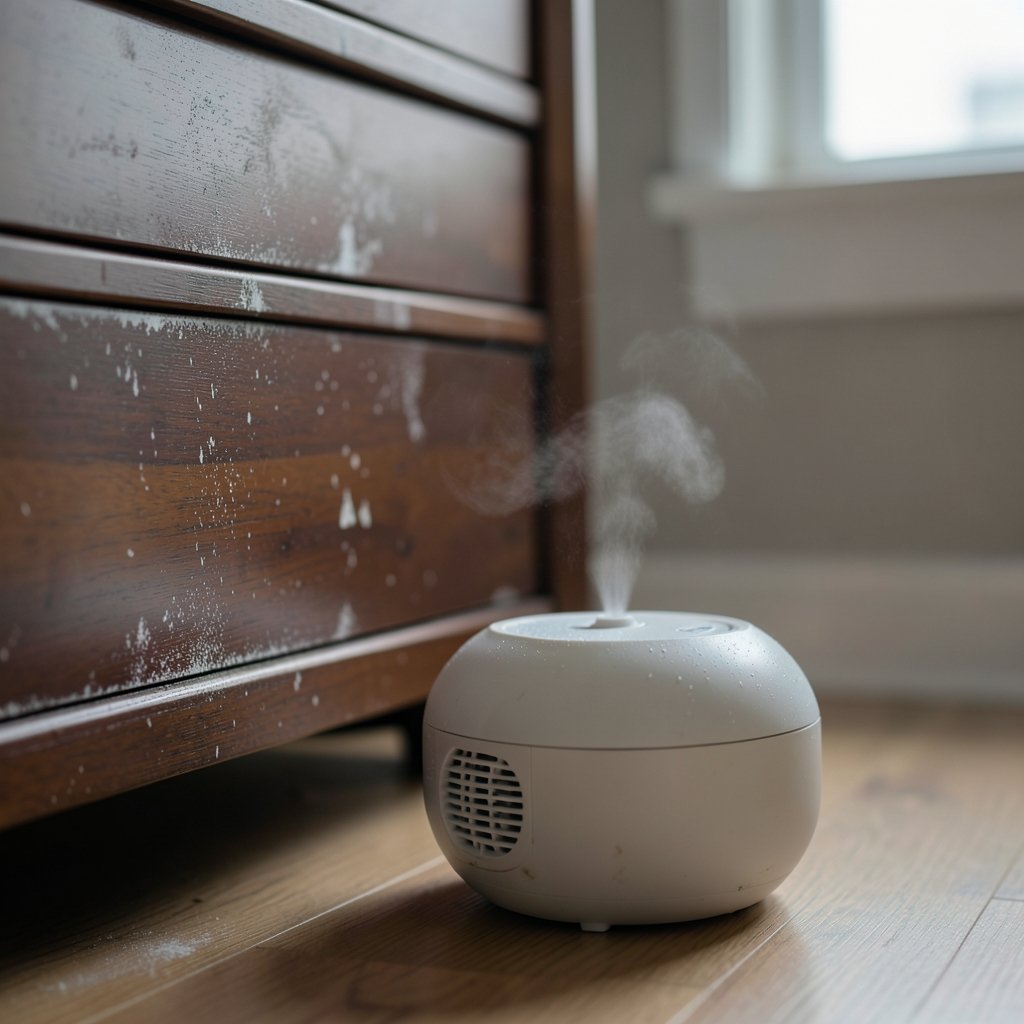
Not all humidifiers behave the same way, and the type you own explains most of the mess.
Ultrasonic humidifiers use a small vibrating plate to break water into a fine mist mechanically. Because the water is atomized rather than boiled or evaporated, everything dissolved in it — calcium, magnesium, and anything else — gets launched into the air along with the moisture. Those mineral particles then drift, settle, and dry into a visible white film.
Evaporative (wick) humidifiers work differently. A fan pulls air through a wet wick, and water evaporates naturally. The minerals stay trapped in the wick, which slowly crusts over and needs replacing. Steam humidifiers boil water and release pure vapor, leaving minerals behind in the tank or on a heating element. Both types can still scale up internally, but they generally do not coat your room in powder.
| Humidifier type | White dust risk | Where minerals end up | Maintenance trade-off |
|---|---|---|---|
| Ultrasonic | High with tap water | Airborne, then on surfaces | Wipe surfaces often; clean plate |
| Evaporative (wick) | Low | Trapped in the wick | Replace wicks regularly |
| Steam / warm mist | Very low | Tank and heating element | Descale the unit periodically |
| Central / whole-home | Varies by system | Depends on design | Professional service |
If you are shopping for a new unit and dust is your main frustration, this comparison matters more than tank size or noise rating. A cheap evaporative model can beat a premium ultrasonic one on this specific problem.
The Practical Fixes That Actually Work
Most advice online repeats the same handful of tips. Some are genuinely effective; others are partial measures. Here is what makes a real difference, ranked roughly by impact.
1. Switch to distilled or demineralized water
This is the single most effective fix. Distilled water has had its minerals removed, so there is nothing left to become dust. Demineralized water works the same way. The catch is cost and effort: buying gallons weekly adds up, and carrying them home is tedious. For a small bedroom unit, it is manageable. For a large living-room humidifier running all day, it can feel like a part-time job.
2. Use a demineralization cartridge
Many ultrasonic units accept a small cartridge that captures some minerals before the water is atomized. These help noticeably, but they do not solve the problem completely — they reduce the dust rather than eliminating it. Cartridges also need regular replacement, and an exhausted cartridge quietly stops working while the machine keeps running.
3. Choose the right machine for the room
If you are buying new, match the technology to your priorities. Evaporative and steam units sidestep the dust problem almost entirely. The trade-off is wick replacement or periodic descaling. For anyone tired of dusting, that is usually a fair swap.
4. Clean the tank on a schedule
White dust is a mineral issue, but poor cleaning creates a separate problem: biofilm and mold. Standing water left in a warm tank is a good place for growth. Empty the tank daily, dry it, and clean it weekly with a mild cleaning mix. Never let water sit for days between uses.
5. Manage humidity levels
Running a humidifier too high wastes water. It can push indoor humidity past comfortable levels, encouraging condensation on windows and damp surfaces. Keep indoor relative humidity in a moderate range, roughly 30 to 50 percent; that also means less water evaporates and less mineral output overall. A cheap hygrometer takes the guesswork out of it.
Common Mistakes That Make the Problem Worse
A few habits quietly sabotage even a well-chosen humidifier.
- Using tap water “just this once.” One fill with hard water can leave a visible film within hours, and repeated exceptions add up to constant cleaning.
- Skipping cartridge replacements. A clogged demineralization cartridge gives a false sense of security.
- Placing the unit near electronics or walls. Fine particles settle on screens, speakers, and dark furniture first, and trapped moisture near a wall can damage paint or drywall over time.
- Ignoring the heating element or ultrasonic plate. Scale buildup on the plate reduces mist output and eventually shortens the machine’s life.
- Running the humidifier in a closed room with no air movement. Gentle air circulation helps particles disperse rather than concentrate in one spot.
Is White Dust a Health Concern?
This is where the conversation gets more nuanced. The dust is not toxic, but inhaling fine mineral particles is not nothing either. Government indoor-air guidance has long noted that ultrasonic humidifiers can disperse minerals and microorganisms into the air, and has recommended distilled or demineralized water for these units along with regular cleaning and avoiding standing water.
Independent product testing has also found that ultrasonic humidifiers running on tap water can raise levels of fine particulate matter (PM2.5) in a room, with distilled water sharply reducing those readings. Allergy and asthma organizations have cautioned that inhaling mineral dust and aerosols may irritate airways, particularly for children and people with asthma or sensitive lungs.
The balanced takeaway: for most healthy adults, a light film of dust is a cosmetic annoyance, not a health crisis. But for households with asthma, young children, or anyone sensitive to particulates, choosing an evaporative or steam unit — or committing to distilled water — is a sensible precaution rather than an overreaction.
Matching Your Water to Your Machine
The smartest approach is to think about your water before you think about your humidifier. If your taps leave spots on glassware and a crust on the showerhead, your water is hard, and an ultrasonic humidifier will make that visible across your home. (Humidifier)
A simple test: fill a shallow dish with tap water and let it evaporate on a dark surface. A chalky ring means minerals are present and will become dust. That five-minute check tells you more than any product label.
For households with very hard water, the most economical long-term path is often an evaporative humidifier plus a habit of replacing wicks. For those who love the quiet, cool mist of an ultrasonic unit, distilled water and a spare cartridge are the price of admission. If you are also weighing other home-tech purchases this year, it helps to compare how different devices handle consumables and upkeep — much like the trade-offs covered in this breakdown of the Kindle vs Kobo Paperwhite vs Libra Colour 2026 comparison, where running costs and long-term value matter as much as the spec sheet.
Seasonal Patterns Worth Knowing
White dust complaints spike in winter for an obvious reason: that is when furnaces dry out indoor air and humidifiers run for hours every day. A unit that seems fine in October can coat a room by January simply because it is running ten times as long.
Seasonal maintenance matters too. Before the heating season starts, descale the tank, replace the wick or cartridge, and check that the mist output is still strong. A machine that has been sitting in a basement since March often has a dried mineral crust that reduces performance from day one. Auto and home maintenance both reward this kind of pre-season prep, a principle that shows up in the latest auto news and industry updates as much as in household appliances.
When to Replace Rather Than Repair
Sometimes the dust is a symptom of a worn-out machine. If the ultrasonic plate is heavily scaled, mist output has dropped, or the tank has persistent odors that cleaning will not fix, replacement is usually cheaper than repair. Humidifiers are affordable appliances, and a model that fits your water type will save hours of wiping.
Before buying, check three things: the technology type, the availability and cost of replacement wicks or cartridges, and how easy the tank is to clean. A wide-mouth tank that you can actually reach into with a brush beats a stylish narrow one that traps residue.
A Realistic Daily Routine
For anyone living with an ultrasonic unit and hard water, a simple routine keeps the dust manageable:
- Fill with distilled or demineralized water whenever possible.
- Empty and dry the tank each morning.
- Wipe nearby surfaces every few days rather than waiting for visible buildup.
- Replace the demineralization cartridge on schedule.
- Deep-clean the tank and plate weekly.
- Keep a hygrometer nearby and aim for moderate humidity.
None of this is glamorous, but it works. The households that complain loudest about white dust are usually the ones running an ultrasonic unit on hard tap water with no cartridge and no cleaning schedule. Change any one of those variables and the film shrinks fast.
Conclusion
White dust is not a mystery, a defect, or a health emergency in most homes. It is hard water meeting a machine that turns water into mist without removing the minerals first. Once you know that, the fix becomes a straightforward choice: switch water, switch technology, or accept a bit more dusting.
The most effective single step is distilled or demineralized water in an ultrasonic unit. The most effective long-term step is choosing an evaporative or steam humidifier that keeps minerals out of the air entirely. Add regular cleaning and sensible humidity levels, and the chalky film becomes a rare sight rather than a daily battle. Your furniture, your electronics, and your lungs will all notice the difference.
Frequently Asked Questions
Is white dust from a humidifier harmful?
For most healthy adults, it is a cosmetic nuisance rather than a danger. The particles are minerals, not toxins. However, inhaling fine mineral dust may irritate airways, especially in children and people with asthma, so sensitive households should consider distilled water or a different humidifier type.
Why does my humidifier leave white dust but my friend’s does not?
Water hardness is the usual answer. Homes on soft water see little to no film, while homes on hard water see it quickly. Humidifier type matters too: ultrasonic units release minerals into the air, while evaporative and steam models keep them inside the machine.
Does distilled water really stop white dust?
Yes, effectively. Distilled and demineralized water have had the calcium and magnesium removed, so there is nothing left to settle as powder. It is the most reliable fix for an ultrasonic humidifier, though buying and carrying water adds ongoing cost and effort.
Can I just use filtered water instead?
Usually not enough. Common pitcher and fridge filters reduce chlorine and some contaminants but leave most dissolved minerals in place, so the dust continues. Only distillation or demineralization removes the minerals responsible for the film.
How often should I clean a humidifier that produces dust?
Empty and dry the tank daily, and deep-clean the tank and ultrasonic plate at least once a week. Replace demineralization cartridges or wicks according to the manufacturer’s schedule. Regular cleaning prevents the separate problem of mold and biofilm growth.
Should I throw out my humidifier because of the dust?
Not necessarily. Try distilled water and a fresh demineralization cartridge first. If the unit is heavily scaled, output has dropped, or odors persist after cleaning, replacement with an evaporative or steam model is often the more practical and affordable choice.



