

Here’s a question worth asking before you spend hundreds of dollars on a portable air conditioner: why do some units come with one thick exhaust hose and others with two? It looks like a minor design detail. It isn’t. The hose setup is one of the biggest factors in how well a portable AC cools, how hard it works, and whether it quietly undermines the comfort it’s supposed to create. This guide breaks down the real differences between single-hose and dual-hose portable air conditioners so you can pick the right one for your room, your window, and your budget.
How Portable Air Conditioners Actually Work
Every air conditioner moves heat from one place to another. A portable AC does this with a compressor, an evaporator coil, and a condenser coil, all packed into one cabinet on wheels. The evaporator absorbs heat and moisture from your room air and blows cooled air back into the space. The condenser has to dump that collected heat somewhere, and that somewhere is outside, through the exhaust hose.
The key difference between the two designs comes down to where the air used to cool the condenser comes from.
With a single-hose unit, the machine pulls air from your room, runs it across the hot condenser coil, and pushes it out the window. That air has to be replaced somehow. Since the room is now slightly depressurized, replacement air gets sucked in through gaps around doors, windows, and outlets, and that replacement air is usually hot outdoor air. (Air conditioning)
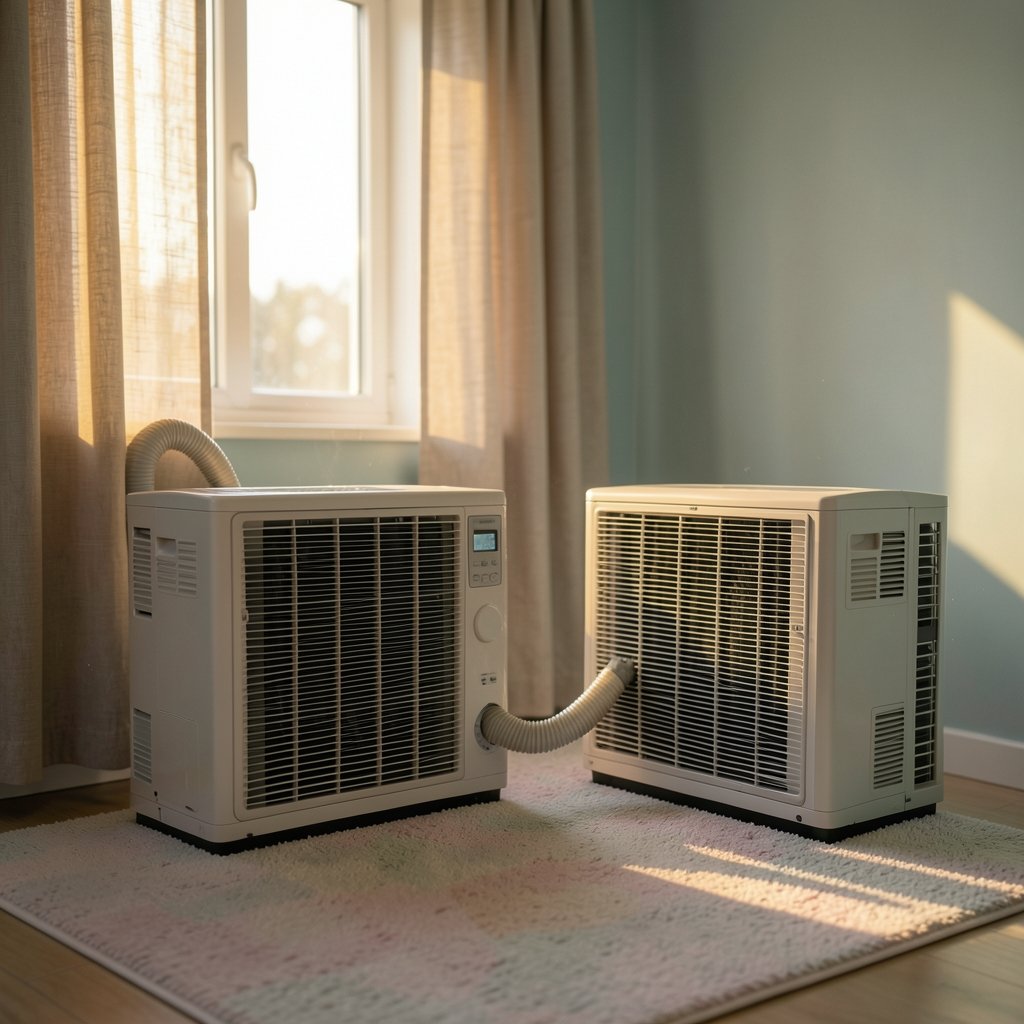
With a dual-hose unit, one hose brings outdoor air in specifically to cool the condenser, and the second hose sends that air back out. Your room air stays in the room. The pressure balance stays roughly neutral.
That’s the whole ballgame. Everything else, from efficiency to comfort to safety, flows from this one design choice.
The Core Comparison at a Glance
| Feature | Single-Hose | Dual-Hose |
|---|---|---|
| Air source for condenser | Room air | Outdoor air |
| Room pressure effect | Creates negative pressure | Roughly neutral |
| Cooling efficiency | Lower | Higher |
| Setup complexity | One window opening | Two openings or a dual-port kit |
| Typical price | Lower | Higher |
| Retail availability | Very common | Less common |
| Backdraft risk in tight rooms | Higher | Lower |
If you want the short answer, dual-hose units generally cool better and run more efficiently. But the single-hose design isn’t pointless, and there are practical reasons it dominates store shelves.
Why Single-Hose Units Can Underperform Their Rating
A portable AC rated at 10,000 BTU is tested under controlled conditions. In a real bedroom on a 95-degree day, a single-hose unit has a hidden handicap: it’s constantly throwing away air it already cooled and paying to cool fresh hot air pulled in through the cracks.
Think of it like bailing out a boat while someone else drills new holes. The unit works harder, the compressor runs longer, and the room may never feel as cold as the number on the box suggests. This is one reason shoppers comparing a 10,000 BTU single-hose model to an 8,000 BTU dual-hose model sometimes find the smaller dual-hose unit performs better in practice.
There’s also a ratings wrinkle worth knowing. Portable AC capacity in the U.S. is governed by Department of Energy test procedures, and a 2016 DOE rule changed how these units are rated, which lowered many advertised BTU figures. That means a pre-2016 box and a post-2016 box with the same number are not necessarily comparable. When you shop, compare units rated under the same standard rather than trusting the biggest number on the shelf.
Efficiency, Explained Without the Jargon
Efficiency here is simple: how much of the electricity you pay for actually goes toward cooling your room versus cooling the outdoors.
A single-hose unit spends part of its energy cooling air that immediately gets expelled. A dual-hose unit doesn’t have that leak, so more of its capacity lands where you want it. For the same nominal cooling output, a dual-hose model typically draws less power over a cooling season and reaches target temperature faster.
Be skeptical of any specific percentage claims you see floating around online. The real efficiency gap depends heavily on how leaky your room is, how hot it is outside, and how the unit was tested. In a drafty old house, a single-hose unit’s penalty can be significant. In a tight, well-sealed modern apartment, the gap narrows. The direction of the effect is reliable; the exact number is not.
The Safety Angle Nobody Mentions
Here’s a point that rarely makes it into product listings. Because a single-hose unit creates negative pressure, it can pull air backward down the flue of a combustion appliance, such as a gas water heater or furnace, in a tightly sealed room. That’s called backdrafting, and it can bring combustion byproducts into your living space.
Dual-hose units largely avoid this because they don’t depressurize the room. If you have gas appliances nearby or a very airtight home, this alone can justify the extra cost. Always read the manufacturer’s warnings and check local codes, and never run any portable AC in a room with a combustion appliance unless you’ve confirmed it’s safe.
Practical Setup: What Actually Works
Window kits matter more than people think
A single-hose unit needs one window panel with a hose port. A dual-hose unit needs either two separate openings or a window kit with two ports. If you rent and can’t modify a window, measure your opening before buying. Many dual-hose kits are designed for sliding windows and double-hung windows differently, and a sloppy seal around the panel lets hot air right back in, wiping out the efficiency advantage.
Seal the gap, always
Whichever design you choose, insulate and seal the window panel. Foam weatherstrip, a cut-to-fit panel, and a little tape around the hose collar make a measurable difference. This is the single most common mistake: people spend $500 on a unit and then leave a two-inch gap around the exhaust panel.
Give it breathing room
Portable ACs need clearance around the intake and exhaust. Pushing one flush against a wall or curtain strangles airflow and makes the compressor work harder. Keep at least a foot of clearance on the sides and front.
Drain or evaporate, know which
Many units evaporate condensate automatically in normal conditions, but in high humidity the tank fills and the unit shuts off. Check the manual for your model’s behavior rather than assuming. If you’re setting up a workspace, pairing the AC with a good desk setup helps, and if you’re building a remote office, our guide to the best portable monitors for remote work covers the display side of that equation.
Noise, Footprint, and Real-World Tradeoffs
Dual-hose units tend to be a bit larger and heavier because of the second hose and the extra ducting. They also cost more upfront, often by a meaningful margin. Single-hose units are lighter, cheaper, and far easier to find at any retailer, which is exactly why they dominate the market.
Noise is roughly comparable between the two designs and depends more on the specific compressor and fan than on hose count. Don’t assume dual-hose automatically means quieter.
One more practical note: dual-hose models are simply less common at retail. If you’ve decided you want one, you may need to shop online or special-order, and you should confirm the window kit fits your window type before checkout. If you’re kitting out a compact setup, the same clearance logic applies to accessories, much like choosing the best USB-C hub for a MacBook Air requires matching ports to your actual hardware rather than buying the biggest option.
Who Should Buy Which
Choose a single-hose unit if: you have a small room, a tight budget, a single small window, and you mainly need spot cooling for a few hours at a time. It’s also the pragmatic choice if you’ll move the unit between rooms frequently, since one hose is easier to manage.
Choose a dual-hose unit if: you’re cooling a larger space, running the unit for long stretches, living in a well-sealed home, or you have gas appliances in the vicinity. The efficiency gain compounds over a full summer, and the pressure balance is a genuine comfort and safety benefit.
For anyone cooling a bedroom overnight through July and August, the dual-hose design usually wins on both comfort and electricity. For occasional use in a spare room, a single-hose model at a lower price is perfectly reasonable.
Common Mistakes to Avoid
Buying by BTU number alone without checking the rating standard is mistake number one. Mistake number two is skipping the window seal. Mistake number three is placing the unit where the exhaust hose has to bend sharply or run long distances, which restricts airflow and hurts performance. Mistake number four is ignoring the manual’s clearance and drainage instructions. And mistake number five, especially relevant if you’re comparing specs across categories, is assuming a bigger number always means better performance; the same trap shows up when people compare handhelds like the Anbernic RG DDS dual screen 3DS handheld 2026 purely by spec sheet rather than real-world use.
Conclusion
The single-hose versus dual-hose decision comes down to one question: do you want your air conditioner to use your room’s cooled air to do its job, or outdoor air? Dual-hose units keep your room air where it belongs, which makes them more efficient, more comfortable in sealed spaces, and safer around combustion appliances. Single-hose units are cheaper, lighter, and everywhere, and they’re fine for small spaces and short cooling sessions. Match the design to your room, seal your window properly, and either type will do the job it was built for.
Frequently Asked Questions
Is a dual-hose portable AC always better than a single-hose one?
Not always, but usually for sustained cooling in a sealed room. Dual-hose units avoid depressurizing the space and don’t waste already-cooled air, so they tend to be more efficient. Single-hose units win on price, weight, and availability, which matters for small rooms and occasional use.
Why do single-hose units create negative pressure?
Because they draw room air in to cool the condenser and then exhaust it outdoors. That expelled air has to be replaced, so outdoor air gets pulled in through gaps around doors and windows. The result is a slight pressure drop and a constant trickle of hot replacement air.
Can a single-hose portable AC cause safety problems?
In tightly sealed rooms with combustion appliances like a gas water heater, the negative pressure can cause backdrafting, pulling exhaust gases backward into the space. Dual-hose units reduce this risk. Always follow the manufacturer’s warnings and check local codes before running any portable AC near gas appliances.
Do dual-hose units really use less electricity?
Generally yes, for the same amount of cooling delivered, because they aren’t expelling conditioned air. The exact savings depend on how airtight your room is, outdoor temperature, and the specific model. Treat any precise percentage claim with caution and compare units rated under the same test standard.
Why are dual-hose portable ACs harder to find?
They cost more to make, are bulkier, and require two window openings or a dual-port kit, which complicates installation for buyers. Retailers stock what sells, and single-hose units dominate because they’re cheaper and simpler. You’ll often need to shop online or special-order a dual-hose model.
How do I know if a portable AC’s BTU rating is comparable?
Check which DOE test standard the unit was rated under. A 2016 DOE rule changed portable AC rating procedures and lowered many advertised BTU figures, so a pre-2016 box and a post-2016 box with the same number aren’t directly comparable. Compare units rated under the same standard, and weigh hose design alongside the number.



