
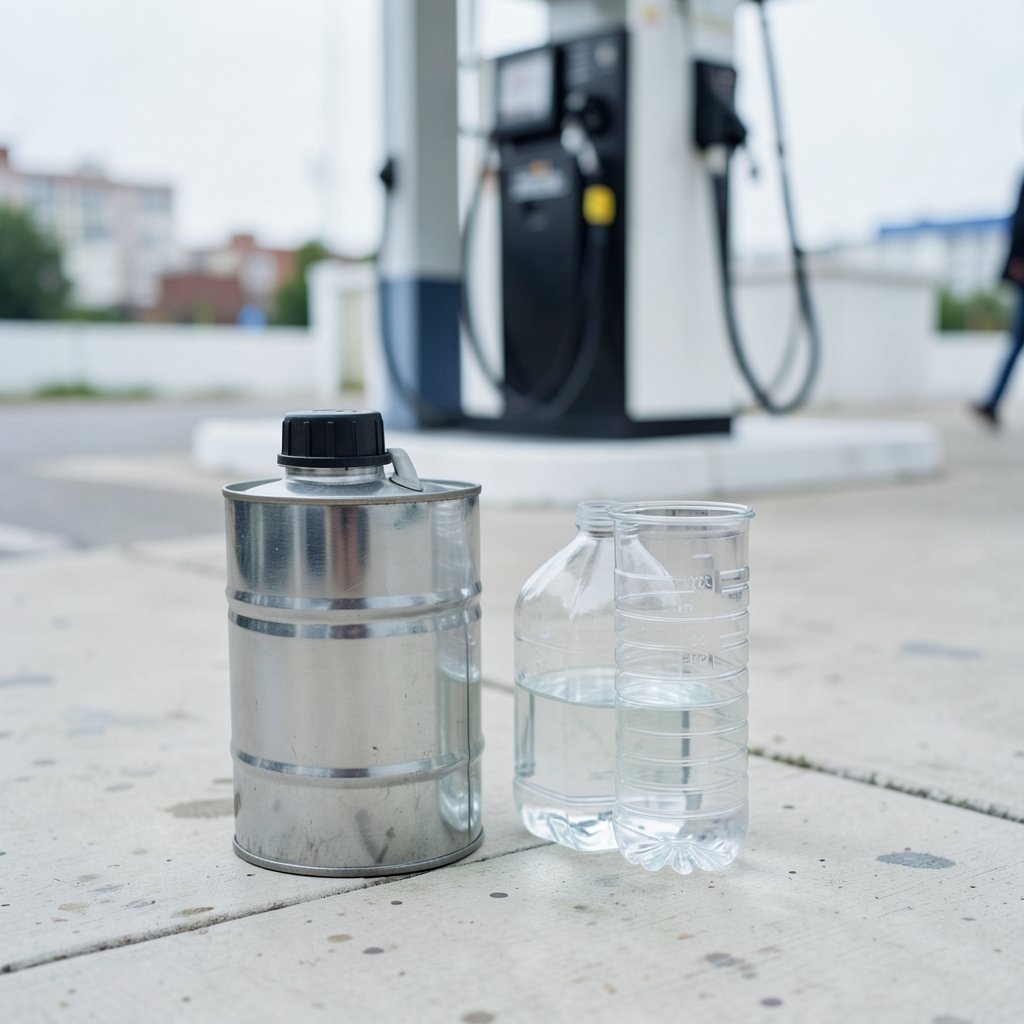
Quick Answer: How many liters in a gallon?
One US liquid gallon equals exactly 3.785411784 liters. One imperial (UK) gallon equals exactly 4.54609 liters, which is about 20% larger than the US version.
The difference matters most when you convert fuel economy, brewing volumes, or recipes that were written in another country. A third unit, the US dry gallon, equals 4.40488377086 liters and survives mainly in agricultural commodity measures. (NIST Unit Conversion)
Before you convert, check which gallon the source means, whether the figure is liquid or dry, whether the recipe uses US or imperial measures, and whether rounding is acceptable for your purpose.
Why the Gallon Question Trips Up So Many People

What could be simpler than asking how many liters are in a gallon? Then you try to fill a rental car in Ireland, follow a British beer recipe in Ohio, or compare fuel economy figures between a US car magazine and a UK one, and suddenly nothing adds up.
The problem is that “gallon” is not one unit. It is a family of units with the same name and very different sizes. The United States uses one gallon for liquids, keeps a second one for dry goods, and the United Kingdom officially moved on to a different gallon decades ago but still uses it in everyday speech. Mix them up and you can be off by a fifth of your total volume, which is enough to ruin a batch of beer, throw off a fuel calculation, or make a recipe come out wrong.
This guide gives you the exact numbers, the mental shortcuts that actually work in practice, and the mistakes people make most often. It also explains where these odd definitions came from, because the history is the reason the numbers look so arbitrary.
The Exact Conversion Factors
Precision matters here, because these are not approximate figures. The US liquid gallon is defined as exactly 231 cubic inches, and since 1959 the inch has been defined as exactly 2.54 centimeters. That makes the liter conversion exact, not rounded.
| Unit | Liters | Cubic inches | Where it is used |
|---|---|---|---|
| US liquid gallon | 3.785411784 | 231 | United States, everyday liquids |
| Imperial (UK) gallon | 4.54609 | about 277.42 | UK (legacy), Ireland, some Commonwealth countries |
| US dry gallon | 4.40488377086 | 268.8025 | US agricultural commodities |
Going the other way, one liter equals about 0.264172 US gallons or about 0.219969 imperial gallons.
The imperial gallon has been defined since 1985 as exactly 4.54609 cubic decimeters. That fixed definition replaced an older one based on the weight of water, which is why the modern number looks so specific.
A Mental Math Shortcut That Actually Works
Nobody wants to multiply by 3.785411784 at the grocery store. For everyday purposes, a simple approximation gets you close enough.
For US gallons, multiply by 4 and then subtract about 5%. So 10 US gallons is roughly 40 liters minus 2, or about 38 liters. The exact answer is 37.854 liters, so the shortcut lands within half a percent.
For imperial gallons, multiply by 4.5 and add a small nudge. Ten imperial gallons is about 45.46 liters, so 45.5 is a fine working figure.
The reverse is just as easy. To turn liters into US gallons, divide by 4 and add about 5%. Sixty liters becomes 15 gallons plus 0.75, or roughly 15.75 gallons. The exact figure is 15.85 gallons. (Nintendo switch 2 lite samsung 8lpu plus chip rumor 2026)
These shortcuts are fine for planning a road trip or sizing a water tank. They are not fine for anything where money or safety depends on the number, such as dosing, fueling aircraft, or commercial transactions.
Where the Two Gallons Came From
The split between US and UK gallons is a historical accident, and understanding it makes the numbers easier to remember.
The US gallon descends from the British wine gallon, sometimes called the Queen Anne gallon, which dates to 1707. When Britain later reorganized its weights and measures in 1824, it created the imperial gallon, based on the volume of ten pounds of water. The United States had already gained independence and kept the older wine gallon. That is why a country that shares a language with Britain uses a unit about 20% smaller. (Gallon)
The dry gallon is a third descendant, historically used for grain and other loose agricultural goods. It sits between the other two in size, which makes it especially easy to confuse with either one.
Common Mistakes People Make
The single biggest error is assuming “gallon” means the same thing everywhere. A British recipe calling for a gallon of water wants 4.546 liters. An American recipe wants 3.785 liters. That is nearly a full extra liter, which matters in baking, brewing, and anything with a sensitive ratio. (Ai cooling water use 222 billion liters figure really means)
The second mistake is forgetting the dry gallon exists. If you are buying grain, seed, or feed in the United States, a quoted gallon may be a dry gallon. The difference from a liquid gallon is about 16%, which is not trivial when you are ordering in bulk.
The third mistake is converting fuel economy in the wrong direction. Miles per gallon and liters per 100 kilometers move in opposite directions, so a bigger mpg number is better while a bigger L/100km number is worse. People regularly flip this and draw the wrong conclusion about which car is more efficient.
The fourth mistake is over-rounding early. If you round 3.785 to 3.8 and then multiply by a large number, the error grows with every step. Keep full precision through the calculation and round only the final answer.
Converting Fuel Economy Without Getting It Backwards
Fuel economy is where gallon confusion causes the most real-world frustration, because US and UK mpg figures are not comparable at all. A UK car advertising 50 mpg is not doing the same as a US car advertising 50 mpg. The UK figure uses imperial gallons, so it represents about 20% more fuel than the US figure suggests.
To convert US miles per gallon to kilometers per liter, multiply by about 0.425144. A car getting 30 US mpg is doing roughly 12.75 km per liter.
The more useful conversion for most of the world is to liters per 100 kilometers, which is the standard measure in Europe and most of Asia. The formula is 235.215 divided by US mpg. So 30 US mpg becomes about 7.84 L/100km.
For imperial mpg, use 282.481 divided by the mpg figure to get L/100km. A UK car at 50 imperial mpg is doing about 5.65 L/100km.
That kind of unit mismatch is the same class of problem that shows up in technology planning, where teams compare specifications that were never measured the same way. It is one of the reasons so many application modernization challenges so many projects stall, and why big infrastructure numbers need careful reading, such as what the AI cooling water use 222 billion liters figure really means before anyone quotes it as a headline.
Gallons in the Kitchen and Behind the Bar
Cooking is where the US-UK gap bites hardest, because recipes are often copied across borders without conversion.
A US cup is 236.6 milliliters. A US gallon is 16 cups. An imperial gallon is roughly 18.6 US cups. If you scale a British recipe up to a gallon without adjusting, you will overshoot by nearly three cups.
For brewing, the difference is even more consequential. Homebrew recipes are usually written in US gallons, but older British brewing texts use imperial gallons. A five-gallon batch means 18.93 liters in US terms and 22.73 liters in imperial terms. Following the wrong one changes your gravity readings, your hop utilization, and your final alcohol content.
A practical habit that saves trouble: write the unit system directly on the recipe card instead of only “gallon.” Two extra words prevent a spoiled batch.
Gallons in Commerce and Law
In the United States, the gallon used for trade is the US liquid gallon, and it is enforced through legal metrology rules that cover fuel pumps, bottled goods, and packaged products. That is why a US gas pump delivers 3.785 liters per gallon, every time, with no ambiguity.
In the United Kingdom, the imperial gallon remains lawful for some purposes, notably draught beer and road signs, even though most other goods are sold in metric units. This is why British pubs still serve beer by the pint and why fuel economy is still discussed in mpg there.
If you are doing business across borders, the safe approach is to state the unit explicitly in contracts and specifications, and to convert to liters as a neutral reference point. Liters are unambiguous everywhere.
When Precision Actually Matters
For most daily purposes, a rough conversion is fine. There are situations where it is not.
Anything involving dosing, whether medication, pool chemicals, or agricultural spray, needs the exact figure and the correct gallon definition. Anything involving billing, such as fuel purchases or bulk commodity sales, needs the legally defined unit for that jurisdiction. Anything involving safety-critical ratios, such as fuel mixing for small engines, needs exact numbers because the engine manufacturer specified one system.
For everything else, the shortcut is your friend. Nobody needs nine decimal places to figure out how many liters of paint to buy for a fence.
Conclusion
The answer to how many liters in a gallon depends entirely on which gallon you mean. The US liquid gallon is 3.785411784 liters. The imperial gallon is 4.54609 liters. The US dry gallon is 4.40488377086 liters. Those are exact definitions, not approximations, and the roughly 20% gap between the two main ones is the source of nearly every conversion error people make.
The practical takeaway is simple. Always name the gallon. Convert to liters when you need a neutral reference. Use the multiply-by-four-minus-five-percent shortcut for everyday US conversions, and keep full precision when money or safety is on the line. Do that, and the gallon stops being a trap and becomes just another number.
FAQ
Is a US gallon bigger than a UK gallon?
No. The US liquid gallon is smaller. It holds 3.785411784 liters, while the imperial gallon holds 4.54609 liters. The imperial gallon is about 20% larger, which means a UK gallon contains roughly 1.2 US gallons.
How many liters are in a half gallon?
A half US gallon is 1.892705892 liters, roughly 1.89 liters. A half imperial gallon is 2.273045 liters. The familiar half-gallon ice cream tub in the US is therefore a little under two liters.
Why does the US use a different gallon from the UK?
The United States kept the older British wine gallon from 1707, while Britain replaced it in 1824 with the imperial gallon based on the weight of water. By then the two countries had separate measurement systems, and neither has changed its gallon since.
How many liters are in a gallon of water?
It depends on the gallon, not the liquid. A US gallon of water is 3.785411784 liters and weighs about 8.34 pounds. An imperial gallon of water is 4.54609 liters and weighs about 10 pounds, which is exactly how the imperial gallon was originally defined.
How do I convert liters to gallons quickly?
Divide the liter figure by 4 and add about 5% for US gallons. For example, 40 liters becomes 10 gallons plus 0.5, or about 10.5 gallons. The exact answer is 10.57 US gallons. For imperial gallons, divide by 4.5 and subtract a small amount.
Is the dry gallon still used?
Yes, though rarely. The US dry gallon equals 4.40488377086 liters and appears mainly in agricultural settings for commodities like grain and seed. It is about 16% larger than the US liquid gallon, so it is worth confirming which one a seller means before ordering in bulk.



