
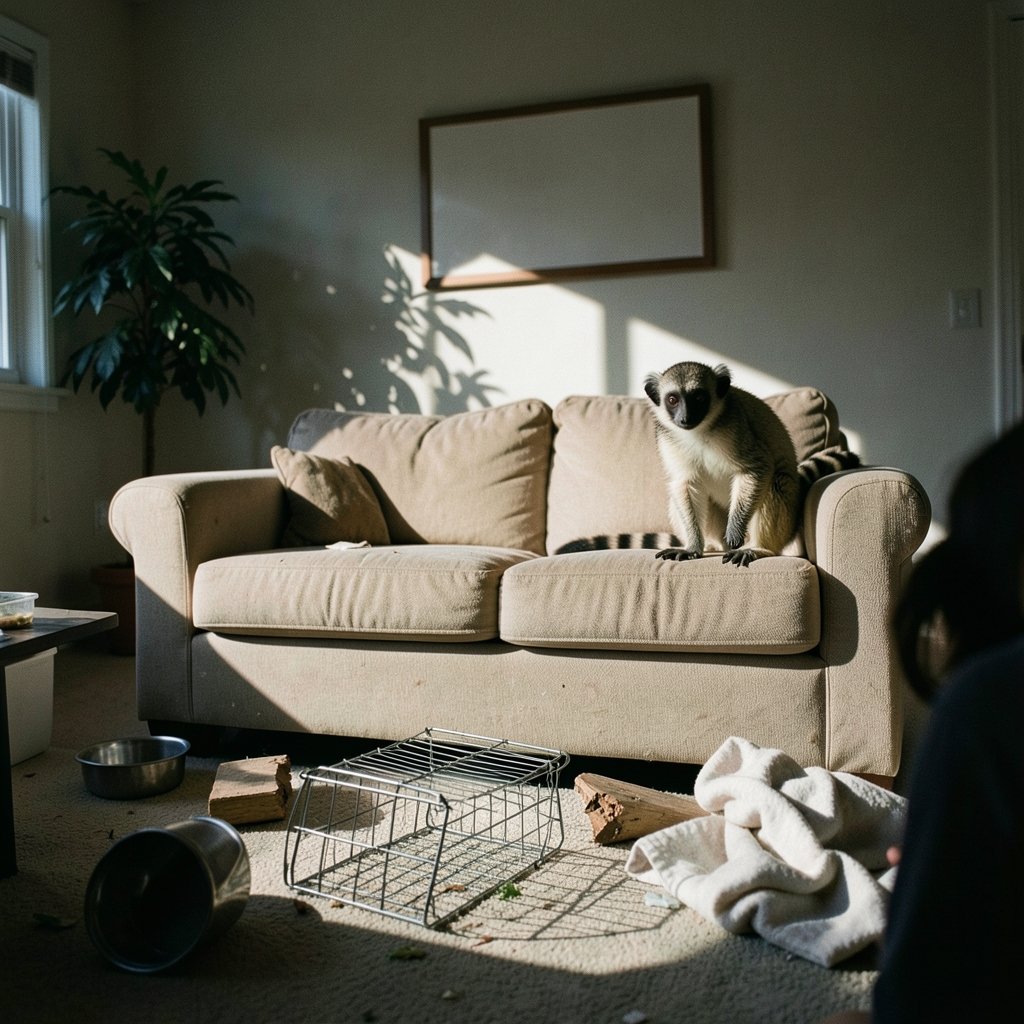
Could you really give a marmoset a good life in your spare bedroom? That question underlies one of the most emotionally charged debates about animal ownership. Primates are smart, expressive, and disturbingly human in the way they look back at us. That is exactly what makes them so appealing to some people and so unsuitable as household companions. The pull is easy to understand. The reality is far messier.
This article walks through what the law now says in major jurisdictions, why primate biology fights back against domestic life, what public health risks come with close contact, and what practical steps people should take if they are serious about the idea. It is written for anyone curious about the topic, from would-be owners to neighbors, landlords, and policymakers trying to make sense of a fast-changing rulebook.
What Makes Primates So Tempting and So Tricky?
A young macaque or capuchin can seem almost like a toddler with fur. They reach for things, mimic gestures, and form intense bonds. Social media clips feed the fantasy. But the same animal that cuddles at six months old becomes sexually mature, territorial, and physically strong within a few years. Primates are not domesticated. Thousands of years of selective breeding have softened dogs and cats. Primates remain wild animals with wild instincts, even when hand-raised.
Their needs are also staggeringly complex. Many species live in large social groups with hierarchies, alliances, and daily politics. They need space to climb, forage, and problem-solve. They need companions of their own kind. A cage in a living room cannot replicate a forest canopy, and a human cannot substitute for a troop. That gap between what a primate wants and what a home can offer is the root of most welfare problems.
The Legal Picture: A Patchwork That Keeps Shifting
Anyone considering primate ownership quickly discovers that the rules are a maze. They vary by country, by state or province, and sometimes by species.
The United States
The biggest recent change came at the federal level. The Captive Primate Safety Act was folded into the 2023 Consolidated Appropriations Act, signed on 29 December 2022. It amended the Lacey Act to prohibit interstate commerce in nonhuman primates for the pet trade, with exceptions carved out for zoos, sanctuaries, research, and similar regulated uses. In plain terms, moving a pet primate across state lines for the pet market is now off the table under federal law.
That does not mean every state bans private keeping. Before the federal law, a minority of states prohibited private primate ownership outright while many others imposed partial restrictions, licensing requirements, or outright silence. State-level rules continue to differ and continue to change. Anyone relying on an old blog post or a forum thread is asking for trouble. The practical takeaway: check the current statute in your own state, and check it again before any transaction. Rules that existed five years ago may no longer apply.
The United Kingdom
England took a licensing approach rather than a blanket ban. Since 1 October 2007, keeping certain primates as pets in England has required a licence under the Dangerous Wild Animals Act 1976, as amended by the 2007 order. The licence is not a formality. It comes with inspection, fee, and welfare conditions.
Welfare standards were tightened further when a statutory code of practice for the welfare of privately kept primates was published in 2021. The code sets out expectations for enclosure size, social housing, enrichment, diet, and veterinary care. Importantly, the UK regimes are devolved. Scotland, Wales, and Northern Ireland each have their own arrangements, so a rule that applies in England may not apply a few hours up the road. Anyone in the UK should confirm the position with the relevant local authority before assuming anything.
International Trade Rules
Most primates are listed in CITES Appendix I or II, which means international trade is regulated. CITES entered into force on 1 July 1975. These listings control legal acquisition and movement across borders, but they do not by themselves ban private keeping inside a country. People sometimes confuse the two. A legal import permit is not a green light to keep an animal in your house.
| Jurisdiction | Core approach | Key detail |
|---|---|---|
| United States (federal) | Trade restriction | Interstate pet-trade commerce banned under the 2022 law |
| United States (states) | Mixed patchwork | Bans, licences, and partial rules vary and change |
| England | Licensing | Dangerous Wild Animals Act licence since October 2007 |
| England (welfare) | Statutory code | Privately kept primate welfare code published 2021 |
| Scotland, Wales, N. Ireland | Devolved | Separate regimes that must be checked individually |
| International | Trade regulation | CITES Appendix I or II listings since 1975 |
Health Risks That Do Not Get Enough Attention
The welfare argument gets most of the airtime, but the zoonotic argument is just as serious. Nonhuman primates can pass infections to humans, and some of those infections are brutal.
The starkest example is herpes B virus, formally Macacine alphaherpesvirus 1. Macaques can carry it, and in humans it causes severe encephalitis that is often fatal. Public health guidance advises against keeping macaques as pets and recommends strict precautions for people with occupational exposure, such as laboratory workers. The virus is rare in human cases, but the consequences are severe enough that the risk deserves far more weight than it usually gets in casual conversations about “cute monkeys.”
Other concerns include tuberculosis, simian foamy virus, and a range of enteric pathogens that move easily in households with shared spaces and imperfect hygiene. There is no comprehensive national surveillance dataset tracking primate-to-human infections from private ownership, so frequency claims should be treated with suspicion in either direction. What can be said plainly is that close contact with a wild animal in a home setting creates exposure routes that do not exist in a properly managed facility.
Welfare Reality: What a Primate Actually Needs
Strip away the novelty and the demands are enormous. Primates need social companions, and single housing is widely regarded as harmful. They need vertical space and complexity. They need mental stimulation that changes daily. They need a diet that meets species-specific requirements, which is harder than it sounds for animals with specialized digestive systems. They need veterinary care from someone with exotic species experience, and such vets are not on every corner.
Then there is the behavior problem. Primates bite, scratch, throw, and destroy. A frustrated adolescent primate is not being naughty. It is expressing natural behavior in an unnatural setting. Many owners respond with confinement, punishment, or rehoming. None of those solve the underlying mismatch.
The end point is often a sanctuary. Rescued pet primates generally cannot be released to the wild, because they lack the skills and social integration to survive. Sanctuaries absorb them, and the burden is real. This is the quiet cost of the pet trade: animals that live for decades and need care for every one of them.
Common Mistakes People Make
First-hand accounts and case patterns point to a handful of recurring errors.
- Trusting outdated legal information. Rules changed in the US in 2022 and in England over the past two decades. Old forum posts and influencer videos are not legal advice.
- Buying before checking the species. “Primate” covers everything from marmosets to macaques, and the legal and practical requirements differ enormously.
- Underestimating the timeline. Many primates live 20 to 40 years. That is a multi-decade commitment that outlasts jobs, homes, and relationships.
- Assuming hand-rearing tames the animal. Bottle-feeding an infant creates a bond that breaks down at maturity, often with aggression.
- Skipping the vet question. Before acquiring any exotic animal, confirm that a qualified veterinarian will actually see it.
- Ignoring the neighbors. Noise, escape risk, and insurance issues surface fast in residential settings.
What Actually Works
For people genuinely drawn to primates, the realistic paths are indirect. Visiting accredited sanctuaries, supporting conservation programs, or volunteering with reputable organizations provides contact without ownership. For anyone who still wants to explore legal private keeping where it is permitted, the practical sequence looks like this:
- Confirm the current legal status in your jurisdiction, in writing, with the relevant authority.
- Identify the exact species and research its social, dietary, and spatial needs from primary sources.
- Secure veterinary commitment before any animal arrives.
- Plan for social housing, not solitary confinement.
- Budget for decades of food, enclosure maintenance, insurance, and emergencies.
- Have a written rehoming plan in case circumstances change.
That last point matters more than most people expect. Circumstances do change, and a primate cannot be dropped at a shelter like a stray cat. Planning for the animal’s whole life is the minimum standard.
Conclusion
Primates as pets sit at an uncomfortable intersection of human affection and animal biology. The desire to care for them is genuine. The conditions required to do it well are rarely met in a home. Laws in the US and UK have moved steadily toward restriction and licensing, and public health evidence keeps pointing in the same direction. None of this means primates should disappear from human life. It means the relationship works best at a distance, through conservation, sanctuaries, and research done responsibly. For readers weighing the decision, the honest answer is that the animal almost never benefits from the arrangement. The humans usually learn that later than they would like.
Frequently Asked Questions
Is it legal to keep a primate as a pet in the United States?
It depends on the state, but federal rules have tightened considerably. The Captive Primate Safety Act, enacted as part of the 2023 Consolidated Appropriations Act and signed on 29 December 2022, prohibits interstate commerce in nonhuman primates for the pet trade. State laws range from outright bans to licensing schemes, and they change. Anyone considering ownership must check current state law directly rather than relying on older summaries.
Can you keep a monkey as a pet in the UK?
In England, certain primates require a licence under the Dangerous Wild Animals Act 1976, as amended by the 2007 order, since 1 October 2007. A statutory welfare code for privately kept primates was published in 2021 and sets expectations for housing and care. Scotland, Wales, and Northern Ireland have their own devolved rules, so the answer differs depending on where you live.
Why are primates considered unsuitable as pets?
Their social, cognitive, and environmental needs are extremely hard to meet in a domestic setting. Many species need large social groups, complex environments, and specialized diets. They also reach sexual maturity with instincts that hand-rearing does not remove. The result is often confinement, behavioral problems, and eventual rehoming to a sanctuary.
What diseases can primates pass to humans?
Nonhuman primates can transmit a range of infections. The most serious is herpes B virus, carried by macaques, which causes severe and often fatal encephalitis in humans. Other concerns include tuberculosis, simian foamy virus, and enteric pathogens. Public health guidance advises against keeping macaques as pets and recommends precautions for occupational exposure.
Does CITES ban private primate ownership?
No. CITES regulates international trade in listed species, and most primates appear in Appendix I or II. It entered into force on 1 July 1975. These listings control cross-border movement and legal acquisition, but domestic keeping rules are set by each country or state, not by CITES itself.
What happens to pet primates when owners can no longer care for them?
They usually cannot be released to the wild because they lack survival skills and social integration. Many end up in sanctuaries that provide lifelong care. This places a long-term burden on rescue facilities and is one of the strongest practical arguments against private ownership. Planning for the animal’s entire lifespan, which can span decades, is essential before acquiring one.



