

What comes to mind when someone says “vampire fish”? A blood-sucking monster from a late-night horror film? A tiny Amazonian terror that swims up a urine stream? Or a real animal with a circular mouth full of teeth that has quietly reshaped the economy of an entire region?
The truth is stranger than the nickname. “Vampire fish” is not a scientific term. It is a popular label slapped onto at least half a dozen unrelated animals, from a jawless parasite in the Great Lakes to a fanged characin in the Amazon. Some of them really do drink blood. Others just look the part. A few have been blamed for things they almost certainly never did.
This guide sorts the real from the rumor, explains how the most famous vampire fish actually feeds, and shows why the nickname matters far more in fishery management than it does in biology.
Which fish are actually called vampire fish?
The nickname gets applied loosely, but a few species come up again and again. Here is the honest scorecard.
| Common name | Species | Does it drink blood? | Where it lives |
|---|---|---|---|
| Sea lamprey | Petromyzon marinus | Yes, as an adult parasite | Native to the North Atlantic; invasive in the Great Lakes |
| Candiru | Vandellia cirrhosa | Yes, from host fish gills | Amazon basin |
| Payara (“vampire tetra”) | Hydrolycus species | No, it impales prey | South American rivers |
| Dracula fish | Danionella dracula | No, fangs are bone projections | Myanmar |
| Various loaches | Several species | No | Freshwaters across Asia |
Notice the pattern. Only two of these animals are genuine blood-feeders. The rest inherited the name from their teeth, their jaws, or a marketing-minded aquarium trade.
That confusion is worth taking seriously, because it shapes public fear. People hear “vampire fish” and picture one creature. In reality, the label describes a feeding strategy, a set of fangs, and a very old body plan that happen to share a nickname.
The sea lamprey: the real vampire of the Great Lakes
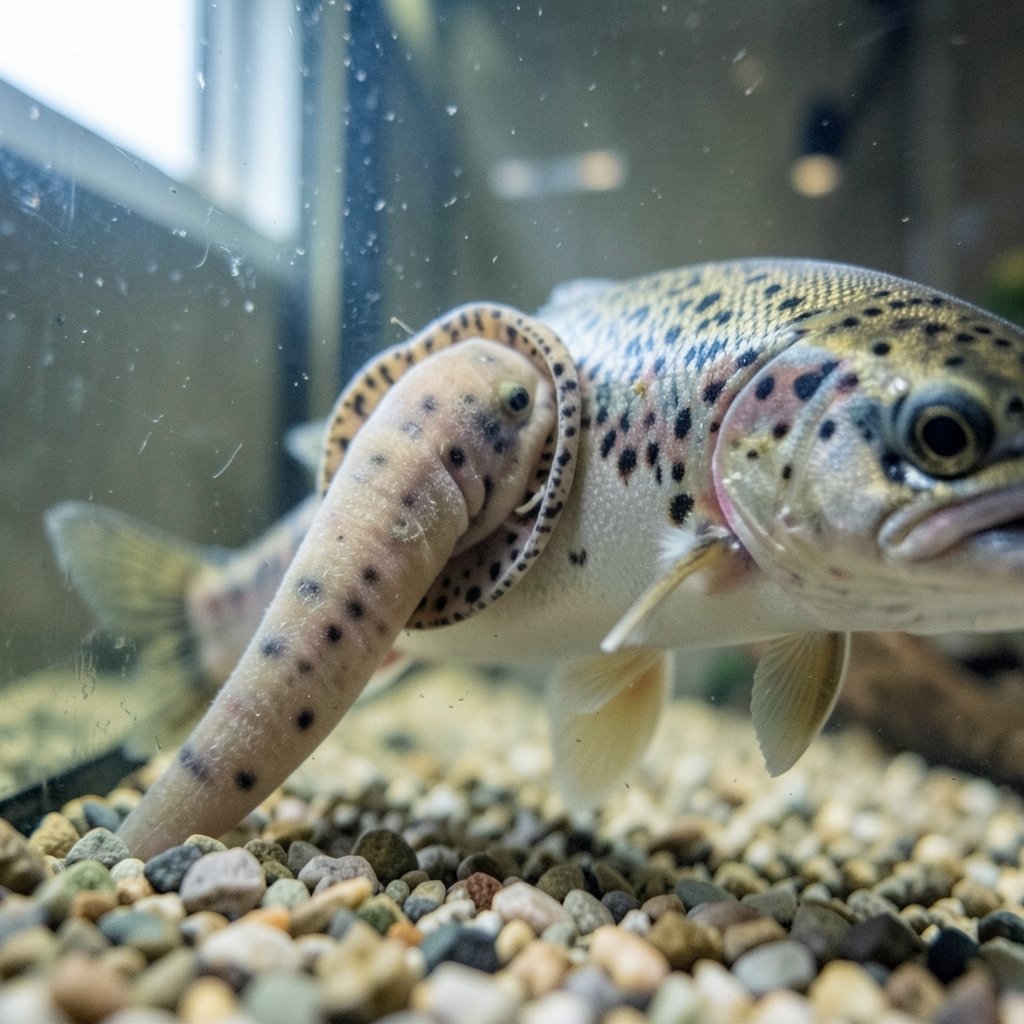
If any animal deserves the title, it is the sea lamprey. It is a jawless fish, meaning it has no jawbone at all. Instead, its mouth is a round, sucker-like disc lined with rings of horny teeth. It attaches to a host fish, rasps through the skin, and feeds on blood and body fluids. Then it drops off, digests, and often does it again.
The anatomy is genuinely unsettling up close, and it is described in detail in standard ichthyology identification guides. But the biology is also elegant. Lampreys are among the oldest living vertebrate lineages, with fossil forms known from the Carboniferous period roughly 300 million years ago. They were sucking blood long before there were lake trout to worry about.
How the invasion happened
Sea lampreys are native to the North Atlantic and the rivers connected to it. In the Great Lakes, they are not native. They got in through a human shortcut.
After the Welland Canal was deepened in 1919, lampreys gained a route around Niagara Falls and into the upper Great Lakes. What followed was slow, then catastrophic. By the 1940s and 1950s, lamprey predation, combined with heavy overfishing, helped push lake trout and other fisheries into collapse.
The scale is hard to overstate. A single adult lamprey can kill many pounds of fish over its parasitic life, and the lakes had millions of them. Coastal communities that had built their economies on lake trout watched the resource disappear.
The control program that followed
In 1955, the Great Lakes Fishery Commission began coordinating control under a U.S.–Canada treaty arrangement. Its approach has three main pillars:
- Lampricides, especially TFM, applied to streams where lamprey larvae burrow in the sediment.
- Barriers and traps that block adults from reaching spawning grounds.
- Ongoing assessment, because lamprey populations rebound quickly if treatment lapses.
What actually works in practice is the unglamorous part: treating the right streams at the right time, year after year, and measuring the result. People new to the topic often assume a one-time chemical treatment solves it. It does not. Lampricide programs are a permanent commitment, and the streams are rotated on a schedule.
The program is not universally loved. Some anglers and residents worry about non-target effects, and lampricide costs are substantial. But the alternative, unmanaged lamprey predation, has been tried, and the historical record is grim.
The candiru: separating fact from a very old story
The candiru (Vandellia cirrhosa) is a small Amazonian catfish, and it is a genuine parasite. It feeds on blood from the gills of larger fish, often by swimming into a host’s gill cavity. That much is well documented in ichthyology references.
Then there is the story everyone has heard. The one about the candiru swimming up a urine stream and lodging in a human urethra.
Here is the honest position: that story is poorly documented and disputed by researchers. Many popular accounts trace back to a single early report, repeated for generations without independent confirmation. Some researchers have argued the anatomy and behavior make the scenario implausible. Others note that reported cases are vanishingly rare relative to the enormous number of people who swim in candiru waters.
None of this means the fish is harmless. It is a parasite with a taste for blood, and it deserves respect. But the specific urethra legend has hardened into folklore, and repeating it as established fact is a mistake. If you are writing about vampire fish for a general audience, flag the uncertainty. It is more interesting than the myth anyway.
The payara and the Dracula fish: fangs without blood
Two more animals wear the vampire label for purely cosmetic reasons.
The payara, sometimes called the vampire tetra, is a predatory characin from South American rivers. It has two long fangs protruding from its lower jaw, which it uses to impale prey. It does not drink blood. It is a fast, efficient ambush predator, and the fangs are a tool for holding fish, not for tapping veins.
The Dracula fish (Danionella dracula) was described in 2009 and made headlines for its fang-like bone projections. Those projections are not true teeth, and the fish is not a blood-feeder. It is tiny, translucent, and about as threatening as a grain of rice.
This is where the nickname does real damage to understanding. A reader who sees “vampire fish” attached to a payara may assume it behaves like a lamprey. It does not. The label describes a look, not a lifestyle.
Why the name matters beyond trivia
So why bother untangling a nickname?
Because names drive policy. When a fish is called a vampire, it becomes easier to justify spending public money to kill it, and harder to explain why anyone would object. The sea lamprey is a genuine ecological problem in the Great Lakes, and the control program is justified by real damage. But the framing shapes how people hear the science.
Names also drive fear. The candiru legend has made people avoid rivers they would otherwise enjoy. The payara’s fangs have made it a trophy fish. The same word, three very different consequences.
And names drive search behavior. Anglers looking for a fishing trip, aquarium hobbyists looking for a curiosity, and students writing a report all type the same phrase and land on the same confusing pile of results. If you write about fish, precision is a service to your readers. The same discipline applies whether you are explaining why branzino deserves a place on your menu or untangling which species a nickname actually refers to.
Practical tips if you encounter these fish
For most readers, vampire fish are something you read about, not something you meet. Still, a few practical notes are worth keeping.
If you are fishing the Great Lakes, know that sea lampreys must not be transported or released. Report unusual catches to the relevant fishery authority. Do not handle them casually; their teeth can grip skin.
If you are traveling in the Amazon, the realistic risks are far more mundane than the legends. Wear appropriate footwear, avoid swimming in murky water at high-risk times, and follow local guidance. The candiru is not the main hazard.
If you keep aquarium fish, be careful with common names. “Vampire fish” at a fish store could mean almost anything. Ask for the scientific name before you buy, and check its adult size and diet. A payara, for instance, grows large and needs serious tank space.
If you are writing or teaching, separate the three categories: true blood-feeders, fang-bearing predators, and pure folklore. That structure alone clears up most confusion.
One common mistake deserves a direct mention. People often assume that because lampreys are called “eels” in some regions, they are eels. They are not. Lampreys are jawless vertebrates with a cartilaginous skeleton, only distantly related to the bony fishes most people picture. That distinction matters for anyone trying to understand how the animal feeds.
Vampire fish in culture and cuisine
The vampire label has a long life outside biology. Lampreys appear in historical accounts of European feasting, where they were considered a delicacy in some regions and a penitential food in others. The association with blood and mystery followed them into folklore and, eventually, into horror fiction.
The candiru legend has its own cultural career, appearing in travel writing, adventure memoirs, and urban legend collections. Like many such stories, it grew in the retelling.
Meanwhile, the payara has become a target for sport anglers in South America, valued for its fight and its teeth. And the aquarium trade has marketed various “vampire” species to hobbyists drawn to the dramatic name.
The pattern holds: the nickname sells. It sells stories, trips, and fish. That is precisely why it is worth knowing what the word actually covers.
Conclusion
Vampire fish are not one animal. They are a nickname stretched across a jawless parasite that genuinely drinks blood, a small catfish burdened with an exaggerated legend, and a pair of fanged predators that have never touched a vein. The most important of them, the sea lamprey, is a real ecological force with a real management program behind it, and the most famous story about the candiru is far shakier than most people assume.
The next time the phrase shows up, the useful move is to ask a simple question: which fish, and on what evidence? That habit serves you whether you are reading about a Great Lakes invasion, planning a fishing trip, or just trying to understand why a fish with no jaw at all became the most convincing vampire in the water. If you want to see how the same naming confusion plays out elsewhere, the best fish and chips near me question is a good reminder that common names rarely mean one thing. And if you are choosing gear for a trip where these fish live, the guide to choosing the best fishing kayak for your water, budget, and body covers the practical side. For anyone comparing tools rather than fish, the breakdown of Voicemod vs Clownfish vs Morphvox workflow differences shows the same lesson: the name tells you less than the details do.
Frequently asked questions
Is the vampire fish real?
Yes, but not as a single species. The name is a nickname applied to several animals, most commonly the sea lamprey and the candiru, both of which really do feed on blood. Other fish, like the payara, carry the label because of their fangs rather than their diet.
Does the candiru really swim into human urethras?
That story is poorly documented and disputed by researchers. Many accounts trace back to a single early report that has been repeated without independent confirmation. The candiru is a genuine parasite on fish gills, but the human urethra claim should be treated as folklore rather than established fact.
How did sea lampreys get into the Great Lakes?
They reached the upper Great Lakes after the Welland Canal was deepened in 1919, which gave them a route around Niagara Falls. Sea lampreys are native to the North Atlantic but invasive in the Great Lakes, where they contributed to the collapse of lake trout and other fisheries in the 1940s and 1950s.
Are lampreys a type of eel?
No. Lampreys are jawless vertebrates with a cartilaginous skeleton. They are only distantly related to true eels, which are bony fishes. The confusion comes from their long, slender shape and from regional common names that call them lamprey eels.
How are sea lampreys controlled today?
Control relies mainly on lampricides, especially TFM, applied to streams where lamprey larvae live, along with barriers and traps that block adults from spawning grounds. The work is coordinated across the Great Lakes region and requires continuous monitoring, because populations rebound when treatment lapses.
Is the payara dangerous to humans?
The payara, or vampire tetra, has two long lower-jaw fangs used to impale prey, and it is a strong predator. It is not a blood-feeder and does not target people. Like any large fish with sharp teeth, it deserves careful handling if caught, but it is not a threat to swimmers.



