

Can a surgeon really turn brown eyes blue? It’s one of those questions that sounds like science fiction until you see the marketing pages promising exactly that. The short answer is messy: no cosmetic eye color surgery is approved by the US Food and Drug Administration, several attempts have gone badly wrong, and the procedures still being advertised come with more open questions than solid answers. If you’ve been searching for a straight explanation, this is it, minus the hype.
The Basic Biology Behind Eye Color
Before judging any procedure, it helps to know what’s actually being changed. Eye color doesn’t come from blue or green pigment. The iris has only one pigment that matters: melanin. Brown eyes carry a lot of it, blue eyes carry very little, and everything in between sits on a spectrum.
The blue you see is a trick of light. When the iris has little melanin, shorter wavelengths of light scatter back out of the tissue, producing that cool blue or gray tone. It’s the same optical effect that makes the sky look blue. So any surgery that “changes” eye color isn’t adding a new color. It’s either reducing melanin, covering the iris with something artificial, or tattooing pigment into the eye.
Eye color is also polygenic, meaning many genes contribute. The strongest known player is a region on chromosome 15 involving the HERC2 and OCA2 genes. That complexity is one reason eye color can shift slightly in infancy and why two brown-eyed parents can occasionally have a blue-eyed child.
The Main Approaches, Ranked by Risk
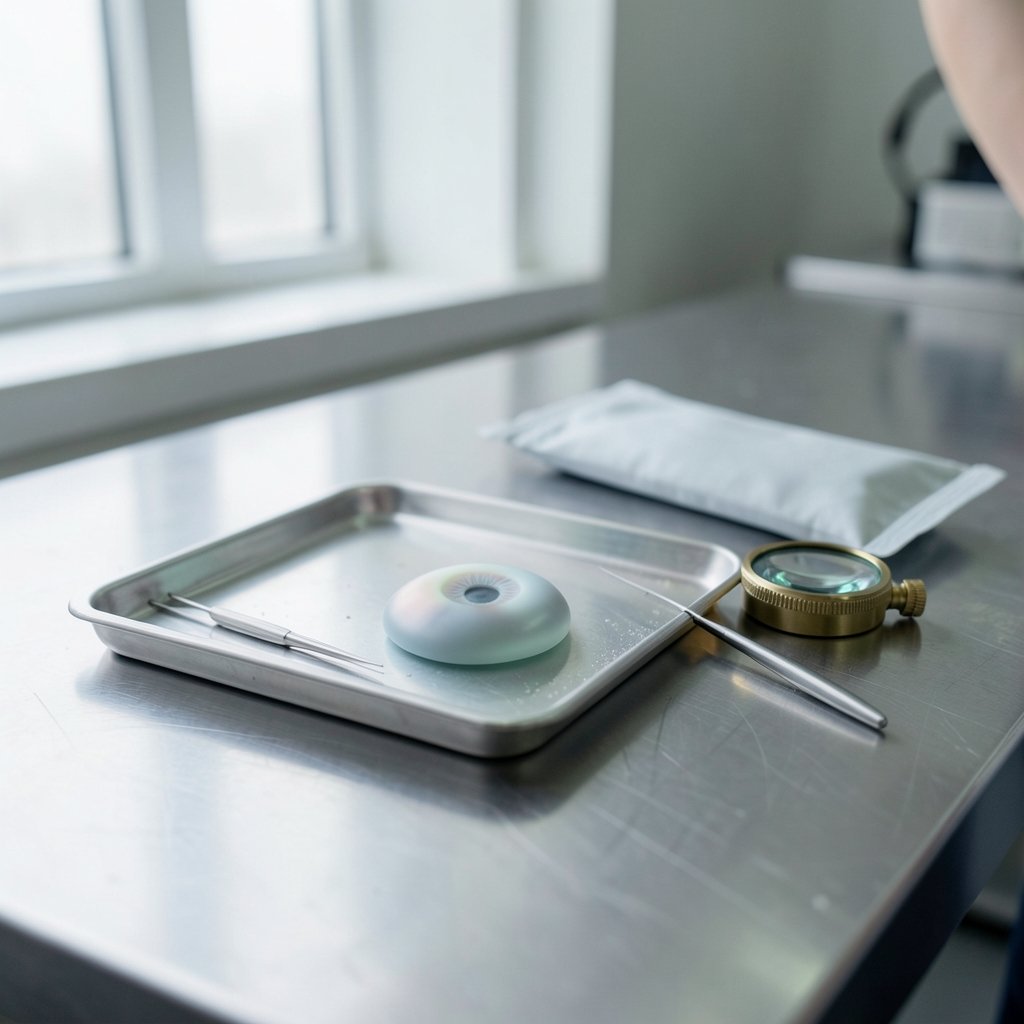
Four broad categories exist. They are not equally safe, and they are not equally real.
| Approach | What It Does | Regulatory Status | Main Concerns |
|---|---|---|---|
| Cosmetic iris implants | Silicone implant placed over the natural iris | Not FDA-approved | Glaucoma, uveitis, corneal damage, implant removal |
| Laser depigmentation | Laser energy reduces iris melanin | Not FDA-approved; safety unproven | No long-term controlled safety data |
| Iris or corneal tattooing | Pigment injected into eye tissue | Not approved for cosmetic color change | Infection, corneal damage, limited evidence |
| Prosthetic iris (medical) | Rebuilds iris after trauma or aniridia | Regulated as a medical device | Intended for reconstruction, not cosmetics |
The fourth row matters because it gets confused with the first. Prosthetic iris devices are legitimate medical tools used when someone loses iris tissue to injury or disease. They are not a cosmetic service, and the surgeons who place them are usually the loudest voices warning against the cosmetic versions.
Cosmetic Iris Implants: The Cautionary Tale
Around 2006, a silicone implant marketed under the name NewColorIris began being offered to people who wanted permanent color change. The implant sat in the anterior chamber of the eye, in front of the natural iris. It spread through medical tourism channels and social media before the complications piled up.
The documented harms are serious and well described in published case series from roughly 2011 to 2016. They include glaucoma, uveitis (inflammation inside the eye), loss of corneal endothelial cells, and corneal edema. The endothelium is a single layer of cells that keeps the cornea clear, and it does not regenerate. Once those cells are gone, they’re gone. Some patients needed the implant removed; others needed a corneal transplant.
Professional ophthalmology bodies issued public warnings against cosmetic iris implants, and regulators in multiple countries moved to restrict them. The pattern is familiar: a procedure spreads faster than the safety data, then the harm reports arrive years later.
Why the Damage Happens
The eye’s front chamber is a tightly balanced space. Fluid flows through it to maintain pressure. An implant sitting there blocks that drainage path, which raises pressure and damages the optic nerve, the definition of glaucoma. The implant also rubs against the iris and the back of the cornea with every blink. That mechanical friction, plus the inflammatory response to a foreign body, is what drives the cell loss.
Laser Depigmentation: Promising Pitch, Thin Evidence
The laser approach, publicized since around 2011 and associated with a company called Stroma Medical under the name Brightocular, works on a different principle. Instead of adding material, a laser aims to break down melanin in the iris so the eye appears lighter.
On paper, that’s elegant. In practice, the evidence base is thin. There are no peer-reviewed controlled trials demonstrating long-term safety and effectiveness. The procedure is not FDA-approved. The eye is an immunologically privileged but delicate organ, and releasing pigment particles inside it raises real questions about inflammation, pressure spikes, and long-term pigment deposition. Promotional claims of a “safe” laser color change should be read as marketing until independent data say otherwise.
A useful rule of thumb: when a procedure’s safety record rests on the clinic selling it, wait. Ophthalmology has seen this movie before with refractive surgery and with implants, and the honest answer is always the same. Time and independent follow-up are the only real proof.
Tattooing the Eye: Older, Not Safer
Iris and corneal tattooing is an older technique, sometimes used for reconstructive reasons, for example to reduce light sensitivity in an eye that has lost iris tissue. As a cosmetic color-change method, the evidence base is limited and the risk list is not short: infection, corneal scarring, and damage to the delicate tissue of the eye.
If you’re the kind of person who researches before committing, apply the same discipline here that you’d use before a bigger life change. The same careful reading applies when you change default apps on Android without breaking your phone or check how to change a tire safely, step by step before a road trip. Small irreversible decisions deserve the same skepticism as big ones. Eyes just happen to be less replaceable than a phone.
What the Regulators Actually Say
The FDA regulates medical devices, and no surgical procedure or implant intended purely to cosmetically change iris color has been approved. That’s the key sentence. It doesn’t mean the FDA has banned everything; it means nothing in this category has cleared the bar.
Regulation also varies by country. Some jurisdictions have restricted or banned cosmetic iris implants, though the specifics differ and are worth checking against a primary government source rather than a forum post. Medical tourism complicates all of this, because a procedure that’s restricted at home may still be offered abroad with no follow-up care arranged.
The Risks in Plain Terms
If you’re weighing any of this, here’s what you’re actually accepting:
- Irreversibility. Removing an implant is itself a major operation, and corneal damage may not be fixable without a transplant.
- Glaucoma risk. Raised pressure inside the eye can silently damage the optic nerve before you notice vision loss.
- Inflammation. Chronic uveitis is painful and can lead to cataracts and other complications.
- No safety net. If something goes wrong abroad, your local ophthalmologist inherits a problem they didn’t create and may not be able to fully fix.
- Unproven claims. Long-term outcome data simply don’t exist for the cosmetic laser approach.
Safer Ways to Change How Your Eyes Look
If the goal is a different look rather than a permanent anatomical change, the options are unglamorous but genuinely safe. Colored contact lenses are the obvious one, and they’re regulated as medical devices in the US, which means quality standards apply. Get a proper fitting from an eye care professional; ill-fitting lenses cause corneal problems of their own.
Cosmetic tricks work too. Clothing and makeup shades shift how eye color reads, and lighting changes everything. Warm bulbs flatter amber and hazel tones while cooler light brings out gray and blue. If you’ve ever wondered why your eyes look different in a bedroom versus a kitchen, that’s the same principle behind choosing the right smart bulb color temperature for bedrooms. It’s not a permanent fix, but it’s free and reversible.
What to Ask If You’re Still Considering Surgery
Anyone who walks into a consultation should arrive with questions and leave with documents.
- Is this procedure approved by a national regulator for cosmetic use? Ask for the specific approval, not a general claim.
- How many of these have you performed, and what is your complication rate? A surgeon who can’t answer precisely is telling you something.
- What is the removal plan if something goes wrong, and who performs it?
- Will you provide published, peer-reviewed outcome data?
- Who handles follow-up care, and for how long?
If the answers are vague, promotional, or pushed toward a deposit, that’s your answer. The same instinct that helps you spot a bad deal elsewhere applies here. Plenty of people learn to read fine print on things like whether Color Wow Money Mist does what it claims and who it suits; eye surgery deserves at least that level of scrutiny.
Conclusion
Eye surgery to change eye color exists, but not in a form anyone should feel confident about. Cosmetic iris implants have a documented trail of glaucoma, inflammation, and corneal damage. Laser depigmentation is unproven and unapproved. Tattooing carries infection and scarring risks with a thin evidence base. The only well-established iris surgery is reconstructive, for people who have lost iris tissue to injury or disease.
The honest takeaway is that eye color is one of those things where the safe options are temporary and the permanent options are risky. Colored lenses, lighting, and makeup can change your look in an afternoon with essentially no downside. Surgery can change it permanently, with a downside that may not show up for years. Given that choice, patience is not a compromise. It’s the smart play.
Frequently Asked Questions
Is there an FDA-approved surgery to change eye color?
No. No surgical procedure or implant intended purely to cosmetically change iris color has been approved by the FDA. Prosthetic iris devices exist, but they’re regulated for medical reconstruction after trauma or in conditions like aniridia, not for cosmetic color change.
Can laser surgery safely turn brown eyes blue?
That claim is unproven. Laser depigmentation has been publicized since around 2011, but there are no peer-reviewed controlled trials showing long-term safety and effectiveness, and it is not FDA-approved. Treat confident marketing claims as promotional until independent data exist.
What went wrong with cosmetic iris implants?
A lot. Published case series from roughly 2011 to 2016 documented glaucoma, uveitis, corneal endothelial cell loss, and corneal edema in patients who received implants like NewColorIris. Some needed the implant removed; others needed a corneal transplant. Professional ophthalmology bodies issued warnings against the practice.
Why is melanin the key to eye color?
Melanin is the only pigment that meaningfully determines iris color. More melanin produces brown eyes; less produces blue or green, with the blue appearance coming from light scattering rather than blue pigment itself. Any color-changing procedure has to either reduce melanin, cover the iris, or add pigment.
Are colored contact lenses a safe alternative?
Yes, when fitted properly. Colored lenses are regulated as medical devices in the US, which means quality standards apply. Get a professional fitting, because poorly fitting lenses can damage the cornea. They’re temporary and reversible, which is the main advantage over any surgical option.
What should someone ask before considering eye color surgery?
Ask whether the procedure is approved by a national regulator for cosmetic use, request the surgeon’s specific complication rate, ask who handles implant removal if something goes wrong, and demand published peer-reviewed outcome data. Vague answers or pressure to pay a deposit are red flags worth taking seriously.



