
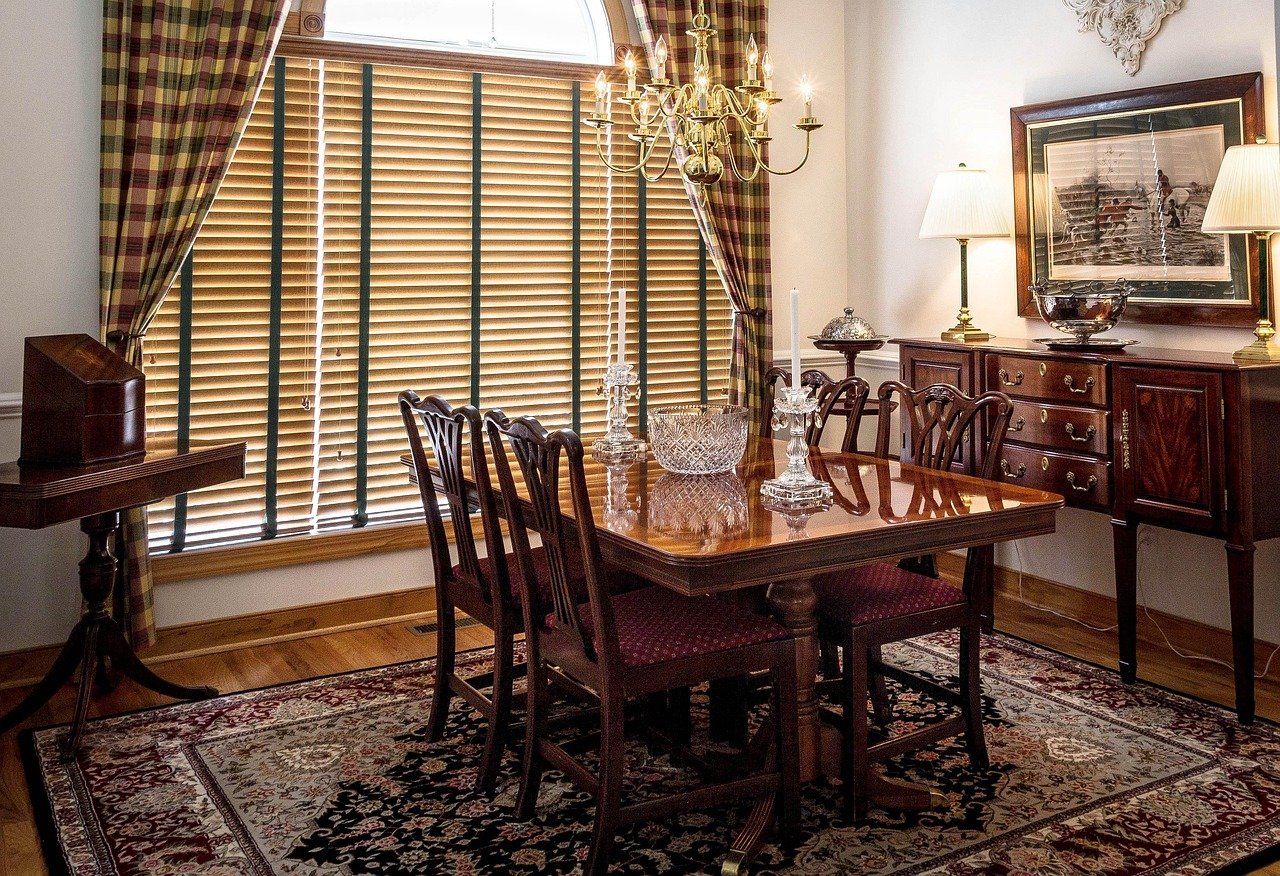
What is the one thing most people get wrong about a dining room rug? It is almost never the color. It is the size. A rug that looks generous in the showroom can turn out to be a postage stamp once a table and four chairs sit on it, and a rug that is too plush can turn every dinner into a wrestling match with chair legs.
This guide walks through the decisions that actually matter: how big the rug needs to be, which pile heights survive daily chair traffic, which fibers hold up, and how to keep the whole thing from sliding, curling, or becoming a trip hazard. It also covers the mistakes that show up again and again in real dining rooms, plus a few practical fixes that cost little and solve a lot.
Start With Size, Because Size Decides Everything Else
The single most repeated piece of design guidance is this: a dining rug should extend roughly 24 inches (about 60 cm) beyond the table edge on all sides. That margin is what keeps chair legs on the rug when someone pushes back to stand up. Chairs that drop half on and half off the edge are the classic cause of wobbling, tipping, and rucked-up rug corners.
A second common rule of thumb says the rug should be at least 2 feet wider and longer than the table. Both figures are conventions passed down through design practice rather than formal standards, and different designers will give you slightly different numbers. Treat them as starting points, not code requirements.
Here is what those rules look like in practice for common table shapes:
| Table size | Minimum rug (24-inch margin) | Comfortable rug |
|---|---|---|
| 36-inch round (seats 4) | 84-inch round (7 ft) | 96-inch round (8 ft) |
| 48-inch round (seats 4–6) | 96-inch round (8 ft) | 108-inch round (9 ft) |
| 60 x 36 inch rectangle (seats 6) | 108 x 84 inch | 120 x 96 inch |
| 72 x 40 inch rectangle (seats 6–8) | 120 x 88 inch | 132 x 96 inch |
| 84 x 42 inch rectangle (seats 8) | 132 x 90 inch | 144 x 108 inch |
Measure your actual table before shopping, including any leaf you use for holidays. If the table extends twice a year, size the rug for the extended version or accept that chairs will hang off the edge during big dinners.
When the room is too small for the “right” rug
Small dining rooms are where the 24-inch rule breaks down. If a correctly sized rug would touch the baseboards on every side, you have three options: choose a round or square rug that fits the room’s proportions, use a flatweave that reads as part of the floor rather than a separate island, or skip the rug entirely and let the table sit on hard flooring. A rug that crowds the walls looks worse than no rug at all.
Pile Height: The Decision That Determines Daily Frustration
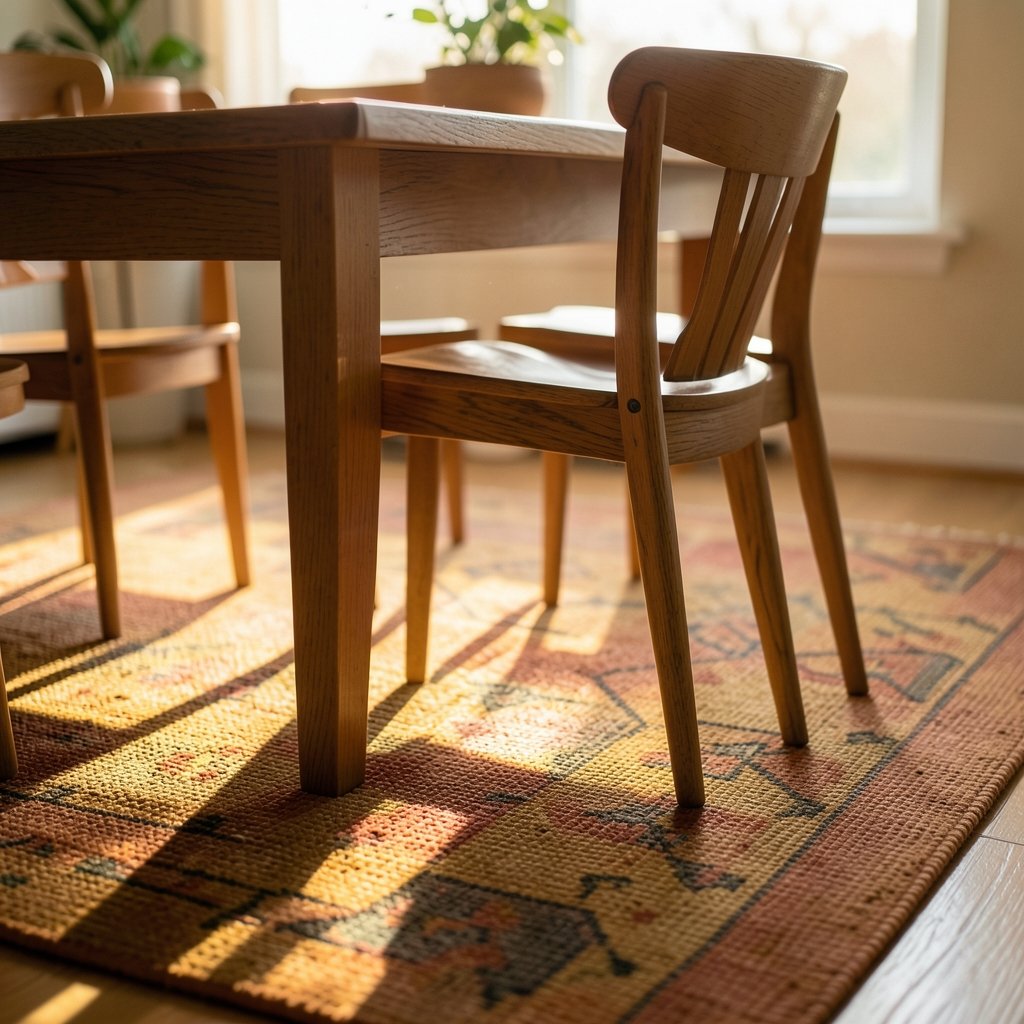
Low-pile and flatweave rugs are the standard recommendation under dining tables, and for good reason. Chair legs sink into a thick pile, catch on the fibers, and either tip or grind the rug into a mess. High-pile rugs also trap crumbs, hold onto spills, and make it nearly impossible to slide a chair in smoothly.
Flatweave constructions, including kilims and dhurries, sit almost flush with the floor. Short-pile wool and synthetic rugs offer a little softness without the sinking problem. Anything described as “shag,” “plush,” or “deep pile” belongs in a bedroom or living room, not under a table where people push chairs back and forth several times a day.
If you love the look of a thicker rug, consider a low-pile rug with a dense, tightly woven backing. Density matters more than height. A tightly packed short pile feels substantial underfoot while still letting chairs glide.
Material Matters More Than Color
Wool is the most commonly recommended fiber for dining rooms. It is resilient, resists soil reasonably well, and ages gracefully rather than matting flat. It also costs more, which is why synthetic blends are so common.
| Fiber | Strengths | Weaknesses |
|---|---|---|
| Wool | Durable, resilient, naturally soil-resistant, repairable | Higher cost, can shed at first, needs careful cleaning |
| Polypropylene | Cheap, stain-resistant, colorfast, easy to clean | Can crush over time, less luxurious underfoot |
| Nylon | Strong, resilient, holds color well | Often looks synthetic, can pill |
| Cotton flatweave | Lightweight, washable in some cases, affordable | Less durable, wrinkles, limited stain protection |
| Jute or sisal | Textured, natural look, very low pile | Stains easily, rough underfoot, not soft |
For a family dining room with young children, a washable synthetic or a wool rug with a stain-protective finish is the practical pick. For a formal room used a few times a month, wool is worth the investment because it holds up for decades. (Switch 2 vs switch oled room lighting changes viewing)
One more consideration: color hides more than pattern. Mid-tone rugs with a subtle pattern hide crumbs and drips far better than pale solids or busy florals. A dark rug shows every light-colored crumb; a very light rug shows every drop of red wine.
The Underlay Question: Pads, Slip, and Safety
A rug pad or underlay is not optional under a dining table. It prevents the rug from sliding when chairs are pushed back, adds cushioning, and extends the rug’s life by absorbing foot traffic and chair-leg pressure. A thin, dense pad works better under a dining table than a thick, spongy one, which can make chairs unstable.
Safety deserves a mention here. Thick rugs with curled edges and loose corners are a recognized trip hazard, and the principle behind accessibility standards for floor surfaces and changes in level applies just as well at home: transitions should be flat and secure. In the United States, the Consumer Product Safety Commission regulates carpet and rug flammability through standards including 16 CFR Part 1630 for carpets and rugs and Part 1631 for small carpets and rugs. Those rules address fire safety, not slipping, so a pad remains the answer for stability.
If your dining room sits next to a hard floor, consider how lighting changes the way the rug and floor read together. The way a room’s lighting shifts perception of surfaces is the same principle that governs how a screen looks in different conditions: the surface you choose looks different under different light. A rug that looks warm and muted in a shop’s fluorescent light can look entirely different in a dining room with a warm pendant overhead. Take a sample home, or at minimum check the return policy.
Placement Rules That Actually Hold Up
A few placement habits separate rugs that look intentional from rugs that look like afterthoughts.
- Center the rug on the table, not the room. The table is the anchor. If the room is asymmetric, let the rug follow the table.
- Keep all chair legs on the rug in both the tucked-in and pulled-out positions. Test this with a real chair before committing.
- Leave breathing room at the walls. A small gap of visible floor around the rug makes the room feel larger, not smaller.
- Align rectangular rugs with the room’s main lines. A rug set at a slight angle to the walls reads as a mistake, not a design choice.
- Use a round rug under a round table. A round rug under a rectangular table can work, but the reverse rarely does.
If you are still deciding on the room’s overall look, tools that generate layout and furnishing ideas can help you visualize proportions before you buy. An AI-assisted layout tool is useful for testing rug scale against table size, though it will not tell you how a wool rug feels underfoot.
Common Mistakes and How to Avoid Them
Buying before measuring the extended table. Holiday leaves add 12 to 24 inches. Measure with the leaf in.
Choosing a rug that only fits the chairs when tucked in. Pull a chair out as if you are sitting down, then check the back legs.
Ignoring the doorway swing. A rug that catches the door is a daily annoyance and a wear point.
Skipping the pad to save money. A $40 pad protects a $600 rug and prevents the sliding that ruins chair legs and floors alike.
Putting a high-pile rug under a pedestal table. Pedestal bases concentrate weight on a small area and can dent thick pile permanently.
Forgetting the cleaning plan. Wool rugs generally benefit from professional cleaning every 12 to 18 months, though recommendations vary widely by use and source. Vacuum weekly, blot spills immediately, and avoid harsh detergents that strip natural lanolin.
There is also a maintenance angle many people overlook: rugs and hard floors collect the same debris, and the tools you use on one affect the other. If your dining room opens onto a rug with a deep pile elsewhere in the house, it is worth confirming which cleaning equipment can handle every surface before you assume one machine does it all.
Rugs, Screens, and the Rooms We Actually Live In
Dining rooms increasingly double as homework stations, game rooms, and second living spaces. That overlap matters more than it used to, because the same principles of surface, light, and viewing comfort show up in both contexts. If a dining room also hosts a portable console or a small screen, the way ambient light interacts with a display follows the same logic as the way it interacts with a rug: the surface and the light have to be chosen together. Readers weighing portable options may find comparisons of portable gaming monitor setups useful for understanding how a room’s light changes what a screen looks like, much as a pendant light changes how a rug’s color reads.
The point is not to turn the dining room into a media room. It is that a single room often serves several purposes, and the rug has to survive all of them. A low-pile, mid-tone wool rug handles dinner, homework, and a board game night without complaint. A pale shag rug handles none of them well. (Ai interior design generator for room ideas)
How to Shop Without Regret
Order a swatch or a small sample first. Put it on the floor, look at it in morning light and evening light, and spill a little water on it to see how it behaves. Check the return policy before you buy, because rug shipping is expensive and returns are often restricted.
Set a budget that includes the pad and a first professional cleaning. Compare prices per square foot rather than per rug, since a “cheap” 5 x 8 and a “pricey” 9 x 12 are not the same purchase. And confirm the construction: hand-knotted, hand-tufted, and flatweave rugs have very different durability and cost profiles, and the terms are used loosely by sellers.
Finally, do not overlook the room’s proportions. A rug that is technically large enough but proportionally wrong for a long, narrow room will still look off. Sometimes the answer is a runner alongside the table rather than a single large rug, particularly in galley-shaped dining spaces.
Conclusion
The right dining room rug comes down to a short list of decisions made in the right order: measure the table with its leaf, add 24 inches on every side, choose a low pile, pick a fiber that matches how the room is actually used, and put a dense pad underneath. Get those right and color becomes a pleasure rather than a gamble. Get them wrong and no pattern will save the room.
Start with the tape measure. Everything else follows.
FAQ
What size rug do I need for a dining table that seats six?
For a standard 60 x 36 inch table, look for at least 108 x 84 inches. That gives roughly 24 inches of rug beyond each edge, which keeps chairs on the rug when pulled out. If your table extends, measure it extended and size for that.
Is a high-pile rug ever okay under a dining table?
Rarely. Thick pile makes chair legs catch, tip, and grind, and it traps crumbs and spills. A dense low-pile or flatweave rug gives a similar look with far fewer daily problems. Save the plush rug for a bedroom.
Which material holds up best in a dining room?
Wool is the most commonly recommended fiber because it is resilient and resists soil. Synthetic options like polypropylene and nylon are cheaper and more stain-resistant but can crush over time. For heavy family use, a wool rug with a stain finish or a washable synthetic both work well.
Do I really need a rug pad under a dining rug?
Yes. A thin, dense pad stops the rug from sliding when chairs are pushed back, protects the floor, and extends the rug’s life. Skip the thick spongy type, which makes chairs unstable.
How often should a dining room rug be cleaned?
Vacuum weekly and blot spills immediately. Professional cleaning is commonly recommended every 12 to 18 months, though the right interval depends on traffic, pets, and whether the room is used daily or only occasionally.
Can a round rug work under a rectangular table?
It can, but the fit is less forgiving. A round rug needs to be large enough that all four corners of the table sit comfortably inside it with margin to spare. Under a rectangular table, a rectangular rug is usually the safer choice.



