
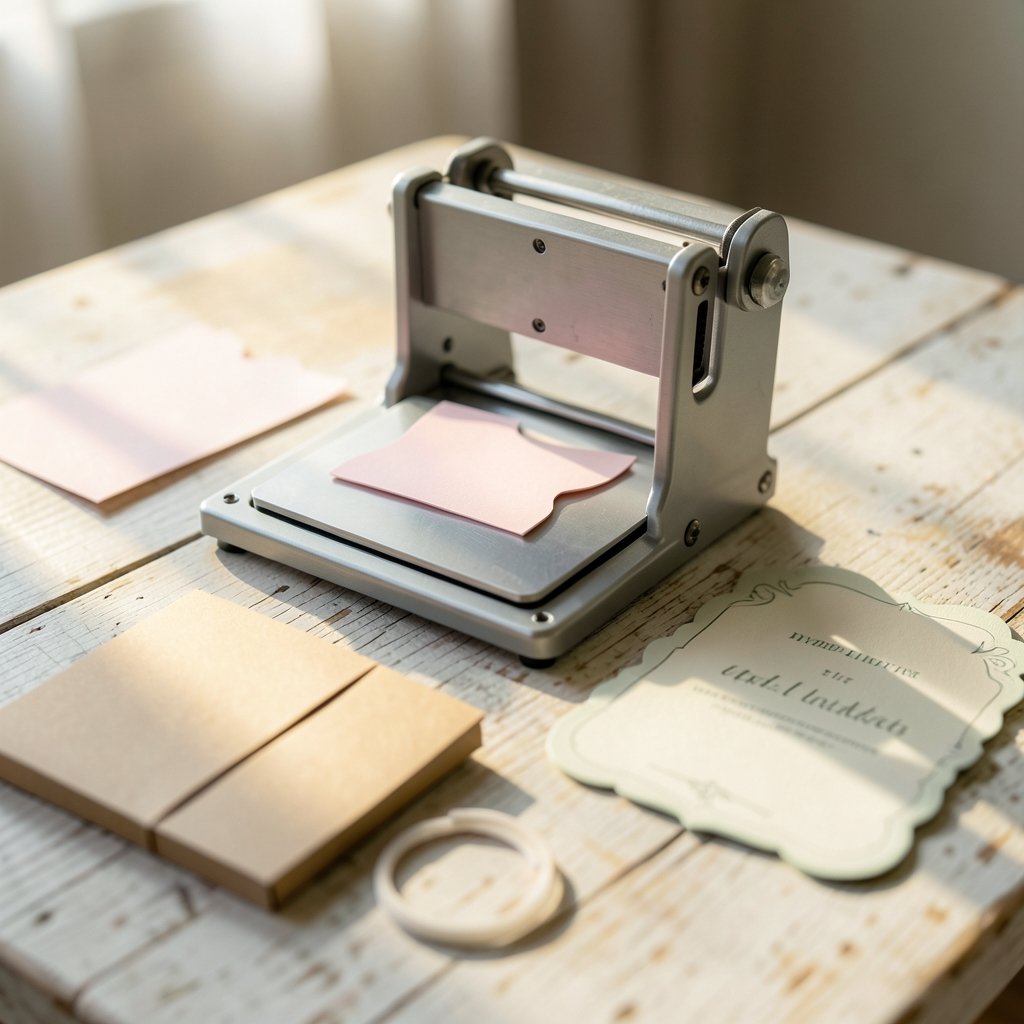
What do a cereal box, a phone screen protector, a wedding invitation, and a car door gasket have in common? All four were almost certainly shaped by a die cutting machine. The same basic idea, pressing a sharpened steel shape through a flat material, works at wildly different scales. That is why the term covers everything from a $60,000 industrial press to a $150 desktop crank tool that lives on a craft shelf.
This guide sorts out the categories, the economics, the safety rules, and the buying mistakes that catch people out. It is written for the person who has heard the term and needs to know whether it applies to their project, their factory, or their weekend hobby.
What a die cutting machine actually does
A die cutting machine presses a shaped cutting die into sheet material to cut, crease, or perforate it in a single pass. The die is the tool: a sharpened edge formed into the shape you want. The machine is just the press that drives it down with enough force to shear the material cleanly.
That is the whole principle. The variation comes from how the die is built, how the press is configured, and what gets fed through it.
In packaging, the dominant die type is the steel-rule die. This is a strip of steel bent into the desired outline and set into a plywood or laser-cut board. The same die can carry cutting rules and creasing rules at once, which is why a folding carton comes off the press already scored for folding. It is the standard method for folding-carton and corrugated-box production, and it has been for decades.
Flatbed, rotary, and desktop: the three families
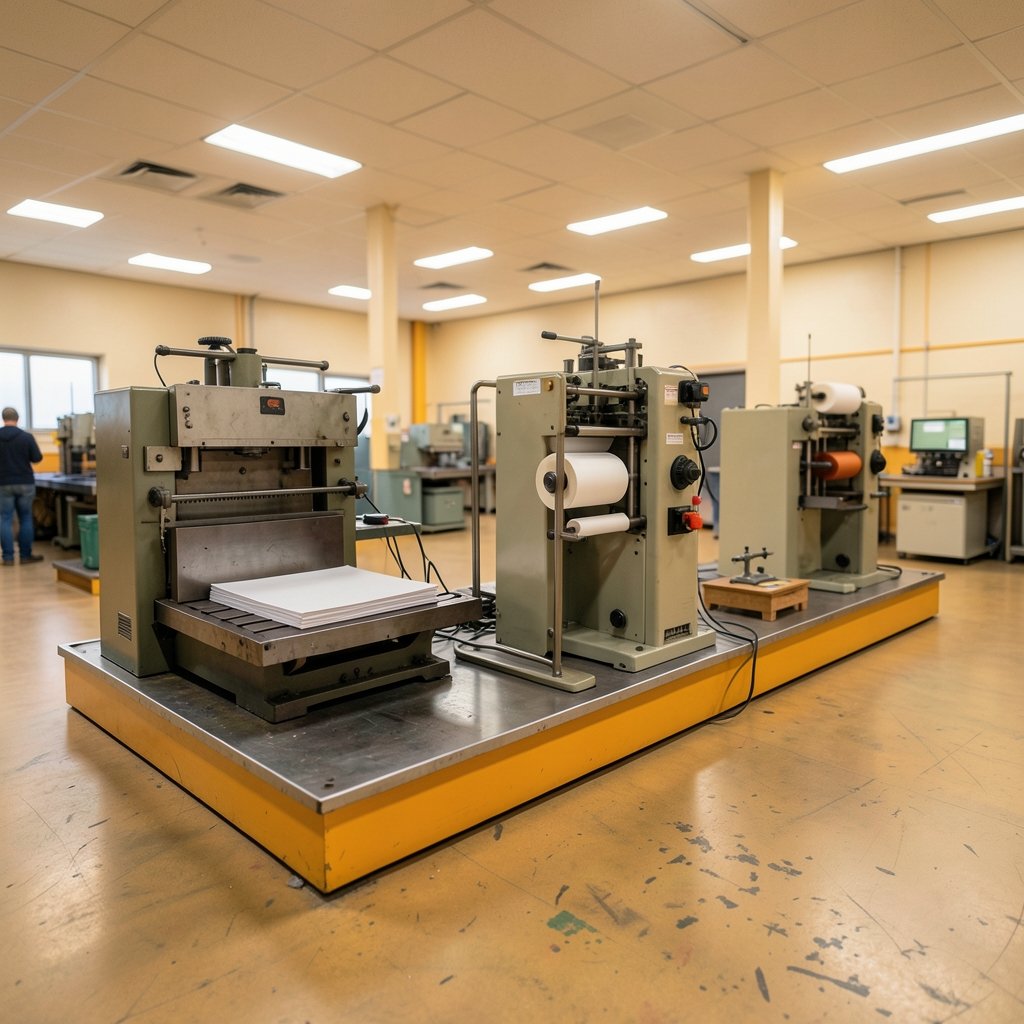
Buyers get confused because the market uses one name for three very different machines. Here is the practical split.
| Type | How it works | Typical use | Run length |
|---|---|---|---|
| Flatbed (platen or cylinder) | Sheet fed; die presses down or rolls across a flat sheet | Folding cartons, display pieces, gaskets, foam | Medium to long |
| Rotary | Web fed; die mounted on a rotating cylinder | Labels, flexible packaging, corrugated | Long, continuous |
| Desktop craft | Manual crank press or electronic cutter | Paper, cardstock, vinyl, thin leather | Short, one-off |
Rotary die cutting is common in label and flexible-packaging lines because the material arrives on a roll and never stops moving. Flatbed work suits sheet stock and heavier substrates where registration matters more than speed. Desktop machines share the name but share almost nothing else with the industrial versions, and a buyer who conflates them will end up with the wrong tool.
Digital die cutting changed the short-run math
Traditional die cutting carries a high fixed cost: someone has to make the die. That cost is trivial across a million units and painful across fifty. This is the core economic fact of the industry. Die cutting dominates long-run packaging because the per-unit cost collapses at volume, and it is a poor fit for very short runs.
Digital die cutting, also called plotter cutting, sidesteps the tooling entirely. An electronic cutter uses a blade or laser guided by vector files such as SVG or DXF rather than a physical die. No die means no tooling cost, which makes short runs and one-offs viable. The trade-off is speed and per-unit cost at scale, where a physical die still wins comfortably.
The practical rule most shops follow: prototype and sample digitally, then commit to a steel-rule die once the design is locked and the volume justifies it. Skipping the digital proof stage is one of the most common and expensive mistakes in packaging development, because a die is unforgiving once it is cut.
Matching the die and press to the material
Substrate choice drives everything downstream. Common materials include paper, paperboard, corrugated board, plastics, foils, rubber, and some textiles. Each one demands a die and press matched to its thickness and hardness.
A few practical notes that experienced operators raise again and again:
- Thin paper needs a sharp, fresh rule and precise pressure. Too much force and the sheet tears instead of cutting.
- Corrugated board needs a die built around the flutes. Crushing the board is the usual failure mode, and it shows up as weak box corners weeks later.
- Foam and rubber need compression tolerance built into the die, because the material springs back.
- Adhesive-backed vinyl needs a clean cut that does not sever the backing liner. This is where desktop cutters earn their keep and where cheap blades fail.
The die and the material are a pair. Buying a machine first and figuring out substrates later is backwards, and it is the single most common ordering mistake in small-shop purchasing.
Desktop machines: what they will and will not do
Consumer die cutting machines cut paper, cardstock, and vinyl using steel dies or digital blade heads. They are genuinely capable within their limits, and genuinely frustrating outside them.
What actually works in practice:
- Start with the material, not the machine. Decide whether you are cutting paper, vinyl, or fabric, then buy for that. A machine that excels at cardstock may struggle with fabric.
- Budget for dies and blades as consumables. The machine is the cheap part. A manual press needs a die for every shape, and electronic cutters dull blades steadily.
- Test the cut depth on scrap before committing. Every new material needs a test pass. Skipping this ruins stock.
- Check the software path early. Electronic cutters depend on vector files. If the design workflow is not sorted, the machine sits idle.
What these machines will not do is replace an industrial press. They cannot handle corrugated board at production thickness, they cannot hold registration across thousands of sheets, and their throughput is measured in minutes per piece rather than pieces per minute.
If the project is closer to a hobby than a production line, the buying logic resembles other small-machine purchases where the accessories quietly cost more than the device itself. The same trap shows up in coffee gear, where the best espresso machine for home is rarely the whole budget once the grinder and baskets are counted, and in capsule systems, where picking the best nespresso machine means pricing pods forever after. Die cutting is no different: the die library is the real commitment.
Safety and the rules that apply
Industrial die-cutting presses are machinery, and machinery carries legal obligations. In the EU, these presses fall under the Machinery Regulation (EU) 2023/1230, which applies from 20 January 2027 and replaces the older Machinery Directive. Harmonized standards sit underneath it, including EN ISO 12100 for risk assessment and the EN 1010 series covering the safety of printing and paper-converting machinery.
In the United States, mechanical power presses are regulated under OSHA 29 CFR 1910.217. Whether a given die-cutting press falls under that section depends on the machine type, so the specific press needs checking rather than assuming.
The practical safety points that matter on any shop floor:
- Two-hand controls and light curtains exist because hands near a closing die lose fingers. Never bypass them.
- Lockout during die changes is non-negotiable. Die changes are the highest-risk moment in the process.
- Nip points on rotary lines are the second major hazard. Guarding is the control.
- Noise and dust are chronic rather than acute risks, and both are routinely underestimated.
Small desktop machines are far safer, but blades are still blades. A dull blade needs more force, and more force means more slips.
Where die cutting fits and where it doesn’t
Die cutting is not always the right answer, and honest suppliers will say so.
It fits well when the shape is fixed, the volume is meaningful, and the material is flat and consistent. Folding cartons, labels, gaskets, foam inserts, display pieces, and envelope shapes all suit it. It also suits creasing and perforating, which is why the same machine often does three jobs in one pass.
It fits badly when the design is still changing, when the run is tiny, or when the material is thick and variable. In those cases, digital cutting, laser cutting, or rotary trimming usually wins. The money counting machine buyers get wrong before they spend article makes a similar point about a different machine category: the purchase decision usually fails on workflow fit, not on the spec sheet.
The same pattern shows up across consumer hardware, where buyers get stuck comparing labels instead of use cases. Anyone weighing a steam machine verified vs steam deck checking compatibility comparison runs into exactly this, and the steam machine release date 2026 question is really a question about timing rather than hardware. Even cloud infrastructure follows the logic, as the Azure virtual machine costs small projects businesses breakdown shows: the headline price is never the whole story. Die cutting rewards the buyer who prices the whole workflow.
How to choose a machine without regret
A short sequence that saves money:
- Define the substrate first. Thickness and hardness decide the machine class.
- Estimate realistic annual volume. Under a few hundred units, digital usually wins. Over tens of thousands, a die pays for itself fast.
- Count the shapes. Each distinct shape is a die. A ten-shape product line means ten tools.
- Ask about die lead time. It is often the real bottleneck, not the press.
- Confirm the safety regime. For industrial equipment, ask for the risk assessment and the declared standards.
- Check service and spare parts. A press down for a week costs more than the price difference between two vendors.
The most common mistake is buying for the volume you hope for rather than the volume you have. The second most common is forgetting that dies, blades, and maintenance are ongoing costs, not one-time ones. A small shop that buys a press sized for a factory will watch it sit idle, and an idle press is the most expensive machine in the building.
Conclusion
Die cutting is one idea with an enormous range. A steel rule bent into shape, pressed into flat material, does the same job whether it is making a million cereal boxes or one wedding invitation. What changes is the press, the tooling cost, and the volume at which the whole thing makes sense.
The buyers who do well are the ones who start from the material and the volume, not the machine. They price the dies and the blades alongside the press. They prototype digitally before committing to steel. And they treat safety rules as part of the purchase rather than an afterthought. Get those four things right, and the machine choice mostly makes itself.
FAQ
What is the difference between die cutting and digital cutting?
Die cutting uses a physical shaped die pressed into the material, which carries a one-time tooling cost but a very low per-unit cost at volume. Digital cutting uses a blade or laser guided by vector files, so there is no tooling cost and short runs become viable. Digital is slower per unit and usually more expensive at high volume.
Can a desktop die cutting machine cut corrugated cardboard?
Most cannot handle production-thickness corrugated board. Desktop machines are built for paper, cardstock, vinyl, and thin leather. Some heavier manual presses manage thin corrugated sheet, but crushing the flutes is a common problem, and results are inconsistent compared with an industrial flatbed press.
How much does a die cost?
It depends on size, complexity, and whether it needs creasing rules. Simple shapes in small formats are inexpensive; large multi-rule dies for folding cartons cost considerably more. The die is a fixed cost per shape, which is why short runs are uneconomical and why ten product shapes means ten tools.
What materials can be die cut?
Paper, paperboard, corrugated board, plastics, foils, rubber, and some textiles are all commonly die cut. The die and press must be matched to the substrate’s thickness and hardness. Adhesive-backed materials need a cut that severs the face without cutting through the backing liner.
Is die cutting safe?
Industrial die-cutting presses are regulated machinery with real hazards, particularly at die changes and at rotary nip points. Guarding, two-hand controls, light curtains, and lockout procedures are standard controls. Desktop craft machines carry far lower risk, though blades still require care and dull blades increase slip risk.
What safety standards apply to die cutting machines?
In the EU, the Machinery Regulation (EU) 2023/1230 applies from 20 January 2027, supported by harmonized standards including EN ISO 12100 for risk assessment and the EN 1010 series for printing and paper-converting machinery. In the US, mechanical power presses fall under OSHA 29 CFR 1910.217, though applicability depends on the specific machine type.



