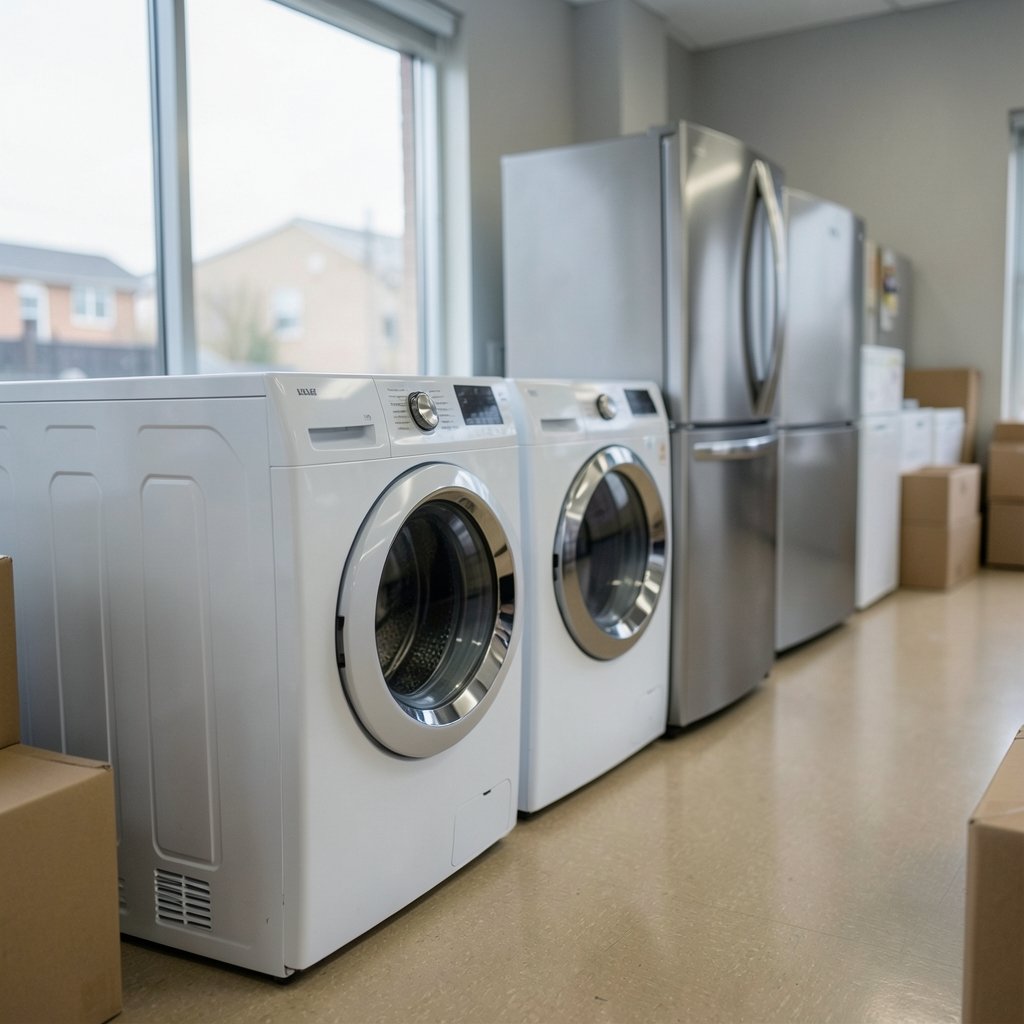
Why is it that two washing machines with the same drum size, the same spin speed, and the same price tag can feel like completely different products five years down the line? The answer usually comes down to the brand behind the badge. Popular appliance brands are not just marketing machines. They shape how a fridge runs in a heatwave, how easy it is to find a replacement filter, and whether a repair technician will look at your model and sigh or nod approvingly.
This guide looks at the appliance brands people actually buy, what separates them in practice, and the mistakes shoppers make when they assume a famous name guarantees a problem-free kitchen. It is written for anyone standing in an appliance showroom, or scrolling one at midnight, trying to work out which brand deserves their money.
What Makes an Appliance Brand Popular?
Popularity in appliances is not one thing. It gets measured in at least three ways, and they often disagree.
Retail sales share shows what people buy in volume. Consumer surveys show what owners think after living with a product for a few years. Ownership concentration shows who actually controls the brand name, which is often a multinational rather than the family firm on the logo.
That last point surprises people. Many familiar appliance names are owned by a small number of large corporations. Whirlpool Corporation has owned Maytag since 2006, and the AEG appliance business has sat under Electrolux since the 1990s. So when a shopper compares a Maytag washer with a Whirlpool one, they may be comparing two arms of the same company. That does not make the products identical, but it does explain why service networks, parts supply, and even design language sometimes overlap.
The practical takeaway: treat “popular” as a starting point, not a verdict. A brand can be the biggest seller in a country and still produce a model that frustrates its owner. Model-level research beats brand-level loyalty almost every time.
The Big Global Names and What They Are Known For
Most popular appliance brands fall into a few loose camps. The categories below reflect general reputation rather than a ranking, because rankings shift by country and by product type.
| Brand type | Typical strengths | Watch-outs |
|---|---|---|
| Mass-market multinationals | Wide service networks, plentiful parts, frequent discounts | Feature lists can outrun build quality at the low end |
| Premium European names | Quiet operation, refined controls, strong design | Expensive spares, longer repair waits |
| Asian electronics giants | Smart features, value pricing, fast model turnover | Support quality varies a lot by region |
| Specialist and heritage brands | Deep expertise in one category | Narrow ranges, higher entry prices |
Mass-market brands win on availability. If a door seal fails, the part is usually in stock somewhere nearby. Premium European brands tend to win on refinement, with quieter motors and better insulation, but a replacement control board can cost a serious fraction of the original purchase price. Asian electronics giants often lead on connected features, though their appliance support can lag behind their phone support. Heritage specialists, the ones that have made one type of product for decades, tend to be excellent at that one thing and thin everywhere else.
A useful habit: before committing to any brand, check how many authorized repairers operate within a reasonable distance. A superb machine with no local technician is a future headache.
Where the Brand Matters Most, and Where It Barely Matters
Brand reputation carries different weight across product categories. Some appliances are engineering problems; others are mostly logistics.
Refrigerators and washing machines are where brand matters most. These are complex, repair-prone, and expensive to replace. Compressor quality, drum suspension, and control board reliability genuinely differ between manufacturers, and parts availability years down the line depends heavily on the brand’s distribution network.
Dishwashers sit in the middle. Build quality matters, but installation and water hardness often determine satisfaction more than the badge on the door.
Microwaves, kettles, and small countertop appliances are where brand matters least. Many are made in the same contract factories regardless of the logo. Paying a premium for a famous name on a kettle rarely buys better boiling.
Range hoods and built-in ovens reward attention to specification over reputation. Airflow ratings, noise levels, and cavity size tell you more than the brand story.
The pattern is simple. The more complex and expensive the repair, the more the brand’s service network and parts pipeline matter. For cheap, replaceable items, buy on price and features.
Energy Labels, Recalls, and the Paperwork That Protects You
Two pieces of official paperwork deserve more attention than they usually get.
First, energy labels. In the EU, appliance energy labels were rescaled to a plain A to G scale, without the old A+, A++, and A+++ grades, from 1 March 2021 for several product groups. In the US, the EnergyGuide label lets shoppers compare estimated annual energy use and cost across models. These labels are regulated and standardized, which means they are far more comparable than a brand’s own efficiency claims. A brand can be popular and still sell a model that sits near the bottom of its class on efficiency.
Second, safety recalls. Recalls are tied to specific model numbers and production dates, not to brand reputation. A well-loved brand can have a recall; a budget brand can have a clean record. Checking the official recall database for the exact model number before buying, and registering the product after purchase, is one of the most underrated habits in appliance shopping. Registration is how manufacturers reach you if something goes wrong.
Country-of-origin perception is another factor that gets more credit than it deserves. Surveys across markets routinely show different brand preferences from one country to the next, so a “most popular brand” claim is almost always market-specific. A brand that dominates one region may barely register in another.
Practical Tips That Actually Work in the Showroom
Experience from the shop floor and from owners’ forums points to a handful of habits that separate happy buyers from regretful ones.
- Write down the exact model number before comparing prices. Brands sell near-identical machines under different model codes for different retailers, which makes price matching nearly impossible if you only have the brand name.
- Open the door, pull the drawer, and press the buttons. Flimsy hinges and mushy controls are early warnings that show up in person, not in a spec sheet.
- Ask how long spare parts are guaranteed. A brand that commits to a decade of parts availability is telling you something real about its confidence.
- Check the noise rating in decibels, not adjectives. “Whisper quiet” means nothing; a number does.
- Confirm the warranty covers labour, not just parts. Parts-only warranties sound generous and cost real money when a technician’s visit is billed separately.
The most common mistake is buying on brand loyalty alone, often inherited from a parent’s kitchen. Appliances change ownership, factories, and platforms over the years. The brand that earned trust in 1995 may be a different operation today, even if the logo looks the same.
A second common mistake is ignoring the installation reality. A popular brand’s flagship model is useless if it will not fit through the doorway or requires a plumber for a non-standard connection. Measure the gap, check the clearance for doors and drawers, and read the installation manual before the delivery van arrives.
What the Smart Money Does
Shoppers who end up satisfied tend to follow a repeatable process rather than a brand list. They shortlist two or three brands with strong local service, then compare specific models on efficiency, noise, capacity, and parts availability. They read owner reviews that are at least a year old, because early reviews are written in the honeymoon phase. They check recall databases. And they buy the simplest model that meets their needs, because every extra feature is one more thing that can break.
That logic shows up across consumer categories, not just appliances. The same discipline of checking real outcomes rather than marketing claims appears in analyses of AI chatbot case studies and the ROI numbers behind them, where the brands that win are the ones measuring results instead of trusting the pitch. It is also the thinking behind guides like picking an e-bike brand that fits your life, where fit and service beat logo recognition every time. Even the way e-commerce brands use AI chatbots to recover abandoned carts follows the same pattern: the tool matters less than whether it solves the actual problem in front of the customer.
Appliance buying rewards the same mindset. The brand is the opening line of the story, not the plot.
How Brand Ownership Shapes What You Buy
Ownership matters more than most shoppers realize. When a large group owns several appliance brands, those brands often share platforms, components, and service infrastructure while being positioned at different prices and design tastes. This is not automatically bad. Shared platforms can mean better-tested parts and wider service coverage.
But it does change how comparisons should work. Two brands under one corporate roof may differ mainly in styling, controls, and warranty terms rather than in core engineering. Conversely, a small independent brand may use completely different suppliers and offer a genuinely distinct product.
The practical move is to look past the logo and ask who makes the machine. A quick search of the parent company, plus a glance at the warranty terms, usually reveals whether you are choosing between real alternatives or between two trim levels of the same appliance.
This is also why hearsay about brands ages badly. A brand praised a decade ago may have moved production, changed suppliers, or been sold. Owner forums are useful precisely because they track these shifts in real time, model by model.
Conclusion
Popular appliance brands earn their reputations for real reasons: service networks, parts pipelines, tested platforms, and the simple comfort of a name people recognize. But popularity is a crowd signal, not a personal guarantee. The brands that serve you best are the ones with strong local support, honest specifications, and models that match how you actually live.
So before you buy, do three things. Shortlist brands with repairers near you. Compare exact model numbers on efficiency, noise, and warranty terms. Check the recall database and register the product once it arrives. Do that, and the logo on the door becomes what it should be: a helpful hint, not the whole decision.
Frequently Asked Questions
Which appliance brand is the most reliable?
There is no single answer that holds across countries and product types. Reliability varies by model, not just by brand, and the same brand can be excellent in washing machines and mediocre in dishwashers. The most useful approach is to check model-specific owner reviews that are at least a year old, look at repair rates where published, and confirm that local technicians service the brand. A reliable brand with no local repairer is a worse bet than an average brand with good support nearby.
Are expensive appliance brands worth the extra money?
Sometimes, but not automatically. Premium brands often deliver quieter operation, better materials, and more refined controls, which can be worth paying for in a fridge or a washing machine you will use daily for a decade. For simple items like kettles or microwaves, the premium rarely buys better performance. The test is whether the extra money buys something you will notice every week, such as lower noise, better efficiency, or a longer labour warranty.
Do appliance brands share the same factories?
Often, yes. Large corporate groups frequently build several brands on shared platforms, and many small appliances come from contract factories that serve multiple labels. That does not mean the products are identical, since specifications, quality checks, and warranty terms can differ. But it does mean brand name alone is a weak guide. Checking the parent company and comparing exact model specifications gives a clearer picture of what you are really buying.
How long should a major appliance last?
Most major appliances are designed for roughly a decade of normal use, though actual lifespan depends heavily on usage, maintenance, and water quality. Washing machines and dishwashers in hard-water areas tend to fail sooner without descaling. Fridges often last longer than their warranties suggest. The bigger variable is repairability: a machine with available parts and a local technician can run well past ten years, while an orphaned model may be scrapped for want of a cheap component.
Is it worth buying an extended warranty?
Usually not for the full term, but it depends on the appliance and the terms. Extended warranties often exclude labour, consumables, and cosmetic issues, which are common failure points. A better use of the money is choosing a model with a strong standard warranty that covers labour, and putting the difference toward a brand with good parts availability. Check what the manufacturer already covers before paying for overlap.
Why do energy ratings differ so much between similar models?
Because efficiency is an engineering choice, not a brand-wide guarantee. Two machines of the same size from the same brand can sit at different points on the energy scale depending on motor type, insulation, and control software. Regulated labels exist precisely so shoppers can compare across brands on a common scale. Always compare the label figures for the exact model number you intend to buy, not the brand’s general marketing claims.