
What happens when a vacuum that glides across plush carpet hits a tile kitchen floor and starts spitting crumbs backward? That moment explains why so many people end up owning two machines when one good one should do. The best vacuum for multiple surfaces is not the most powerful model on the shelf. It is the one that can change its behavior to match the floor under it, without the owner needing a manual and a prayer.
This guide breaks down what separates a true multi-surface vacuum from a one-trick upright, which features matter, and where most buyers go wrong. It covers full-size machines and robot vacuums, because both now claim multi-surface skills, and both deserve scrutiny. (Robot vacuum multi level homes actually works upstairs)
Why Carpet and Hard Floor Need Different Machines
Carpet is a mat of fibers that traps soil below the surface. Pulling that soil out takes airflow, agitation, and a brushroll that digs in. Hard floors are the opposite problem. There is no pile to trap dirt, so debris sits on top and gets pushed around by airflow. A spinning brushroll on bare floor can scatter crumbs, fling kitty litter into corners, and in the worst cases mark softer finishes like vinyl plank or oiled wood.
That is why the single most important feature in any multi-surface vacuum is brushroll shutoff or a soft-roller design. Shutoff stops the brush from spinning so suction does the work on hard floors. Soft rollers use gentler microfiber or rubber vanes that sweep debris without the aggressive beat-and-sweep action of a stiff bristle roll.
Carpet performance itself is measured through independent testing. The Carpet and Rug Institute’s Seal of Approval program tests vacuums for soil removal, dust containment, and how much the machine changes carpet texture. A vacuum that carries that seal has at least been tested on carpet by someone other than its own marketing department. Bare-floor cleaning is tested separately through methods like ASTM F2607, which covers hard-floor and laminate cleaning effectiveness. If a manufacturer publishes results from either program, that is a stronger signal than a spec sheet full of airflow numbers. (Robot vacuum cliff sensors fail black carpet works)
The Features That Actually Matter for Mixed Flooring
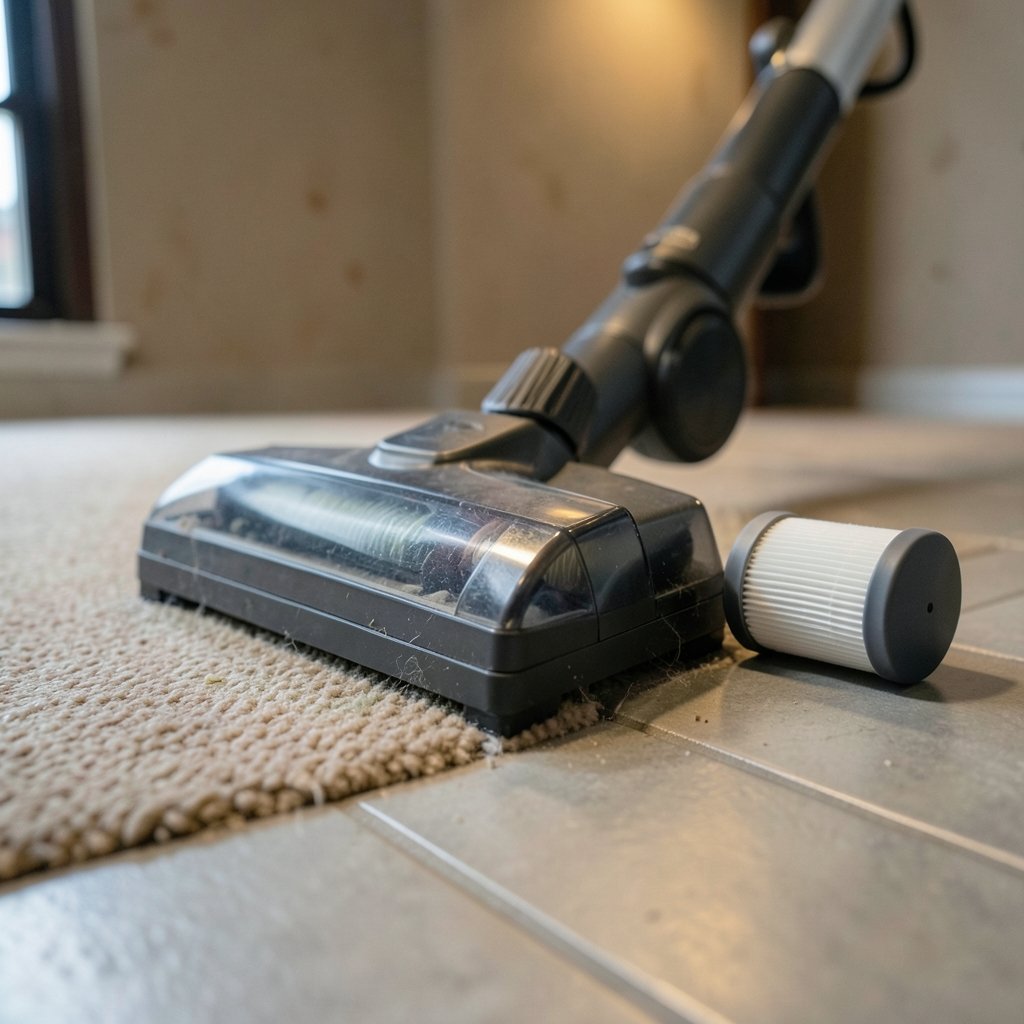
Most shoppers fixate on suction. In practice, suction is only one of five things that determine whether a vacuum works across surfaces.
Brushroll control and height adjustment
Manual or automatic height adjustment lets the cleaner head lift on thick carpet and drop on low pile. Without it, a machine set for plush carpet will clamp down on a low-pile rug and stall, or float above tile and miss debris. Automatic height adjustment is convenient; manual is more predictable and less likely to fail.
Filtration and allergen control
True HEPA filtration means the filter captures 99.97% of particles at 0.3 micrometers, tested under standards such as IEST-RP-CC001 or the EN 1822 series. That matters on hard floors, where fine dust that gets stirred up rather than captured ends up back in the air. Allergy guidance from health organizations commonly recommends HEPA-filtered or bagged vacuums for allergy sufferers, because both reduce dust re-release when the bin is emptied. A bagless bin with a poor seal undoes good filtration every time it is emptied over a trash can.
Weight and maneuverability
Multi-surface homes usually have stairs. An upright that weighs over 18 pounds and cannot detach its canister is a machine people stop carrying upstairs by week three. Canisters and stick vacuums with detachable handheld modes handle stairs and above-floor cleaning far better. The trade-off is usually bin size and cordless runtime.
Corded versus cordless
Cordless vacuums typically run 20 to 60 minutes on standard mode, and that figure drops sharply on max or boost settings. For a whole-house deep clean, a corded machine avoids the anxiety of watching a battery bar shrink. For daily touch-ups in a mixed-floor home, cordless wins on convenience. Many households end up with one of each, which is fine as long as the roles are clear.
Sealed system claims
“Sealed system” is a marketing term, not a formal standard, unless the brand ties it to a named test like HEPA or the CRI program. Treat it as a claim to verify, not a feature to pay extra for on faith.
Upright, Canister, Stick, or Robot: Matching the Machine to the House
| Type | Best for | Watch out for |
|---|---|---|
| Upright with brushroll shutoff | Wall-to-wall carpet plus some hard floor | Heavy on stairs; check weight before buying |
| Canister | Stairs, above-floor cleaning, mixed flooring | Bulkier to store; head can be awkward on thick pile |
| Cordless stick | Daily quick cleans, apartments, hard floor heavy homes | Runtime drops fast on boost; small bins |
| Robot vacuum or mop combo | Maintenance cleaning between deep cleans | Navigation limits; needs mapping and clear floors |
The honest answer for most mixed-floor homes is a two-tier system: a full-size machine for deep cleaning and a robot for maintenance. That is also where robot vacuums have improved fastest, and where the marketing gets loudest.
Where Robot Vacuums Fit Into a Multi-Surface Home
A robot vacuum that claims multi-surface cleaning is really making three separate claims: it can climb from hard floor to carpet, it can adjust suction for each, and it can navigate without getting stuck. All three can fail independently.
Climbing is the first hurdle. Most robots handle a standard transition strip, but thick carpet edges, deep pile rugs, and raised thresholds stop them cold. The practical fix is to think about thresholds before buying. A model with larger drive wheels and a documented climb height will save a lot of rescuing.
Navigation is the second. Lidar and camera-based systems behave very differently in rooms with dark furniture, mirrors, and clutter, and the differences show up most in complex floor plans. A robot that maps well on tile may struggle on dark carpet.
Battery and bin size are the third. A robot that runs 90 minutes on hard floor may run 45 on carpet with boost enabled. On a mixed floor, the carpet sections are where the battery disappears.
Mop combos add a fourth wrinkle. A vacuum-mop combo that drags a wet pad across carpet is a problem, so the good ones lift the mop pad or detect carpet and switch to vacuum-only. Buyers who want one machine to do both jobs should read the carpet-detection behavior carefully rather than the marketing photos.
For homes with several levels, the practical question is whether the robot can be carried upstairs and still know where it is. Some models store multiple maps and handle a second floor well; others lose their map the moment they leave the dock.
Common Mistakes Buyers Make
Buying on suction specs alone. Airflow numbers are not standardized across brands, so comparing them directly is close to meaningless. A machine with modest suction and a good cleaner head will outperform a high-suction machine with a bad one.
Ignoring the brushroll on hard floors. This is the most common and most avoidable mistake. A vacuum without brushroll shutoff or a soft roller will scatter debris on tile and can dull the finish on wood over time. If the home is 70% hard floor, this feature should be non-negotiable.
Trusting decibel ratings. Noise is measured in decibels, but the tests are not standardized across manufacturers, so a “quiet” claim from one brand cannot be compared to another. Judge noise from reviews or in-store demos, not from the box.
Forgetting the bag or bin. Bagless convenience comes with a dust cloud at emptying time. Bagged machines cost more to run but are easier on allergy sufferers. Neither is wrong; the mistake is not thinking about it until after purchase.
Skipping the weight test. Pick up the machine in the store, ideally with the bin full. The difference between a 12-pound stick and an 18-pound upright only becomes obvious on the third flight of stairs.
Assuming the EU power limit still applies as written. Regulation 666/2013 capped mains-powered vacuum input power at 900 W from September 2015, but the EU later revised and withdrew some ecodesign rules. Anyone citing wattage limits should check the current status rather than repeating 2015 numbers.
A Practical Buying Checklist
Before comparing models, write down the home’s actual floor mix. Then run through these checks in order:
- Confirm the vacuum has brushroll shutoff or a soft roller if hard floors are more than a small share of the home.
- Check for manual or automatic height adjustment if there is thick pile anywhere.
- Look for HEPA filtration and a sealed, well-reviewed bin or bag system if anyone in the house has allergies.
- Weigh the machine and confirm it can be carried upstairs or has a detachable canister.
- For cordless, note the runtime on standard mode, not boost, and compare it to the size of the home.
- For robots, check climb height, multi-floor map storage, and carpet detection on mop models.
- Look for third-party testing like the CRI Seal of Approval rather than trusting brand claims.
That checklist will eliminate most of the market in about ten minutes, which is the point. The best multi-surface vacuum is rarely the most expensive one; it is the one whose features match the floors it will actually meet.
Conclusion
A vacuum that handles carpet and hard floor well is defined by adaptability, not raw power. Brushroll control, height adjustment, real filtration, sensible weight, and honest runtime figures do more for cleaning performance than any single spec on the box. Independent testing through programs like the CRI Seal of Approval and ASTM methods gives buyers a way to check claims that marketing copy cannot fake.
The practical path is to match the machine to the floor mix, accept that a full-size vacuum plus a robot is often the smartest combination, and verify every “sealed system” or “multi-surface” claim against a named standard. Do that, and the moment when a vacuum hits the tile and starts spitting crumbs backward simply stops happening.
FAQ
What is the best type of vacuum for a home with both carpet and hard floors?
An upright with brushroll shutoff or a canister with a dedicated hard-floor head covers both surfaces well. Uprights suit wall-to-wall carpet with some hard floor, while canisters handle stairs and above-floor cleaning better. The key feature is the ability to stop or soften the brushroll on bare floors.
Do I really need brushroll shutoff?
If hard floors make up more than a small portion of the home, yes. A spinning bristle brushroll on tile or wood can scatter debris and, over time, dull softer finishes. Soft-roller designs are a good alternative because they sweep debris gently without the aggressive beat-and-sweep action.
Are robot vacuums good for multiple surfaces?
They are good for maintenance cleaning on mixed floors, but performance varies widely. Check climb height for carpet transitions, how the robot adjusts suction between surfaces, and whether mop models lift the pad on carpet. A robot works best as a supplement to a full-size vacuum, not a replacement. (Robot vacuum cleaning solution alternatives that actually)
How long do cordless vacuums actually run?
Most cordless vacuums run 20 to 60 minutes on standard mode, and runtime drops sharply on max or boost settings. Carpet sections drain the battery faster because the machine ramps up suction. Match the runtime to the size of the home and expect real-world numbers below the box claim.
Does HEPA filtration matter on hard floors?
It can. Hard floors let fine dust get stirred into the air rather than trapped in pile, so good filtration and a well-sealed bin matter more than many buyers expect. True HEPA filters capture 99.97% of particles at 0.3 micrometers, and allergy guidance often recommends HEPA or bagged machines for sensitive households.
How can I tell if a vacuum’s multi-surface claims are real?
Look for third-party testing such as the CRI Seal of Approval for carpet performance and ASTM F2607 for hard-floor cleaning. Treat terms like “sealed system” as marketing unless tied to a named standard. Decibel and airflow figures are not standardized across brands, so reviews and independent tests beat spec sheets.



