
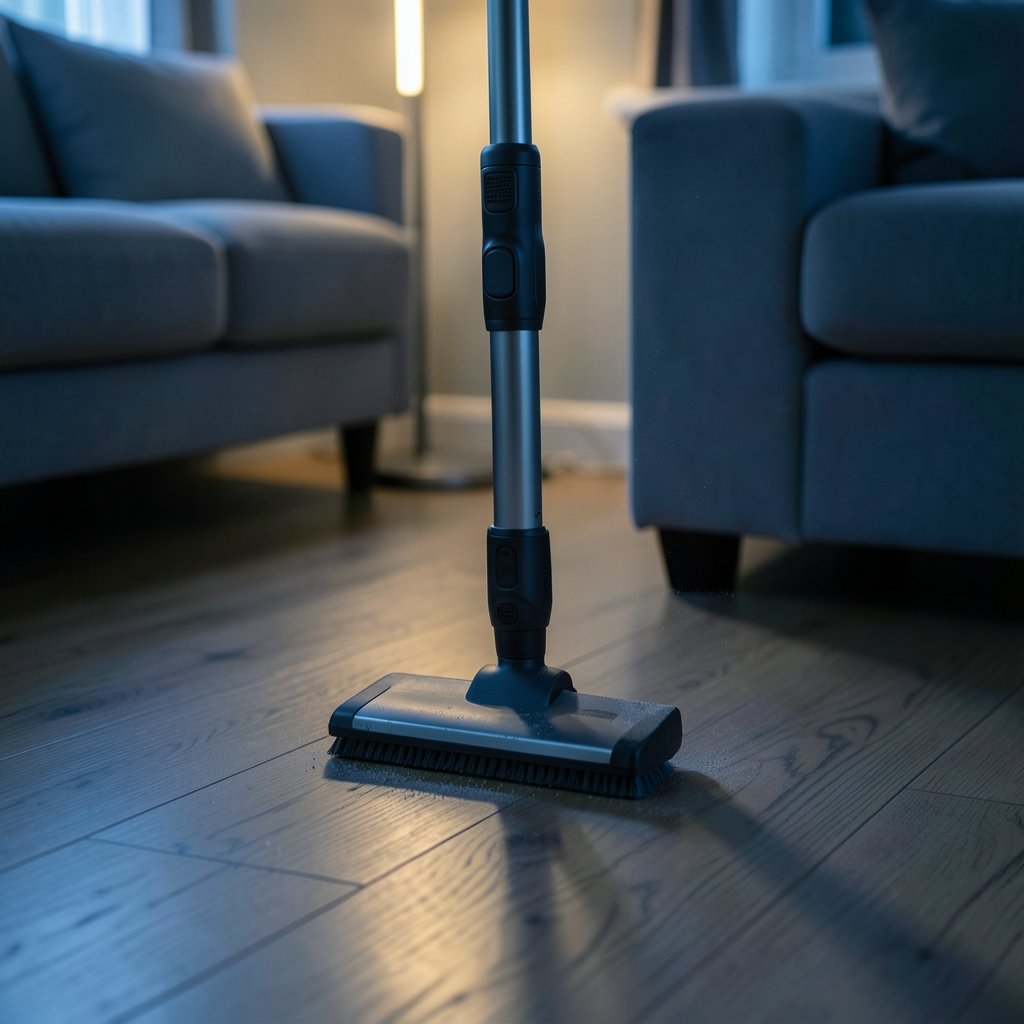
What happens when you run a spinning brush roll across a finished oak floor a few hundred times? If you guessed “nothing good,” you’re already ahead of most shoppers. Hardwood is a soft, scratch-prone surface, and the vacuum you choose can either protect that finish or slowly dull it. The right cordless vacuum for hardwood floors is not the most powerful one on the shelf. It is the one built to lift dust without grinding grit into the grain.
This guide walks through what matters on wood, what marketing hides, and how to pick a machine you won’t regret.
Why hardwood floors punish the wrong vacuum
Carpet hides mistakes. Wood shows them. A beater bar designed to agitate carpet fibers will slap and spin against a sealed hardwood finish, and trapped grit under that brush acts like sandpaper. The National Wood Flooring Association advises against beater bars and stiff brush rolls on finished hardwood, recommending suction-only heads or soft-bristle attachments instead. Hard plastic wheels and dragged debris can mar a finish just as easily.
There’s a second issue most people miss: fine dust. On carpet, particles get trapped in the pile. On a hard surface, light dust lifts into the air far more readily. That’s why sealed filtration and a controlled exhaust matter more on wood than most buyers expect. If anyone in the house has allergies, this is the detail worth paying for.
And a third: glide. A vacuum head on carpet grips and self-propels to some degree. On wood it simply glides, so the full weight of the machine hangs off your wrist. A heavy stick vacuum that feels fine on a rug can become tiring across 800 square feet of open hardwood.
The specs that actually matter on wood
Air watts, and why the number is slippery
Air watts (AW) is the suction-power metric used across cordless vacuum marketing. It’s defined in IEC 62885-2, the international standard for domestic vacuum cleaner test methods, which also includes separate hard-floor cleaning tests with crevices. That standard is the reason air-watt figures can be compared at all.
The catch: they’re only comparable when every brand tests to the same edition of the standard. A 2021 edition exists, and older test data may not line up with newer claims. Treat air watts as a rough sorting tool, not a precision instrument. A 150 AW machine and a 230 AW machine will both pick up cereal on wood. The difference shows up in crevices and in how much airflow survives a loaded filter.
Runtime claims are almost always eco mode
Manufacturers typically quote maximum runtime at the lowest power setting with a non-motorised tool attached. High-mode runtime is often a fraction of that headline number. A vacuum advertised at 60 minutes may run 8 to 12 minutes on max. That’s not a lie, but it’s not the number you’ll experience while chasing crumbs under a dining table.
Practical rule: divide the advertised runtime by three and ask whether that covers your largest room. If not, look at models with swappable batteries.
Battery math worth doing
Battery capacity is quoted in amp-hours (Ah) and voltage (V). The comparable energy figure is watt-hours: Wh = Ah × V. A 4.0 Ah pack at 25 V holds 100 Wh. That number tells you more about real capacity than either figure alone.
It also matters for travel. Lithium batteries are capped at 100 Wh for carry-on without airline approval under IATA rules, so a vacuum battery near that ceiling is a packing consideration, not just a spec-sheet curiosity.
HEPA: certified versus “HEPA-type”
EN 1822 defines HEPA classes (H13 and H14) by particle retention at the most penetrating particle size, around 0.3 micrometres. A vacuum marketed as “HEPA-type,” “HEPA-like,” or “HEPA-style” is not the same as one with a certified filter. On hardwood, where fine dust goes airborne instead of settling into pile, a genuinely sealed system with a certified filter is the difference between cleaning the floor and redistributing the floor.
Weight and balance
This is editorial judgement rather than a measured standard, but it’s the spec buyers regret ignoring. Aim under about 3.5 kg (roughly 7.5 lb) for a full-size stick if you have large hard-floor areas. Check where the motor sits. A top-heavy machine with a small head is harder to steer on slick wood than a balanced one.
Brush rolls, soft rollers, and the scratch question
Here’s where shopping gets confusing. Many cordless vacuums ship with a motorised brush roll as standard and a soft roller as an optional extra. On hardwood, the soft roller is the one you want.
| Head type | Best for | Risk on hardwood |
|---|---|---|
| Stiff brush roll | Carpet, high pile | Can abrade finish; drags grit |
| Soft roller (plush) | Hard floors, large debris | Low risk; gentle on finish |
| Suction-only floor tool | Delicate or waxed wood | Lowest risk; weaker on crevices |
| Combination head | Mixed flooring | Depends on bristle stiffness |
If your home is mostly wood with a couple of rugs, buy for the wood and accept slightly weaker carpet performance. If it’s the reverse, a combo head plus a dedicated soft roller covers both. This is the same logic that separates a good vacuum mop combo from a mediocre one: the floor head decides the outcome, not the motor.
One practical tip that saves finishes: vacuum before you wet-clean. Grit left on the surface gets pushed around by a damp pad and acts as an abrasive. Dry pickup first, then mop.
Wet-dry and mop combos on sealed wood
Cordless vacuums that also mop are tempting for hardwood, and for sealed factory finishes they can work well. The risks are real, though. Standing water and excess solution are the enemy of wood edges and seams. Most combo units meter liquid sparingly, but the user controls the pace.
If you go this route, use the lowest solution setting, keep the machine moving, and never leave a wet pad resting on the floor. The best robot vacuum mop combos actually cleans floor surfaces with similar discipline, and the same rules apply to a manual stick mop. For anyone weighing liquid options, these robot vacuum cleaning solution alternatives that actually work are worth reading before you pour anything into a tank.
For waxed or oiled wood, skip wet cleaning entirely and stick to dry suction.
Common mistakes people make
Leaving the brush roll running on bare wood. Some machines let you switch the roller off. Use that setting on delicate finishes.
Skipping filter maintenance. A clogged filter cuts airflow and effective air watts regardless of battery charge. IEC test conditions assume a clean filter, and your floor gets the dirty-filter version. Washable filters need rinsing on a schedule, and they need to be bone dry before refitting.
Judging runtime by the box. See above. Eco mode numbers flatter every brand.
Buying for peak suction instead of usable suction. A machine that holds airflow as the bin fills beats one with a bigger headline number and a fast-clogging pre-filter.
Ignoring navigation and sensors on robot companions. If you’re pairing a cordless stick with a robot for daily upkeep, know the limits. Robot vacuum cliff sensors fail black carpet works differently than on wood, and dark flooring can confuse downward sensors on some models. It’s a known quirk worth checking before you buy.
Forgetting hair. Long hair wraps rollers fast, and on wood there’s no pile to hide it. If that’s your household, read up on what robot vacuum long human hair actually works to handle before you commit to a roller design.
Matching the vacuum to your floor and your habits
Think in scenarios rather than spec sheets.
Open-plan hardwood, no pets. Prioritise low weight, a soft roller, and a genuinely sealed filter. Suction beyond about 150 AW adds little on bare wood.
Hardwood plus area rugs. You need a combo head and a soft roller, plus enough battery for both surfaces. Check that switching heads doesn’t require tools.
House with shedding pets. Hair and fine dander on wood is a filtration problem as much as a suction problem. Certified HEPA and a tangle-resistant roller matter more than raw air watts.
Small apartment, mostly hard floor. A lighter stick with a 30-minute real runtime beats a heavy flagship you dread lifting.
Mixed flooring with a robot for daily runs. A cordless stick handles stairs and edges; the robot does maintenance passes. Just verify the robot’s navigation handles your floor transitions. The differences between lidar and camera systems are covered in this breakdown of robot vacuum lidar vs camera navigation key differences pick, and they matter more on multi-surface homes than on a single open floor.
What to ignore in the store
The EU energy label for vacuum cleaners is no longer a valid comparison tool. Regulation (EU) No 665/2013 took effect in 2013 and was annulled by the General Court in 2017 in Case T-544/13 RENV, and the Commission withdrew the label. Any A-plus-plus-style energy class you see on a box or listing is legacy marketing, not current regulation.
Also ignore “Pa” (pascal) figures quoted without test conditions. Static suction sealed against a plate tells you almost nothing about pickup on an open floor.
And be skeptical of “works on all surfaces” claims. Every vacuum works on every surface in the sense that it turns on. The question is whether it protects the finish while doing so.
A quick buying checklist
- Confirm a soft roller or suction-only head is included, not sold separately.
- Convert battery specs to watt-hours and check high-mode runtime estimates.
- Look for a certified HEPA filter and a sealed system, not “HEPA-type.”
- Weigh the machine in your hand if possible; aim under 3.5 kg for large wood areas.
- Check filter access and whether spares are easy to buy.
- Verify the roller can be switched off for delicate finishes.
- If it mops, confirm you can control solution flow.
For carpet-heavy homes, the priorities invert, and it’s worth reading a dedicated guide to the best vacuum for carpet before assuming one machine covers everything. If your stick ever starts dragging or pulling to one side, that’s usually a wheel or caster issue rather than a motor fault, and this guide to what to do when a robot vacuum wheel stuck error it happens fix it fast covers the common fixes.
Conclusion
The best cordless vacuum for hardwood floors is a modest, well-filtered machine with the right floor head, not the loudest spec sheet. Prioritise a soft roller, a sealed certified filter, sensible weight, and honest battery expectations. Convert Ah and V to watt-hours, discount eco-mode runtime claims, and treat air watts as a rough guide rather than gospel. Protect the finish, keep the filter clean, and vacuum before you mop. Do that, and your floor will look the same in five years as it does today.
Frequently asked questions
Can I use a regular brush roll on hardwood floors?
It’s risky on finished wood. Stiff bristles and beater bars can abrade the finish, and trapped grit under a spinning brush acts like sandpaper. Use a soft roller or suction-only head instead, and switch the roller off where the machine allows it.
How many air watts do I need for hardwood?
For bare sealed wood, around 100 to 150 AW handles everyday dust and debris comfortably. Higher figures help in crevices and on rugs. Remember that air-watt claims are only comparable when tested to the same edition of the IEC 62885-2 standard.
Is a wet-dry cordless vacuum safe for wood floors?
On sealed factory finishes, yes, with care. Use the lowest solution setting, keep the machine moving, and don’t leave a wet pad sitting on the floor. Avoid wet cleaning on waxed or oiled wood, where moisture can damage the surface.
Why does my cordless vacuum run out so fast?
Advertised runtime is usually measured in eco mode with a non-motorised tool. High mode often runs a fraction of that. Battery energy in watt-hours (Ah × V) gives a more honest picture, and a spare battery solves most runtime complaints.
Does HEPA filtration matter more on hardwood than carpet?
It can. Carpet traps fine dust in the pile, while hard floors let it lift into the air more easily. A certified HEPA filter under EN 1822 (H13 or H14) with a sealed system is more useful than a “HEPA-type” marketing claim.
How often should I clean the filter?
Follow the manufacturer’s schedule, and rinse washable filters more often in homes with pets or heavy dust. A clogged filter cuts airflow and effective suction regardless of battery charge, so a dirty filter can make a good vacuum feel broken.



