
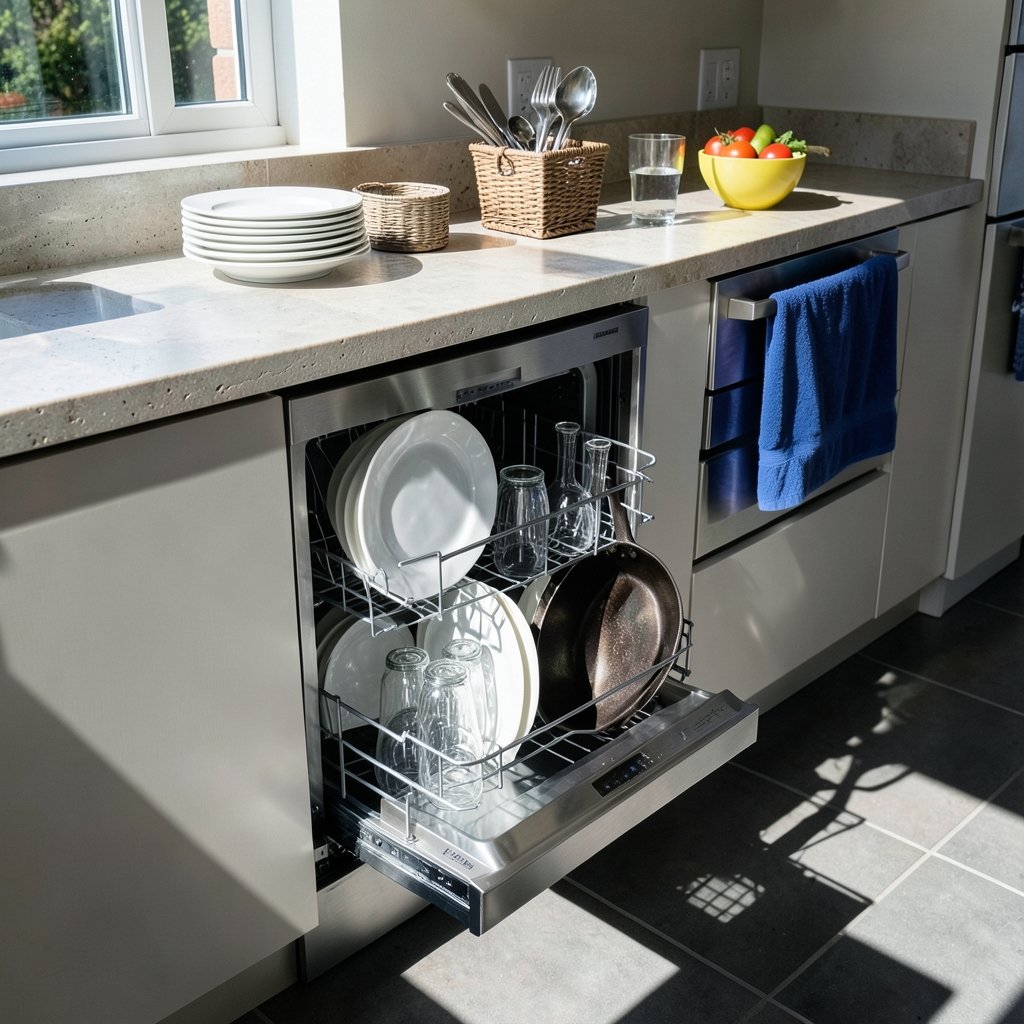
What if the dishwasher with the highest rating isn’t the one that belongs in your kitchen? Most shoppers never ask that question when they read a “best rated” list. They see a top score, assume it means “best for everyone,” and end up with a machine that cleans brilliantly but roars through dinner conversation, or one that sips electricity but can’t handle a roasting pan.
The truth is that “best rated” is a label, not a verdict. It depends entirely on who is doing the rating, what they measured, and what they left out. This guide unpacks how built-in dishwasher ratings actually work, where the scoring systems disagree, and how to translate a lab score into a decision that fits your kitchen, your dishes, and your tolerance for noise.
What “Best Rated” Actually Means for a Built-In Dishwasher
Walk into any appliance showroom and you’ll see stars, badges, and “top rated” stickers everywhere. They are not measuring the same thing.
Lab-test ratings focus on performance: how clean dishes come out, how much energy and water a cycle uses, how loud the machine runs, and how long a cycle takes. These ratings come from controlled testing with standardized soil loads and measured decibel readings.
Efficiency ratings are narrower. They certify that a model meets a threshold for energy or water use. A dishwasher can earn an efficiency badge while scoring mid-pack on cleaning. That’s not a contradiction; it’s just a different question being answered.
Owner-survey ratings capture something labs can’t: how often the machine breaks, how annoying the filter is to clean, and whether the door hinge still feels solid after four years.
A model can be top-rated on one axis and mediocre on another. Before you trust any list, find out which axis it’s built on.
How the Major Rating Systems Differ
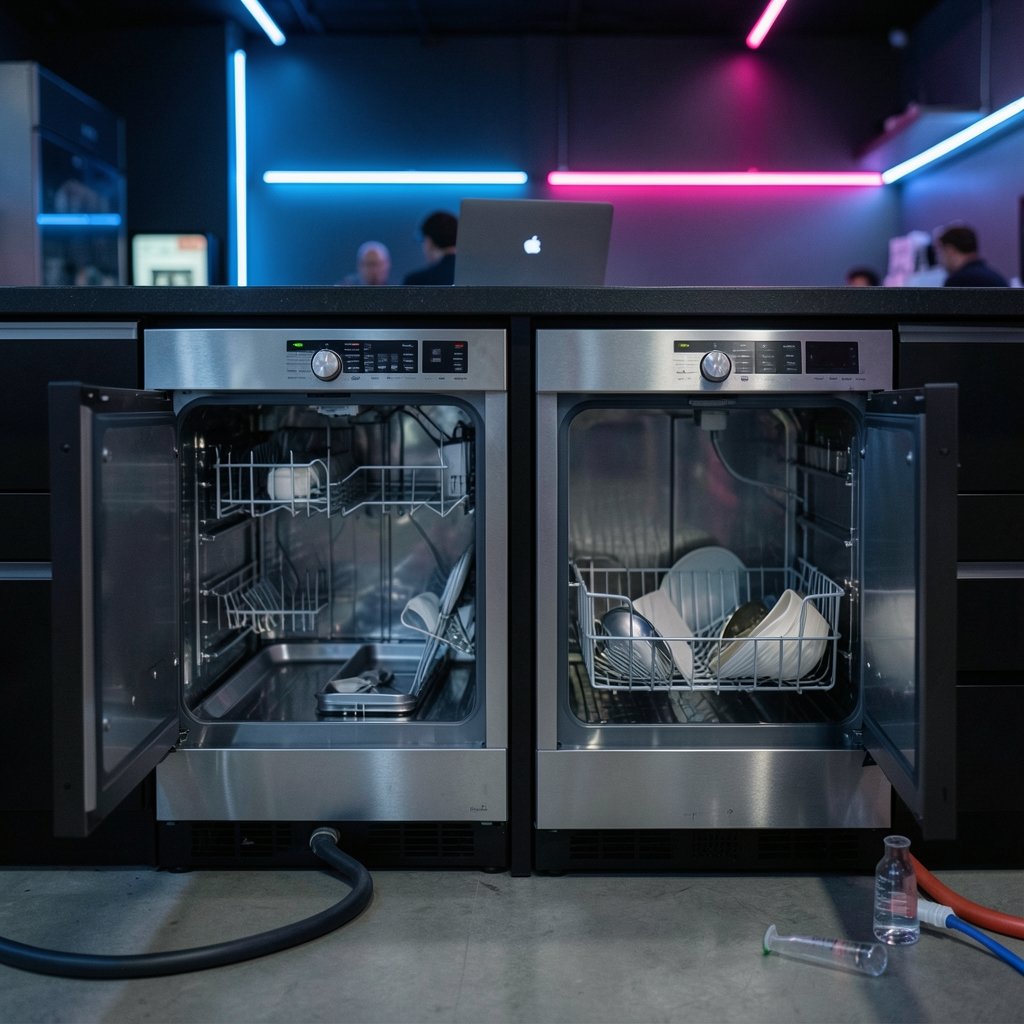
The biggest source of confusion is that the United States and Europe use entirely different scales, and even within the US, different organizations measure different things.
| Rating System | What It Measures | What It Ignores | Best Used For |
|---|---|---|---|
| Lab performance tests | Cleaning, noise, cycle time, energy and water per cycle | Long-term reliability | Comparing raw performance |
| Energy Star certification | Meets annual energy and water limits | Cleaning quality, noise | Confirming efficiency |
| EnergyGuide label | Estimated yearly kWh and cost | Performance, features | Comparing running costs |
| EU A–G label (2021 onward) | Energy class, noise class, water per cycle | Cleaning performance | European buyers comparing models |
| Owner reliability surveys | Repair rates, satisfaction over time | Lab-measured cleaning | Judging long-term ownership |
The EnergyGuide label deserves special attention because it’s the one number every US shopper can read on the showroom floor. It shows estimated annual energy use and cost based on a standard usage assumption. It is a comparison tool, not a performance grade. Two machines with identical EnergyGuide numbers can clean very differently.
In Europe, the picture shifted in March 2021, when the old A+++ scale was scrapped and replaced with a simpler A–G scale. The new label also added a noise class and water consumption per cycle. If you’re reading older reviews that cite A+++ ratings, you’re looking at a retired scale.
The Efficiency Label Nobody Explains Properly
Here’s a mistake shoppers make constantly: they assume a lower annual energy number means a better dishwasher. It doesn’t. It means a cheaper one to run, assuming the standard usage pattern holds.
The standard usage assumption matters. If you run your dishwasher every single day and your neighbor runs theirs twice a week, your real costs diverge from the label immediately. The label gives you a fair comparison between machines, not a prediction of your bill.
Energy Star certification works the same way. Qualifying standard-size models must meet maximum annual energy-use and water-use limits set by the EPA. The specification versions have been revised over time, so the thresholds in force today aren’t the same as those from a decade ago. A machine certified under an older version may still be sold but no longer represent the current benchmark.
The practical takeaway: use efficiency labels to narrow the field, never to pick the winner. A hyper-efficient machine that forces you to rewash greasy pans by hand is not efficient in real life.
Noise Ratings: The Number That Changes Your Kitchen
If your kitchen opens into a living area, the decibel rating may matter more than any cleaning score. Roughly speaking, models under about 45 dB(A) are considered quiet for open-plan spaces, and under about 40 dB(A) is very quiet. These thresholds are industry convention rather than hard rules, so treat them as approximate.
A few practical notes that ratings pages rarely mention:
- Decibel figures are usually measured on a specific cycle, often the quiet or eco program. The heavy cycle will be louder.
- A dishwasher that’s quiet but takes four hours per cycle may run while you’re watching TV anyway.
- Vibration and installation quality can matter as much as the rated number. A poorly leveled machine rattles regardless of its spec sheet.
If silence is your priority, compare noise ratings first, then check cleaning scores among the quietest models. Doing it the other way around leads to disappointment.
Features That Show Up Again and Again in Top-Rated Models
Higher-rated machines tend to share a cluster of features. None of them guarantee performance, but their presence tells you the manufacturer invested in usability.
Third-rack cutlery trays are the clearest example. Moving forks and knives to a shallow top rack frees up lower-basket space and stops utensils from nesting. It’s a small design choice that shows up repeatedly in well-reviewed models.
Adjustable upper racks let you drop the top basket to fit stockpots or raise it for tall wine glasses. Without this, a “flexible” interior is mostly marketing.
Soil sensors and auto cycles adjust water and time based on how dirty the load is. They’re genuinely useful, though they make cycle times unpredictable.
Fold-down tines and stemware clips are cheap to add and easy to break. Check how sturdy they feel.
Hard food disposers versus filters is a real fork in the road. Models with disposers handle food scraps more forgivingly; filter-based models tend to be quieter and more efficient but need regular rinsing.
Where Ratings Get It Wrong
Ratings have blind spots, and knowing them saves you from a bad purchase.
The first blind spot is reliability. Lab tests run for weeks. Your dishwasher runs for a decade. Repair-rate surveys capture this, but they lag behind the market, and a model’s reliability reputation can shift after a redesign even if the nameplate stays the same.
The second is installation fit. Standard US built-in widths are typically 24 inches, with 18-inch compact models for tighter spaces. Height and clearance requirements vary by model, and fit problems are a common cause of returns. A top-rated dishwasher that doesn’t slide under your counter is a zero-rated dishwasher. Measure your opening, including the countertop overhang, before you fall in love with a spec sheet.
The third is cycle time. Some highly rated machines run two to three hours on normal. If you cook twice a day and entertain often, a fast cycle may matter more than a marginal cleaning advantage.
The fourth is regional mismatch. US efficiency criteria and the EU A–G label are not directly comparable. A European buyer reading a US “best rated” list is looking at a different regulatory universe.
There’s a broader lesson in how ratings get built and how trust in them forms. The same dynamic shows up in finance, where wildcat money and unregulated banknotes taught buyers to ask who stands behind a promise. A star rating is a promise too. Ask who tested it.
How to Read a Rating Like a Pro
Here’s a process that works in practice, refined from the mistakes shoppers make most often.
- Measure your opening first. Width, height, depth, and the location of your water line and outlet. Write the numbers down. This eliminates half the market before you read a single review.
- Set your noise ceiling. Decide whether you need under 45 dB(A) or under 40 dB(A). This is a lifestyle decision, not a spec-sheet one.
- Check the efficiency label for running cost, not bragging rights. Compare annual kWh among your finalists only.
- Cross-reference at least two rating types. A lab score plus an owner reliability survey beats either alone.
- Read the one-star reviews for patterns. One complaint about a leak is noise. Fifteen complaints about the same door latch is a signal.
- Confirm the cycle time on the program you’ll actually use. Not the eco cycle. The normal one.
A note on method: ratings bodies genuinely disagree, and that’s fine. Lab tests and efficiency certifications measure different things. When a “best rated” list conflicts with another, the useful question isn’t which is right. It’s which one is answering your question.
The same principle applies to any ranked list you encounter. Rankings reflect the ranker’s priorities. When a 144-core Arm CPU built for sovereign AI gets praised, the praise depends on what the reviewer values: raw throughput, power draw, or independence from foreign supply chains. Dishwashers work the same way at a much smaller scale.
Practical Tips That Actually Change Outcomes
These are the things that separate a happy purchase from a return.
Run the machine before you commit to a loading style. If you’re used to pre-rinsing, a sensor-based machine may underperform because it senses clean dishes and shortens the cycle. Scrape, don’t rinse.
Use rinse aid even if you think you don’t need it. Modern efficient machines use less water, which makes drying harder. Rinse aid does more work than it did twenty years ago.
Clean the filter monthly. Filter-based models are quieter and more efficient, but a clogged filter quietly wrecks cleaning performance. Most “my dishwasher stopped cleaning” complaints trace back to this.
Check the door spring tension in the showroom. It sounds trivial until you’ve lived with a door that slams.
Don’t chase the top score if the second-place model fits better. A dishwasher that fits your cabinet, your noise tolerance, and your cycle habits will outperform a higher-rated machine that fights you daily.
And when you’re comparing lists, remember that rankings are built on assumptions about how people live. A rivalry built on playoff shock and long memories is analyzed through the lens of the analysts doing the ranking, and appliance reviews carry the same bias. The reviewer’s kitchen is not your kitchen.
Conclusion
The best-rated built-in dishwasher is not a single model. It’s the one whose rating was built on the criteria you actually care about. Lab scores tell you how well a machine cleans. Efficiency labels tell you what it costs to run. Reliability surveys tell you whether it will still be working in year eight. Noise ratings tell you whether you’ll hear it from the couch.
Buyers who get this right do three things: they measure their opening before shopping, they set a noise ceiling, and they cross-reference at least two types of rating before deciding. Buyers who get it wrong chase a single number and discover, too late, that it measured something they didn’t care about.
Ratings are a starting point, not an answer. Treat them as evidence, weigh them against your own kitchen, and the right machine becomes much easier to spot.
FAQ
What does “best rated” mean for a built-in dishwasher?
It means a model scored highest under a specific rating body’s method. Lab tests measure cleaning, noise, and resource use. Efficiency programs certify energy and water thresholds. Owner surveys track reliability. These systems measure different things, so “best rated” only means something once you know which method produced the score.
Is Energy Star certification the same as a performance rating?
No. Energy Star certifies that a model meets maximum annual energy-use and water-use limits. It says nothing about cleaning quality, noise, or durability. A certified machine can be excellent or mediocre at washing dishes. Use it to confirm efficiency, not to judge performance.
How quiet should a built-in dishwasher be?
As a rough guide, models under about 45 dB(A) are considered quiet for open-plan kitchens, and under about 40 dB(A) is very quiet. These thresholds are industry convention, not fixed standards. Also check which cycle the figure was measured on, since heavy cycles run louder than eco programs.
Why do dishwasher ratings from different sources disagree?
Because they measure different things. A lab test scores cleaning and cycle time. An efficiency program scores resource use. An owner survey scores repair rates. A machine can top one list and land mid-pack on another without either being wrong. The disagreement is a signal to check which criteria matter for your household.
What size built-in dishwasher should I measure for?
Standard US built-in widths are typically 24 inches, with 18-inch compact models for smaller spaces. Height and clearance requirements vary by model, and fit problems are a common reason for returns. Measure the opening’s width, height, and depth, and confirm the water line and outlet locations before buying.
Do third-rack cutlery trays actually matter?
They’re a genuine usability plus, not a performance guarantee. Moving utensils to a shallow top rack frees lower-basket space and stops forks from nesting. Higher-rated models often include them, but their presence tells you about design attention, not cleaning results. Check the rack’s sturdiness in person if you can.



