
What is AI hallucination and how to check AI answers is a question worth asking before you trust a chatbot with anything important. An AI hallucination is a confident, plausible answer that is factually wrong, and you can check it by asking for sources, cross-checking the key claims, and refusing to act on any fact you cannot verify.
You have probably seen it already, even if you did not have a name for it. A chatbot gives you a neat summary with a citation that does not exist. It names a study, a date or a quote that sounds right, and falls apart when you look for it. It is not lying in the human sense. It is predicting what sounds likely, and sometimes the likely answer is wrong.
This guide explains why that happens, how to spot it, and a simple routine you can use every time. It will not make AI perfect. It will make you harder to mislead.
This guide is part of AI Atlas.
Key takeaways
- An AI hallucination is an output that sounds plausible but is factually wrong, irrelevant or fabricated.
- Language models predict the next word based on patterns in training data. They do not check facts as they write.
- Hallucinations are most likely on niche topics, recent events, precise figures, and questions where the model has thin evidence.
- Ask for sources, then open them. A citation you have not checked is not a check.
- Use a six-step verification routine for anything you will publish, send to a client, or use to make a decision.
- Grounding tools, such as retrieval-augmented generation, can reduce hallucinations, but they do not remove them.
What is AI hallucination?
AI hallucination is when an AI system produces an output that sounds plausible but is factually wrong, irrelevant or entirely fabricated.
That definition, in similar wording, is used by IBM. It covers the main cases: fake facts, invented studies, non-existent web addresses, and wrong details about real people, places and events. The key word is plausible. A hallucination does not look like a mistake. It looks like a confident answer, written in clean sentences, with the right tone and structure.
Why confidence is the danger
A human expert who is unsure will usually say so. A language model is trained to give a fluent answer, and fluency can look like certainty — which is why a wrong figure in a client report is harder to undo than a wrong date in a draft.
Why do AI models hallucinate?
Language models do not retrieve facts from a database as they write. They predict the next token, roughly a word, based on patterns in training data. That is statistical pattern matching, not fact-checking. IBM puts it directly: a model does not know what is true or false, only what fits the pattern.
Several causes make this more likely.
1. The model predicts, it does not verify
A model chooses the next word that seems most likely, given the words before it. If the likely continuation is wrong, the model will still produce it, and the next words will build on that error. There is no pause in the middle to check a source, unless the system is designed to do that.
2. Training data is imperfect
Models learn from large collections of text that include errors, outdated facts, contradictions and bias. If the training data contains a mistake, the model can learn the mistake as a pattern. It cannot reliably tell verified fact from plausible fiction in that data.
3. Knowledge has a cutoff
Every model has a training cutoff date. Questions about events after that date force the model to extrapolate, which often produces confidently wrong answers. A search-grounded tool can help here, because it can fetch current information, but a model answering from memory alone cannot.
4. Guessing is rewarded
A paper by researchers at OpenAI and Georgia Tech, published in September 2025, argues that hallucinations persist because training and evaluation often reward guessing over admitting uncertainty. Like a student facing a hard exam question, a model may guess rather than say it does not know, because guessing improves its score on many tests.
5. Vague prompts leave room to improvise
An ambiguous prompt gives the model more room to fill in gaps. A question such as “Tell me about the new regulation” is more likely to hallucinate than “Summarise Article 5 of Regulation (EU) 2024/1689, using only the text I have pasted below”. Specificity is a form of protection.
The main types of hallucination
Not every hallucination looks the same. Knowing the types helps you spot them faster.
- Factual hallucination. A wrong date, figure, name or place, stated as fact.
- Fabricated citation. A study, book, article or web address that does not exist, or that exists but says something different.
- Invented entity. A person, company, product or law that sounds real but is not.
- Logical contradiction. An answer that contradicts itself, or contradicts the source you provided.
- Outdated answer. A correct answer for an earlier date, presented as if it were current.
- Misattribution. A real quote or fact attached to the wrong person, source or date.
Fabricated citations are the most common trap for students and researchers. A reference can look complete, yet a search shows nothing — a signal to check every other claim in the same answer.
How to check AI answers: a six-step routine
Use this routine for anything you will publish, send, or use to make a decision. It takes a few minutes, and it catches most errors.
Step 1: Split the answer into claims
Mark each factual claim: dates, figures, names, quotes, and causal statements. Ten claims means ten small checks, not one big one.
Best for: long summaries and reports, where one wrong claim can hide among nine right ones.
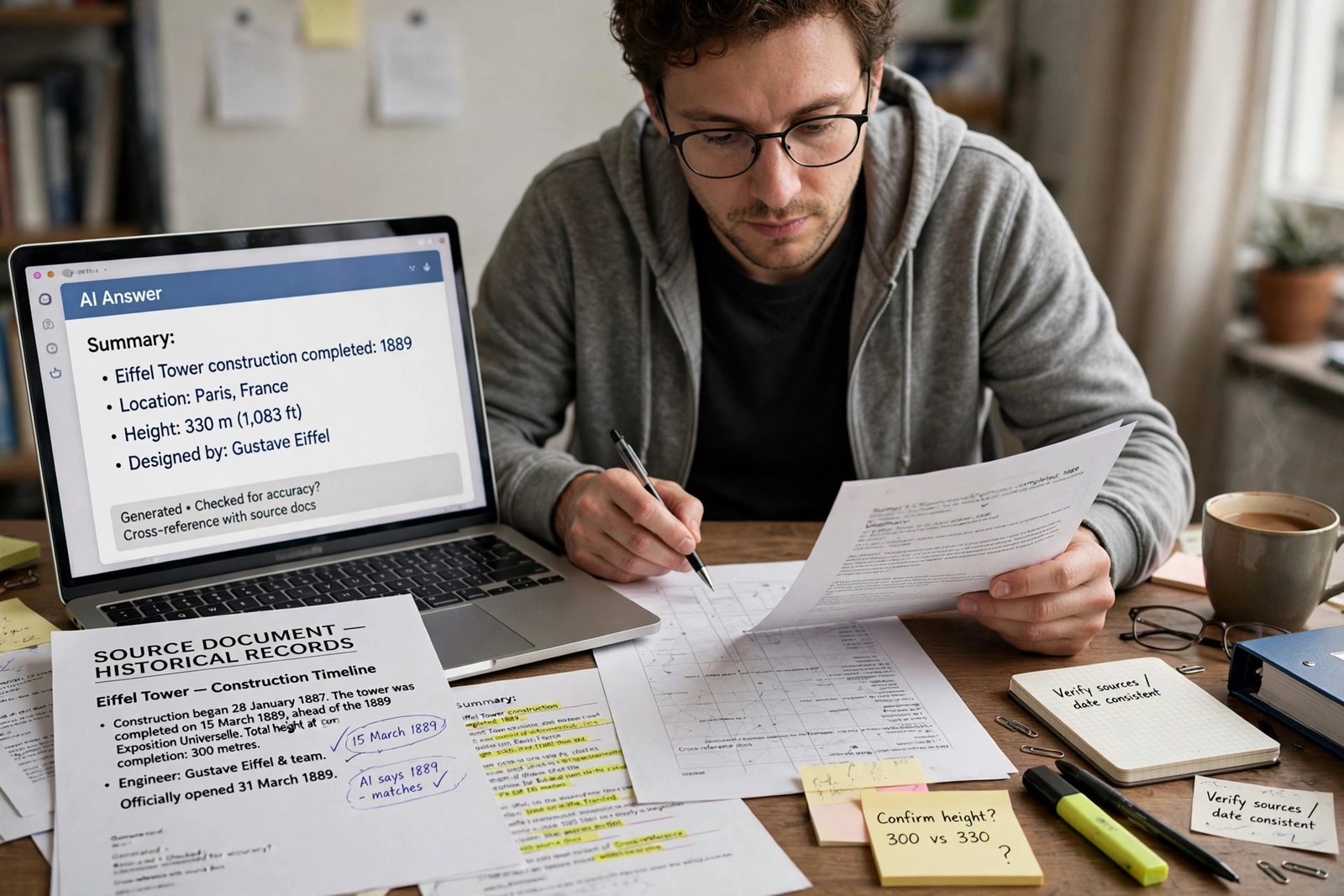
Step 2: Ask for sources, then open them
Ask for sources, then open each one. Check that it exists, says what the model claims, and is current. A dead link is a warning sign.
Best for: any answer that includes citations, statistics or legal references.
Step 3: Cross-check the key claims
Check the two or three claims that matter most against an independent primary source: an official website, a regulator, a published paper, or the original document. Do not cross-check one AI answer with another and call that verification.
Best for: figures, dates and anything a client or reader will rely on.
Step 4: Test the citations
Search for each citation by title, author or web address. If a study cannot be found, treat it as unverified. A single fabricated citation should make you more careful about the rest of the answer.
Best for: essays, articles and research notes, where citations carry weight.
Step 5: Ask the model to show its working
Ask: “Which paragraph of the source supports that figure?” A guessing model will often soften or contradict itself. A grounded answer will point to a specific passage.
Best for: complex answers where you cannot check every claim yourself.
Step 6: Decide what you will trust
Sort the answer into verified, plausible but unverified, and wrong. Use only the verified group in a final document. Treat the plausible group as a lead, not a fact.
Best for: final drafts, where the cost of an error is highest.
Checking methods compared
No single check catches everything. The table below compares the main methods, so you can choose the right one for the task.
| Checking method | What it catches | Time needed | Best for |
|---|---|---|---|
| Ask for sources and open them | Fabricated citations, misattribution | A few minutes | Essays, articles, research |
| Cross-check key claims | Wrong dates, figures and names | A few minutes | Client work and published content |
| Use a search-grounded tool | Outdated answers, recent events | A few minutes | News, prices, and current rules |
| Retrieval-augmented generation (RAG) | Answers based on the wrong document, or no document at all | Set-up time, then fast | Internal knowledge bases and customer support |
| Ask for the supporting passage | Vague answers, logical contradictions | One follow-up prompt | Complex summaries |
| Human review by a subject expert | Subtle errors, context, and judgement | Longer | Legal, medical and financial work |
Caption: Six ways to check AI answers, and when each one is most useful.
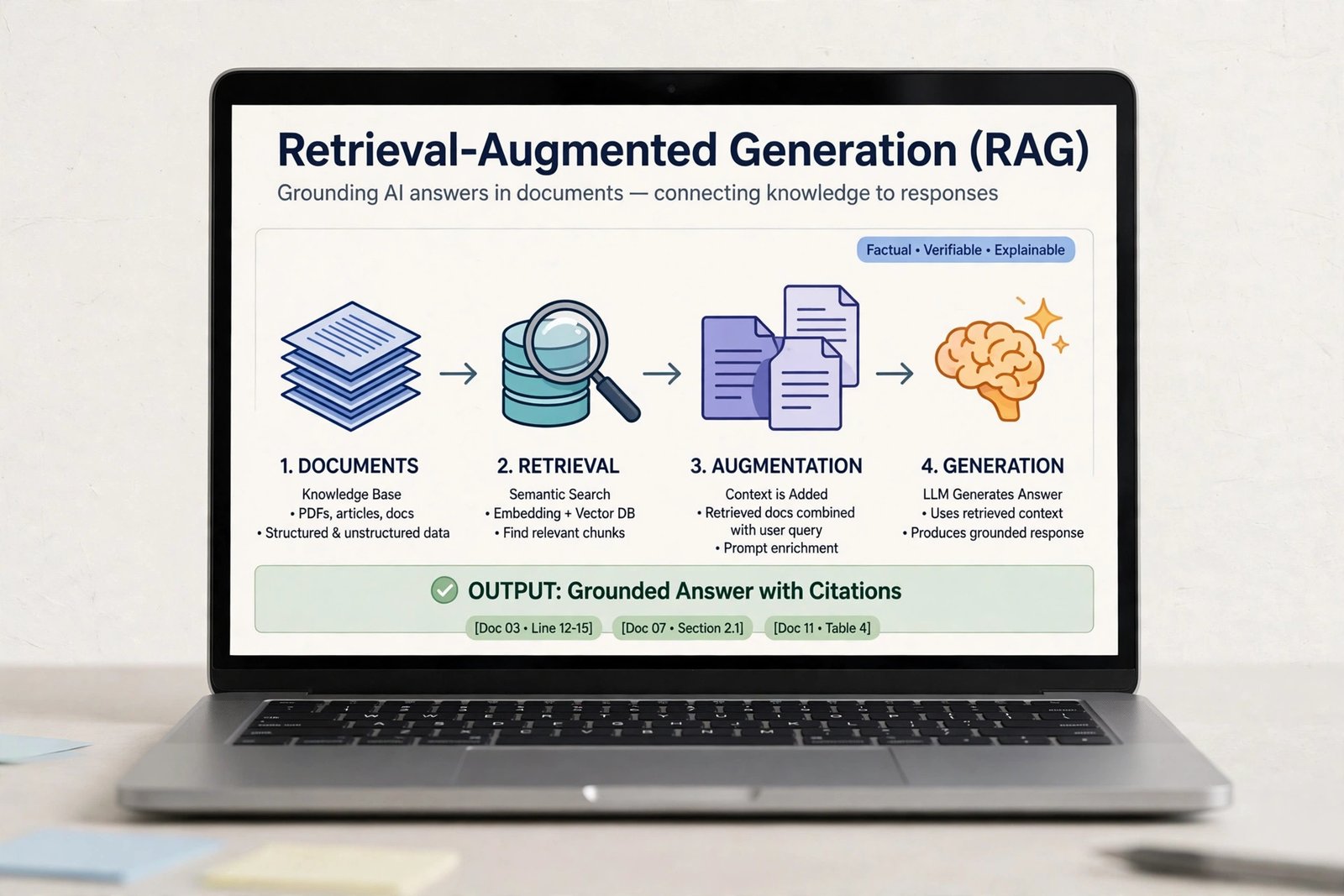
Retrieval-augmented generation, or RAG, means the model first retrieves passages from a trusted document store, then answers from them. That grounding reduces hallucinations, but it does not remove them: a system can fetch the right document and still misread it, or answer when no relevant passage was found.
When hallucinations are most likely
Hallucinations are more likely on niche, recent or technical topics, and when you ask for precise figures, specific citations, or a long list of examples. The more specific and verifiable the claim, the more you should check it.
What not to trust AI with, unchecked
Some uses need a human check every time, no matter how good the model seems. Do not rely on an unchecked AI answer for legal advice, medical information, financial decisions, or safety-critical instructions. Do not copy a citation into an essay or a report without opening it. Do not send a client a figure, a deadline or a price that you have not verified against the source document.
AI can still draft, summarise and explain in those areas, and help you find the right source faster. It should not be the final authority. That should be the primary source, or a qualified person who has checked it.
For workplace use, read how to use AI safely at work before sharing anything sensitive with a chatbot.
Frequently asked questions
What is AI hallucination in simple terms?
AI hallucination is when a chatbot gives you an answer that sounds right but is wrong. It may invent a fact, a study, a date or a web address. It happens because the model predicts likely words, rather than checking facts as it writes.
Why do AI chatbots hallucinate?
They generate text by predicting the next word based on patterns in training data. They do not verify facts as they write, and their training data can be incomplete, outdated or wrong.
Can AI hallucinations be stopped completely?
No. Grounding, retrieval-augmented generation, and careful prompting can reduce hallucinations, but they do not remove them. The practical goal is to reduce the risk and catch errors before they cause harm.
How do I check if an AI answer is correct?
Split the answer into claims, ask for sources and open them, and cross-check the key claims against an independent primary source. Use only the claims you can verify.
Do ChatGPT, Claude and Gemini all hallucinate?
Yes. Hallucination is a property of how large language models generate text, not a flaw in one product. No current chatbot is free of the problem. For a closer comparison, see ChatGPT vs Claude.
Is a confident AI answer more likely to be right?
No. Confidence in the tone of an answer does not show confidence in the facts. A model can state a wrong answer in the same confident style as a right one. Treat tone as style, not evidence, and check the claims.
The bottom line
AI hallucination is not a sign that a chatbot is broken. It is a sign of how chatbots work: they predict what sounds likely, and sometimes the likely answer is wrong. That is why the most useful skill is not prompting. It is checking.
Start with the six-step routine. It takes a few minutes, and it turns a confident draft into a verified one.
Next time a chatbot gives you a perfect answer, pause before you copy it. That answer is the one most worth checking.